Elizabethtown


ElizabethtownIf ever there was a candidate for a movie that needed a Second Look, it is the 2005 Cameron Crowe romantic comedy-drama, Elizabethtown.  Crowe wrote and directed the film, which features music by his wife, Nancy Wilson, one-half of the musical duo Heart.

Drew Baylor (Orlando Bloom) is a rising young star in a world-beating athletic shoe company in Oregon (think Nike) working for a man named Phil (Alec Baldwin).  He has designed what the company has hyped as the next great shoe, Späsmotica, but just before it is released, the reviews start tumbling in and it turns out that it is the biggest turkey ever put out by the prestigious firm, doomed to loose the company close to a billion dollars.  He has to say goodbye to his job and his girlfriend Ellen (Jessica Biel).

When he gets home, Drew rigs his exercycle with a knife in an effort to kill himself, but before he can actually do the deed, his sister, Heather (Judy Greer) calls him to inform him that their father, Mitch (Tim Devitt) has died and that he must go to Elizabethtown, Kentucky, his father’s home town, to cremate the body so that he can bring the ashes back to Oregon.  As they talk, their mother, Hollie (Susan Sarandon) is freaking out trying to cook.  On the flight, he meets offbeat, perky flight attendant Claire Colburn (Kirsten Dunst) and they have an immediate affinity for each other.  She gives him directions on how to get from Louisville to Elizabethtown and gives him her phone number.

After arriving, his cousin, Jessie (Paul Schneider), a former member of country-rock band called Ruckus, greets him and re-introduces him to his dad’s friends and family, including Uncle Dave (Loudon Wainwright III) and Aunt Dora (Paula Deen).  They had planned on a burial in Elizabethtown and are completely against cremation.  He checks into his Louisville hotel and finds him in the middle of gigantic wedding party, “Chuck and Cindy: The Wedding.”  He tries to call Heather, Ellen, and Claire with no luck, then Heather calls him and tells him he needs to return at once to deal with Hollie, who is still freaking out.  Ellen calls him to break up and finally he gets on the line with Claire who is just returning home.  They begin a conversation that lasts all night long, discovering more and more how much they like each other and they finally meet half-way to watch the sun rise together.  They spend the day together and shop for his father’s urn.  Along the way, Drew becomes friends with Chuck and Claire practically joins the wedding party.

With so much going on around him, Drew just doesn’t have either the time or the inclination to grieve for his father’s loss, but he does keep revisiting the man in the form of flashbacks to his childhood.  At one point, Drew is ready to call off the cremation, but it is too late.  The deep has been done, so he collects the urn.  Claire shows up at his hotel again and they finally consummate their relationship, but the next morning, she prepares to leave.  Drew catches her in the hotel parking lot and explains about his monumental failure with the shoe company.  To her credit, Claire doesn’t care, but there is still something that keeps her from committing to him.  She explains several times that both of them are stand-ins, one side of an incomplete relationship and that this role is one they have to play.

As romantic comedies go, this is a very smart one, always entertaining, and deeper than it probably should be.  Crowe is an excellent screen writer and he really knows how to tell a story.  His characters get under your skin and you can’t help but root for them to have success.  Both Drew and Claire are extremely well-written and their romance is something that feels very special, maybe as special as Chuck and Cindy?  Could be.

However, even with such a great script and excellent director on hand, the movie could have easily failed—and nearly did.  The first actor cast as Drew, Ashton Kutcher, apparently had no chemistry at all with Dunst and was replaced after filming had started with Bloom.  It was a brilliant decision because the character of Drew must carry the film and Bloom is extraordinary in the role.  I don’t often rave about young actors suddenly fulfilling their promise, but Orlando Bloom is so engaging, both in the comedy and in the drama, that it is pretty much impossible not to like him and pull for him.  Dunst gives one of the best performances of her career and the worldly, carefree Claire, someone that every guy I know would love to meet.

I always love seeing Susan Sarandon in any movie she does and she is great once again as Drew’s mother Hollie, bringing a careless wonder to a woman trying to cope with the loss of beloved husband.  As if that wasn’t enough, the ensemble cast is terrific.  Paul Scheider is great as cousin Jessie, Bruce McGill is hilarious as Bill Banyan, and both Deen and Wainwright are wonderful in their cameos.

One staple of any Cameron Crowe film is great music and Nancy Wilson has obliged us with a big catalogue of mix and fill music, as well as her own film score that compliments the action and the mix music perfectly.

The end of the film is quite something and I find that I can watch Drew’s trip cross-country back to Oregon again and again for the footage of the great central United States.  And I love that Mitch’s final resting place isn’t one place, but rather an entire country.  I can’t help wishing that I had a son like Drew to help distribute me between Lincoln, Nebraska, Santa Fe, New Mexico, and San Francisco, California. 

What a way to go!

Calendar Girls

Calendar-Girls-001Even though the cinema is full of buddy movies and mindless stupid comedies, the joy of friendship, through good times and bad, isn’t celebrated enough in film, yet it is the heart and soul of this wonderful 2003 British comedy-drama.

A group of older friends in the small Yorkshire town of Knapely are members of the local Women’s Institute (WI), an organization dedicated to the advancement of women.  Every week, they attend lectures on various mundane topics and take place in the competitions for sewing and baking.  Chris (Helen Mirrin) is a buddy of Annie (Julie Walters) and she delights in making fun of these inane little events and the yearly calendar the WI puts out with pictures of flowers or bridges.  She helps her husband, Rod (Ciarán Hinds) run the local florist shop and they are raising a teenage son, Jem (John-Paul Macleod).  They decide to ask Annie’s husband, John (John Alderton), a connoisseur of flowers who works for the national park, to give a talk at the WI, but he reveals that he has cancer (leukemia).  Although he writes a lovely speech, comparing the women of Yorkshire to flowers, he dies before he can give it and Chris ends up reading it instead.  The combination of this writing and a the presence of a nude calendar at the local bicycle repair shop gives her the idea to do a nude WI calendar to raise money to replace the sofa in the family waiting room of the cancer wing at the local hospital.  She recruits Annie and their friends in the WI as models.

After many trials (including setting up a photoshoot with a trusted photographer, swilling a little wine to grease their courage, going through with the shoot, each getting naked, and somehow convincing the WI to go along with their idea), the calendar is finally released.  Not only is it a resounding success locally, but the British press pick up the story and the little town is beset with photographers and journalists.  Rod is a little put off by all the press and Jem is embarrassed that his mother has appeared naked in a calendar, but Hollywood calls and six of the women set off for Tinseltown to do an interview with Jay Leno.

With all of the exposure, Chris’s friendship with Annie is sorely tested and the two women must decide for themselves what is truly important in their lives.

Based on a true story, the screenplay by Tim Firth and Juliette Towhidi is truly funny, not at the expense of these middle-aged (or older) women who make a nude calendar, but in respect to the strain on family and friendship that such celebrity creates.  It treats the drama very tenderly, with respect and restraint.  The direction by Nigel Cole is so cozy and kindly it creates a sense of warm familiarity that draws the viewer inside the story.

The performances are uniformly beautiful.  Helen Mirrin and Julie Walters create true, believable, and very warm characters, so real that we wish we actually knew them.  The other women are all great, especially Linda Bassett as Cora, the piano player, and Penelope Wilton as Ruth, a woman whose husband has gone wandering.  Ciarán Hinds and John Alderton are both terrific as the understanding husbands.

The nudity is very brief, mostly suggested, and very tastefully done.  In a story about friendship, it may be the driving plot device, but it certainly isn’t what the movie is about.

This is a wonderful film that I am happy to recommend to everyone.

Edge of Tomorrow

Edge of TomorrowUsing the same plot device as Harold Ramis’s temporal breakthrough script Groundhog Day, Edge of Tomorrow gives a more plausible rationale for a person living the same day over and over again, but couches the story in a science fiction action adventure format.

Sometime in the future, a meteor crashes into earth, unleashing a vicious alien fighting force.  These creatures, which look like a cross between an octopus and the creature from Alien, immediately take over most of Europe and then are stopped by the human allies, the United Defense Force (UDF).  The public relations spokesperson for the UDF, Major William Cage (Tom Cruise) announces that the forces have been halted at Verdun by a female soldier using a new fighting machine, Sergeant Rita Vrataski (Emily Blunt).

When ordered to report to the commanding officer of the allied invasion force, British General Brigham (Brendan Gleeson), Cage finds himself ordered to report to the front lines to cover the invasion.  A coward at heart, Cage tries to finagle a way to get out of it and finally resorts to blackmailing the General.  Brigham will have no part of it and orders Cage arrested.  He wakes up the next morning at Heathrow Airport.  He has been busted down to the rank of Private, branded a deserter, and assigned to Master Sergeant Farell (Bill Paxton).  He is marched to his new unit, J Company, a bunch of stupid soldiers dumber than any unit ever depicted in film history (and that’s saying quite a bit, actually).  The next day, he is strapped into his fighting machine and the soldiers are flown to Normandy.

Before the drop, they come under attack and the plane is shot down.  Dropping onto the beach, Cage is truly lost in a masscre.  He is attacked by an alien who is a bit larger than the others and of a bluish color.  Later, this creature will be identified as an “Alpha.”  He is killed by the Alpha and wakes up back at Heathrow, living the same day over.  He tries to convince the others that they are heading to a massacre, but no one will listen.  He is killed and the day resets.  This action prompted the advertising slogan, “Live. Die. Repeat.”  As the days go by, he learns more from each day’s events and finally meets Rita on the field of battle.  She watches him going through a very precise series of motions designed to keep him alive and she tells him, “Find me when you wake up tomorrow.”

This begins a new series of days where he gradually figures out how to find her at Heathrow.  Explaining the situation to her, she takes him down to a basement where Dr. Carter (Noah Taylor), a scientist in the guise of a worker reveals that the aliens are all linked to an Omega that controls them all, but that the Alphas control the time loop.  Rita had previously ran into an Alpha at Verdun and she went through the same process of living a day over and over again until she was badly hurt and they replaced her blood—that is what broke the time loop.  They know that eventually the looper will begin to dream about where the omega is and that his how they will eventually find and kill it.

Rita begins to train him to prepare for battle and they live the same day over and over many times as he begins to perfect how to find the Omega.  He dreams of a dam in Germany where the Omega is hiding and so they hatch a plan to get there.  Every day, of course, he has to re-educate Rita, Carter, and his squadron as to what is going on.  At one point, he and Rita make it pretty far, holding out at a farm house, but he tells her that this is the point where she dies and if he is actually going to kill the Omega, he doesn’t want her dead.  The next time he relives the day, he goes alone and makes it all the way to the dam, but the Omega isn’t there.  Instead, he finds an ambush and is killed again.

Carter has a device that he thinks will allow them to tap into the aliens and find out the real hiding place of the Omega, but part of his equipment has been confiscated by General Brigham.  This begins another series of days where Cage must figure out how to get to the general and convince the man to give him the equipment.  When he does so, he taps into the alien part of his blood and discovers that the Omega is actually hiding underneath the Louvre, but he is injured during the escape and wakes up in the hospital getting fresh blood.

His day will no longer reset and he will only have one chance to take out the Omega.

There are a lot of really good things in this movie. 

Based on the 2004 Japanese novel All You Need Is Kill by Hiroshi Sakurazaka, the screenplay went through a large number of writers to achieve its final form.  As directed by Doug Liman, this film really moves fast.  The trick in these time loop movies is getting the audience to quickly figure out that the same day is being lived over and over again so that each day can move ahead in plot and not get bogged down in too much repetition.  The film copies the techniques used in Groundhog Day to extremely good effect and it moves like a bat out of hell.  It uses a lot of humor to provide relief from the many violent scenes of warfare and it does so very effectively.  The fighting machines used by the soldiers remind me a lot of machines conceived of by Robert A Heinlein in his novel Starship Troopers, a terrific concept that wasn’t actually used in the movie based on Heinlein’s work.  The aliens are extremely well designed and executed.

This movie is a lot of fun to watch!

In addition to all the technical wizardry, the acting is surprisingly good.  Emily Blunt is always great and she really comes through brilliantly in this movie.  Tom Cruise begins as his usually dislikable self, but as the film goes on he gains considerable traction and ends up with a really fine performance.  I liked him for once!

But the best acting job by far is accomplished by Bill Paxton.  I didn’t even know he was in the movie until the credits rolled at the end and then I was stunned because I didn’t recognize him at all.  It is one of those breakthrough acting jobs like Cameron Diaz in Being John Malkovich or Christian Slater in The Figher.

Overall, I think most audiences will enjoy this movie regardless of some of the extremely violent scenes.  The comedy carries well and the film moves so quickly along that it all adds up to more than the sum of its parts.  Quick, fun entertainment.

An Introduction to the World of Pern

Anne McCaffrey’s Dragonriders of Pern Saga

Pern 01

At first glance, one might assume that the Dragonriders of Pern story is fantasy, not science fiction, but Anne McCaffrey has moved the fantastic concept of fire-breathing dragons onto a firm scientific basis.  Granted, it is far from hard science fiction, but even such devices as faster than light travel and telepathy have some science fiction traction.  There is no magic in the series, nor mythical creatures come to life.  It must be considered science fiction. 

The planet Pern exists somewhere in the Sagittarius arm of our spiral galaxy.  It was originally colonized by members of the Federation who were looking to establish a society based on agrarian ideals.  Pern, devoid of the rich metals that were much sought after by the Federation was deemed a perfect spot for such a colony.  The survey team noted that the system of the star named Rukbat had one wandering planet (the “Red Star”) that didn’t follow a normal orbit, but it was not deemed a threat.  However, the early colonists discovered that when it passed too close to Pern, some kind of ovoid life form was cast off from the planet and traveled the distance between the two bodies, turning from hard spheres into vibrant, life eating “threads” when they entered Pern’s atmosphere.

To fight thread, the colonists genetically altered a unique indigenous life form, the “fire lizard” (a small, winged, telepathic creature who chews firestone to breath flames) into a much larger creature: a dragon.  When these creatures hatch from eggs, they bond telepathically with a human who is destined to be their rider.  These dragons and their riders fly high and fast to char thread from the sky and keep it from devouring all of the biological life on Pern.  The fire they belch comes from eating firestone, which ignites when the gasses come into contact with the air.  Dragons can also teleport, traveling into a realm called between, a cold, dark, airless, and sensationless place between one location and another.

McCaffrey has written a number of prequels, including Dragonsdawn, which tells the story of Admiral Paul Benden, Governor Emily Boll, and the other valiant colonists who had to fight thread, Moreta: Dragonlady of Pern, and The Masterharper of Pern, but the Saga officially begins with the first novel of the Dragonriders of Pern trilogy, Dragonflight.

The dragonriders and their beasts are normally housed in gigantic structures of caves, called “weyrs.”  There are six weyrs (Fort, High Reaches, Ista, Igen, Telgar, and Benden) placed at various distances around the northern continent of Pern, but for some unknown reason five are vacant when Dragonflight begins and only one weyr, Benden Weyr, remains to protect the planet.  Later on, a Southern Weyr is established on the Southern continent.

There are five colors of dragons.  From the largest to the smallest, they are:

Gold (queens, female, always bonded with a human female, a weyrwoman)

Bronze (male, always bonded to male riders, they are the only dragons who can mate with the queens)

Brown (male, always bonded to male riders, they mate with greens)

Green (female, always bonded to a male rider, they mate with all male dragons)

Blue (male, always bonded to male riders, they mate with greens).

When a queen dragon mates with a bronze, she first bloods her kill then flies high as the bronze dragons chase her.  The bronze riders assemble around the queen’s rider and when a bronze dragon finally “flies the queen,” mating with her, the bronze rider also mates with the queen’s rider.  The leaders of a weyr are determined by senior queen, whose rider is the Weyrwoman, and the bronze who flies her, whose rider becomes the Weyr Leader.

Although these heterosexual relationships are the norm, the level of homosexuality or bisexuality among riders is extremely high, due to the fact that female green dragons are bonded with male riders and when they mate with a male dragon, the riders also mate.  This loose sexuality makes the weyr a  social unit distinct from the rest of Pern.

Over 2,500 years have passed since the original colonization and humans have lost their memories and records of the past.  They have descended into a feudal state, residing exclusively on the northern continent, where individual political units are called Holds, each governed by a Lord Holder, and most of the skilled occupations are called the Crafts, each governed by a Master.


Major Holds, governed by a Lord Holder.

Far West:

            Tillek, High Reaches

Mountainous Area West:

            Crom, Nabol, Ruatha, Fort, Southern Boll

Moutainous Area East:

            Telgar, Lemos, Igen


the_northern_continent_of_pern__labeled__by_oracle_the-d5jkkk9

Map of Pern

Island:

            Ista

Far East:

            Bitra, Benden, Keroon, Nerat

The Major Crafts, governed by a Craft Master

Harper, Smith, Miner, Weaver, Tanner, Herds, Farmer, Forest, Healer

Other crafts are created as needed, including study of the Stars, Printing, and Wood crafts.

Normally, the planet goes through a 250 year cycle with the Red Star; the threads appear every two hundred years, then the pass lasts fifty years, but at the beginning of Dragonflight, the erratic orbit of the Red Star has missed one pass so four hundred years have passed since the last thread incursion.  This has led the people to believe that there will be no more threads.  Many of them have stopped giving their tithes to the weyrs and dragonriders have fallen into disrepute.

The normal rule is one hold to one holder, but a greedy warrior, Lord Fax of the High Reaches, has taken over a number of holds when the saga begins, including the historically rich Ruatha Hold.  In a surprise attack, he killed every member of the Ruathan bloodline, except for one, a girl named Lessa.  When F’lar, a virile young dragonrider from Benden comes in search of a rider for the new queen about to be hatched, he must confront Fax in order to get to Lessa.

CHRONILOGICAL ORDER OF STORIES

The following chronological order of the story only lists the books in the main series as written by Anne McCaffrey.  A second series of books, written by Anne McCaffrey and Todd McCaffrey cover the period of time after the first Thread incursion.

MAIN STORIES

“Survey: PERN” a short story included in The Chronicles of Pern: First Fall.  This story details the original Federation survey of the planet.


dragonsdawnDragonsdawn, the story of the original colonization of Pern.


“The Dolphin’s Bell,” a short story about the evacuation of the Southern Continent, included in The Chronicles of Pern: First Fall.


“The Ford of Red Hanrahan,” a short story about the creation of Ruatha Hold, included in The Chronicles of Pern: First Fall.


“The Second Weyr,” a short story about the founding of Benden Weyr, included in The Chronicles of Pern: First Fall.


“Rescue Run,” a short story about a Federation ship that responded to the call for help issued by rebellious colonists, included in The Chronicles of Pern: First Fall.


“Ever the Twain,” a short story from A Gift of Dragons.


Moreta, Dragonlady of Pern, the story of “Moreta’s Ride,” the ballad that is frequently cited by harpers and plays a major role in Dragonsinger.


Nerilka’s Story, a novella that occurs sometime during the Moreta tale.


The Masterharper of Pern, the story of Petiron and his son Robinton, both Masterharpers of Pern.


“Runner of Pern,” a short story from A Gift of Dragons.


THE DRAGONRIDERS OF PERN TRILOGY

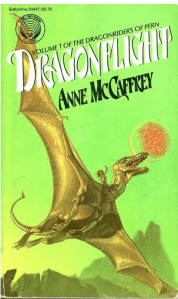
DragonflightDragonflight, the story of how Lessa and F’lar came together to unite Pern and bring the five lost weyrs forward in time to fight Thread after the four hundred year interval before the 9th Pass of the Red Star.


Pern 01Dragonquest, the story of how F’lar and Lessa united the weyrs, how F’nor went between to investigate the Red Star, and how they opened the Southern Continent.


White DragonThe White Dragon, the story of how Jaxom became both a dragonrider and the Lord of Ruatha Hold and how he courted and won Sharra.  It also tells the story of how the Oldtimers were ultimately defeated and the Southern Continent retaken.  Jaxom discovers the site of the original colonial landing.


THE HARPER HALL OF PERN TRILOGY


The first two novels of this trilogy occur during Dragonquest, the second novel of the first trilogy.  The third novel begins before and then overlaps The White Dragon.

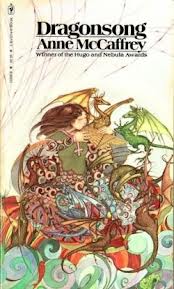
McCaffrey DragonsongDragonsong, the story of how Menolly escaped her abusive father and mother at Half Circle Sea Hold, how she impressed her nine fire lizards, and ended up at the Harper Hall.


DragonsingerDragonsinger, the story of how Menolly became a Journeywoman of the Harper Hall.


dragon-drums-det_0Dragondrums, the story of how Piemer got himself a gold fire lizard and permanent became a part of the Southern Continent.


OTHER STORIES IN THE TIMELINE


“The Smallest Dragonboy,” a short story included in A Gift of Dragons.


“The Girl Who Heard Dragons,” a short story included in A Gift of Dragons.


Another novel overlaps the entire time period of the two trilogies:

Renegades of PernRenegades of Pern, the story of Holdless Thella and her attempts to kill the girl who heard dragons.  This novel also dovetails with the end of The White Dragon and contains important information about the relationship of Piemer and Jancis. 


All the Weyrs of PernAll the Weyrs of Pern tells the story of the intelligent computer, AIVAS, who helps the people of Pern finally defeat the Red Star.


The Dolphins of Pern.


Skies of Pern Les EdwardsThe Skies of Pern, the story of F’lessan, son of F’lar and Lessa and his love for Tai, the Green Rider, this book also explains what the dragonriders will do now that there will no longer be Thread for them to fight.

Psycho

Psycho 1The line between suspense and horror is blurred anyway, but when director Alfred Hitchcock and screen writer Joseph Stefano adapted master horror writer Robert Bloch’s 1959 novel Psycho for the screen, and composer Bernard Herrmann was brought on board, they changed the horror film genre forever, creating ripples that are still felt by filmmakers today.

It began when Hitchcock read Bloch’s novel on a flight to England.  He immediately decided it would be his follow-up to the blockbuster North by Northwest and that it would be a stark departure from his acknowledged style.  Noting the success of low budget black and white horror films, he wondered what would be the effect if such a film was made by someone who really understood the cinema.  The first writer called in wrote a boring script that he immediately rejected, instead bringing in young Joseph Stefano to craft a completely original screenplay that was based only marginally on the book.  Stefano was in therapy at the time and they decided to center the film in a young man who was patently, homicidally, crazy. 

This movie is so well-known that I will discuss the entire plot in detail.

They decided to begin the movie from the point of view of Marion Crane (Janet Leigh), a Phoenix girl in her late twenties in a serious relationship with a man named Sam Loomis (John Gavin), a hardware store manager from a mid-sized Northern California town named Fairvale.  Caught in a situation of having to pay alimony to his ex-wife, Sam believes that marriage is impossible until he can get out of his financial crisis. 

Psycho 3In the first scene, in a Phoenix hotel room, we see Marion wearing a white bra and slip and Sam naked from the waist up.  They have just finished making love and discuss their situation.  Marion goes back to the real estate office where she works and finds that a client is giving them $40,000 in cash to hold for a purchase.  However, instead of taking the money to the bank, she goes home, packs, gets in her car and sets out for Fairvale, thinking that they money will give them the fresh start they need.

Along the way, she is menaced by a highway patrolman, ominous in his dark glasses.  She trades in her car and spends $700 of the money for a new one with California plates.  She drives into a thunderstorm and pulls over at the Bates Motel, a lonely spot on an old highway, with a mansion on the hill behind it and meets the proprietor, Norman Bates (Anthony Perkins).  A quirky, nervous young man, he volunteers to share his dinner with her.  In the back room of the motel office, surrounded by the stuffed birds that Norman works on as his hobby, she encourages him to leave and find a life for himself, but he protests that he is the only one who can take care of his mother, an invalid, who sometimes goes “a little crazy.”  As they talk, Marion realizes that she can’t solve her problems by running away and decides to return to Phoenix.  She has enough in her bank account to make up for the $700 she has already spent.

Norman watches her from a peephole as she undresses to take a shower.  As she scrubs herself, a fuzzy figure appears behind the shower curtain.  It is Norman’s mother and she mercilessly stabs Marion until she is dead.  Norman, seeing the blood on his mother, runs to motel room.  To cover up the crime, he cleans the room, moves the body into the trunk of Marion’s car (along with, unknowingly, the $39,300 remaining of the theft), and disposes of them all in a nearby swampy lake.

The next day, Marion’s sister Lila (Vera Miles) arrives in Fairvale, thinking that Marion must have taken the money to join Sam, but he has no idea where Marion might be.  A private investigator, Milton Arbogast (Martin Balsam) shows up also looking for Marion.  Grudgingly accepting that Lila and Sam really don’t know where she is, he begins to check every hotel and motel in Fairvale with no luck.  However, at the Bates Motel, he catches Norman in several lies and decides that he will need to interview Norman’s mother.  When Norman refuses, Arbogast leaves and calls Lila and Sam from a public phone to tell them that he’s going to go back to the Bates Motel to interview the invalid mother.

Returning to the motel, Arbogast watches Norman head to one of the rooms to work and then goes to the mansion to interview his mother.  At the top of the stairs, however, she rushes from her room and stabs Arbogast to death.  After disposing of this second body, Norman puts his mother in the fruit cellar because he’s afraid that more people will come to investigate, even though she loudly protests the action.

Lila and Sam try to get the local sheriff, Al Chambers (John McIntire) involved, but he tells them that Mrs. Bates has been dead for more than ten years.  She apparently poisoned her lover and then herself in a murder-suicide.  When Lila tells him that Arbogast claimed she was still alive, the sheriff wonders who it was they buried ten years earlier.

Without any significant action by the sheriff, Lila gets Sam to join her in their own investigation of the Bates Motel.  They check in, then Sam keeps Norman busy in conversation while Lila goes up to the mansion to try to find Mrs. Bates, but Sam thinks that Norman has stolen the money and gets Norman all worked up to the point where Norman bashes him in the head and runs to the mansion to find Lila.  Upstairs in Mrs. Bates’ bedroom, Lila notices that the bed has been permanently indented in the form of a body.  As she’s getting ready to leave, she sees Norman running for the house, so she ducks down the stairs toward the root cellar.  Curious, she goes all the way down and sees Mrs. Bates sitting in a chair.  She touches the woman on the shoulder and when the body swings around, the mummified skull of the old woman stares at her.  She screams, then the old woman appears in the doorway with a butcher knife, but before she can attack Lila, Sam shows up and wrestles her to the floor.  As she falls, a wig comes off her head and we see that “she” is actually Norman dressed up in his mother’s clothing.  All this time, he as been impersonating her, even going so far as to use her voice in conversations with himself.

Psycho 2Much of the psychology of Norman’s dual personality is revealed by a psychiatrist, Dr. Fred Richmond (Simon Oakland) at the jail who also tells them that the Mother has now taken full control of Norman’s body and that he will probably never be himself again.  We see Norman, right near the end, sitting in the jail, with a voice-over of his mother talking.  He sees a fly on his fingers and she says, “I wouldn’t even harm a fly,” as Norman grins maniacally.  The final shot is over the car being pulled from the swamp.

Eschewing the big budget color films of the day, he made the movie using his television crew, only relying on the skills of longtime collaborators George Tomasini for the editing and Bernard Herrmann for the score.  Probably the major breakthrough of the film was in building up the character of Marion Crane, getting the audience completely on her side, then killing her off barely 45 minutes into the movie, but there were other major departures from standardized cinema as well.  Showing her in a brassiere, lying in bed with Sam was extremely risqué for the time.  Hitchcock later had her in a black brassiere and slip, after she had stolen the money.  This was amazingly the first movie ever to show a toilet.  When Marion rips up her notes about the money, she flushes them down the toilet.

Joseph Stefano thought they were going to have a great film, but when he watched the rough cut, he became very depressed because it just didn’t look like it was going to work.  Hitchcock spoke to him very kindly.  “It’s just a rough cut, dear boy” he said.  The reason Hitchcock knew it was going to work was that the score was missing.

Although Bernard Herrmann wrote many great film scores for Hitchcock and other directors, the music for Psycho is by far his best and most effective composing.  In the history of cinema, there may never be a better match of action and score than the contribution of Herrmann to Psycho.  Very early in the process of composing the music, Herrmann made one critical decision—to use only strings in his composition.  The intense use of violins, cellos, and basses gives the action a depth that is astounding.  Most people remember the shower scene, but throughout the film, the music flies and dances, going dead silent at times, and pulsing organically at others.

The shower scene changed the American understanding of montage.  Shot over seven days, using 70 separate set-ups, the scene is a masterpiece of modern editing.  Some shots only appear for a few frames.  Hitchcock worked with Tomasini to put together an absolute tour-de-force in which it appears that Marion is hacked to death, without ever showing a knife piercing skin, without ever showing a bared breast.  In her book about the making of the film, Janet Leigh said that part of Hitchcock’s mastery was in allowing the audience to fill in the gaps.  By jumping all around in scenes that sometimes lasted less than a second, he created the illusion of the murder and allowed the minds of the audience to fill in the gaps.

Although the music and the editing contributed greatly to the success of the scene, what really set it apart was that it came so unexpectedly.  Never before had a director spent so much film time drawing the audience to a character only to have her viciously dispatched in a scene that lasts less than two minutes.

A case can certainly be made that Psycho is Hitchcock’s masterpiece, but a case can also be made for many of Hitchcock’s movies.  What is beyond debate is that Psycho changed the course of horror movies forever.