Mansfield Park by Jane Austen

Mansfield-ParkThe review contains a synopsis with some spoilers.

Jane Austen’s third novel deviates from the first two books quite dramatically, not only in the nature of her heroine, but also in her domestic position.

The novel deals principally with the progeny of three sisters. Mrs. Bertram has married into wealth and position. As the wife of Sir Thomas Bertram, she is mistress of Mansfield Park, a large country estate in Northamptonshire. They have four children, Tom, Edmund, Maria, and Julia. Her sister, Mrs. Norris, marries into the clergy and her husband is resident in the Mansfield parsonage.

They have no children. The third sister, Mrs. Price, marries into the lower middle class and lives on the verge of poverty in Portsmouth with her husband, a former navy man. She has nine living children (and one deceased), the chief of which are William, the eldest, Fanny, the next eldest, and a younger sister, Susan.

As the novel opens, Mrs. Norris has conferred with the Bertrams about bringing one of their sister’s children from Portsmouth to live with them and it is decided that the eldest girl, Fanny, should be the one. She arrives as a slight, uneducated girl of ten, and is installed in an attic bedroom. From the very beginning, she is told that she is always to be inferior to Mrs. Bertam’s four children and Mrs. Norris takes great pains to make sure that she never forgets it. Although she becomes dedicated to helping the sickly Mrs. Bertram, she lives in fear of Sir Thomas, who seems very great to her indeed. Among the other children, only Edmund befriends her. He becomes her advocate and remains so throughout the novel.

The children grow up through their teen years and a pecking order is established. Tom, as the eldest son, is destined to inherit Mansfield Park and he lives his life in carefree abandon, gambling, traveling to London, and acquiring debts. Edmund is the more level-headed of the two, but he is destined to become a clergyman. The two Bertram girls grow up as privileged belles, and Fanny continues timid, shy, and very serious. Through Edmund’s efforts, she has been very well-educated, is a devout reader, and is constantly at needlework, but she never develops the habits of wealthy young ladies, such music or drawing.

Facing problems with his West Indies company, Sir Thomas sails to Antigua to set everything right. Maria eventually manages to secure a proposal of marriage from a local lordling, Mr. Rushworth, with assistance from Mrs. Norris. When Mr. Norris dies, Mrs. Norris moves into a smaller house. She is still present at Mansfield Park every day, organizing the household and the children, but the parsonage is now occupied by Dr. and Mrs. Grant. When family problems force Mrs. Grant’s half brother and sister, Henry and Mary Crawford, into an extended visit at the parsonage, the two young urbanites become good friends with the Bertram children.

Against Edmund’s advice and Fanny’s strong disapproval, the young people decide to do a play for their own amusement. During the course of rehearsals, a lot of flirtation goes on. Henry Crawford is charming both Bertram girls, in spite of Maria’s engagement, while Mary Crawford takes a liking to Edmund. To create the theater, they appropriate Sir Thomas’ office and billiard room, but their plans go awry when Sir Thomas returns unexpectedly and puts an end to it. Maria marries Mr. Rushworth and they take Julia with them away to Brighton.

From that point on, everything goes downhill. Although Fanny very much disapproves of the Crawfords for a variety of moral and ethical reasons, Henry begins to court her, while Mary attempts to become her best friend. Fanny is astounded when Henry proposes to her. She goes into full retreat as she is pestered by everyone to agree to the marriage. She stoutly refuses and is eventually sent back to Portsmouth for two months so that she can see what her life would have been like without Mansfield Park to give her gentility. It is quite a shock to her, but she maintains her belief regarding the Crawfords and is eventually proved right.

Fanny Price is one of deepest and most well-constructed characters in all literature. Although she is timid to a fault, she learns everything that Mansfield Park can teach her and it all becomes a rock-solid part of her character. Once she has been molded, she becomes inalterable in her essence. Having seen first-hand what the Crawfords are, she does not deviate in her opinion of them, even when all around her would be duped. Even Edmund, steady as he is, becomes drawn to Mary Crawford, and Fanny grieves for him and wishes him to see the truth. When Sir Thomas approaches her with Henry Crawford’s proposal, she refuses to give in and stands up to him. Her personal feelings are always kept inside and she leaves others to discover truth for themselves. The few times during the novel when she becomes overwhelmed with events and breaks down, it seems truly catastrophic and creates deeply moving passages of writing.

In many ways, Mansfield Park is superior to Pride and Prejudice, which is her acknowledged masterpiece. The biggest downfall to the novel is the conclusion, which Ms. Austen writes first person, author to reader, summarizing how everything falls out, rather than creating scenes which depict this action. Otherwise, it is first rate all the way.

Starters by Lissa Price

Starters cover with borderThis is a good Young Adult Dystopian Science Fiction novel that could have been much better. The premise isn’t really good, but it doesn’t completely suck, either. At some time in the near future, friction between the United States and Pacific Rim countries reaches such a level that the PR countries develop a bomb that kills everyone between about 20 and 60.  The young survivors are called Starters and the older people are called Enders.  Unless children come from a wealthy family where grandparents can take care of them, they are pretty much left to survive on the streets.  Such is the case of teenager Callie, who tries to take care of a sick younger brother as they squat wherever they can.

There is one way out of this dilemma and that is to go to a Body Bank, an institution run by Enders that allows other Enders to rent a young body for 30 days.  A device in implanted in the young person’s brain to receive signals from the older person’s brain so that they can walk around in the body. It gives these rich old people a chance to experience youth all over again, while it gives the young people the money necessary to get off the street.

Callie rents her body to Bank, but suddenly wakes up as herself, with her renter as a voice in her head.  The renter lets her know that there is something seriously wrong with the Body Bank and that the owner is trying to change the laws to favor the Bank by using a Senator.  Her goal had been to assassinate the senator and expose the Bank.  Although Callie fights against this initially, she becomes friends with the Senator’s grandson and discovers that the Body Bank has plans to not just rent young bodies any more, but to sell them without the Starter’s permission.

Although the story is okay, it becomes a bit predictable after a while.  The book probably should have been in development with an editor for considerably longer.  Although told in First Person, it is told in Past Tense and could have benefited from going to Present Tense, as all of the other successful YA Dystopian novels have done.

It’s entertaining, a quick read, and has spawned a sequel called Enders.

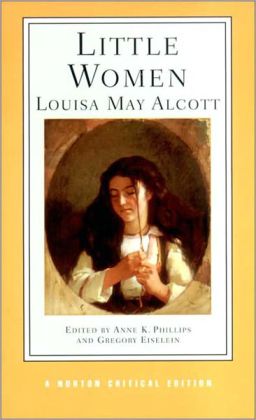
Little Women by Luisa May Alcott

Little Women Norton Critical EditionThis review contains spoilers.

I read this classic American novel, first published in 1868, in the Norton Critical Edition, edited by Anne K. Phillips and Gregory Eiselein.  In addition to the original text, published with very few corrections, the volume also contains a timeline, excerpts from Alcott’s journal, copies of letters with her first publisher, excerpts from texts cited in the manuscript (such as Bunyan’s Pilgrim’s Progress) and other writings by Alcott that relate to the book, including some of the juvenile plays that the Alcott sisters performed.

The original version, it should be noted, underwent significant revision in 1880 to “modernize” the text, so this original version is much closer to what Alcott intended when she wrote the book.

The story concerns the four March sisters, Meg, Jo, Beth, and Amy, their family, including their mother (Marmee), father, Aunt March, their neighbors, Mr. Laurence and his grandson, Teddy (Laurie), as well as various men involved in their lives, but the book is concentrated in the person of Jo, the second daughter, who is fifteen when the novel opens.

Their father has just gone off to Union Army to serve as a pastor in the Civil War after a reversal of fortune has left them in some degree of poverty.  Living in a small town just outside of Boston, the girls still give time to the local poor, help keep house, and perform various plays that Jo writes.  They have their own little “Pickwick Club” that published a small paper that they all contribute to and they play the parts of men from the Dickens classic.

Noticing that the neighbor boy must spend much time alone toiling with his tutor, John Brooke, Jo decides to make friends with him.  Laurie becomes friends with all four girls and they induct him as a member in the Pickwick Club.  As time passes, their father returns home, Meg and John Brooke become a couple and eventually marry, and Laurie goes off to college.  Upon his return, he proposes to Jo, but she tells him that she only likes him as a friend.  Aunt March takes Amy off with her to Europe and also goes there to get over his rejection.  Jo moves to New York City and begins her life as a writer, meeting Professor Bhaer, a German man looking over his two nephews in the boarding house where Jo serves as governess.  Writing sensational stories for the newspaper, Jo finds herself upbraided by the Professor for writing vulgar tales and gives up writing altogether.  At home, the always weak Beth, due to an earlier bout with scarlet fever, falls very ill and Jo returns to nurse her.

In Europe, Laurie courts the now womanly Beth and wins her heart.  When Beth dies and Aunt March decides to stay in Europe, Laurie weds Beth so that they return to the family, but Beth dies before they can make it back.  Aunt March also eventually dies, leaving her estate to Jo who married Bhaer and starts a school for boys in the old house, eventually having two boys of her own.  Laurie and Amy have a girl, whom they name Beth, after the deceased sister.

Although there are a number of issues with the book, there are parts of it that still remain among some of the best written American prose ever.

There are a number of issues, especially to a modern reader.  The purpose of the novel was to serve as an instruction guide to adolescent girls in how to live their lives, so it carries a heavy moral burden.  Girls must not only love and support their parents wholeheartedly, but they must have a regular devotion to the Christian god.  Indeed, page after page harps on these points over and over.  All this preaching really gets in the way of the story that’s being told.  The author frequently steps from behind her wall and speaks directly to the reader, telling us how she feels about the story, how the girls should behave, and so on.

Beyond that, the story has a few issues of its own.  Alcott spends a great deal of time setting up Jo’s relationship with Laurie so that the reader expects it work out and it is quite a letdown when it doesn’t.  They seem perfect for each other.  Then, Jo’s relationship with Professor Bhaer seems really forced.  He reveals himself to be a very shallow, narrow-minded man.  When his actions result in Jo giving up writing, I really lost respect for her.  That is a serious issue in a book where she is the protagonist.  I believe the issue is compounded by her falling in love with him.

I don’t think that I’m the only one to see this.  The movies adapted from the book have all changed not just the character of Professor Bhaer to make him more likable, they’ve actually changed the plot so that Jo continues to write.  In the book, he is 40 years old and she is 19.  I personally have no objection to the age difference and the people of that time had no objection to it, but I think that today’s audience might have some qualms.  The movies almost all picture him as younger.

In spite of these various drawbacks, the scene where Jo rejects Laurie must be among the best ever written. It is heart-wrenching.  Likewise, the love and care of the four girls for each other is so endearing that it literally makes the book successful on its own.  Although Alcott seems self-deprecating about the poetry in book, I found it to be extremely well-written and a strong hit to the heart.  Although I admit that I am prone to my Irish sentimentality, I am also quick to reject overt sentimentality and I found myself tearing up many times during the reading.

So, problems and all, I have to admit this is an amazing and wonderful book that everyone who is interested in American literature must read.  If you are lucky, you will find that place in your heart that it is willing and waiting to touch.

Inherent Vice by Thomas Pynchon

inherent viceI am not a huge fan of Thomas Pynchon, but I have a friend who is quite devoted.  Prior to this book, I had only read Gravity’s Rainbow.  I enjoyed it quite a bit, but was not motivated to read other books by Pynchon.  However, earlier this year, my friend loaned me his copy of Inherent Vice, explaining that it was like Raymond Chandler on acid and I couldn’t resist giving it a try.  Later, reading the review from The New Yorker, which extensively quotes Raymond Chandler’s essay “The Simple Art of Murder”, I came to understand how much my friend’s explanation made sense.

Others may dwell on the plot, but I would prefer to allow readers walk into it a little blind, so that the book may be a treat. What impressed me the most was the style of writing.  This is a comedy–and for me it was a laugh-out-loud comedy.  In terms of style, I thought Inherent Vice more closely resembled what you would get if you attempted to take some Zap Comix and novelize them.  Yes, Doc Sportello is a private eye, but he is a gumshoe who is permanently stoned.  His adventures involve characters who appear to be permanently tripping.  The “serious” characters are actually full-blown cartoons.  When a house full of surfer band hangers-on turn into zombies and chase Doc and his friends in the Woody from Hell, you can’t tell if it is really happening or if Doc is just tripping, but it is a hilarious sequence.

The book captures the Southern California of the early 1970’s very accurately, populating it with a hilarious beach crowd, throwing in bimbos, policemen on steroids, surfers, lawyers, real estate developers and gonzo bums.  The book could have very easily been a collaboration with R. Crumb.

If you read this book and understand it as a comedy and I think that you will completely enjoy it.

The Savages

linney hoffman savagesThe Savages is a 2007 film featuring two of my favorite actors, Laura Linney and Phillip Seymour Hoffman as sister and brother Wendy and Jon Savage. 

The estranged pair, both theater people, have been estranged for some time, both having suffered from parents who were never there for them.  Wendy, a playwright, has even written a semi-autobiographical play about their father.  She lives in New York working temp jobs and applying for grants and having an affair with a married man who will not commit to her.  Jon lives in Buffalo and teaches Brecht at a college.

The two are forced to pull together when their father Lenny (Phillip Bosco), who lives in Sun City, Arizona, develops dementia at about the same time the woman he is living with dies.  Over Wendy’s objections, Jon decides to place their father in a nursing home not far from where he lives.  However, Wendy is assigned the unsavory task of accompanying the old man on a cross country flight to Buffalo.

Wendy and Jon must deal with their own personal issues, as well the incapacity of a man they once hated.

There’s no doubt that this is a “slice of life” movie and also an “actor’s drama.”  Those types of movies do not have to be alienating in any way, especially when you have such incredible talent as Linney and Hoffman in the lead roles.  However, I think that even the best slice of life movies must have a hand at the helm that will keep them moving in a direction and I felt that lacking in the script and direction of Tamara Jenkins.

After sleeping on the movie, I did realize that there is somewhat of a character arc for Wendy, but it was so subtle that I didn’t pick it up during the viewing—it only becomes apparent at the end.  It is extremely difficult to see any kind of arc for Jon and yet he has changed at the end of movie, too.  And I must say that Linney and Hoffman give wonderful performances.  The characters are believable, the comedy is very funny, and the drama works extremely well.

I just had the feeling that I was spinning my wheels.  The movie didn’t really seem to go anywhere.  And yet, it had enough of an effect on me that I thought about it overnight and finally saw what I failed to see during the viewing—an actual character development for Wendy.

For fans of good acting, I highly recommend this movie.  For those who cannot take the time to dig the subtlety out of the movie, you might find it tough going.

The Joneses

1106574_The_JonesesThis 2009 movie saw only limited theatrical release and there’s a reason for that.  Although entertaining, writer/director Derreck Borte has created a project that feels incomplete and contrived.

The idea is that some company has ramped up marketing to the level where they hire good-looking people to pose as an extremely wealthy family, they move these people into a big house in an affluent community, then provide then with products that will make their neighbors so envious they will go out and buy their own.

This particular group of cons is led by Kate Jones (not her real name), played with understated elegance by Demi Moore.  She’s been working the game for a while, while the failed golf pro/used car salesman posing as her husband, Steve Jones (David Duchovny), is a rookie, still learning the ropes.  Their teenage kids, Mick and Jenn (Ben Hollingsworth and Amber Heard) each have their own problems.  Mick is gay, but still definitely in the closet, while Jenn is oversexed and prefers older men.

The wife and kids do well at the beginning because they know what they’re doing, while Steve stumbles along trying to figure out.  When Kate gives him the tip that he needs to find the right person to endorse the products (she’s gayfriending the local hair stylist), he begins to work on the golf pro at the country club and his numbers begin to skyrocket.

During this time, they are making friends and Steve is trying to pursue a real relationship with Kate, which she is having none of.  That’s the set-up and it’s pretty good.  There’s a lot of great places you can go from there and I was looking forward to several promising developments.

However,  Borte has two serious problems.  First of all, for the romance between Steve and Kate to work, there must be chemistry between Duchovny and Moore—it just never develops.  Moore comes across as a real cold fish and Duchovny’s ah-shucks demeanor never quite rings true.  The second problem is that it doesn’t really develop the comedic possibilities.  Instead, it turns stone cold serious when their neighbor commits suicide because he can’t “keep up with the Joneses.”

A better approach would have been to create a situation that forces them into a sink-or-swim mentality, such as the discovery of Jenn’s affair with a neighbor, something that would force them all to work together to convince the neighbors that they were a real family—and then have them develop into a real family in the process.  Now that would be a good movie to watch!

The bend into seriousness really causes problems.  Matt, for example, has a really interesting girlfriend who doesn’t know he’s gay.  There are all kinds of possibilities in that situation, but Borte chooses to have Matt make a pass at her brother.  While they are driving at high speed, the girl, following them, gets into an accident and ends up in the hospital.  This turn away from comedy  is like committing suicide for a writer.  It’s giving up because you haven’t figured out the right plot.

Enough said.  It’s entertaining.  It’s not long, which is a bonus.  The best recommendation for seeing this movie is for film students to figure out what when wrong and how to solve it.

How To Draw A Bunny

ray johnson how to draw a bunnyThis 2002 documentary on the elusive, enigmatic artist Ray Johnson really gives us a lot more than it promises.  Almost from the beginning, it is suggests that “no one really knew Ray Johnson” and then, through interviews and close-ups of his art, the film proceeds to give us one insight after another into the man’s genius.

First of all, if you are not familiar with Ray Johnson’s art, this movie will enlighten you very quickly, whether you are looking at one of his happenings, the many postcards he drew and sent to friends and acquaintances or the masterful collages that he frequently changed or cut up for his customers.

A major influence on Andy Warhol, Johnson pretty much ignored every major bid for success and instead chose to always go his own way, creating work that now seems so obviously brilliant that we wonder how he could have avoided success.  Everyone in the art world of the 1950’s through the 1990’s knew who he was and what his brilliant contribution to the art world consisted of.

Never married, he seems to have had an amorphous life of relationship, palling around with both men and women, including many artistic luminaries such Christo, Jeanne-Claude, Chuck Close, Richard Feigen, Morton Janklow, Judith Malina, Roy Lichtenstein, and James Rosenquist.

For one commission, he decided to drop footlong hotdogs over Long Island.  Johnson offered a major collage for $2,000, but a patron countered at $1,000.  When they settled on $1,500, Johnson promptly sent the collage with 1 / 4 of it cut off.  He did a number of profiles of one person and when they started dickering on the price, Johnson began to make major changes, adding more art, changing some of them to the point that you could no longer recognize the cameo at all.  And every time he made a change, he would begin the dickering process all over again, as they became more valuable with each change.

On January 13, 1995, he dove off a bridge into Sag Harbor off Long Island, an apparent suicide.  For many weeks beforehand, he had told friends that he was working on his greatest work of art yet.  Authorities found his house completely organized with all of his art facing against the wall except for one portrait of himself.

From Wikipedia:  “His body washed up on the beach the following day. Many aspects of his death involved the number “13”: the date; his age, 67 (6+7=13); the room number of a motel he’d checked into earlier that day, 247 (2+4+7=13), etc. Some continue to speculate about a ‘last performance’ aspect of Johnson’s drowning.”

Directed by John Walter and with music composed and performed by Max Roach, this is a compelling film, bound to keep anyone interested in the arts completely engaged.  The great views of Johnson’s art are worth the price of admission.  I highly recommend this movie!

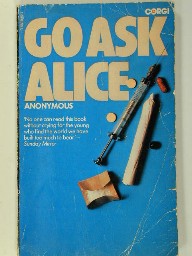
Go Ask Alice by Beatrice Sparks

Originally published in 1971 as a scare book for teenagers, Go Ask Alice was pushed on the public as a real diary of a troubled teenage girl sometime between 1968 and 1971, the author listed as “Anonymous.”  The book is the “Reefer Madness” of literature, not only because of the gross exaggerations concerning various drugs, but because the character of the teenage girl rings about as false as a character possibly can.go-ask-alice

The failures of this novel are so deep and profound, it’s hard to tell where to begin.  Many plot points are dropped in for no other purpose than to shock the audience and with total disregard for reality.  I know of only one person in my life who got stoned on pot and had visions and that person was a certifiable psychotic.  That this girl has one hit and goes off the deep end is truly outside the scope of reality.  She seems just completely ditzy, one minute all “Daddy, I love you” and the next minute all “Fuck everything I want to kill myself.”

This leads to situations where one minute she’s completely committed to being clean and then she has one speed tab and goes on a bender where she runs away from home and lives on the streets for months.  What?

There are a few pages in the book that ring true, but any parent who gave this book to their kid as a way to try to steer them clear of drugs has been misled by literature.  It will provoke laughter because it is so unbelievable.

Maybe the most disappointing thing about the book is that as the diary draws to a close, we see this girl finally getting her life together. She has a boyfriend, girlfriends, good grades, and great prospects for the future.  The diary ends on a very positive note.  Then, suddenly, the author comes on board with an Epilogue that tells us, “The subject of this book died three weeks after her decision not to keep another diary.” 

WHAT?

HOW?  “Her parents came home from a movie and found her dead.  They called the police and the hospital, but there was nothing anyone could do.”  This makes no sense at all.  It just comes out of the blue and there is no motivation, no build-up, nothing.

WHY?  “Was it an accidental overdose?  A premeditated overdose?  No one knows, and in some ways that question isn’t important.”  WHYEVER NOT???  “What must be of concern is that she died, and that she was only one of thousands of drug deaths that year.”  This makes no sense at all and it is a complete evasion of the most important question in any book.  Why?

What a letdown.  Can’t you at least tell me how a girl who was clean and straight and completely dedicated to the beautiful new life ahead of her does something like that?  It’s insane.

Kids—don’t  ever write like this!  Maybe the book—now considered a classic of Young Adult literature—should be brought up in English class as an example of how NOT to write Young Adult literature.

Stoner & Spaz by Ron Koertge

Stoner and Spaz Book CoverAlthough classified as a breakthrough novel in the Young Adult genre, Stoner & Spaz–like all good novels–can be read and enjoyed by anyone.

It’s a short book, very lean and very well-written.  Maybe my own experience with cutting a large novel down to size has colored my point of view, but I have grown to really appreciate storytelling that gets right to the heart of the subject.  The characters are bold, the Southern California landscape spare, and the theme explored relentlessly.

Told from the point of view of sixteen-year-old Ben Bancroft, a survivor of Cerebral Palsy, it relates his experiences with Colleen Minou, a stoner girl at his high school.  Ben is a true nerd, a cinephile who lives through his experiences with movies.  He has seen so many that he understands the form intimately.  He knows why tracking shots are used, how black and white enhances certain movies, why characters act the way they do, and he deeply wishes he could live his own life as if he was one of those powerful, charismatic characters.  But he doesn’t.  Instead, he feels the weight of that half of his body that is completely unresponsive.  He stays away from the other kids, lost in his own little world.

That changes one night at the Rialto Theater when Colleen asks to borrow a couple of dollars because they won’t change the hundred dollar bill in her hand.  To his surprise, she tracks him down in the theater and sits with him.  Although he’s mortified, he’s also a little turned on, especially when she falls asleep with her head on his shoulder.

Thus begins an unlikely relationship that turns Ben completely around–and opens him up to the possibilities of his own life.

There are several great things about the book.  One, obviously, is the interaction of two kids who are complete opposites, each discovering the other’s world and opening themselves to change.  But secondly, and most important, is Ben’s character arc.  For me, the best stories involve a character that must go through dramatic changes in order to realize his or her potential.  And the more barren the character at the beginning, the deeper and wider the potential for change.  By using an introverted character with Cerebral Palsy, Koertge begins in a pretty deep chasm.  To deflect potential darkness, he gives the character a quirky, smart, self-deprecating sense of humor.

The leanness of the book also works to advantage in that it could be a movie itself.  Think how some movies fail because a director is in love with long, tracking shots, mood shots, unnecessary character background, and long scenes.  Successful films are edited down to what matters–all of the unimportant stuff lays on the cutting room floor, rather than padding out a 90 minute film into a two hour bore.

Stoner & Spaz is a wonderful little novel, something that all writers should read and something that will entertain and enlighten every one who reads it.  Highly recommend!