Notorious

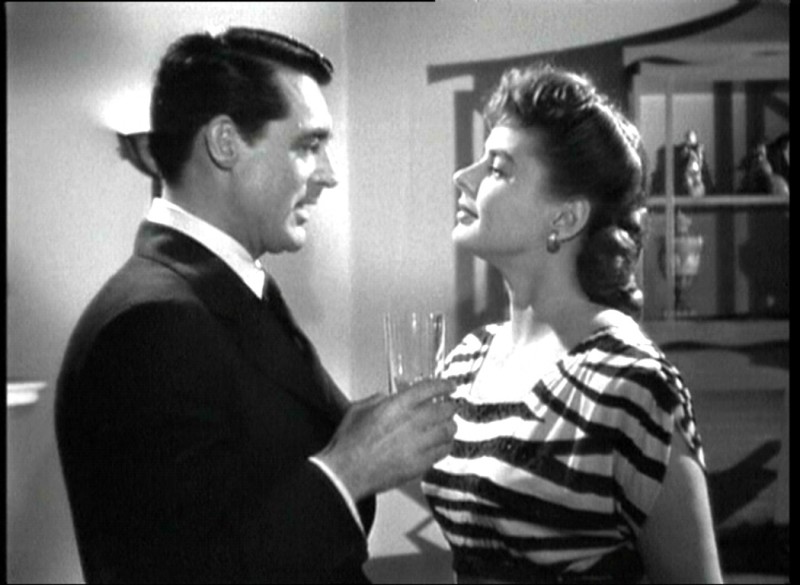
Notorious 03The sexiest and most mature of all Alfred Hitchcock’s films, Notorious is also one of his most suspenseful movies.  It’s a torchy love story set among dangerous ex-Nazis in Rio de Janeiro, with Ingrid Bergman putting her life in danger to prove to the American agent she loves that she has become an honest woman.  Beautifully shot in black and white, all of Hitchcock’s mastery drives a story that is thrilling right up to the end.

This review contains plot spoilers.

When her German immigrant father is convicted of treason in 1945, beautiful Alicia Huberman (Ingrid Bergman) goes on a binge.  Her reputation as a party girl has been well earned, so American agent T. R. Devlin (Cary Grant) tries to keep some distance as he prepares to recruit her to spy on her father’s old friends, but he can’t seem to help getting involved with her.  Although she claims not to care about it, Devlin has wiretapped proof that she is a patriot and so he gets her to fly to Rio de Janeiro for a job.

By the time she is settled in Rio, Alicia is in love Devlin and she goes off of alcohol and dedicates herself to him, but he doesn’t quite believe her.  He is still suspicious that she will take another lover when she can.

Her job is to hook up Alex Sebastian (Claude Rains), one of her father’s friends who made advances to her in the past.  She practically begs Devlin to tell her not to take the job, but he thinks that she should refuse it on her own.  This test of wills leads her to accept the challenge.  She is successful with Sebastian, but he keeps seeing her with Devlin and suspects that she may not really love him.  He dares her to prove her loyalty by marrying him.  Alicia brings her dilemma to the American agents, all of whom want to leave the decision up to her, except for Devlin.  In love with her and angry that she has actually taken Sebastian for a lover, he advises her to go through with the marriage.

Notorious 01Alicia becomes convinced that whatever Sebastian is hiding is kept in his wine cellar, but he has the only to it.  On Devlin’s urging, she steals the key and plans to investigate during a large party.  She invites Devlin and the two of them sneak away during the party to look in the wine cellar.  He accidentally breaks a wine bottle and it is full of uranium.  Although he cleans up the mess and they make their escape, Sebastian has discovered that his key is missing when he goes to get more wine.  He sees Devlin and Alicia together and they kiss to cover their escape from the wine cellar.  Sebastian sees them and realizes that Alicia doesn’t really love him, then, when his key appears on his key ring the next morning, he realizes that she is a spy.

At the urging of his mother (Leopoldine Konstantin), they begin a slow process of poisoning Alicia.  When she grows more and more ill, she cannot make a meeting with Devlin and he becomes suspicious.  He goes to the house to investigate and finds her deathly ill.  Confessing his love for her, he takes her from the house right in front of all of the Germans.  Sebastian begs to go along with them, but Devlin refuses, leaving Sebastian to face the wrath of his ex-Nazi friends.

In its restored version, this black and white film is absolutely beautiful.  Ingrid Bergman was made for the black and white film medium and the camera certainly loves her beauty.  Alicia is a very complicated role and her performance is dynamic and powerful.  Likewise, Cary Grant plays Devlin as a very complicated man and gives probably the best performance of his career, nuanced and detailed.  Hitchcock uses his camera masterfully, creating some of the best shots of any of his films.

Notorious 02The suspense in this movie is palpable, at times so thick that it is almost impossible to watch, but the story is so compelling it is difficult to turn away.  The kisses between Bergman and Grant are incredibly sexy.  In one shot, they kiss, nuzzle, talk, and kiss over and over again for minutes.  The movie also contains one of Hitchcock’s most well known shots, a long crane shot from the second floor of the house, moving inexorably down to a close-up of Bergman’s hand, behind her back, holding the key.

Written by Hollywood’s legendary screen writer, Ben Hecht, Notorious is a masterpiece that must be included among the very best of Alfred Hitchcock’s movies and it should be seen by everyone!

The Skies of Pern by Anne McCaffrey

Skies of Pern Les EdwardsIn this final book in the 9th Pass saga of The Dragonriders of Pern, the story turns to the aftermath of events in All the Weyrs of Pern.  At the end of that book, the dragonriders, led by Jaxom and under the guidance of the computer AIVAS move the engines of the three space ships that brought the original colony from Earth into Red Star, exploding to force it into an orbit from which it can no longer drop Thread onto Pern.  Following this heroic exploit, AIVAS turned itself off and Master Robinton expired.

The following review contains plot spoilers.

The Skies of Pern brings forward the character of F’lessan, son of F’lar and Lessa, who appeared much earlier in the saga as a boy and a young man.  Now, the mature rider of bronze dragon Golanth, with sons of his own, F’lessan looks toward the end of the Pass, contemplating what he will do After.  In the previous novel, he discovered the ruins of Honshu Hold deep in the Southern Continent.  He has been restoring it.  Coming to Landing for the Turnover festivities at the beginning of the 31st Turn of the Pass, he goes to the AIVAS library to do some research and runs into a female green dragon rider, Tai, whose dragon is Zaranth.  Making friends with her, they attend the festival, but she disappears when Mirrim and T’gellan show up, she disappears, only to discover Abominators breaking glass at the Healer’s Hall.

The same dumb Abominators from All the Weyrs of Pern are back, wreaking havoc by destroying products that AIVAS showed the Pernese how to create and use.  They are working on a large, concerted level.  F’lessan finds Tai swimming and shows unusual concern for her welfare, just as Golanth seems to care about Zaranth.

Before their relationship can proceed further, however, a comet fragment bursts through the atmosphere and plunges into the eastern sea, causing massive tidal waves that inundate both the north and south, completely submerging Monaco Weyr.

After a great deal of timing, once again the dragons of Pern and their courageous riders rescue holders and move people to higher ground, exhausting themselves in the process.  F’lessan manages to work with Tai and gets her and the other Monaco riders to go to Honshu for rest.  After the others have made new weyrs, Tai and Zaranth stay on.  When Zaranth rises to mate, Golanth flies her and F’lessan discovers that Tai has never had a good experience with the almost compulsory sex that goes along with a mating flight of dragons.  She has been raped over and over by other dragonriders.  Showing a great deal of care and concern, F’lessan makes love to her and brings her to love him.

Having served as an assistant to Starsmith Wansor, Tai is well versed in studying the heavens, so F’lessan retrieves what he needs from Landing in order to get the Honshu telescope working again.  After a night of stargazing, they swim in the river and then fall asleep on one of the ledges above the pool, with their dragons sleeping just below them.  Zaranth wakes up to a feeling of danger just as a large pack of the wild felines attack them.  Golanth is closest to them and they do considerable damage to him and to F’lessan, while Zaranth uses her newfound power of telekinesis to throw the felines off.  Ruth, Ramoth and Mnementh all respond to Zaranth’s distress call and she shows them how to use telekinesis to destroy the felines.

As F’lessan and Golanth go through a long and difficult recovery, the holders of the planet plan to press the dragonriders into finding a way to prevent future meteorites and comets from attacking Pern.  The answer lies in mapping the skies, a concept that F’lessan had previously given to the weyrleaders.  With a future in astronomy, F’lar and the others make plans to build more observatories to map the skies and watch for future incursions.  With the dragons having telekinesis, they will find a way to deflect future meteorites.

F’lessan and Tai become weyr mates and will be in charge of the Honshu observatory.

Along the way, the Abominators are defeated.

There are a great many delightful things in this novel, but the villains are such minor characters that they really don’t get much in the way of the story, as McCaffrey’s villains do in some of the other books.  All of the familiar characters are back, of course, excluding Master Robinton.  F’lar and Lessa are considering retirement, but F’lar wants to continue to lead Benden Weyr through the end of the Pass.  They are much larger characters in this novel than in some of the other later novels in the series.

F’lessan and Tai are both delightful characters and the attack of the felines is one of McCaffrey’s best written action sequences in any of her books.  There is much to love in this novel for the dedicated Pern reader, but I must confess that I felt very sad when it was finished, almost as if I were putting away Pern again for a while.

But the wonderful thing about The Dragonriders of Pern is that it can be started all over at any time and the reader will delight in following through all the books to get to The Skies of Pern.  It’s such a wonderful series that it can be read over and over again.  You can look forward to the beginning, even as you read through the end.

To Catch A Thief

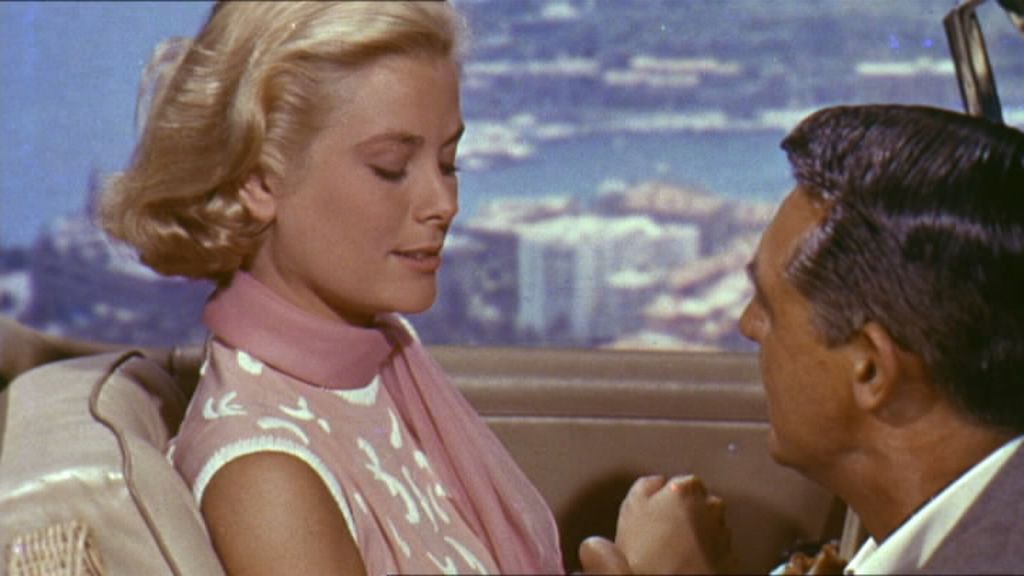
To Catch a Thief 01This is Alfred Hitchcock’s most visually beautiful movie.  Filmed on the French Riviera, the gorgeous hills, dotted with old mansions overlooking the Mediterranean Sea vie with the stark beauty of Grace Kelly and chiseled features of Cary Grant to provide enough eye candy to last a lifetime.  The following review contains plot spoilers.

The story is simply an excuse for the beauty.  American ex-patriot John Robie (Cary Grant) is a former jewel thief who was known as “the Cat” before World War II.  He paid his dues by fighting in the French Resistance, killing over 70 Nazis proving his loyalty to France.  After the war, he put aside his thieving ways and lives respectably and very well, thank you, in a villa on a ridge overlooking the Mediterranean.  This idyllic life is disturbed when a copycat burglar begins stealing the most expensive jewels on the Riviera.  When the Police come calling, thinking he has renewed his life of crime, he evades them in a breathtaking car chase through some of the most beautiful scenery in the world.  Turning his car over to a woman on the street, he hops a bus and sits next to Alfred Hitchcock.

He goes to see his old friend from the Resistance, Monsieur Bertani (Charles Vanel), who runs a restaurant that is manned by head waiter Foussard (Jean Martinelli) and more of their old Resistance buddies, who are all suspicious that the Police are right about Robie.  Bertani helps him escape with the aid of Foussard’s daughter, teenager Danielle (Brigitte Auber) who has a crush on him.  She takes him across the water to the Hotel Carlton, where beautiful American tourist Frances Stevens (Grace Kelly) sees him.  He makes contact with a British insurance company representative, H. H. Hughson (John Williams), and pleads his case, that he is innocent and only wants to catch the thief to clear his name.  Caught by the Police, Robie is released due a lack of evidence and convinces Hughson to give him the names of his clients who have the most expensive jewels waiting to be stolen.  Abashed at having already had to pay out huge sums, Hughson agrees, also sharing the list with the Police to hedge his bets.

To Catch a Thief 02He begins by meeting rich American tourist Jessie Stevens (Jessie Royce Landis), mother of Frances, and posing as a rich Oregon timber man.  After a stimulating evening, he escorts the two ladies back to their rooms, but before he can depart, Frances gives him a passionate kiss and arranges to meet him the next day.  While swimming, he runs into Danielle and Frances becomes jealous.  She and Robie take a drive to look at villas and are followed by the Police.  When he asks her to drive a little faster, she speeds up considerably, taking a kind of devilish delight in tempting fate.  They safely evade the Police and find a nice spot overlooking the sparkling waters of the Mediterranean and she tells him that she’s figured out that he’s actually John Robie.  He denies it, but after lunch the end up kissing again.  She tells him to meet her in her room to watch the fireworks or she will reveal who he really is.

That night, she seduces him again, proposing that they go into business together as burglars.  He continues the façade of being a tourist, but when she goes to sleep, he keeps watch in her bedroom.  During the night, however, the burglar robs Jessie of all her expensive jewels and finally Robie reveals himself to them.  Frances calls the Police on him and he departs over the rooftops as they arrive to search for him.

Hiding out, he stakes out what he thinks is the next target, alerting Hughson and putting the Police on notice.  As he waits in the dark, he is attacked by a man dressed in black.  Struggling, he throws the man over the cliff.  The Police find the body of Foussard in the Sea and announce that he was the burglar, clearing Robie of charges.

At her father’s funeral, Danielle becomes distraught and calls Robie a murder.  Chagrined, Frances again hooks up with Robie and he tells her of his plans to capture the real burglar by attending a fancy costume ball.  The Police follow and also stake out the ball, which Bertani is catering, with Danielle’s help.  After changing disguises with Hughson, Robie waits on the roof for the burglar to show up, but when he does, it turns out to be Danielle.

To Catch a Thief 03On Robie’s hillside villa, Frances kisses Robie again, remarking that her mother is going to love the house.

From beginning to end, the cinematography is stunning, so much so that the film won Robert Burks, Hitchcock’s longtime associate an Academy Award.  Although nominated for her incredible costuming, especially of Grace Kelly, Edith Head did not win.

This film has a different feel than most of Hitchcock’s work.  Although it contains a lot of humor, the film is not a comedy.  There is certainly some mystery as to who the real burglar is, but the film lacks the tension and suspense that mark most of Hitchcock’s movies.  In truth, this is a feel-good romance, concentrating, as it does, so intensely on beauty.  This was the last film he made with Grace Kelly before she married Prince Ranier of Monaco and gave up acting and it is appropriate that she shows so well.  Stunning in an array of dazzling Edith Head costumes, the three gowns she wears are all breathtaking.

It moves at a really good clip, coming in at under two hours, and you never notice the time passing because there is always so much beauty for your eye.  It is a fun movie, something you can’t really say about too many Hitchcock films and it transports you to a time and place full of such charm that it can honestly be said to elevate one beyond the every day.

A stunning film!  I highly recommend this movie for all audiences.

Waste Land

Waste Land 01One man’s trash another man’s art?  One man’s human scum another man’s hero?

Brazilian artist Vik Muniz works with “natural materials” such as sugar and garbage.  He has been so successful that he has relocated his studio to New York, but in 2005, he decides it is time to give something back to the country where he grew up poor.  He picks as his subject the largest landfill in the world, Jardim Gramacho, an island just outside Rio de Janeiro, where hundreds of humans comb through the newly arrived trash.

At first, his main concern is for his own welfare.  Would it be safe to work there?

When he arrives at Jardim Gramacho, he is quite surprised that the pickers.turn out to be the perfect subjects for his art.  Far from being abject poor, struggling to live off of the garbage, they are honest workers collecting plastic and metal to recycle and earning $20 to $25 a day for their labor.  Most of them found their way there through unemployment.  Although it took a “while to get used to the smell,” most of them don’t even notice after a while and Muniz goes through the same process.

In fact, their occupation is not only honest, it provides decent livings for most of them in this impoverished land, and it contributes environmentally as well.  Followed by documentary filmmaker Lucy Walker, Vik spends a great deal of time interviewing and getting to know the catadores, choosing seven men and women to work with specifically as his subjects, including a man named Tiao who has organized the workers into an association.  As representative of the catadores, he lobbies the government to make sure that they are provided for and that laws enacted for the improvement of their neighborhoods are carried out.  A friend of his picks up books from the dump and they are collecting them to form a community library.

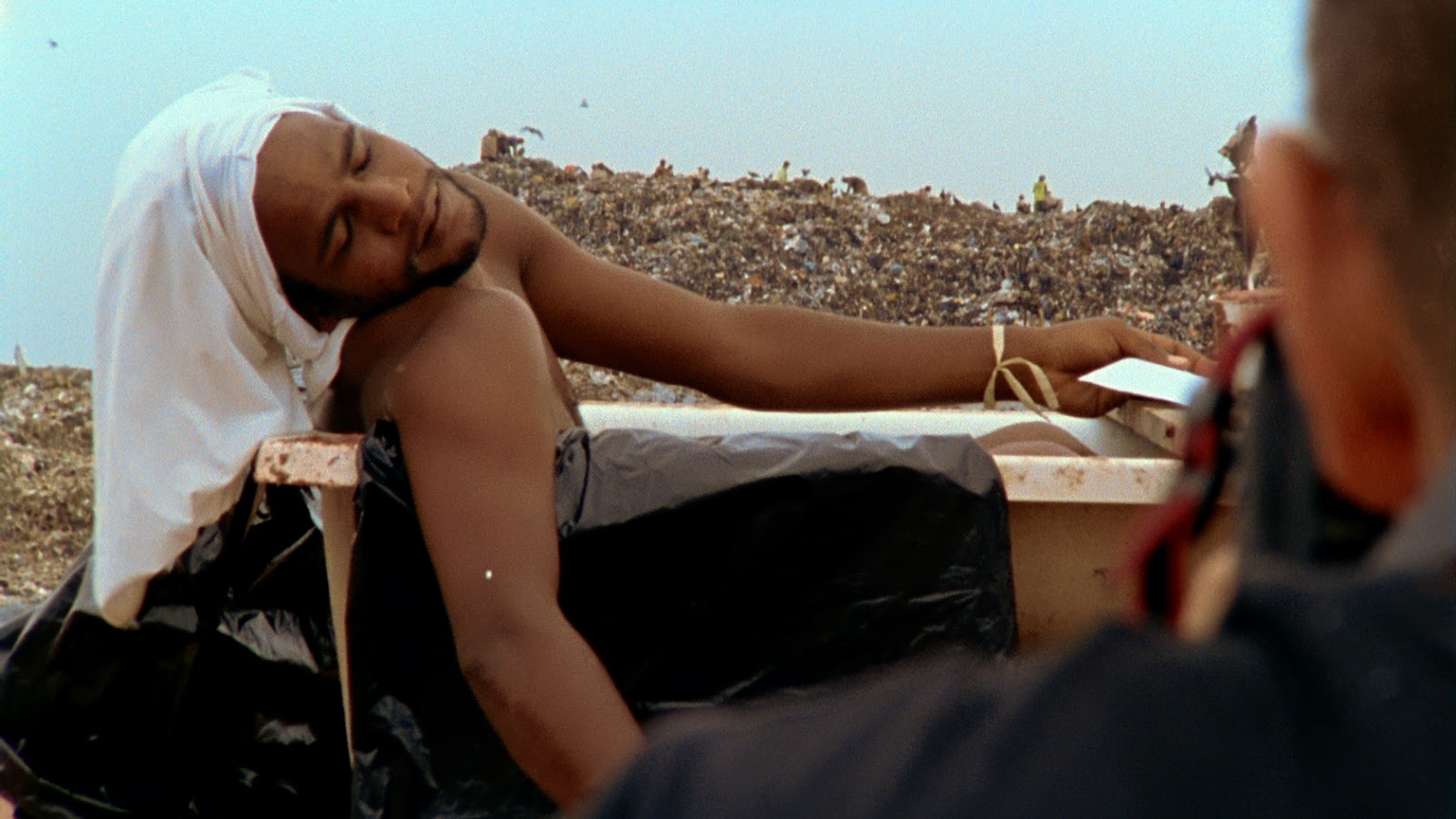
Waste Land 02Posing Tiao as Jean Paul Marat, in an abandoned bathtub found at the dump, Muniz shoots photographs, then he systematically goes through the catadores that he has selected and puts them in famous poses.  Hiring them away from the dump, he brings them a warehouse where their photos are projected from a height onto the floor.  The workers then select garbage and use it to create the picture over the projection.  Muniz then takes photographs of the picture made of garbage.

Flying Tiao to Berlin, he watches as the photograph is sold at auction for an astounding price and all of the money goes back to the association to help the catadores to expand their center, buy computers and begin teaching adults and children how to build a better life for themselves.  Sale of the art raises over $250,000 for the catadores.

The experience is transformative for all of the workers as they try to make better lives for themselves and their children.  The association expands into a major recycling player in Brazil.

Walker does a masterful job of assembling this film, creating a work that is in itself transformative.  What started out as a film about a socially conscious artist turns out to be about a people who learn, grow and make better lives for themselves.

This is a truly powerful film that accumulates emotional punch as it develops until by the end, the viewer is pulled deeply into the lives of the catadores.  Sometimes all it takes is one person who cares deeply about something to make the world a better place and in this regard both Vik Muniz and Lucy Walker elevate the world around them, using as their tools human beings, cast-offs from society, and their art.

To enjoy more, please visit Artsy’s Vik Muniz page: https://www.artsy.net/artist/vik-muniz.

Katharine Hepburn by Barbara Holland

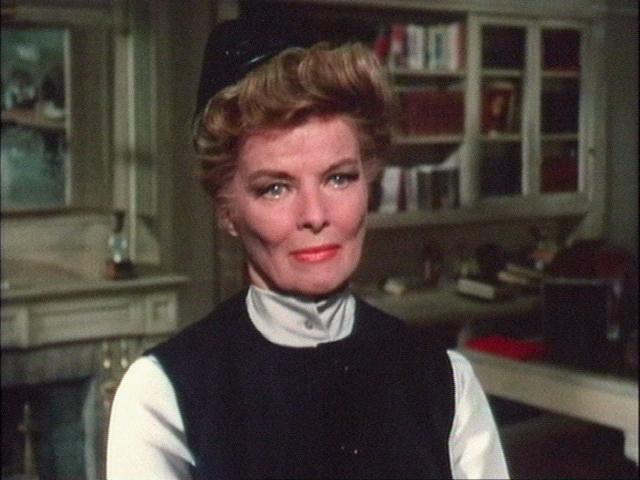
Katharine Hepburn 01This brief look into the life of one of our greatest actresses was written in association with the Biography television program and it has the feel of that breezy show as it reduces a great life into a few cogent points, concentrating instead on the mention of her films and stage appearances.

Hepburn was certainly an enigmatic personality.

Although her birth date remains in doubt to this day, it is reckoned that she was born in either May or November of 1907 in Hartford, Connecticut to Dr. Tom Hepburn and Katharine Houghton (of the Houghton-Mifflin publishing firm and Corning Glass Works).  Her father was a very strong conservative figure, who encouraged his children to take risks, but it was almost impossible to gain his good graces.  Her mother was rather liberal and was involved in the women’s rights movement in America from the earliest stages.  Kate grew up torn in two directions.

Her family had a history of suicides and biographer Holland hints that it may have been due to heredity, although the rigid, emotionless aspects of her father certainly hints at rebellion against convention.

Her older brother Tommy committed suicide while on a trip to New York with Kate, but the whole family glossed over it, almost as if it didn’t happen.  Kate’s family believed that you should never dwell on the past, but always look ahead to the future.  Planning and working were the things that you got you through life and that partly accounts for her optimistic views, healthy lifestyle, and prodigious work right up until her death in 1996.

Katharine Hepburn 02Much is made of her relationships, specifically with director John Ford and actor Spencer Tracy.  Likening each of these men to father figures, the book ponders whether her lifelong obsession with pleasing her father didn’t spill over into her love life.  Both men were married and yet each carried on a 30 year love affair with Kate.  Tracy, it is stated, was the love of her life, but he would not divorce his wife because of his strict Catholic background.  He comes off very badly in this biography, as a bully who ruined Katharine’s career by insisting that she be at his beck and call.  When he went on drinking binges for days at a time, she would wait outside his door and tend to his needs.  Apparently, he did not live with his wife, but spent many years living in a Los Angeles hotel before retiring to guest house on George Cukor’s estate.

Many people may not realize that Katharine Hepburn had an extensive state career and was a failure at stage acting for many years because she always appeared to be so manic.  In middle and late years, she began to act Shakespeare, touring and playing a variety of roles, relaxing in her celebrity and doing very well.  She was a big hit in the Broadway musical Coco, even though she couldn’t sing.

During her career, she won four Academy Awards for Best Actress, even though critics constantly complained that she only played herself.  That is not unusual at all, even now, when most film actors don’t really act.  Since the early days of silent film, audiences have flocked to the theater to see the personalities, not to see them disappear into their characters.  Spencer Tracy did not even want to have any make-up applied at all.  But even though these celebrity actors play themselves, they are still able to carve out excellent performances from the force of their character and Hepburn did that in a great many of her films.

Katharine Hepburn 03She remained a health nut, swimming in icy Long Island Channel into her 80’s, cooking her own food, and staying true to herself.

Her films will certainly remain as classics long into the future.

Friends with Kids

Friends with KidsThis 2011 movie written, produced and directed by Jennifer Westfeldt is about a group of shallow, sex-obsessed Manhattan Yuppies who start having children.  I’m going to discuss the full plot in some detail, so if you don’t want the ending spoiled, you probably shouldn’t read this review.  On the other hand, the story is quite predictable and if you haven’t figured out the entire plot in the first five minutes, then all cylinders aren’t firing anyway.

Jason (Adam Scott) and Julie (Westfeldt), are both well-paid professionals in their mid-30s.  Best friends for many years, they live in the same building in Manhattan and have long telephone conversations usually involving a choice between grisly ways to die.  Julie asks Ben if he’d rather die a long, painful death by cancer or to see a loved one die the same way.  Ben chooses to watch the loved one die because he would still be alive.

They gather regularly with married friends Alex (Chris O’Dowd) and Missy (Kristen Wiig), who are obsessed with having sex, and Ben (Jon Hamm) and Leslie (Maya Rudolph).  Not interested in each other Jason and Julie continually seek their own romantic relationships, the success measured in sexual happiness.  Their friends have children, but they continue to seek permanent mates themselves until one evening they decide to have a child of their own.  Seeing the misery that their friends have experienced, they decide that they can raise a child and still search for their own soul-mates.

While Ben and Leslie manage to make their marriage work, Alex and Missy’s relationship falls apart, further evidence that they’ve made the right decision.  As time passes, Jason becomes involved with a dancer, Mary Jane (Megan Fox), while Julie finds Mr. Right in the form of Kurt (Edward Burns).  When Alex gets drunk at a New Years skiing getaway for the eight of them, he comes down hard on Jason and Julie for not thinking through the effect their decision will have on their child.  Jason strongly defends the decision, declaring how much they love each other and how much they love their little boy.

Taking this to heart, Julie realizes that she really does love Jason more than Kurt.  When they get together to celebrate her birthday, she tells him how she feels, but Jason recoils, explaining that he loves her as a friend and is already in a deep relationship with Mary Jane.  Julie decides to move to Brooklyn to get away from him.  Both of their relationships end and Jason then realizes that he actually loves Julie, too.  It ends with him telling her that he’s changed his mind: he’d rather die himself than to watch her die of cancer.  She is reluctant at first to accept this change of heart, but when he promises great sex, she changes her mind.

There are moments in this movie that ring true and come close to being genuinely touching, but the predictability of the plot makes it very hard to become attached to story.  The characters are genuinely shallow.  Self-obsessed relationship-junkies who have probably never had an original thought in their lives, their elevation of sex to the be-all and end-all of human love comes across as pathetic and self-serving.

Maybe this is the present or the future of American ideals, but I sure hope not.  One can admire Westfeldt for her hard work in doing the project, but I really wish she had taken the time to put some thought into it.  I can’t really recommend this movie to anyone.

The Graduate

Graduate 01“Hello, darkness, my old friend… I’ve come to talk with you again…”

Packed like a factory assembled doll among a throng of passengers, Benjamin Braddock (Dustin Hoffman) sits anonymously on an airplane about to land in Los Angeles.  As “The Sound of Silence” plays, he steps up onto a conveyor belt, his figure black against a white wall, as if he were on an assembly line about to be delivered for final packaging.

A recent graduate of a prestigious east coast college, Ben has no idea what to do with himself, no idea what he wants to do with himself.  He feels lost, adrift.  His parents (William Daniels and Elizabeth Wilson) hold a party to celebrate his graduation, but it is attended only by their wealthy friends, not one person his own age.  Lying in bed, in front of his fish tank, he stares blankly out into the world.  Forced to attend the party, he searches for some escape, but is cornered by a man who has only one word for him: plastics.

Retreating to his room, his privacy is broken by Mrs. Robinson (Anne Bancroft), the wife of his father’s law partner (Murray Hamilton), who nearly forces him to give her a ride home.  Getting him inside on the pretense that she needs the lights on, she fixes him a drink.  Ben figures out that she’s trying to seduce him and attempts to escape, but can’t seem to get away.  Mrs. Robinson then invites him up into the bedroom of her daughter Elaine (Katherine Ross) to see the girl’s portrait.  She is currently away at school attending the University of California-Berkeley.  Mrs. Robinson begins to undress in spite of Ben’s obvious nervousness, but is interrupted by the return of Mr. Robinson.  Ben quickly runs downstairs and sits with his drink when the man comes in the front door.  Mr. Robinson encourages him to date Elaine when she returns to L.A. on a school break.

Graduate 02At her request, Ben calls up Mrs. Robinson and she agrees to meet him at a hotel.  Overcome with nervousness, Ben goes through with his tryst and begins a summer of laziness, lying around in the pool during the day and meeting Mrs. Robinson for sex at night.  Gradually, he begins to want more from their relationship and forces Mrs. Robinson to begin talking about herself.  When the conversation comes around to Elaine, she forbids him to date her.  Ben rebels and they each say hurtful things, but when Mrs. Robinson begins to dress to leave, he apologizes and they continue their sexual meetings.

After Elaine has returned, Ben’s parents force him into dating her, over Mrs. Robinson’s objections.  In order to make it a horrible date, Ben takes Elaine to a strip joint and the stripper on stage twirls her pasties directly over Elaine’s head as silent tears fall from her eyes.  Humiliated, Elaine runs out and Ben follows her, feeling horrible about what he’s done.  He catches her, apologizes profusely, and they go out for burgers.  Whether through guilt or genuine attraction, Ben falls for Elaine and she seems to be falling for him.  He makes another date with her, but when he pulls up at the house, in a rainy downpour, Mrs. Robinson gets into his car instead, once again forbidding him to see Elaine, this time with the threat that she will tell Elaine about their affair.

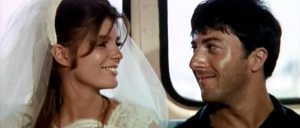
Graduate 03Ben runs back to the house and reveals to Elaine that he has been having an affair with her mother.  Appalled, she throws him out and tells him she never wants to see him again.  Ben watches from a distance as she returns to Berkeley, then he follows her there and finally gets her to admit that she loves him, too.  Mr. Robinson shows up at Ben’s apartment and forbids the relationship, leading Elaine to leave school and marry her boyfriend.  Frantically driving back and forth, Ben finds the church, but he can’t get in.  Running up to the second story, he looks down as the wedding vows are concluded and begins to scream her name.  Seeing the vicious faces of those around her, Elaine screams back Ben’s name.  Using a cross to fight off the angry wedding party, Ben and Elaine escape, getting into the back of a bus and riding away.

The Graduate, released in 1967, still stands today as one of the best films ever made.  The screenplay by Calder Willingham and Buck Henry is based on the 1962 novel of the same name by Charles Webb.  Produced by Lawrence Turman and directed by Mike Nichols, the movie was delayed for several years because they simply could not find the right cast.  Almost every big name in Hollywood was considered for every major role, but no one seemed to fit.

Actresses considered for the role of Elaine included Patty Duke, Faye Dunaway, Sally Field, Shirley MacLaine, Raquel Welch, Joan Collins, Carroll Baker, Candice Bergen, Goldie Hawn, Jane Fonda, Ann-Margret, Elizabeth Ashley, Carol Lynley, Sue Lyon, Yvette Mimieux, Suzanne Pleshette, Lee Remick, Pamela Tiffin, Julie Christie, and Tuesday Weld. 

Robert Osborne of TCM said, “Mike Nichols wanted Doris Day for Mrs. Robinson, Robert Redford for Benjamin Braddock, and Gene Hackman for Mr. Robinson.”

Other actresses considered for Mrs. Robinson included Jeanne Moreau, Joan Crawford, Lauren Bacall, Audrey Hepburn, Patricia Neal, Geraldine Page, Claire Bloom, Angie Dickinson, Sophia Loren, Judy Garland, Rita Hayworth, Susan Hayward, Anouk Aimee, Jennifer Jones, Deborah Kerr, Eva Marie Saint, Rosalind Russell, Simone Signoret, Jean Simmons, Lana Turner, Eleanor Parker, Anne Baxter, Shelley Winters, Angela Lansbury, Natalie Wood, and Ava Gardner.  All were either turned down, refused to appear nude, or were unimpressed with the part.  Anne Bancroft, an accomplished stage and screen actress, wife of director Mel Brooks, took the part even though she was only seven years older than Dustin Hoffman

Graduate 05Hoffman and Ross were both chosen as Ben and Elaine when they tested together.  He was a 29 year old New York actor who was virtually unknown outside the live theater, but Turman brought him to Los Angeles to test.  Even though he was very much against the type they wanted for Ben, Nichols liked him very much and gave him the role.

The Graduate was also Nichols’ first film, although he was very well known from his Broadway successes.  It is surprising that a stage director should create one of the best films ever made in his first effort.  Maybe the long wait while they searched for the right cast gave him the extra time to craft the film into the beauty that it became.  Every single shot is lovingly assembled and extraordinarily powerful.  Hitchcock had mastered the art of framing long before this film was made, but Nichols uses camera angles in an even more powerful way.  The most iconic shot in the film is, of course, the one that shows Ben framed behind Mrs. Robinson’s leg, sheathed in a black stocking, but it is only one of hundreds of nearly perfect shots.

The creative use of dark and light in a color film was nearly unprecedented at the time.  For example, there is a scene early in the seduction when Mrs. Robinson is sitting at the bar in her home and Ben nervously paces back and forth in front of her.  It is shot from behind Ben who appears only as a black silhouette moving with a kind of nervy relentlessness back and forth, revealing Mrs. Robinson sitting with one leg propped on a bar stool, allowing Ben a tantalizing view.

Mirror shots are used to extreme advantage, the most obvious one when Mrs. Robinson takes Ben to Elaine’s room to seduce him.  As he looks at the portrait of Elaine, Mrs. Robinson appears nude in the reflection off of the glass.  Brilliant!  Not only is it a visually stunning image, but it also points up the terrible situation that Ben will be in later when he has to choose between the mother and daughter.

The use of music and sound is also brilliant.  “The Sound of Silence” is such a perfect representation of Ben’s state of mind at the beginning of the movie that the simple image of Ben’s head framed against the aquarium as it plays tells a whole story without any dialogue whatsoever.  The other Paul Simon songs, performed by Simon and Garfunkel, are super appropriate and set the mood wherever they are used.  The song “Mrs. Robinson” was adapted by Paul Simon especially for the film and it went on to become a huge hit.  Quite often Nichols uses silence itself to punctuate that deep, dark mood that Ben brings into the movie, relieving it with the beautiful Paul Simon melodies.

The acting is all superb.  Dustin Hoffman is wonderful as Ben, creating all kinds of great little mannerisms that make him a complete person, not the least of which is the short falsetto “Humpf” that comes out when he is particularly nervous.  Anne Bancroft gives a great performance as Mrs. Robinson, terribly restrained, yet allowing the viewer to see how great her own boredom is and how much her affair with Ben means to her, despite the fact that it is exclusively sexual.  Although Katherine Ross’s part is not huge, she does a great deal with it, especially in the scene where Ben reveals he’s been having an affair with her mother.

In addition, the supporting roles are extremely well done, most especially William Daniels as Mr. Robinson.  The cast list isn’t dense, but there are also a large number of cameo appearances, including Buck Henry, Alice Ghostley, Elaine May, Mike Farrell, and Richard Dreyfuss.

In spite of Ben’s heavy attitude coming into the film, it is really a first rate comedy and also a feel-good movie.  Although it was made in 1967, the comedy isn’t dated at all.  In fact, it could have been made last year and still hold up to scrutiny.  The only real reference to the time it was made was when Ben gets a room in Berkeley, his landlord tells him that he won’t tolerate any “agitators.”  In places, the costumes or hairstyles may give away the time, but they are nearly invisible, unlike many other period movies where they are obvious.  It comes in at under two hours and it doesn’t feel long at all.  In fact, it moves really fast.

The only “error” I found in the movie is that when Ben is driving north to see Elaine in Berkeley, he crosses the Bay Bridge into San Francisco, which he wouldn’t have done without a specific purpose.  It doesn’t really make sense in an otherwise perfectly crafted movie.

All of the parts of this film work so harmoniously that it should stand the test of time going forward in the future.  Many other good films may be made, but I believe that The Graduate will remain one of the best films ever made.  It certainly makes my Top Ten.  Because of the adult situations, I will recommend it for mature viewers.

A brilliant, long-lasting movie with great comedy, great angst, and a feel-good ending!
Graduate 04

P

ricci_penelopePenelope

Penelope is a fun and well-made modern fairy tale. The wealthy Wilhern family has a curse on it.  Generations ago, a Wilhern son fell in love with a servant girl and wanted to marry her, but when the family found out, the engagement was broken.  The poor girl then killed herself, but her mother, a witch created a spell so that the next Wilhern daughter would be born with the face of a pig!


Pretty-in-Pink-Duckie-AndiePretty in Pink

It’s very rare in the realm of popular movies (outside of period pieces) that costumes play a major role, but Marilyn Vance is largely responsible for the success of the 1986 John Hughes script Pretty in Pink.  The third of the “Brat Pack” trilogy of movies, following Sixteen Candles and The Breakfast Club, it closely resembles the first film, Sixteen Candles, and if Hughes had had his way by casting Anthony Michael Hall in the pivotal role of Duckie, it might have been even closer.


Psycho 1Psycho

The line between suspense and horror is blurred anyway, but when director Alfred Hitchcock and screen writer Joseph Stefano adapted master horror writer Robert Bloch’s 1959 novel Psycho for the screen, and composer Bernard Herrmann was brought on board, they changed the horror film genre forever, creating ripples that are still felt by filmmakers today.


O

Ordinary Tim Hutton Elizabeteh McGovernOrdinary People

For those who remember what life was like in 1980, Ordinary People will be a real trip to the past.  For those who are too young to know, this movie will give you a brief tutorial in clothing, hair styles, cars, and so on.  For both types of people, this will be an extraordinary family drama, full of terrific performances, raw and deeply moving.