An Introduction to the Universe of the Academy Novels by Jack McDevitt

Academy IntroIn the realm between hard science fiction and space opera there is a zone where some of the rules of science may be broken very carefully, but the author may still make his or her universe look and feel realistic.

The works of Jack McDevitt certainly belong in that zone and none more squarely than the Academy Novels, which I am about to begin reviewing. The purpose of this introduction is to present a basic understanding of the world that McDevitt has created. For those who have not yet read the novels, it will serve to set up the reading. For those who have already read the series, it will be a refresher to make the reviews easier to follow. As for the reviews themselves, I will be assuming that the reader has already finished reading the novels, so there will be spoilers. Not so for this introduction.

The Academy Novels officially begin on the date of February 12, 2197, which is where the Prologue to The Engines of God (1994) kicks the series off. The other novels in this series include Deepsix (2001), Chindi (2002), Omega (2003), Odyssey, (2006) and Cauldron (2007).  The conclusion takes place in the year 2255.

At this time in future history, governments have consolidated in order to control the gradual, but sure, devastation of Earth.  Although there is a governing World Council, it is made up of political entities that were previously two or more countries.  The North American Union (NAU), for example is made up of the United States and Canada.  However, between overpopulation, drought, economic ennui, degrading weather patterns, religious strife and global warming, death has become so commonplace that no one thinks twice about a few million dying in India due to a grain shortage.  Melting of the polar ice caps has raised shorelines around the world, so the people have had to re-engineer their cities to go on.  The wealthy and those who cultivate professions that are in demand still do quite well.  There are expensive restaurants, dinner parties and diverse live entertainment.  The poor are generally never seen.

What McDevitt has done in his future history is to show that no matter how bad things get, most of the population will continue to go on as if nothing was wrong.  He has taken this attitude directly from the present situation on Earth and extrapolated on it.  We are at this moment presiding over the initial stages of Earth’s deterioration: the world economy fluctuates dramatically with widespread unemployment and collapsing markets, the earth is suffering from multiple natural disasters, we continue to depend on fossil fuels and, yes, we are pretty much ignoring global warming. Yet, if you turn on a television today, you would think that we were at the height of prosperity with no problems in the world. 

Media plays a large part in these novels.  McDevitt drops in news headlines throughout the Academy Novels and the news is both devastating and understated.  No matter what happens, life goes on and we all pretend that everything is okay.  In fact, as long is everything is okay for me, then it is okay for everyone.

One criticism that McDevitt receives quite often is that his characters are shallow and two-dimensional.  Although I would not argue that point in general, I believe the characters in the Academy Novels are that way on purpose.  They fit in with his extrapolation of the present into the future.  Although everyone today tries to look on the bright, happy side of existence, the truth is that most people are terribly mundane.  We are gradually becoming a society of specialists, of people who concentrate on their own little niche.  Very few people are well rounded intellectually and most of them are not intellectual at all.  Most people today – and in McDevitt’s future – are shallow and self-involved.  We tend to feed off of tawdry news events, social gossip, games, images and social interaction aimed at our own personal well-being.

In the Academy, most of the scientists, academics, engineers and technicians are specialists who burrow into their own little worlds, so caught up in their own careers and specialties that most of them have no life outside of their areas of expertise.  And within those areas, most are concerned with their own ego more than they are with actual technological development.

The politicians are pragmatists who flow with the general tide.  They don’t think for themselves.  Instead, they take polls and roll with whatever will keep them in power.  When the Greens finally become a political powerhouse, they are just like the Democrats and Republicans of today.  They do not listen to others, they do not think things through and make rational decisions.  Instead, they push their agenda unconscionably regardless of any evidence to the contrary.

I think that this approach to future history by McDevitt is very smart indeed and it is something that we all can see and understand just by looking around us. He isn’t really introducing any new conflicts here, but he has extrapolated fiercely on what is and that realism sticks in your brain. Issues that we debate at this moment are still being debated nearly 200 years in the future and people and attitudes haven’t changed. It is both deeply chilling and bizarrely reassuring at once.

Throughout the novels, news organizations play a big role and McDevitt again has extrapolated from our present to our future.  Most of the reporters are plainly superficial; they are suave, beautiful manikins, who play up whatever appears to be an emotional event and they mostly ignore more difficult, in-depth stories.  Man jumps off building.  Congressman caught in love tryst: details at eleven.  Like scientists and entertainers, reporters are more concerned with their own future than they are with the news.

The exception to this is the magazine, The National, whose editor, Gregory MacAllister, delights in attacking pompous airheads.  He is definitely similar to the curmudgeonly journalist H. L. Mencken of the Twentieth Century.  Although, in many ways, he is dislikeable (for example, he is an outspoken chauvinist and he distrusts religious leaders on the grounds that they have become more important than God), he also provides one of the deeper characters in the series.  He is capable of listening, analyzing problems and changing his mind.  At his best, he truly does reach for the underlying truth of existence.  This level of complexity sets him well apart from others.

Technologically, some big changes take place during the next 200 years.

Of course, the big thing – and the first thing that really takes the Academy Novels outside the realm of hard science fiction – is the development of faster than light space travel (FTL).  At a time when space exploration was believed to be dead, scientist Ginjer Hazeltine developed a theory of transdimensional transit.  Once a drive unit was perfected, it was named the Hazeltine Drive.  This is a rather murky theory, but most science fiction that crosses the threshold into space opera depends on some mechanism or other to allow transit across many light years in a short period of time.  If you don’t worry about the details, you will be fine. 

The Academy, by the way, is the space exploration arm of the NAU, controlling all official flights throughout the galaxy.  Eventually, of course, private companies contract to have their own vessels built.  Kosmik, Inc., for example, is involved in the business of terraforming.  Orion Tours allows the extremely wealthy to go site seeing.  And the media have their own vessels so that they can rush to the scene of any intergalactic hanky panky.

Since development of the Hazeltine Drive, the Academy has been looking through the Orion Arm of our galaxy (our immediate neighborhood) for two things: planets with an Earth-like biosphere that would be good for colonization and alien life. 

Several planets have been found that meet the first criteria, some with only single-celled life, some with much higher, non-intelligent life, but most simply sterile.  One planet has been found that possesses intelligent life: Inokademeri.  But the inhabitants, referred to as Noks, have not developed technologically past where humans were at in World War I.  Due to their innate intolerance, they are constantly at war; they have used up most of their natural resources and are considered (in MacAllister’s words) “idiots”.  It is so bad on Nok that scientists are not permitted interaction with the locals.  A few of the planets capable of supporting human life have actually been colonized, one by religious zealots and the other by political malcontents.  Both colonies are failing.

And although humans most deeply desire to find another intelligent species, one that is technologically mature, they haven’t had much luck.  In fact, mostly what they have found is archeological treasures: races that evolved a complex society and then (for one reason or another) died off.  These discoveries – and others that will be discussed later – become a major plot element in several of the novels.

The other breakthroughs that keep the Academy Novels firmly outside the realm of hard science fiction are anti-gravity devices, artificial gravity and Flickinger fields.

Anti-gravity is used for a number of functions.  There are vehicles that skim through the sky, depositing their passengers on special landing pads.  (Apparently ground transportation has all but disappeared.)  There is also the “spike” which is used to lift vehicles beyond a planet’s gravity well.  And anti-gravity comes in really handy if you have to move anything that is large, massive or unwieldy.

Artificial gravity is, of course, used to keep people upright and functioning in a zero gravity environment, such as a space ship.

And the Flickinger Field is a kind of personal force field made of energy that molds itself to the human body.  When connected with air tanks, these fields act like a space suit, protecting the wearer from harsh environments.  They do have two problems: they are not impermeable (leaving them open to breaching) and they have a hard shell that forms over the face so that the wearer can breathe.  Rest assured that these problems will be exploited by McDevitt.

Two of the best technological advances are easily within our grasp.

Artificial Intelligence has become a booming business in the Academy Novels.  An AI runs every household; it serves as friend, cook, butler, maid, alarm and communications system.  It’s like having a Google you can chat with.  In addition, all complex operations are now exclusively handled by AIs and they even serve as back-up systems for pilots of space ships.

What’s really neat is that AIs can also appear as holograms.  The common AI system on every Academy vessel is named Bill and he interacts with every captain in a unique individual way, projecting different images of “himself” throughout the ship.  Contrary to the official line, AIs do have a sense of humor.

The disappearance of television isn’t spectacular because it is replaced (as is actually happening now) by the net and by 3D interactive entertainment known as Sims.  The Net is huge, but as we see now in television, there are a few “channels” that rise to the top.  In this way, there is a common experience, much the way we have now with the major broadcast networks.  Some programs and personalities always rise to the top.  And the desire for common entertainment experience will always funnel viewers in specific directions.

The Sims are like watching a movie that takes place around you, but you can also program your image and voice to appear as one of the characters.  If you have a number of people doing this, it is apparently quite a bit of fun.

The protagonist of the Academy Novels is a pilot named Priscilla Hutchins (everyone calls her Hutch), a diminutive, black-haired beauty imbued with her own particular hang-ups and fears. She is tied to the Academy pretty much throughout the series, but in the beginning she mostly works with the archeologists.  In fact, it is her association with one of the most prestigious of these, Dr. Richard Wald, which leads to the beginning of The Engines of God.

Hutch lives in Arlington, VA, just outside of what remains of Washington, DC. With all of the coastal flooding that continues as a result of polar ice melting, the former capital of the United States is now partly underwater, with the rest bolstered by levees so that the buildings may remain as tourist attractions.

She is one of those people matched perfectly with her job.  In the first few novels, one can feel the excitement of space exploration through her eyes: the awe of discovery, the wonderful little social groups that form during a long flight, and the vastness of the universe.  Hutch is smart and sexy, she has a grip on reality that others could benefit from touching.  She is heroic, but not for the reasons that others behave heroically.  She is immensely likeable, a terrific character to carry a series through six novels.

But the time she spends on Earth is pained.  Her mother wants grandchildren and a stable relationship for her daughter. Hutch herself would like some stability, but her long absence hampers this ambition. The men who are interested in her simply cannot tolerate the absences, so Hutch remains frustrated on that level. However, her relationship with academics and archeologists is most stimulating – the time that they spend traveling between systems (normally a few months) is really the basis of her social life. She is both intelligent enough to hold her own with them, so whether they are just playing games, running sims or engaged in arcane discussions, she gains a great deal emotionally from the trips.

The most fascinating and puzzling discovery by the archeologists is the existence of gigantic sculptures scattered here and there along the rim. Perhaps the most fascinating is an alien’s self-portrait left on the snow-covered surface of Iapetus, the third largest of Saturn’s moons. That these aliens, referred to as “the Monument Makers” (for lack of a better term), actually visited the solar system some 24,000 years ago is a source of amazement to archeologists.  Most of the sculptures are cubes or rectangles – shapes with straight lines and right angles – but the one on Iapetus is clearly a self-portrait.

It is at this point, on February 12, 2197, that The Engines of God begins. Hutch has piloted Dr. Wald to view the Iapetus sculpture and the opening words of the novel paint a chilling picture:

“The thing was carved of ice and rock. It stood serenely on that bleak, snow covered plain, a nightmare figure of gently curving claws, surreal eyes and lean fluidity. The lips were parted, rounded, almost sexual… stamped on its icy features was a look she could only have described as philosophical ferocity.”


The Horse Whisperer by Nicholas Evans

TheHorseWhispererBookSPOILER ALERT: Details of the novel are revealed in this review.

First, I saw the film before I read the book, so that has prejudiced my reaction somewhat.

This is the story of a family that has been fractured by a monumental accident. Grace Maclean is a twelve year old girl, the daughter of very wealthy New Yorkers.  Her father, Robert is a lawyer and her mother Annie is a magazine editor, an English woman.

Grace’s embrace of life is fullsome and the reader is drawn to her immediately.  Robert Maclean is also an extremely sympathetic character.  Annie, however is a driven woman. After taking over at the magazine, she has instituted a “bloodletting” by firing old staffers and has alienated not only those she works with, but her husband and daughter as well.

The first unfortunate decision Nicholas Evans made was to feature the most despicable character in the book and set her up as the centerpiece of the action.

But the book still begins with tremendous promise.  The writing is excellent, the descriptions so precise as to engender the feeling that one is living in the moments and places he creates.  Grace is riding her horse, Pilgrim, with her friend Judith at the country estate that the Macleans own.  Her father has come down from New York with her, while Annie works away in the Big Apple.  On an icy road, the horses panic as a tractor trailer advances on them, skidding on the ice itself.  Grace is thrown off as her horse Pilgrim turns to face the oncoming semi and literally leaps at it trying to protect her rider.

Judith and her horse are both killed, Pilgrim is severely wounded and Grace’s leg is mangled so severely that it must be amputated.  There is severe psychological trauma for both Grace and Pilgrim.  The horse is crazed and completely uncontrollable.  While Robert reacts in much the way one would expect a parent to, Annie controls her emotions completely, but becomes obsessed with finding a cure for Pilgrim.

That cure comes in the form of Tom Booker, a cowboy and rancher in Montana who is a “horse whisperer”.  He has the ability to calm and cure horses with psychological problems.  At first, he refuses to work with Pilgrim.  Annie’s persistence, which includes driving her daughter and the horse to Montana, finally pays off once Tom meets Grace and sees that the problem runs deeper than just an injured horse.  He takes on Pilgrim as a project and Annie and Grace move to the spare house at the ranch so that Grace can work with Tom as he slowly brings Pilgrim back to life.

At this point, the story has been told so expertly that a reader cannot disengage no matter what.  The story has been wonderfully drawn as the tale of a family that has fallen apart, a girl and horse painfully and perhaps permanently wounded and the calm man who can supply the solutions to cure them all.

Unfortunately, it is also at the point that Evans strays from his story and inserts a romance that has no business being in this book.  By having Annie fall for Tom, the reader comes to vilify her and see her as the selfish, arrogant bitch that she apparently is.  Further, the character of Tom, initially so strong and admirable, becomes a parody — the cowboy who can’t help falling in love with city women.  Why on earth this calm and centered human being could fall in love with one of the most unlikable characters ever written is a complete mystery that has no answer, except that it adds a level of melodrama that brings the book to a complete halt.  Maybe it wouldn’t have been so bad if it had merely been a flirtation that Tom turned his back on (in order to work on the horse, which is what the story is really about), but Evans does not stop when given the chance.  He creates a little vacation for Tom’s ranch family — to Disneyland of all places — so that Tom can spend a week having sex with Annie.

At this point, the story has become thoroughly disgusting and all of the promise has permanently departed.  After the week of sex, Grace finds out, of course, and takes Pilgrim out on some kind of crazy ride.  It says a great deal that the reader finds their own disgust reflected in Grace.  In rescuing Grace, Tom allows himself to get killed.  Now, what’s going on with that is also a complete mystery.

Lost in this tawdry little subplot is the final cure of Pilgrim, which should have been built correctly so that it provided the denouement of the story that Evans so carefully set up during most of the book.  It becomes almost a little side show as Tom and Annie wallow in lust and self-pity.

I guess the bottom line is that every author should have an editor with a steady hand who can say, “Stop — you’re going in the wrong direction.”  But with the state of publishing any more, it may even have been an editor who said, “You need some romance in this book.”

It’s a great pity to see a story with so much promise flushed down the drain.

Mansfield Park by Jane Austen

Mansfield-ParkThe review contains a synopsis with some spoilers.

Jane Austen’s third novel deviates from the first two books quite dramatically, not only in the nature of her heroine, but also in her domestic position.

The novel deals principally with the progeny of three sisters. Mrs. Bertram has married into wealth and position. As the wife of Sir Thomas Bertram, she is mistress of Mansfield Park, a large country estate in Northamptonshire. They have four children, Tom, Edmund, Maria, and Julia. Her sister, Mrs. Norris, marries into the clergy and her husband is resident in the Mansfield parsonage.

They have no children. The third sister, Mrs. Price, marries into the lower middle class and lives on the verge of poverty in Portsmouth with her husband, a former navy man. She has nine living children (and one deceased), the chief of which are William, the eldest, Fanny, the next eldest, and a younger sister, Susan.

As the novel opens, Mrs. Norris has conferred with the Bertrams about bringing one of their sister’s children from Portsmouth to live with them and it is decided that the eldest girl, Fanny, should be the one. She arrives as a slight, uneducated girl of ten, and is installed in an attic bedroom. From the very beginning, she is told that she is always to be inferior to Mrs. Bertam’s four children and Mrs. Norris takes great pains to make sure that she never forgets it. Although she becomes dedicated to helping the sickly Mrs. Bertram, she lives in fear of Sir Thomas, who seems very great to her indeed. Among the other children, only Edmund befriends her. He becomes her advocate and remains so throughout the novel.

The children grow up through their teen years and a pecking order is established. Tom, as the eldest son, is destined to inherit Mansfield Park and he lives his life in carefree abandon, gambling, traveling to London, and acquiring debts. Edmund is the more level-headed of the two, but he is destined to become a clergyman. The two Bertram girls grow up as privileged belles, and Fanny continues timid, shy, and very serious. Through Edmund’s efforts, she has been very well-educated, is a devout reader, and is constantly at needlework, but she never develops the habits of wealthy young ladies, such music or drawing.

Facing problems with his West Indies company, Sir Thomas sails to Antigua to set everything right. Maria eventually manages to secure a proposal of marriage from a local lordling, Mr. Rushworth, with assistance from Mrs. Norris. When Mr. Norris dies, Mrs. Norris moves into a smaller house. She is still present at Mansfield Park every day, organizing the household and the children, but the parsonage is now occupied by Dr. and Mrs. Grant. When family problems force Mrs. Grant’s half brother and sister, Henry and Mary Crawford, into an extended visit at the parsonage, the two young urbanites become good friends with the Bertram children.

Against Edmund’s advice and Fanny’s strong disapproval, the young people decide to do a play for their own amusement. During the course of rehearsals, a lot of flirtation goes on. Henry Crawford is charming both Bertram girls, in spite of Maria’s engagement, while Mary Crawford takes a liking to Edmund. To create the theater, they appropriate Sir Thomas’ office and billiard room, but their plans go awry when Sir Thomas returns unexpectedly and puts an end to it. Maria marries Mr. Rushworth and they take Julia with them away to Brighton.

From that point on, everything goes downhill. Although Fanny very much disapproves of the Crawfords for a variety of moral and ethical reasons, Henry begins to court her, while Mary attempts to become her best friend. Fanny is astounded when Henry proposes to her. She goes into full retreat as she is pestered by everyone to agree to the marriage. She stoutly refuses and is eventually sent back to Portsmouth for two months so that she can see what her life would have been like without Mansfield Park to give her gentility. It is quite a shock to her, but she maintains her belief regarding the Crawfords and is eventually proved right.

Fanny Price is one of deepest and most well-constructed characters in all literature. Although she is timid to a fault, she learns everything that Mansfield Park can teach her and it all becomes a rock-solid part of her character. Once she has been molded, she becomes inalterable in her essence. Having seen first-hand what the Crawfords are, she does not deviate in her opinion of them, even when all around her would be duped. Even Edmund, steady as he is, becomes drawn to Mary Crawford, and Fanny grieves for him and wishes him to see the truth. When Sir Thomas approaches her with Henry Crawford’s proposal, she refuses to give in and stands up to him. Her personal feelings are always kept inside and she leaves others to discover truth for themselves. The few times during the novel when she becomes overwhelmed with events and breaks down, it seems truly catastrophic and creates deeply moving passages of writing.

In many ways, Mansfield Park is superior to Pride and Prejudice, which is her acknowledged masterpiece. The biggest downfall to the novel is the conclusion, which Ms. Austen writes first person, author to reader, summarizing how everything falls out, rather than creating scenes which depict this action. Otherwise, it is first rate all the way.

Starters by Lissa Price

Starters cover with borderThis is a good Young Adult Dystopian Science Fiction novel that could have been much better. The premise isn’t really good, but it doesn’t completely suck, either. At some time in the near future, friction between the United States and Pacific Rim countries reaches such a level that the PR countries develop a bomb that kills everyone between about 20 and 60.  The young survivors are called Starters and the older people are called Enders.  Unless children come from a wealthy family where grandparents can take care of them, they are pretty much left to survive on the streets.  Such is the case of teenager Callie, who tries to take care of a sick younger brother as they squat wherever they can.

There is one way out of this dilemma and that is to go to a Body Bank, an institution run by Enders that allows other Enders to rent a young body for 30 days.  A device in implanted in the young person’s brain to receive signals from the older person’s brain so that they can walk around in the body. It gives these rich old people a chance to experience youth all over again, while it gives the young people the money necessary to get off the street.

Callie rents her body to Bank, but suddenly wakes up as herself, with her renter as a voice in her head.  The renter lets her know that there is something seriously wrong with the Body Bank and that the owner is trying to change the laws to favor the Bank by using a Senator.  Her goal had been to assassinate the senator and expose the Bank.  Although Callie fights against this initially, she becomes friends with the Senator’s grandson and discovers that the Body Bank has plans to not just rent young bodies any more, but to sell them without the Starter’s permission.

Although the story is okay, it becomes a bit predictable after a while.  The book probably should have been in development with an editor for considerably longer.  Although told in First Person, it is told in Past Tense and could have benefited from going to Present Tense, as all of the other successful YA Dystopian novels have done.

It’s entertaining, a quick read, and has spawned a sequel called Enders.

Little Women by Luisa May Alcott

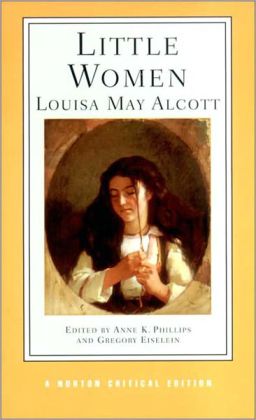
Little Women Norton Critical EditionThis review contains spoilers.

I read this classic American novel, first published in 1868, in the Norton Critical Edition, edited by Anne K. Phillips and Gregory Eiselein.  In addition to the original text, published with very few corrections, the volume also contains a timeline, excerpts from Alcott’s journal, copies of letters with her first publisher, excerpts from texts cited in the manuscript (such as Bunyan’s Pilgrim’s Progress) and other writings by Alcott that relate to the book, including some of the juvenile plays that the Alcott sisters performed.

The original version, it should be noted, underwent significant revision in 1880 to “modernize” the text, so this original version is much closer to what Alcott intended when she wrote the book.

The story concerns the four March sisters, Meg, Jo, Beth, and Amy, their family, including their mother (Marmee), father, Aunt March, their neighbors, Mr. Laurence and his grandson, Teddy (Laurie), as well as various men involved in their lives, but the book is concentrated in the person of Jo, the second daughter, who is fifteen when the novel opens.

Their father has just gone off to Union Army to serve as a pastor in the Civil War after a reversal of fortune has left them in some degree of poverty.  Living in a small town just outside of Boston, the girls still give time to the local poor, help keep house, and perform various plays that Jo writes.  They have their own little “Pickwick Club” that published a small paper that they all contribute to and they play the parts of men from the Dickens classic.

Noticing that the neighbor boy must spend much time alone toiling with his tutor, John Brooke, Jo decides to make friends with him.  Laurie becomes friends with all four girls and they induct him as a member in the Pickwick Club.  As time passes, their father returns home, Meg and John Brooke become a couple and eventually marry, and Laurie goes off to college.  Upon his return, he proposes to Jo, but she tells him that she only likes him as a friend.  Aunt March takes Amy off with her to Europe and also goes there to get over his rejection.  Jo moves to New York City and begins her life as a writer, meeting Professor Bhaer, a German man looking over his two nephews in the boarding house where Jo serves as governess.  Writing sensational stories for the newspaper, Jo finds herself upbraided by the Professor for writing vulgar tales and gives up writing altogether.  At home, the always weak Beth, due to an earlier bout with scarlet fever, falls very ill and Jo returns to nurse her.

In Europe, Laurie courts the now womanly Beth and wins her heart.  When Beth dies and Aunt March decides to stay in Europe, Laurie weds Beth so that they return to the family, but Beth dies before they can make it back.  Aunt March also eventually dies, leaving her estate to Jo who married Bhaer and starts a school for boys in the old house, eventually having two boys of her own.  Laurie and Amy have a girl, whom they name Beth, after the deceased sister.

Although there are a number of issues with the book, there are parts of it that still remain among some of the best written American prose ever.

There are a number of issues, especially to a modern reader.  The purpose of the novel was to serve as an instruction guide to adolescent girls in how to live their lives, so it carries a heavy moral burden.  Girls must not only love and support their parents wholeheartedly, but they must have a regular devotion to the Christian god.  Indeed, page after page harps on these points over and over.  All this preaching really gets in the way of the story that’s being told.  The author frequently steps from behind her wall and speaks directly to the reader, telling us how she feels about the story, how the girls should behave, and so on.

Beyond that, the story has a few issues of its own.  Alcott spends a great deal of time setting up Jo’s relationship with Laurie so that the reader expects it work out and it is quite a letdown when it doesn’t.  They seem perfect for each other.  Then, Jo’s relationship with Professor Bhaer seems really forced.  He reveals himself to be a very shallow, narrow-minded man.  When his actions result in Jo giving up writing, I really lost respect for her.  That is a serious issue in a book where she is the protagonist.  I believe the issue is compounded by her falling in love with him.

I don’t think that I’m the only one to see this.  The movies adapted from the book have all changed not just the character of Professor Bhaer to make him more likable, they’ve actually changed the plot so that Jo continues to write.  In the book, he is 40 years old and she is 19.  I personally have no objection to the age difference and the people of that time had no objection to it, but I think that today’s audience might have some qualms.  The movies almost all picture him as younger.

In spite of these various drawbacks, the scene where Jo rejects Laurie must be among the best ever written. It is heart-wrenching.  Likewise, the love and care of the four girls for each other is so endearing that it literally makes the book successful on its own.  Although Alcott seems self-deprecating about the poetry in book, I found it to be extremely well-written and a strong hit to the heart.  Although I admit that I am prone to my Irish sentimentality, I am also quick to reject overt sentimentality and I found myself tearing up many times during the reading.

So, problems and all, I have to admit this is an amazing and wonderful book that everyone who is interested in American literature must read.  If you are lucky, you will find that place in your heart that it is willing and waiting to touch.

Inherent Vice by Thomas Pynchon

inherent viceI am not a huge fan of Thomas Pynchon, but I have a friend who is quite devoted.  Prior to this book, I had only read Gravity’s Rainbow.  I enjoyed it quite a bit, but was not motivated to read other books by Pynchon.  However, earlier this year, my friend loaned me his copy of Inherent Vice, explaining that it was like Raymond Chandler on acid and I couldn’t resist giving it a try.  Later, reading the review from The New Yorker, which extensively quotes Raymond Chandler’s essay “The Simple Art of Murder”, I came to understand how much my friend’s explanation made sense.

Others may dwell on the plot, but I would prefer to allow readers walk into it a little blind, so that the book may be a treat. What impressed me the most was the style of writing.  This is a comedy–and for me it was a laugh-out-loud comedy.  In terms of style, I thought Inherent Vice more closely resembled what you would get if you attempted to take some Zap Comix and novelize them.  Yes, Doc Sportello is a private eye, but he is a gumshoe who is permanently stoned.  His adventures involve characters who appear to be permanently tripping.  The “serious” characters are actually full-blown cartoons.  When a house full of surfer band hangers-on turn into zombies and chase Doc and his friends in the Woody from Hell, you can’t tell if it is really happening or if Doc is just tripping, but it is a hilarious sequence.

The book captures the Southern California of the early 1970’s very accurately, populating it with a hilarious beach crowd, throwing in bimbos, policemen on steroids, surfers, lawyers, real estate developers and gonzo bums.  The book could have very easily been a collaboration with R. Crumb.

If you read this book and understand it as a comedy and I think that you will completely enjoy it.

Go Ask Alice by Beatrice Sparks

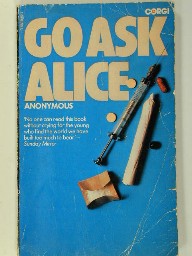
Originally published in 1971 as a scare book for teenagers, Go Ask Alice was pushed on the public as a real diary of a troubled teenage girl sometime between 1968 and 1971, the author listed as “Anonymous.”  The book is the “Reefer Madness” of literature, not only because of the gross exaggerations concerning various drugs, but because the character of the teenage girl rings about as false as a character possibly can.go-ask-alice

The failures of this novel are so deep and profound, it’s hard to tell where to begin.  Many plot points are dropped in for no other purpose than to shock the audience and with total disregard for reality.  I know of only one person in my life who got stoned on pot and had visions and that person was a certifiable psychotic.  That this girl has one hit and goes off the deep end is truly outside the scope of reality.  She seems just completely ditzy, one minute all “Daddy, I love you” and the next minute all “Fuck everything I want to kill myself.”

This leads to situations where one minute she’s completely committed to being clean and then she has one speed tab and goes on a bender where she runs away from home and lives on the streets for months.  What?

There are a few pages in the book that ring true, but any parent who gave this book to their kid as a way to try to steer them clear of drugs has been misled by literature.  It will provoke laughter because it is so unbelievable.

Maybe the most disappointing thing about the book is that as the diary draws to a close, we see this girl finally getting her life together. She has a boyfriend, girlfriends, good grades, and great prospects for the future.  The diary ends on a very positive note.  Then, suddenly, the author comes on board with an Epilogue that tells us, “The subject of this book died three weeks after her decision not to keep another diary.” 

WHAT?

HOW?  “Her parents came home from a movie and found her dead.  They called the police and the hospital, but there was nothing anyone could do.”  This makes no sense at all.  It just comes out of the blue and there is no motivation, no build-up, nothing.

WHY?  “Was it an accidental overdose?  A premeditated overdose?  No one knows, and in some ways that question isn’t important.”  WHYEVER NOT???  “What must be of concern is that she died, and that she was only one of thousands of drug deaths that year.”  This makes no sense at all and it is a complete evasion of the most important question in any book.  Why?

What a letdown.  Can’t you at least tell me how a girl who was clean and straight and completely dedicated to the beautiful new life ahead of her does something like that?  It’s insane.

Kids—don’t  ever write like this!  Maybe the book—now considered a classic of Young Adult literature—should be brought up in English class as an example of how NOT to write Young Adult literature.

Stoner & Spaz by Ron Koertge

Stoner and Spaz Book CoverAlthough classified as a breakthrough novel in the Young Adult genre, Stoner & Spaz–like all good novels–can be read and enjoyed by anyone.

It’s a short book, very lean and very well-written.  Maybe my own experience with cutting a large novel down to size has colored my point of view, but I have grown to really appreciate storytelling that gets right to the heart of the subject.  The characters are bold, the Southern California landscape spare, and the theme explored relentlessly.

Told from the point of view of sixteen-year-old Ben Bancroft, a survivor of Cerebral Palsy, it relates his experiences with Colleen Minou, a stoner girl at his high school.  Ben is a true nerd, a cinephile who lives through his experiences with movies.  He has seen so many that he understands the form intimately.  He knows why tracking shots are used, how black and white enhances certain movies, why characters act the way they do, and he deeply wishes he could live his own life as if he was one of those powerful, charismatic characters.  But he doesn’t.  Instead, he feels the weight of that half of his body that is completely unresponsive.  He stays away from the other kids, lost in his own little world.

That changes one night at the Rialto Theater when Colleen asks to borrow a couple of dollars because they won’t change the hundred dollar bill in her hand.  To his surprise, she tracks him down in the theater and sits with him.  Although he’s mortified, he’s also a little turned on, especially when she falls asleep with her head on his shoulder.

Thus begins an unlikely relationship that turns Ben completely around–and opens him up to the possibilities of his own life.

There are several great things about the book.  One, obviously, is the interaction of two kids who are complete opposites, each discovering the other’s world and opening themselves to change.  But secondly, and most important, is Ben’s character arc.  For me, the best stories involve a character that must go through dramatic changes in order to realize his or her potential.  And the more barren the character at the beginning, the deeper and wider the potential for change.  By using an introverted character with Cerebral Palsy, Koertge begins in a pretty deep chasm.  To deflect potential darkness, he gives the character a quirky, smart, self-deprecating sense of humor.

The leanness of the book also works to advantage in that it could be a movie itself.  Think how some movies fail because a director is in love with long, tracking shots, mood shots, unnecessary character background, and long scenes.  Successful films are edited down to what matters–all of the unimportant stuff lays on the cutting room floor, rather than padding out a 90 minute film into a two hour bore.

Stoner & Spaz is a wonderful little novel, something that all writers should read and something that will entertain and enlighten every one who reads it.  Highly recommend!

The Collector by John Fowles

The CollectorIn his debut novel in 1963, John Fowles created a classic that will long endure as the best fiction kidnapping ever.  An entire genre has sprung up around the idea of men capturing young women, usually to torture or rape them, certainly keeping them prisoners over a long period of time.  Although the kidnapper usually brings in his own scars, the situation inevitably creates even deeper scars in the poor feminine victim.

Fowles, in the quintessential kidnapping story, disdains both torture and rape by creating a villain who goes far out of his way to ensure the comfort of his victim—and far from raping or torturing, he loves her so much that all he requires is her company.  In fact, the idea of physical intimacy is abhorrent to him.  What he doesn’t realize is that keeping her in a basement with no fresh air or sunshine, with no company, with no radio or television is itself a psychological torture.

The relationship between the abductor and the victim attains an amazing intimacy and poignancy in The Collector that is surprising and shocking, especially for 1963.  And when the victim decides to give the abductor what she thinks he wants—physical intimacy—it catapults the situation from something that was within her control (reasonably) into something far more dangerous that she ever anticipated.

The first part of the novel is told from the point of view of the abductor, Frederick Clegg.  By giving us the voice of this man who sounds oh-so-reasonable, Fowles puts us in the conductor’s chair and we see his loneliness, his inability to relate, his petty hatreds and distrust of society in tones so cool and controlled that we understand what he’s doing and why (not that we ever agree with it, but he does gain our sympathy somewhat, the poor fellow.)

The second part of the book is related in a diary that Miranda Grey, the victim, keeps under the mattress in her tiny cell in the basement of Clegg’s country home outside London.  This is the part of the book that digs deep into the soul.  We experience day after day Miranda’s fears and hopes, her delicate dance with Clegg to attempt escape, to keep her humanity in the face of what she must do to get out.  We see her gradually fall in love with the life that is now completely denied her and we understand her plans and schemes to save it.

Emotionally, the novel is a rollercoaster, a tour-de-force that is nearly impossible to put down.  After over 50 years, it still packs a gigantic punch that’s impossible to escape.  It’s a novel that should take its place as a classic.  A MUST-READ!