Wallander


?????????????????????????This BBC mystery series is actually a chain of films based on the novels by Swedish writer Henning Mankell featuring Ystad police detective Kurt Wallander, a middle aged man coping with the deterioration of Sweden’s utopian ideals as the country wades into the 21st Century.  The Wallander novels have attained a world-wide popularity based as much on the character’s accessibility as the gripping nature of the crimes he solves.

Although many of the novels had already been adapted into Swedish films, in 2006 Mankell formed a production company called Yellow Bird for the express purpose of bringing the novels to the English speaking part of the world.  Producers Anne Mensah of BBC Scotland and Andy Harries and Francis Hopkinson of Left Bank Pictures were brought in to shepherd the project.  Although many distinguished British actors were considered for the series, Kenneth Branagh was a fan of the books and directly interceded the process.  He met with Mankell at an Ingmar Bergman film festival and literally talked the author into hiring him to play the role.  Various locations were considered for the movie including Scotland and the state of Maine in the United States, but the importance of the country the books were set in, Sweden, ultimately won out.  The country is so important that it is like a co-starring character.

The first three books to be filmed were Sidetracked, Firewall, and One Step Behind, although eventually the other novels would also be filmed.  This article deals exclusively with the first three movies.

Sidetracked introduces us to the character of Kurt Wallander by immediately dousing us in the beauty of a Swedish field abloom with rapeseed (a bright-yellow flowering member of the mustard family–see the photo) that dominates the camera.  Wallender has been called in because a young woman is hiding in the field.  He tries to approach her, declaring himself as a policeman, but she pours a can of gas over herself and sets herself afire.  Wallander is appalled and perplexed.  “What’s our country coming to,” he asks, “when fifteen year old girls set themselves on fire?”  In this first movie we discover that he is recently separated from his wife and that his grown daughter Linda (Jeany Spark) who is deeply concerned about his lifestyle, especially his hideous eating habits and his devotion to his job that frequently leaves him burned out and exhausted.  He has a very difficult relationship with his father (David Warner), but Linda eventually brings them back together and Kurt discovers that his father now has Alzheimer’s.  We also meet Wallander’s co-workers, most of whom are as devoted their work as he is.  Anne-Britt Hoglund (Sarah Smart) works most closely with him, but the group of detectives also includes Kalle Svedberg (Tom Beard) and Magnus Martinsson (Tom Hiddleston)  His investigation of the self-immolation eventually leads to a former police executive who is running a forced prostitution ring, supplying young girls, many foreign, to provide as virgins to wealthy businessmen.

Firewall begins with the murder of a cab driver by two young women who calmly turn themselves in and then wallow in a fatalist state that reveals nothing of why they did it.  In this movie, Linda sets up her father to participate in an internet dating site and he eventually dates the first woman to respond, but his faith that he might actually be able to start over is severely shaken by developments in the story.  His investigation of the murder uncovers a plot to bring down the European banking system by way of computer hacking.

The third film, One Step Behind, is a much more personal story as Wallander investigates a serial killer who is so random that no pattern can be discerned, even though they bring in a professional profiler to help them.  He forms a close bond with a girl who might lead them to the killer, but she is murdered practically before his eyes.  This leads him to a much deeper love for his own daughter, Linda.  He also meets a very interesting woman who seems to understand what he is going through.  Ultimately, the killer becomes more daring and brings his carnage to Wallander’s front door.

The directing, under the guidance of Philip Martin, is very smart, combining both documentary and drama film techniques to bring alive the landscape of Sweden.  The films capture the modern architecture and the nearly surreal beauty of the countryside by using a very lightweight, high resolution digital camera.  They create a kind of stark beauty that makes the movies each stand out as a visual delight, a rare and extraordinary imagery that doesn’t just bring the stories to life, but brings the landscape front and center.  The use of color in the imagery consistently keeps the viewer in a state of hyper-realism that is bold and addictive.

Branagh is perfect as Wallander, creating a character that is completely believable and engaging, so personally involved in his work that the viewer is allowed to see a fully realized person, with all of his faults as well as his good points.  He is very easy to identify with and that is part of what makes the movies so special.  All of the supporting actors are also well cast and believable.

If there is any fault to find with the movies, it is that the first two mysteries are pretty easy to solve and there are points where you wonder why Wallander hasn’t put it all together.  In those first two films, I knew who committed the murders long before the detective did, even though the directors did not tip it off.  At a certain point, I realized that even though I knew who committed the crimes, the films concentrate so well on the personal aspects, Wallander’s character, and the nature of the landscape that it just wasn’t important.  The third movie, however, works both as a mystery and as a great real-life drama and it makes me eager to see more.

I confess that I’m not a great fan of crime drama or murder mystery, but Wallander goes far beyond simple genre filmmaking, into a depth of character and landscape that makes each movie very special.  I look forward to seeing more of the Wallander movies in the future!

Torn Curtain

Torn Curtain 3Alfred Hitchcock’s 1966 cold war thriller is unique among his films because it contains some of the best filmmaking since he moved to America and also some of the worst.  I will discuss the plot in detail, so there will be spoilers.

American physicist Michael Armstrong (Paul Newman) arrives in Copenhagen with his fiancée, colleague Sarah Sherman (Julie Andrews) to attend a conference.  Receiving a call that a book is waiting for him at a local book store, she picks it up for him.  Taking it into a toilet at the hotel, he reads a secret message telling him to “Contact π.”  His behavior disturbs Sarah and when she discovers he has changed his plans and will be flying to Stockholm, she decides to follow him, but he isn’t going to Stockholm, he’s actually boarding a plane for East Germany.  In a state of shock, she watches as he defects, stating to the press that he was disappointed that the United States shut down his missile program and he plans to develop an anti-missile system in Leipzig with Professor Gustav Lindt (Ludwig Donath) that will end the threat of nuclear war.  They have been shadowed by Professor Karl Manfred (Günter Strack) who arranged the defection.

Michael is angry that Sarah has followed him and repeatedly tells her that she should go back home while she can, but the East German government asks her to stay and work as Michael’s assistant.  Despite her disillusionment, Sarah decides that she loves Michael enough to stay and support his work.  At the time of the interview, he is informed by East German Security that he has been assigned a security watchdog, Hermann Gromek (Wolfgang Kieling) who is to follow him around and watch his actions.

The next morning, Michael leaves the hotel and hops a bus.  Gromek follows him on his motorcycle to a museum where Michael tries to lose him.  Going out the back, he hails a cab and gives the driver an address.  At a farm outside Berlin, Michael has the cab wait while he meets an American agent (Mort Mills) who is under cover as a farmer.  It turns out that π is an escape network and Michael is going to attempt to get information from Professor Lindt that will aid the United States in their own anti-missile system.  Before he can leave, Gromek shows up.  Seeing the π symbol in the dirt where Michael had drawn it for the farmer’s wife (Carolyn Conwell), Gromek interrogates him.  As Gromek attempts to call the authorities, the farmer’s wife throws a pot at him and Michael attacks him.  As they fight, she stabs Gromek with a knife and they wrestle his head into an oven.  She turns on the gas and he dies.  Indicating that she will bury both Gromek and his motorcycle, Michael leaves.

In Leipzig, Michael is about to be debriefed for Professor Lindt when state security bursts in with the news that Gromek is missing, so they decide to debrief Sarah first, but when confronted with revealing American secrets, she can’t go through with it.  Speaking to her alone, Michael finally reveals to her that he is on a spy mission and gets her cooperation.  The cab driver (Peter Lorre, Jr.) sees the missing Gromek’s picture in the paper and comes forward, telling the police that he drove Michael to the farm.  When they arrive, the farmers are gone, so they commence digging and find the motorcycle 

After Michael gets the formula he is looking for, he and Sarah begin a convoluted escape route that includes assistance from a university clinic physician Dr. Koska (Gisela Fischer) and another man from π (David Opatoshu), eventually landing them back in East Berlin.  Their instructions call for them to go to a  post office and along the way the meet exiled Polish countess Kuchinska (Lila Kedrova) who wants them to sponsor her to the United States.  Their escape plan calls for them to go the ballet where state security hunts them down.  Michael’s only resort is to yell “Fire!”  During the ensuing chaos, they are taken backstage and put in ballet trunks for shipment to Sweden, the ballet’s next stop.  As the trunks are about to be offloaded, the lead ballerina (Tamara Toumanova) blows the whistle and a guard shoots up the trunks, but they are the wrong trunks.  Michael, Sarah, and their rescuer have jumped into the water and swim safely to shore.

Normally, Hitchcock’s scripts have been worked over for many months, if not years in advance of shooting.  In this case, the script by Brian Moore was not ready.  Both Hitchcock and Newman knew it and Hitch sought additional help with the dialogue, but the studio had foisted Julie Andrews on him as his leading lady and she had a very short window to film the movie, so they went ahead with a faulty script.  It did not help that longtime Hitchcock collaborators Robert Burks (cinematography) and George Tomasini (editing) had both passed away, so he was working with people he wasn’t completely certain of.  He also had a falling out with his longtime musical director, Bernard Herrmann, and even though Herrmann scored part of the film, Hitch fired him and had John Addison complete the work.

The second problem in the film is that the climax occurs when Michael finally gets the formula from Professor Lindt, but the film continues on for nearly forty-five minutes after that as the elaborate escape, done with Hitchcock’s usual sense of suspense, plays out.  It simply goes on too long and it should have been edited down to fifteen or twenty minutes tops.  It makes the movie drag exactly where you don’t want a movie to drag.  At two hours and eight minutes, the film feels like it goes on forever.

That being said, the movie also contains the best scene Hitchcock ever filmed: the killing of Wolfgang Kieling by Paul Newman and Carolyn Conwell. 

Although both Herrmann and Addison had written music to accompany the gritty scene, in the end Hitchcock opted to only use the natural sound of the three people in their life and death struggle.  We hear grunts, scuffling, and very little dialogue as the two men struggle with each other.  Hitchcock intercut the scene as montage, so the viewer gets glimpses of arms and hands, short close-ups of faces, and two-shots of the struggle.  Almost forgotten is Conwell’s terrific contribution to the scene.  They can’t make any loud noises because the cab driver is still waiting outside, so they can’t shoot him.  She tries to stab him, but in the struggle the knife only goes into his shoulder, the blade breaking off and blood soaking his shirt.  She takes a shovel and bangs his knees to make him go to the floor.  Kieling gets both of his hands around Newman’s neck and tries to choke him, but Conwell begins to drag them across the floor, her face sweaty and creased with the exertion.  In the final moments, Hitchcock shoots the scene from above the oven and we see Newman and Conwell gasping for air as Kieling’s hands go through the paroxysm of death, fighting against the gas and gradually giving in, eventually resting with no movement at all.  If feels like an absolutely real death.

The reactions of Newman and Conwell afterward is just as important. As they regain their breath, the viewer can see the emotional scars of the act of killing: the trembling, the sweat, the redness of their faces, the disbelief that they have just taken a man’s life. 

It is overpowering cinema. 

When I first saw this movie in a theater in 1966, that scene haunted me and I have never forgotten it.  I think it has a much greater impact than the shower killing in Psycho, which is generally considered Hitchcock’s best murder scene.

There are other wonderful things in the movie to delight film students and Hitchcock fans.  The scene in the museum, for example, where Hitchcock never shows Gromek following Michael, but we hear the echo of the pursuer’s footsteps.  The tension on the bus on the escape back to East Berlin is almost unbearable.

However, even with all of the wonderful techniques of Hitchcock at his best, the film as a whole has too many problems to be considered one of his best.  A flabby script, lenient editing, and way too much time at the end all work together to sink this movie.  In fact, in the canon of films that Hitchcock made in America, it must be considered one of his least successful.

Elizabethtown


ElizabethtownIf ever there was a candidate for a movie that needed a Second Look, it is the 2005 Cameron Crowe romantic comedy-drama, Elizabethtown.  Crowe wrote and directed the film, which features music by his wife, Nancy Wilson, one-half of the musical duo Heart.

Drew Baylor (Orlando Bloom) is a rising young star in a world-beating athletic shoe company in Oregon (think Nike) working for a man named Phil (Alec Baldwin).  He has designed what the company has hyped as the next great shoe, Späsmotica, but just before it is released, the reviews start tumbling in and it turns out that it is the biggest turkey ever put out by the prestigious firm, doomed to loose the company close to a billion dollars.  He has to say goodbye to his job and his girlfriend Ellen (Jessica Biel).

When he gets home, Drew rigs his exercycle with a knife in an effort to kill himself, but before he can actually do the deed, his sister, Heather (Judy Greer) calls him to inform him that their father, Mitch (Tim Devitt) has died and that he must go to Elizabethtown, Kentucky, his father’s home town, to cremate the body so that he can bring the ashes back to Oregon.  As they talk, their mother, Hollie (Susan Sarandon) is freaking out trying to cook.  On the flight, he meets offbeat, perky flight attendant Claire Colburn (Kirsten Dunst) and they have an immediate affinity for each other.  She gives him directions on how to get from Louisville to Elizabethtown and gives him her phone number.

After arriving, his cousin, Jessie (Paul Schneider), a former member of country-rock band called Ruckus, greets him and re-introduces him to his dad’s friends and family, including Uncle Dave (Loudon Wainwright III) and Aunt Dora (Paula Deen).  They had planned on a burial in Elizabethtown and are completely against cremation.  He checks into his Louisville hotel and finds him in the middle of gigantic wedding party, “Chuck and Cindy: The Wedding.”  He tries to call Heather, Ellen, and Claire with no luck, then Heather calls him and tells him he needs to return at once to deal with Hollie, who is still freaking out.  Ellen calls him to break up and finally he gets on the line with Claire who is just returning home.  They begin a conversation that lasts all night long, discovering more and more how much they like each other and they finally meet half-way to watch the sun rise together.  They spend the day together and shop for his father’s urn.  Along the way, Drew becomes friends with Chuck and Claire practically joins the wedding party.

With so much going on around him, Drew just doesn’t have either the time or the inclination to grieve for his father’s loss, but he does keep revisiting the man in the form of flashbacks to his childhood.  At one point, Drew is ready to call off the cremation, but it is too late.  The deep has been done, so he collects the urn.  Claire shows up at his hotel again and they finally consummate their relationship, but the next morning, she prepares to leave.  Drew catches her in the hotel parking lot and explains about his monumental failure with the shoe company.  To her credit, Claire doesn’t care, but there is still something that keeps her from committing to him.  She explains several times that both of them are stand-ins, one side of an incomplete relationship and that this role is one they have to play.

As romantic comedies go, this is a very smart one, always entertaining, and deeper than it probably should be.  Crowe is an excellent screen writer and he really knows how to tell a story.  His characters get under your skin and you can’t help but root for them to have success.  Both Drew and Claire are extremely well-written and their romance is something that feels very special, maybe as special as Chuck and Cindy?  Could be.

However, even with such a great script and excellent director on hand, the movie could have easily failed—and nearly did.  The first actor cast as Drew, Ashton Kutcher, apparently had no chemistry at all with Dunst and was replaced after filming had started with Bloom.  It was a brilliant decision because the character of Drew must carry the film and Bloom is extraordinary in the role.  I don’t often rave about young actors suddenly fulfilling their promise, but Orlando Bloom is so engaging, both in the comedy and in the drama, that it is pretty much impossible not to like him and pull for him.  Dunst gives one of the best performances of her career and the worldly, carefree Claire, someone that every guy I know would love to meet.

I always love seeing Susan Sarandon in any movie she does and she is great once again as Drew’s mother Hollie, bringing a careless wonder to a woman trying to cope with the loss of beloved husband.  As if that wasn’t enough, the ensemble cast is terrific.  Paul Scheider is great as cousin Jessie, Bruce McGill is hilarious as Bill Banyan, and both Deen and Wainwright are wonderful in their cameos.

One staple of any Cameron Crowe film is great music and Nancy Wilson has obliged us with a big catalogue of mix and fill music, as well as her own film score that compliments the action and the mix music perfectly.

The end of the film is quite something and I find that I can watch Drew’s trip cross-country back to Oregon again and again for the footage of the great central United States.  And I love that Mitch’s final resting place isn’t one place, but rather an entire country.  I can’t help wishing that I had a son like Drew to help distribute me between Lincoln, Nebraska, Santa Fe, New Mexico, and San Francisco, California. 

What a way to go!

Calendar Girls

Calendar-Girls-001Even though the cinema is full of buddy movies and mindless stupid comedies, the joy of friendship, through good times and bad, isn’t celebrated enough in film, yet it is the heart and soul of this wonderful 2003 British comedy-drama.

A group of older friends in the small Yorkshire town of Knapely are members of the local Women’s Institute (WI), an organization dedicated to the advancement of women.  Every week, they attend lectures on various mundane topics and take place in the competitions for sewing and baking.  Chris (Helen Mirrin) is a buddy of Annie (Julie Walters) and she delights in making fun of these inane little events and the yearly calendar the WI puts out with pictures of flowers or bridges.  She helps her husband, Rod (Ciarán Hinds) run the local florist shop and they are raising a teenage son, Jem (John-Paul Macleod).  They decide to ask Annie’s husband, John (John Alderton), a connoisseur of flowers who works for the national park, to give a talk at the WI, but he reveals that he has cancer (leukemia).  Although he writes a lovely speech, comparing the women of Yorkshire to flowers, he dies before he can give it and Chris ends up reading it instead.  The combination of this writing and a the presence of a nude calendar at the local bicycle repair shop gives her the idea to do a nude WI calendar to raise money to replace the sofa in the family waiting room of the cancer wing at the local hospital.  She recruits Annie and their friends in the WI as models.

After many trials (including setting up a photoshoot with a trusted photographer, swilling a little wine to grease their courage, going through with the shoot, each getting naked, and somehow convincing the WI to go along with their idea), the calendar is finally released.  Not only is it a resounding success locally, but the British press pick up the story and the little town is beset with photographers and journalists.  Rod is a little put off by all the press and Jem is embarrassed that his mother has appeared naked in a calendar, but Hollywood calls and six of the women set off for Tinseltown to do an interview with Jay Leno.

With all of the exposure, Chris’s friendship with Annie is sorely tested and the two women must decide for themselves what is truly important in their lives.

Based on a true story, the screenplay by Tim Firth and Juliette Towhidi is truly funny, not at the expense of these middle-aged (or older) women who make a nude calendar, but in respect to the strain on family and friendship that such celebrity creates.  It treats the drama very tenderly, with respect and restraint.  The direction by Nigel Cole is so cozy and kindly it creates a sense of warm familiarity that draws the viewer inside the story.

The performances are uniformly beautiful.  Helen Mirrin and Julie Walters create true, believable, and very warm characters, so real that we wish we actually knew them.  The other women are all great, especially Linda Bassett as Cora, the piano player, and Penelope Wilton as Ruth, a woman whose husband has gone wandering.  Ciarán Hinds and John Alderton are both terrific as the understanding husbands.

The nudity is very brief, mostly suggested, and very tastefully done.  In a story about friendship, it may be the driving plot device, but it certainly isn’t what the movie is about.

This is a wonderful film that I am happy to recommend to everyone.

Edge of Tomorrow

Edge of TomorrowUsing the same plot device as Harold Ramis’s temporal breakthrough script Groundhog Day, Edge of Tomorrow gives a more plausible rationale for a person living the same day over and over again, but couches the story in a science fiction action adventure format.

Sometime in the future, a meteor crashes into earth, unleashing a vicious alien fighting force.  These creatures, which look like a cross between an octopus and the creature from Alien, immediately take over most of Europe and then are stopped by the human allies, the United Defense Force (UDF).  The public relations spokesperson for the UDF, Major William Cage (Tom Cruise) announces that the forces have been halted at Verdun by a female soldier using a new fighting machine, Sergeant Rita Vrataski (Emily Blunt).

When ordered to report to the commanding officer of the allied invasion force, British General Brigham (Brendan Gleeson), Cage finds himself ordered to report to the front lines to cover the invasion.  A coward at heart, Cage tries to finagle a way to get out of it and finally resorts to blackmailing the General.  Brigham will have no part of it and orders Cage arrested.  He wakes up the next morning at Heathrow Airport.  He has been busted down to the rank of Private, branded a deserter, and assigned to Master Sergeant Farell (Bill Paxton).  He is marched to his new unit, J Company, a bunch of stupid soldiers dumber than any unit ever depicted in film history (and that’s saying quite a bit, actually).  The next day, he is strapped into his fighting machine and the soldiers are flown to Normandy.

Before the drop, they come under attack and the plane is shot down.  Dropping onto the beach, Cage is truly lost in a masscre.  He is attacked by an alien who is a bit larger than the others and of a bluish color.  Later, this creature will be identified as an “Alpha.”  He is killed by the Alpha and wakes up back at Heathrow, living the same day over.  He tries to convince the others that they are heading to a massacre, but no one will listen.  He is killed and the day resets.  This action prompted the advertising slogan, “Live. Die. Repeat.”  As the days go by, he learns more from each day’s events and finally meets Rita on the field of battle.  She watches him going through a very precise series of motions designed to keep him alive and she tells him, “Find me when you wake up tomorrow.”

This begins a new series of days where he gradually figures out how to find her at Heathrow.  Explaining the situation to her, she takes him down to a basement where Dr. Carter (Noah Taylor), a scientist in the guise of a worker reveals that the aliens are all linked to an Omega that controls them all, but that the Alphas control the time loop.  Rita had previously ran into an Alpha at Verdun and she went through the same process of living a day over and over again until she was badly hurt and they replaced her blood—that is what broke the time loop.  They know that eventually the looper will begin to dream about where the omega is and that his how they will eventually find and kill it.

Rita begins to train him to prepare for battle and they live the same day over and over many times as he begins to perfect how to find the Omega.  He dreams of a dam in Germany where the Omega is hiding and so they hatch a plan to get there.  Every day, of course, he has to re-educate Rita, Carter, and his squadron as to what is going on.  At one point, he and Rita make it pretty far, holding out at a farm house, but he tells her that this is the point where she dies and if he is actually going to kill the Omega, he doesn’t want her dead.  The next time he relives the day, he goes alone and makes it all the way to the dam, but the Omega isn’t there.  Instead, he finds an ambush and is killed again.

Carter has a device that he thinks will allow them to tap into the aliens and find out the real hiding place of the Omega, but part of his equipment has been confiscated by General Brigham.  This begins another series of days where Cage must figure out how to get to the general and convince the man to give him the equipment.  When he does so, he taps into the alien part of his blood and discovers that the Omega is actually hiding underneath the Louvre, but he is injured during the escape and wakes up in the hospital getting fresh blood.

His day will no longer reset and he will only have one chance to take out the Omega.

There are a lot of really good things in this movie. 

Based on the 2004 Japanese novel All You Need Is Kill by Hiroshi Sakurazaka, the screenplay went through a large number of writers to achieve its final form.  As directed by Doug Liman, this film really moves fast.  The trick in these time loop movies is getting the audience to quickly figure out that the same day is being lived over and over again so that each day can move ahead in plot and not get bogged down in too much repetition.  The film copies the techniques used in Groundhog Day to extremely good effect and it moves like a bat out of hell.  It uses a lot of humor to provide relief from the many violent scenes of warfare and it does so very effectively.  The fighting machines used by the soldiers remind me a lot of machines conceived of by Robert A Heinlein in his novel Starship Troopers, a terrific concept that wasn’t actually used in the movie based on Heinlein’s work.  The aliens are extremely well designed and executed.

This movie is a lot of fun to watch!

In addition to all the technical wizardry, the acting is surprisingly good.  Emily Blunt is always great and she really comes through brilliantly in this movie.  Tom Cruise begins as his usually dislikable self, but as the film goes on he gains considerable traction and ends up with a really fine performance.  I liked him for once!

But the best acting job by far is accomplished by Bill Paxton.  I didn’t even know he was in the movie until the credits rolled at the end and then I was stunned because I didn’t recognize him at all.  It is one of those breakthrough acting jobs like Cameron Diaz in Being John Malkovich or Christian Slater in The Figher.

Overall, I think most audiences will enjoy this movie regardless of some of the extremely violent scenes.  The comedy carries well and the film moves so quickly along that it all adds up to more than the sum of its parts.  Quick, fun entertainment.

Psycho

Psycho 1The line between suspense and horror is blurred anyway, but when director Alfred Hitchcock and screen writer Joseph Stefano adapted master horror writer Robert Bloch’s 1959 novel Psycho for the screen, and composer Bernard Herrmann was brought on board, they changed the horror film genre forever, creating ripples that are still felt by filmmakers today.

It began when Hitchcock read Bloch’s novel on a flight to England.  He immediately decided it would be his follow-up to the blockbuster North by Northwest and that it would be a stark departure from his acknowledged style.  Noting the success of low budget black and white horror films, he wondered what would be the effect if such a film was made by someone who really understood the cinema.  The first writer called in wrote a boring script that he immediately rejected, instead bringing in young Joseph Stefano to craft a completely original screenplay that was based only marginally on the book.  Stefano was in therapy at the time and they decided to center the film in a young man who was patently, homicidally, crazy. 

This movie is so well-known that I will discuss the entire plot in detail.

They decided to begin the movie from the point of view of Marion Crane (Janet Leigh), a Phoenix girl in her late twenties in a serious relationship with a man named Sam Loomis (John Gavin), a hardware store manager from a mid-sized Northern California town named Fairvale.  Caught in a situation of having to pay alimony to his ex-wife, Sam believes that marriage is impossible until he can get out of his financial crisis. 

Psycho 3In the first scene, in a Phoenix hotel room, we see Marion wearing a white bra and slip and Sam naked from the waist up.  They have just finished making love and discuss their situation.  Marion goes back to the real estate office where she works and finds that a client is giving them $40,000 in cash to hold for a purchase.  However, instead of taking the money to the bank, she goes home, packs, gets in her car and sets out for Fairvale, thinking that they money will give them the fresh start they need.

Along the way, she is menaced by a highway patrolman, ominous in his dark glasses.  She trades in her car and spends $700 of the money for a new one with California plates.  She drives into a thunderstorm and pulls over at the Bates Motel, a lonely spot on an old highway, with a mansion on the hill behind it and meets the proprietor, Norman Bates (Anthony Perkins).  A quirky, nervous young man, he volunteers to share his dinner with her.  In the back room of the motel office, surrounded by the stuffed birds that Norman works on as his hobby, she encourages him to leave and find a life for himself, but he protests that he is the only one who can take care of his mother, an invalid, who sometimes goes “a little crazy.”  As they talk, Marion realizes that she can’t solve her problems by running away and decides to return to Phoenix.  She has enough in her bank account to make up for the $700 she has already spent.

Norman watches her from a peephole as she undresses to take a shower.  As she scrubs herself, a fuzzy figure appears behind the shower curtain.  It is Norman’s mother and she mercilessly stabs Marion until she is dead.  Norman, seeing the blood on his mother, runs to motel room.  To cover up the crime, he cleans the room, moves the body into the trunk of Marion’s car (along with, unknowingly, the $39,300 remaining of the theft), and disposes of them all in a nearby swampy lake.

The next day, Marion’s sister Lila (Vera Miles) arrives in Fairvale, thinking that Marion must have taken the money to join Sam, but he has no idea where Marion might be.  A private investigator, Milton Arbogast (Martin Balsam) shows up also looking for Marion.  Grudgingly accepting that Lila and Sam really don’t know where she is, he begins to check every hotel and motel in Fairvale with no luck.  However, at the Bates Motel, he catches Norman in several lies and decides that he will need to interview Norman’s mother.  When Norman refuses, Arbogast leaves and calls Lila and Sam from a public phone to tell them that he’s going to go back to the Bates Motel to interview the invalid mother.

Returning to the motel, Arbogast watches Norman head to one of the rooms to work and then goes to the mansion to interview his mother.  At the top of the stairs, however, she rushes from her room and stabs Arbogast to death.  After disposing of this second body, Norman puts his mother in the fruit cellar because he’s afraid that more people will come to investigate, even though she loudly protests the action.

Lila and Sam try to get the local sheriff, Al Chambers (John McIntire) involved, but he tells them that Mrs. Bates has been dead for more than ten years.  She apparently poisoned her lover and then herself in a murder-suicide.  When Lila tells him that Arbogast claimed she was still alive, the sheriff wonders who it was they buried ten years earlier.

Without any significant action by the sheriff, Lila gets Sam to join her in their own investigation of the Bates Motel.  They check in, then Sam keeps Norman busy in conversation while Lila goes up to the mansion to try to find Mrs. Bates, but Sam thinks that Norman has stolen the money and gets Norman all worked up to the point where Norman bashes him in the head and runs to the mansion to find Lila.  Upstairs in Mrs. Bates’ bedroom, Lila notices that the bed has been permanently indented in the form of a body.  As she’s getting ready to leave, she sees Norman running for the house, so she ducks down the stairs toward the root cellar.  Curious, she goes all the way down and sees Mrs. Bates sitting in a chair.  She touches the woman on the shoulder and when the body swings around, the mummified skull of the old woman stares at her.  She screams, then the old woman appears in the doorway with a butcher knife, but before she can attack Lila, Sam shows up and wrestles her to the floor.  As she falls, a wig comes off her head and we see that “she” is actually Norman dressed up in his mother’s clothing.  All this time, he as been impersonating her, even going so far as to use her voice in conversations with himself.

Psycho 2Much of the psychology of Norman’s dual personality is revealed by a psychiatrist, Dr. Fred Richmond (Simon Oakland) at the jail who also tells them that the Mother has now taken full control of Norman’s body and that he will probably never be himself again.  We see Norman, right near the end, sitting in the jail, with a voice-over of his mother talking.  He sees a fly on his fingers and she says, “I wouldn’t even harm a fly,” as Norman grins maniacally.  The final shot is over the car being pulled from the swamp.

Eschewing the big budget color films of the day, he made the movie using his television crew, only relying on the skills of longtime collaborators George Tomasini for the editing and Bernard Herrmann for the score.  Probably the major breakthrough of the film was in building up the character of Marion Crane, getting the audience completely on her side, then killing her off barely 45 minutes into the movie, but there were other major departures from standardized cinema as well.  Showing her in a brassiere, lying in bed with Sam was extremely risqué for the time.  Hitchcock later had her in a black brassiere and slip, after she had stolen the money.  This was amazingly the first movie ever to show a toilet.  When Marion rips up her notes about the money, she flushes them down the toilet.

Joseph Stefano thought they were going to have a great film, but when he watched the rough cut, he became very depressed because it just didn’t look like it was going to work.  Hitchcock spoke to him very kindly.  “It’s just a rough cut, dear boy” he said.  The reason Hitchcock knew it was going to work was that the score was missing.

Although Bernard Herrmann wrote many great film scores for Hitchcock and other directors, the music for Psycho is by far his best and most effective composing.  In the history of cinema, there may never be a better match of action and score than the contribution of Herrmann to Psycho.  Very early in the process of composing the music, Herrmann made one critical decision—to use only strings in his composition.  The intense use of violins, cellos, and basses gives the action a depth that is astounding.  Most people remember the shower scene, but throughout the film, the music flies and dances, going dead silent at times, and pulsing organically at others.

The shower scene changed the American understanding of montage.  Shot over seven days, using 70 separate set-ups, the scene is a masterpiece of modern editing.  Some shots only appear for a few frames.  Hitchcock worked with Tomasini to put together an absolute tour-de-force in which it appears that Marion is hacked to death, without ever showing a knife piercing skin, without ever showing a bared breast.  In her book about the making of the film, Janet Leigh said that part of Hitchcock’s mastery was in allowing the audience to fill in the gaps.  By jumping all around in scenes that sometimes lasted less than a second, he created the illusion of the murder and allowed the minds of the audience to fill in the gaps.

Although the music and the editing contributed greatly to the success of the scene, what really set it apart was that it came so unexpectedly.  Never before had a director spent so much film time drawing the audience to a character only to have her viciously dispatched in a scene that lasts less than two minutes.

A case can certainly be made that Psycho is Hitchcock’s masterpiece, but a case can also be made for many of Hitchcock’s movies.  What is beyond debate is that Psycho changed the course of horror movies forever.

I

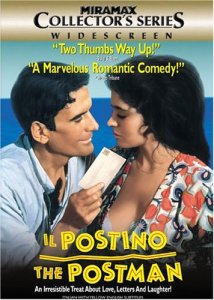
 Il Postino PosterIl Postino (The Postman)

“I love you without knowing how, or when, or from where. I love you simply, without problems or pride: I love you in this way because I do not know any other way of loving but this, in which there is no I or you, so intimate that your hand upon my chest is my hand, so intimate that when I fall asleep your eyes close.”

~ Pablo Neruda, 100 Love Sonnets

G

Graduate 01The Graduate

One of the best films ever made, this 1967 classic, directed by Mike Nichols, features great performances by Dustin Hoffman, Anne Bancroft and Katherine Ross in a story about a young man considering his future and the mother and daughter who most heavily influence his choices.  A brilliant comedy featuring great songs by Simon and Garfunkel, this is a true classic!


Gravity Sandra BullockGravity

Alfonso Cuarón’s 2013 science fiction film Gravity is extremely well-made, a tight thriller that will keep you on the edge of your seat for an hour and twenty-four minutes holding on for dear life.  It is almost a perfect movie.


North by Northwest

north-by-northwest Samt and GrantMistaken identity, an innocent man, bloodthirsty spies, a long train trip, a beautiful, sexy blond, and suspense building to a nail-biting conclusion—all these staples of legendary director Alfred Hitchcock drive his epic 1959 film, North by Northwest.  This review assumes the reader has already seen the film, and thus reveals many plot details that might spoil the movie for a novice film viewer.  Beware!

New York advertising executive Roger O. Thornhill (Cary Grant) is about to conclude another busy day when he is kidnapped by two vaguely eastern European men (Adam Williams and Robert Ellenstein) and taken to a mansion in the country. An erudite Englishman, whom Thornhill assumes is the estate owner, Mr. Townsend (James Mason) has mistaken him for a George Kaplan, a mysterious man who moves about the country making short stays in hotels before moving on.  Townsend recites Kaplan’s complete itinerary, demanding information from him.  When Thornhill tells him of his real identity and refuses to cooperate, Townsend tells his henchman, Leonard (Martin Landau) to kill him.  They force a bottle of bourbon into Thornhill, then put him behind the wheel of a stolen car and aim it at the ocean, but Thornhill revives just enough to avoid the plunge and leads them on a wild car chase.

Arrested for drunken driving, Thornhill calls his mother (Jessie Royce Landis) and tries to explain about his kidnapping. On a return trip to the mansion, Mrs. Townsend tells the police that he was there for dinner, got drunk, and went off on his own.  Thornhill then takes his mother back to the hotel where Kaplan was staying and they find evidence of his presence, but none of the hotel employees have actually seen Kaplan.  When Townsend’s flunkies show up, Thornhill grabs a taxi and goes to the United Nations, where he discovers that the real Townsend knows nothing about his adventures.  As he speaks to Townsend, Leonard sneaks up and stabs the diplomat in the back, leaving Thornhill holding the knife.  A photographer takes a picture, then Thornhill drops the knife and runs off.

Hitchcock usually includes a scene in his movies where the audience learns something that his hero doesn’t know. In North by Northwest, that scene occurs in a Federal Government building (FBI? CIA? Hitchcock never says) where a group of executives led by the Professor (Leo G. Carroll) ponder Thornhill’s predicament and wonder if they should help him.  Kaplan, you see, doesn’t actually exist.  They created him in order to make the spies think that they were closing in on them, while actually they are simply trying to get them to reveal information.  They decide to allow Thornhill to sink or swim on his own.

Knowing that Kaplan’s next stop is in Chicago, Thornhill boards a train, the 20th Century Limited. With no disguise but dark glasses, he should be easy to spot, but the beautiful blond, Eve Kendall (Eva Marie Saint) appears and hides him in her private room.  While the porter is putting down the bed and Thornhill is hiding in her toilet, she slips a note to Luther Vandamm (James Mason), the man who had posed as Townsend earlier.  In Chicago, she pretends to help him by calling Kaplan to set up a meeting, but she gives him instructions to take a bus into the country.  That is where the famous scene with the crop-dusting plane occurs.  Waiting on the side of the highway, surrounded by bleak, empty fields, a small plane dives him, trying to run him down and spraying deadly poison on him.  He makes it to a field, then runs back onto the highway, stopping a tanker truck, which the plane then proceeds to hit, causing an explosion.  Stealing a pick-up left idling by a local, he returns to Chicago and goes to Kaplan’s hotel only to find out that Kaplan had checked out and left before Eve could have possibly talked to him.

Now that he knows she is working for his enemies, he goes to confront her at an art auction, only to find Vandamm and his henchmen. Disrupting the auction, he is able to save his own life by getting arrested.  Diverted to the airport, the police deliver him to the Professor who explains that Eve is actually working for the government, gathering information on Vandamm, and that Thornhill has now endangered her life.

North by Northwest - Saint on RushmoreFollowing the villains to Rapid City, South Dakota, Thornhill and the Professor have set up a little scene in the restaurant at Mt. Rushmore where Eve shoots him with a gun loaded with blanks, but when he finds out that Eve will be leaving the country with Vandamm, he eludes the Professor and goes off on his own to save Eve, resulting in the famous final scene at Mt. Rushmore where Thornhill and Eve clamor over the president’s faces running from Leonard and the others with a statue filled with microfilm.

At two hours and 16 minutes, this should feel like a very long movie, but Hitchcock keeps the tension building so that viewers will not notice the passing of time. Even so, I wonder if it couldn’t have been cut a bit to bring it down to a more realistic length.  As with most of Hitchcock’s films, there isn’t much in the story, but action and suspense.  When Ernest Lehman wrote the script, he definitely wanted this to be the best Hitchcock film of all time and there may have been a certain amount of collusion from all of Hitchcock’s collaborators to make this movie his “masterpiece,” resulting in a greater length than usual.  It is Hitchcock’s longest running film and although it was stunning at the time of its release, in retrospective, there are many other films that would better fit the description “masterpiece.”

Although Hitchcock pulls all the right strings to keep the audience involved, I thought that Cary Grant really just mailed in his performance. Aside from a few moments early in the film, I really didn’t care what happened to him.  Eva Marie Saint was considerably better, bringing a level of nuance that was involving, but Mason, Landau, and all of the other actors seemed to be on automatic pilot.

The opening credits by Saul Bass are quite captivating, especially with the music of Bernard Herrmann behind them. This may be one of Herrmann’s best scores for Hitchcock as it does much of the work of keeping the film moving along.  The cinematography by Robert Burks and the editing by George Tomasini, both long time Hitchcock collaborators are terrific.  The widescreen color by Vistavision is magnificent.

What makes the film most memorable are the two iconic scenes, by themselves kinetic masterpieces: the scene in the fields with the crop dusting airplane and the scramble across the President’s faces at Mt. Rushmore. The scenes between Grant and Saint on the train are also very sexy and quite suggestive for their time.

North by Northwest deserves its place as a iconic Hitchcock film and it should be seen anyone who is a fan of suspense movies, Hitchcock or 1950’s Hollywood. It is an outstanding film and it definitely has its place in film history.  Even so, I would not call it Hitchcock’s ultimate masterpiece, as Ernest Lehman called it, “the Hitchcock picture to end all Hitchcock pictures.” 

In fact, Hitchcock’s very next film, Psycho, would leave a much deeper impact on his audience.