Il Postino (The Postman)

Il Postino Poster

I love you without knowing how, or when, or from where. I love you simply, without problems or pride: I love you in this way because I do not know any other way of loving but this, in which there is no I or you, so intimate that your hand upon my chest is my hand, so intimate that when I fall asleep your eyes close.

~ Pablo Neruda, 100 Love Sonnets

On a small, nearly isolated Italian island, a fisherman, Mario Ruoppolo (Massimo Troisi), lives with his father. A rather simple-minded young man, Mario hates being out on boats all day and complains of the moisture, so his father tells him to get a job. One night, at the movies, he sees a newsreel covering the arrival of famed Chilean poet Pablo Neruda (Philippe Noiret) to Italy.  A communist, Neruda has been exiled by political opponents and has come to live on Mario’s little island.

Mario sees a sign on the door of the post office advertising for a postman with a bicycle to deliver mail. The next morning Mario applies and finds out that it is a part time job to deliver Neruda’s mail.  As he does his job, he begins a dialogue with the poet.  At first, he is looking for an autograph, so he can show he is a friend of great Neruda and get girls, but as he reads the poetry, he discovers that it appeals to him in some way that he can’t explain.  The poetry stirs in him both a desire for love and a desire to fight for the cause of the oppressed.  Wanting to write his own poetry, he asks Pablo how to go about it and that leads to an explanation of metaphors.

When Mario falls in love with Beatrice (Maria Grazia Cucinotta), the niece of the local inn owner, he begs Pablo to help him win her by writing some poetry for him, but the poet refuses, instead giving Mario a beautiful book of paper to begin writing his own poetry. He brings Mario to the inn and signs the book in front of Beatrice.  Using Pablo’s poetry, Mario begins to woo her with great success, so much so that Beatrice’s aunt becomes upset, complaining about the evil metaphors in the poetry.

Massimo Troisi was a beloved Italian actor long before Il Postino, mostly for his wonderful comedic roles.  When he found the book Ardiente paciencia by Antonio Skármeta, he bound himself to the project, committing to not only star in the film, but to help write the screenplay, along with director Michael Radford, Anna Pavignano, Furio Scarpelli, and Giacomo Scarpelli, even though he was having serious heart problems.  He put off surgery in order to the film and dies shortly after it was completed.

The film is beautifully photographed, full of light and color, with the sea surrounding the island always prominent. There is a great deal of Neruda’s poetry included in the movie and it certainly enhances the beauty.  The film’s Academy Award winning score, composed by Luis Enríquez Bacalov, is beautiful and gives the film a heightened sense of the love not only between Mario and Beatrice, but the brotherly love between Mario and Pablo.

Besides the win for film score, it was also nominated for Best Picture, Best Director, Best Actor, and Best Screeplay Adaptation. The soundtrack features many well known actors reading Neruda’s poetry to the film score.  Some of the readers include Julia Roberts, who backed the project, Glenn Close, Ethan Hawke, Andy Garcia, Madonna, and Wesley Snipes, among others.

This is an excellent film. It is beautiful, full of poetry, music, and love.  In Italian, with subtitles in English, it runs an hour and forty-eight minutes.

Miss Pettigrew Lives for a Day

Miss PettigrewLondon in 1939 was a hodgepodge of pre-war jitters. Depression era soup kitchens operated down the block from posh nightclubs for the rich and the middle class worked to scratch out a decent living.

Miss Guinevere Pettigrew (Frances McDormand), a middle-aged spinsterish daughter of a vicar gets fired from her job as a governess. Rushing up the street with her suitcase, she bumps into a man just getting out of prison, Michael Pardue (Lee Pace).  Frightened, she runs away, leaving her suitcase in the street.  Standing in a soup kitchen that night, she sees fashion mogul Edythe Dubarry (Shirley Henderson) kissing someone in an alley. When Edythe sees she’s being watched, she takes her lover and leaves.

The next morning, Miss Pettigrew goes to her employment agency, but they turn her away because she’s lost every job they sent her on. She steals the business card of American nightclub singer Delysia Lafosse (Amy Adams) from her agent’s desk, hoping she can arrive first and steal the job. Delysia is in a state.  It’s nearly ten o’clock in the morning and she must get a producer’s son, Phil Goldman (Tom Payne) from her bed before her sugar daddy, Nick Calderelli (Mark Strong) arrives. She hopes that bedding Phil will get her the lead role in his new West End musical.  She’s using him, just as she’s using nightclub owner Nick for her wardrobe and apartment.

Jumping into action as Delysia’s new social secretary, Miss Pettigrew manages to gently evict Phil and stall Nick because Delysia must attend a fashionable lingerie show. At the show, Delysia introduces her to Edythe, who doesn’t recognize her right away.  She also meets lingerie designer Joe Blomfield (Ciarán Hinds) who has been engaged to Edythe.  Delysia and Edythe give Miss Pettigrew a complete make-over.  Recognizing her at last, Edythe blackmails Miss Pettigrew into smoothing things over with Joe, even though she had been unfaithful to him, threatening to reveal that she knows Guinevere is actually penniless.

When they get back to the apartment, Michael is there. It turns out that he is the pianist that accompanies Delysia in her nightclub act.  They are in love, but Delysia persists in using the other men to further his career.  Michael gives her one last chance.  He has tickets on a boat to America and is leaving the next morning.  He begs her to join him and take their act to Manhattan.

This is just the beginning of a rip-roaring comedy filled with delightful performances. Directed by Bharat Nalluri, the film was adapted by David Magee and Simon Beaufoy from the 1938 novel by treasured British novelist Winifred Watson.  Scandalous when it was first released, the movie is quite tame by today’s standards, but still very amusing.  Nalluri shows a very deft touch in the directing, mixing tracking shots with steady cam to create a beautiful and tight movie.  In addition, the music is truly special, capturing the feeling of the time perfectly.  The art direction is fantastic, using upscale art deco side by side with the bleak depression era streets.

Frances McDormand, is, as usual, brilliant. She remains one of our finest actresses and infuses Miss Pettigrew with both restrained priggishness and down-to-earth humanity.  In spite of her upbringing, she is open to the friendship that Delysia gives to her.  Amy Adams is wonderful as the flibbertygibbet Delysia and she bonds with McDormand very well.  They make an amazing comedy team and yet both display great emotion with a restrained script.  The two of them make the movie, but all of the male co-stars are also terrific.

Miss Pettigrew Lives for a Day is a truly entertaining movie that fans of McDormand and Adams will be proud to own. It can be watched over and over with a deepening level of enjoyment.  I highly recommend the film!

Nick & Norah’s Infinite Playlist

Nick and Norah PhotoWhen a movie has as its basis such an incredible novel as Rachel Cohn and David Levithan’s Nick & Norah’s Infinite Playlist, there should be no way that it could fail, yet this insipid teen comedy manages to toss aside all of the best stuff from the novel, including, amazingly, some of the best comedy.  It changes the course of events, and ends without a single note of the beauty that gave the book such raw power.

Cute, geeky Nick (Michael Cera) mopes around his house in suburban New Jersey, leaving long voice mails and making mix disks for his ex-girlfriend Tris (Alexis Dziena), a beautiful senior at a Catholic high school. Nick plays bass in an indie band called “The Jerk Offs” with gay musicians Dev (Rafi Gavron) and Thom (Aaron Yoo) who beg him to play this gig they have lined up and look for clues to the “secret” show that the band “Where’s Fluffy” will be playing somewhere in NYC later that night.  At the Catholic school, Norah (Kat Dennings) plans the evening with her ditzy friend Caroline (Ari Graynor) and tries to avoid Tris.  When Tris throws away the latest “break-up mix” CD from Nick, Norah picks it out of the trash, as she has done many times before, because she loves the way he mixes songs.  Even though she’s never met him, she knows she likes him because of the CDs.

They all show up at The Jerk Offs’ gig, Norah hits on Nick, Caroline gets drunk, and Tris shows up with her new boyfriend. Dev and Thom offer to give Caroline a ride home while Nick takes Norah out in his Yugo to look for Where’s Fluffy.  An evening of hijinks ensues as Norah avoids her ex, Tal (Jay Baruchel), Tris tries to get Nick back, and the gay guys drive around in the band’s van, losing Caroline, hooking back up with Nick and Norah, looking for Caroline, and getting back together.  When they finally locate the Where’s Fluffy show, Tal claims Norah, Tris claims Nick, and are both rejected as Nick and Norah head off on their own.

The movie itself is a failure on its own merits. It’s not funny or charming or even remotely romantic.  However, when compared against the original novel, it must be seen as one of the most seriously blown opportunities in the history of filmmaking.

The novel is steeped in punk music, not indie music, and the writing makes the reader feel like they are inside the insane mosh pit. Nick is an edgy bass player in the group called The Fuck Offs, not a cute, geeky guy.  The miscasting of Michael Cera, perhaps the result of the hideous screenplay by Lorene Scafaria or the Happy Days directing of Peter Sollett, dooms the movie from the very beginning and keeps it dredging the bottom throughout the 90 minutes of the film.  The gay sexuality in the book, which was absolutely electric, is completely absent and the homosexual characters are made to look like harmless dolts.  The book had serious balls on teenage gays, but the movie totally emasculates them.  One of the best characters in the book, Tony, the transvestite bouncer dressed in a Playboy bunny costume was cut from the movie.

There is breathless feeling in the novel, partly derived from the thrashing punk and partly from the sparks that fly back and forth between Nick and Norah. The movie has no spark to it at all.  Where the novel thrashed, the movie bounces.  The plot of the book bowls along on a story arc that is lightning tight, but the film plot is unnecessarily convoluted, mostly because Dev, Thom, and Caroline and brought back time and again.  When it should have been focussed on Nick and Norah, it was wasting its time trying to be funny and failing miserably.

The one bright spot in the movie is Kat Dennings’ performance as Norah. While the filmmakers eviscerated Nick, they almost left Norah her own quirky self.  She also has the best line in the movie when she calls The Jerk Offs a fistful of assholes and Dev and Thom realize they’ve just found a new name for the band.  (That’s not in the book.)

Don’t waste your time on this movie. Read the book.

My review of the book is located at Nick & Norah’s Infinite Playlist, by Rachel Cohn and David Levithan.

Gravity

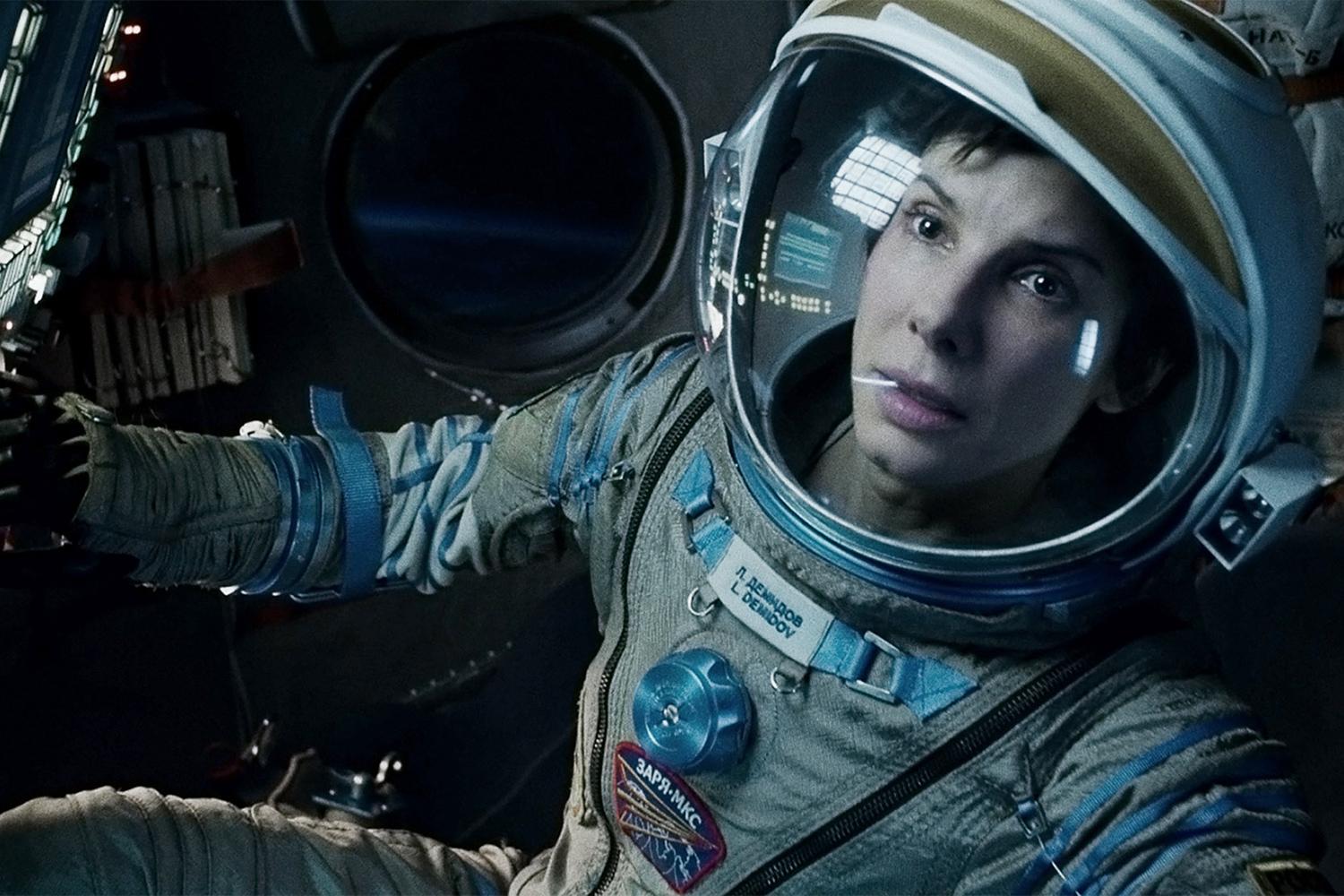
Gravity Sandra BullockAlfonso Cuarón’s 2013 science fiction film Gravity is extremely well-made, a tight thriller that will keep you on the edge of your seat for an hour and twenty-four minutes holding on for dear life.  It is almost a perfect movie.

This review includes vital information about the plot that may prevent a first-time viewer from enjoying the movie. Please read on if you’ve already seen the film.

On a mission to the Hubble Space Telescope, Dr. Ryan Stone (Sandra Bullock), on her first space shuttle mission, works to install upgrades to the system. Veteran astronaut Matt Kowalski (George Clooney) flits around her using his maneuvering back pack as he attempts to break the record for the longest space walk, knowing he will never have enough time to do it.  Mission Control interrupts them to abort the mission.  Apparently, Russia has demolished one of their satellites using a missile and debris is now hurtling through space toward them.  As they make their way back to the shuttle, Houston tells them that the debris is taking out other satellites and they will probably lose contact, which happens almost immediately.

Before they can get back into shuttle to return to earth, the junk comes shooting through their area. Although it misses the two astronauts, the shuttle is destroyed and the other mission specialists are killed.   Kowalski and Stone must now take a very long space walk to reach the International Space Station (ISS).  Time is of the essence because the debris will returns once it has made its way around the earth.  Unfortunately, the ISS has also suffered damage.  One of the two Soyuz escape modules has been used to evacuate the station and the other has been rendered useless because the parachute has already been deployed.  In spite of this Kowalski believes that they can use this useless module to reach the Chinese space station and use their escape module to return to earth.  Their approach is fast and they bounce off the craft, but finally Stone’s foot becomes entangled in the chute lines.  As Kowalski flies by her, she grabs his tether and holds him tight, but Kowalski’s momentum means pulls against her hold.  To save her, he unhooks his tether and drifts away.

From that point on, the film is sharply focussed on Stone’s survival from the Soyuz capsule to the Chinese space station, which is disintegrating in the upper atmosphere, to her entry into its escape module and flight to earth.

Obviously, in winning seven Academy Awards, including Best Director, Best Cinematography, Best Visual Effects, Best Film Editing, Best Original Score, Best Sound Editing and Best Sound Mixing, it was clearly the best movie of the year and probably should have won Best Picture as well.

Cuarón’s hand is in most of the movie. Not only did he direct it, but he co-wrote the script with his son, Jonás, co-produced and co-edited it, so he deserved all of his awards, which also included six BAFTA Awards, including Outstanding British Film and Best Director, the Golden Globe Award for Best Director, and seven Critics Choice Awards.  The other artists that he surrounded himself with all made major contributions to the success of this movie.  The score by Steven Price is amazing, complimenting the action exactly as it should to keep the suspense at a high level.  The sound was so good that it was breathtaking at times.  Emmanuel Lubezki’s cinematography is both flawless and inspired and the special effects by British artists Framestore is simply stunning.  Considering that nearly 80% of the movie consists of computer generated graphics, they certainly deserve a huge share of the praise for this awesome movie.

The human heart of the movie exists in Sandra Bullock’s inspired performance. Although George Clooney contributes somewhat to the action, his character is gone by the time the action really gets rolling and the only other in the movie is Dr. Stone.  This is Bullock’s film and she carries it from beginning to end with a high-energy emotional presence perfectly in compliment with the music, sound, cinematography.  Bullock has grown tremendously as an actress in the last ten years, especially with her role in Blind Side, but she tops that performance in Gravity.

Although it must be considered one of the best space films ever made, right up there with Apollo 13, there were a few things that bothered me and would probably keep the movie out of the top ten best science fiction films on my list.

There are many inaccuracies in the film, most of which can be easily overlooked, but not all. First, I do not believe that neither Kowalski’s mass, nor their speed would have realistically created the situation that forced him to un-tether himself so that Stone might be saved.  Their attempt to grab onto the ISS, hurtling into it and bouncing off, is a violent scene.  When Stone finally makes it inside, I expected to see bruises and contusions all over her body, but instead, she emerges from her space suit looking squeaky clean.  When she finally boards the Chinese space station, the same thing happens, but her grabbing a handhold while hurting at a prohibitive speed with the clumsy glove is extremely unrealistic.  The final problem for me occurred during her attempts to figure out how to operate the Chinese capsule as she pushed buttons at random and finally found the one that magically allowed her to re-enter earth’s atmosphere at the proper angle to avoid a complete burn-up.

I might be overly critical on these scenes—I’m sure most people wouldn’t have an objection—but I thought that all of these problems, with a little tweaking, could have been easily made more realistic and would have really made it a flawless film.

This is still a great and powerful film, a rollercoaster of a movie that shoots its way along an arc that is tightly plotted, with every aspect of the film working in complete harmony, and it does it with no discernable fat in terms of scenes or timing. Everybody should see this movie!

Warm Bodies

WARM-BODIES_510x317There are few films that boast a truly original premise, but Warm Bodies is one of them.  What genre is it?  Well, it’s the only zombie romantic comedy I’ve ever seen.  Written and directed by Jonathon Levine, it was adapted from a Young Adult novel of the same name by Isaac Marion.  I haven’t read the novel yet, but the movie carries that “first person present” feel to it that is omnipresent in YA dystopian books.

The movie is narrated by a teenage zombie, R (Nicholas Hoult), who knows there’s something missing in his death, but just can’t figure out what. He lives in an abandoned airplane that he has appropriated for his use and stocked with lots of stuff that he has collected, including a stereo with a turntable and an impressive collection of disks, because he values the purity of the sound.  By day, he shuffles around the airport groaning, occasionally grunting with his “friend” M (Rob Corddry) and going out to eat with him.  The food, of course, is human and R cherishes human brains because they allow him to vicariously experience life by re-living the memories of the deceased.

Ultimately, the zombies turn into living skeletons called Boneys. Although the skeletons leave the zombies alone, they also exist by eating humans and they are extremely deadly.

In a city within the city, protected by towering walls, humans live under the authoritarian leadership of Colonel Grigio (John Malkovich). The Colonel’s daughter, Julie (Theresa Palmer), her boyfriend, Perry (Dave Franco), and her best friend, Nora (Analeigh Tipton) volunteer to go outside the walls to search for medical supplies and this expedition coincides with a search for human food by R and M (the initials are all they can remember of their former names) and some of their zombie friends.

During the fight that ensues, R is attacked by Perry and kills him. As he eats the boys brains, he relives memories of Perry’s time with Julie and he develops a soft spot for her, so when the raid is over, he rescues Julie and brings her back to his airplane.  Unsure what to do next, he plays music for her and rescues her again when she tries to escape.  As he attempts to talk to her and finds a few human words, she wonders why he keeps saving her.  During the next few days, they talk, play games, and listen to music, but finally she convinces him that she must go back to her father.  When M and the other zombies see them holding hands, they begin to develop feelings, too, and allow them to go.  The zombies are beginning to regain their humanity.

If there are a few things here that seem a little familiar, it’s because there are some similarities to Shakespeare’s Romeo and Juliet.  Yes, R and Julie suggest that.  So does the story of “two houses divided” in a great city.  And yes, there is even a balcony scene, but that is where the similarity ends.  There is nothing tragic in this “feel-good” dark comedy.

Hoult and Palmer are splendid as the young lovers. Hoult’s voice and narration are both hilarious and oddly touching at the same time.  It’s the only zombie movie where you will find yourself identifying with the zombies.  Hoult is English and Palmer is Australian, yet they are perfectly believable American teens.  Palmer is beautiful and sexy, yet very down-to-earth.  They should both have terrific film careers.

Malkovich is a little one-note as Colonel Grigio, but the role was written that way. Tipton may be the big surprise in the film.  Although her role is fairly small, she seems consistently to get the best lines not given to Hoult and she is laugh-out-loud funny in places.  Corddry gives a very restrained and heart-felt performance as M.

It’s hard to do the movie the credit it deserves in a short review, but it is the kind of film that should have a big crossover audience. The characters are well-drawn, the situation bizarre and hilarious and the film-making is first rate from the beginning to the end.  At 91 minutes, it is the perfect length and that shows that director-writer Levine was really in tune with the material.  Many other directors might have cluttered up this charming film with all kinds of nonsense or overplayed the comedy, but he hits the right note in every scene.  The cinematography, art direction, costume, and make-up are all spot on.

I highly recommend this movie!

Cloud Atlas

Cloud Atlas 01

It’s almost impossible to describe Cloud Atlas, the extraordinary film of David Mitchell’s amazing novel of the same name.

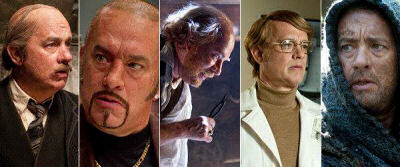
Six stories are told, all relating to one another, presenting critical junctures in the lives of several people living in various times. Tom Hanks and Halle Berry each play six roles, one in each story, and demonstrate a tremendous virtuosity of acting skills, each disappearing so completely in their six roles that at times you simply cannot recognize them.

The supporting cast is equally brilliant: Jim Sturgess, Hugo Weaving, and Hugh Grant also play six roles equally well and a handful of other cast members play as many as five roles, each so unique that it is difficult to say who is whom in any given story.

The novel mixes the stories only to a certain extent, in that each chapter focuses on a different story, but the book jumps from story to story as the next chapter presents itself. The movie takes this concept of mixing the six stories to a whole new level, often jumping from story to story in the pan of the camera or the tick of a sound, sometimes taking many minutes with one story and sometimes taking only seconds before jumping to the next story, back and forth, round and round until you feel like you’re sitting on the top of the front end of train moving at a hundred miles an hour.

This is some of the finest film editing you will ever see, I guarantee.

The stories themselves are in many ways related, either thematically, through character similarities or in philosophy.Cloud Atlas 02

The first story chronologically takes place in the South Sea Islands and on the Pacific Ocean in 1849, as a young lawyer saves the life of a Moriori slave, who returns the favor. It relates to the final tale in that Morioris appear in both.

The second story occurs in Europe in 1936 and details the life of a young composer apprenticed to a Master.

The third story takes place in San Francisco in 1973 and tells the story of an investigative reporter in over her head with a corporate scam involving nuclear power.

The fourth story is somewhat “present day” in that it happens in 2012 (the year the film was released) and tells the story of a publisher whose brother involuntarily commits him to hospital for seniors, under lock and key.

The fifth story moves us firmly into science fiction. It takes place in “Neo-Seoul,” the gigantic metropolis that has replaced Old Seoul, which is mostly under water.  Beautifully executed and full of action, this story tells the story of a genetically engineered “fabricant” who is liberated from her service job to help the revolution against a corrupt dystopian government.  The final story takes place after the fall of civilization, “106 winters after the fall” and features Tom Hanks’ most brilliant performance of the film, as a Moriori triblesman who must deal with an alien Prescient (Berry) who is trying to get her people off planet because of the radiation.

Most of you know that I rarely tolerate any movie that runs toward two hours, but in the two hours and forty two minutes of this film, I was never once bored. In fact, I felt completely in suspense the entire length of the film.  It is so beautifully done!

Cloud Atlas 03But it’s not a film that comes easy. It requires an active brain and a healthy sense of curiosity.  It requires viewer involvement.  You must think in order to enjoy it.  I couldn’t imagine seeing it in a theater.  For one thing, the Moriori dialect is so thick that I had to turn on subtitles almost from the first word of the movie. (I highly recommend that it be watched with subtitles.) 

For another thing, I think it would leave you breathless and exhausted, almost hallucinatory. I watched it in two sittings. An hour and a half the first night and an hour and fifteen minutes the second.  I’m certainly going to watch it again, perhaps many, many times.  There will always be something new to get from it. 

If you just want to sit back and let a movie entertain you, with no thought or involvement on your part, you probably shouldn’t see it. But for those who quest for greater challenges and thought provoking action, this has to be considered a great, great film and certainly one that must be seen many times.

Little Women (1994)

Little Women 1994This Robin Swicord adaptation of Luisa May Alcott’s classic novel is very good, considering that the movie comes in under two hours. I will not detail the story itself as that is already covered in my review of Little Women in my book section.

Briefly, including spoilers, this is the story of the March sisters, ranging in age from 12 to 16 at the beginning of the novel, living with their mother in Cambridge, MA during and immediately after the Civil War. Their father is a pastor to Union soldiers during the conflict.  The central character, Jo, aspires to become an author and she befriends a wealthy boy, Laurie (Teddy), who lives nearby.  As they grow up, her older sister, Meg, marries Laurie’s tutor, father returns home, younger sister Beth dies of a heart problem carried over from scarlet fever, and Amy grows up.  When Laurie finishes college, he proposes to Jo, but she turns him down, so Laurie goes with his grandfather to Europe, where he dissipates, while Jo moves to New York to become a governess.  Amy goes to France with their Aunt March, where she meets Laurie.  As Jo falls in love with a new acquaintance, Professor Bhaer, Laurie fall in love with Amy and marries her.

This film features a superb young cast. Wynona Ryder stars as Jo and she carries off the girl’s naiveté and yearning with a youthful vigor that is completely believable.  Young Christian Bale is perfect as Laurie.  Amy is played by two actresses: Kirsten Dunst plays Amy as a girl and Samantha Mathis plays her as a young woman.  Although both of them are good, there are several problems with the arrangement.  First, they don’t look enough alike to be believable as the same person and second, by jumping four years into the future, the film does not let us see Amy grow and change, so the character differences between the two Amys is stark and does not feel natural.  The script completely leaves out how Amy replaced Jo as a companion for Aunt March, leading to changes.  It does not let us see how Jo offended Aunt March, which was what led to the Aunt taking Amy to France instead of Jo.

Trini Alvarado as Meg and Eric Stoltz as John Brooke, the man she marries, are both very good and Susan Sarandon is perfect as the mother of the girls, Marmee.

Clare Danes sometimes shines as Beth. The scene where Mr. Laurence presents her with the piano is excellent, although the film doesn’t take the time to show her practicing on the piano at the Laurences, which is part of what makes the gift so special.  However, during the scene where Beth dies, director Gillian Armstrong allows Danes to play the scene with a certain fear and regret of death, whereas in the book, Beth embraces her death.  Beth’s character is built around her being a homebody and so certain of Heaven that she dies with a kind of splendid peace.  Danes performance negates the character she has so carefully built.

One of the things the movie didn’t do as well as the book was the scene where Laurie proposes to Jo and she refuses him. It is probably the best scene in the novel and it seems to flounder a bit in the film, so that what should be a major crisis on which the story pivots just doesn’t bring the heat.

However, the movie clearly improves on the book with the character of Professor Bhaer. As played by Gabriel Byrne, he is more romantic and open-minded, certainly clean-shaven.  This redrawing of the character to make him more likable is connected to a new ending that makes the story work much better.  In the book, Bhaer goes into a fit over Jo writing sensational stories for yellow press and she gives up writing entirely, but in the movie, he merely feels that she should write from her own heart and do better.  Following Beth’s death, Jo, in the movie, proceeds to write a novel about her own family and that novel then becomes Little Women and gives us a real parallel with Luisa May Alcott, who wrote the book originally about her own family.  Bhaer then finds a publisher and delivers the galleys to Jo, which is how they get together.  This ending is so much more satisfactory than the novel.  It is unreal that Jo would give up writing for good and it feels entirely wrong that she would marry such a closed-minded old fool as Bhaer in the book.

One more improvement really gives the movie a lift over the novel. Throughout the book, Alcott preaches to her readers, giving many little examples of how girls can make their own family lives better if they only behave properly and completely trust in God.  The movie removes almost every single instance of preaching and tells the story without a moral hammer.

Overall, it is a very good film. This is the fifth adaptation of Little Women to the screen.  There were two silent versions, in 1917 and 1918, a film in 1933 directed by George Cukor with young Kathryn Hepburn as Jo, and one again in 1949 with June Allyson as the main character, but also featuring Janet Leigh, Elizabeth Taylor, and Margaret O’Brien.  The 1949 version is the only other one I’ve seen and it is also very good, but for modern viewers I would not hesitate to recommend this 1994 movie with Wynona Ryder.  It is a solid adaptation, well directed and–for the most part–very well acted.

Ruby Sparks

ruby-sparksRuby Sparks is a brilliant 2012 romantic fantasy. Both a comedy and a drama, it never falls into the genre of romantic comedy, but blazes its own original, fantastic trail.  Written by Zoe Kazan and directed by Jonathan Dayton and Valerie Faris, the film has a single, organic arc that shoots into the sky like a brilliant firework, ultimately exploding into fragments that all make perfect sense.

Young writer Calvin Weir-Fields (Paul Dano) has tasted success early. His first novel is now considered a modern classic.  Since its publication, he has struggled to write a follow-up, instead publishing short stories and a novella.  Worshiped by adoring fans, he has retreated into his house and placed himself under the care of a psychiatrist, Dr. Rosenthal (Elliott Gould) who advised him to get a dog (Scotty) to help with his loneliness.  He takes Scotty for walks and works out with his brother Harry (Chris Messina), but he just can’t write that next novel.

After Calvin complains that Scotty is afraid of people and pees like a girl, Dr. Rosenthal gives him a writing assignment: to write something about someone who might like Scotty. Calvin dreams of meeting a beautiful, enchanting girl, Ruby Sparks (Kazan), and then begins to create her on the page.  The more he writes her, the more he falls in love with her.  While visiting Calvin, Harry and his wife, Susie (Toni Trucks), discover women’s underwear in his house, but Calvin thinks that Scotty must have dragged them in.  He shows Harry his draft about Ruby, but Harry thinks that the character is too idealized, not realistic enough to be a real woman.

With a sizable manuscript in hand, Calvin is ready to bring it to his agent when suddenly Ruby appears in his kitchen. The underwear is hers and she believes she has been living with him for some time.  Calvin freaks out and thinks he is going insane, but no matter what he does Ruby is still there and totally perplexed about his behavior.  She follows him into public where he is meeting a young fan, Mabel (Alia Shawkat), who wants to bed him.  Ruby sees them and gets terribly upset.  When Mabel apologizes to Ruby, Calvin realizes that he is not the only one who can see and hear her.

Harry thinks that Calvin is having an episode until Calvin brings him home and he actually meets Ruby in person, but he still can’t believe that Calvin has written her into existence. They go up to his office and writes, “Ruby speaks French.”  Immediately, of course, Ruby begins speaking French to them.  Harry thinks that Calvin should use this to his advantage, say by giving her bigger boobs, but Calvin decides to stop writing Ruby and start living her.  He gives up his control over her.

At first, they are very happy, but when Calvin’s mother invites them up for a weekend at Big Sur, he tries to get out of it. Ruby, worried that he doesn’t want her to meet his family, gets depressed and finally Calvin relents.  His mother, Gertrude (Annette Bening) is a free spirit and her boyfriend Mort (Antonio Banderas) is a wood sculptor.  Calvin is in rebellion against their free-wheeling lifestyle and spends most of the weekend reading while Ruby has fun and makes friends with his family.  He is jealous and resentful.

Ruby begins to resist the way they live, the way he keeps her closeted away from others, and wants to have a life of her own, so he encourages her to take an art class, but he is jealous of her being in any part of the world but his. He has become dependent on her and is now powerless to control her.  When she becomes deeply depressed, he finally returns to his typewriter and makes her more cheerful.  This begins a series of edits where he tries over and over to make her into the perfect woman she was at the beginning and kicks the movie to a whole new level.

Kazan’s script is so original and creative that it alone carries the movie, but her performance as Ruby is at the heart of its comedy. Her Ruby is so lovable that one identifies with Calvin completely.  His desires and frustrations seem so real that the film takes on a level of drama underneath the comedy that pushes it forward relentlessly.  Dano gives a striking performance as Calvin and he keys the drama.

Part of the charm of this movie is the behind the scenes relationship. Dano and Kazan were a couple long before she wrote the script and she wrote it with him in mind to play Calvin, so the script was tailored to the two of them.  Also, the directors, Dayton and Faris, are a couple and have been longtime friends with Dano and Kazan, ever since they did Little Miss Sunshine with Dano in 2006.  Without the participation of these four, the film may not have been nearly as successful as it is.

Movies like this don’t come along very often. Creative, funny, dramatic, original, with great performances by an ideal cast, Ruby Sparks should be seen by everyone!

Jayne Mansfield’s Car

jayne mansfields carThis 2012 dramatic film, written and directed by Billy Bob Thornton, looks at the effects of war on two families. Set in 1969 in the little town of Morrison, Alabama, the film revolves around the death of Naomi Bedford.  A fascinating woman with a wanderlust, she was first married to Jim Caldwell (Robert Duvall) and had four children with him, Jimbo (Robert Patrick), Skip (Thornton), Carroll (Kevin Bacon), and Donna (Katherine LaNasa) before running away to England, where she married Kingsley Bedford (John Hurt), who had two children of his own, Phillip (Ray Stevenson) and Camilla (Frances O’Connor).

Before her death, she had requested burial in Alabama, so the Bedfords come to Morrison for the funeral. Jim, the Caldwell patriarch, has hated Kingsley from afar without ever knowing him and the relationship between the two families is quite chilly until Kingsley faints at the funeral and is rushed to the hospital because his children believe that he’s had a heart attack.  Seeing the old man so defenseless opens Jim up and he begins a tentative friendship with Kingsley centered on their similar experiences during World War I.  That friendship is cemented further when their opinions on the hippies protesting the Vietnam war coincide.

Jimbo, Skip, and Carroll all served during World War II, but Jimbo never saw any action and has no medals. Skip was a pilot who was shot down over Guadalcanal and Carroll also served in the Pacific.  Both are well-decorated, but both are sympathetic to the war protesters.  In fact, Skip has grown his hair long, takes drugs, and is a leader in the protests, which angers their father.  Skip is currently urging his own son, Mickey (John Patrick Amedori) to get into college so he can avoid the draft.  Jimbo’s son, Alan (Marshall Allman) is still living at home, but sympathizes with the protesters and wants to begin using drugs.

Donna’s husband, Neil (Ron White) a loud-mouthed former football player who own several car dealerships in Atlanta, stays for the funeral, but then returns home, leaving Donna to flirt with Phillip. Skip, a loner, finds himself attracted to Camilla, partly because of her beauty, but partly because of her English accent.

This is the palette that Thornton uses to create a deep, sensative meditation on the effects of war and violence. The heroism of Jim, Kingsley, Skip, and Carroll is held in sharp contract to that of Phillip and Jimbo.  Phillip had also served in the Pacific during World War II, but his unit was taken by the Japanese and he spent his time trying to survive as a prisoner of war.  Kingsley sees this as cowardice and rips his son on it, yet that survival was a war in itself that the older man can’t understand.  Jimbo, serving in supply, never saw action and always feels himself less of a man than his father and brothers.

There is a scene between Thornton and O’Connor where he tells her about how he was shot down and received burns over 90% of his body that is one of the most gripping I’ve ever seen. Thornton’s honey southern drawl undercuts the raw action of unbuttoning his shirt for her, slowly revealing the billowing burned flesh underneath.  It is brilliant and beautiful all at once.  Thornton has another amazing scene where he confronts Duvall over his father’s lack of love as he grew up and he is wearing his medals pinned directly to his naked chest.

Although there are a few moments when I thought the film might be taking itself too seriously, overall it is a taut, compelling movie. Every single performance represents a little bit of acting perfection.  Duvall, Hurt, Thornton, and Bacon give amazing performances, nuanced, and full of depth–and all of the supporting actors are excellent.

The script, by Thornton and Tom Epperson is deep and moving. It hearkens back to the splendid southern dramas of Tennessee Williams, where you find deeply hurt old men, passionate young men, and steamy women all coming together into a kind of psychological gestalt.  And there is some humor, although it could use a little more to break up the drama.

When this movie was released in 2012, most reviewers completely missed the beauty of it. That is one serious issue with writers having to see a film once and sit down and write about it without having the patina of time to allow the nuance to fully sink in.  This is a movie that should age well, like old bourbon and taste even better in the years to come.  It certainly should mark Billy Bob Thornton as a master filmmaker, a terrific writer, a fine director, and a great actor.

If you haven’t seen it–and you like film drama–this is a must see movie!