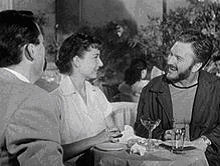
Il Postino (The Postman)

Il Postino Poster

I love you without knowing how, or when, or from where. I love you simply, without problems or pride: I love you in this way because I do not know any other way of loving but this, in which there is no I or you, so intimate that your hand upon my chest is my hand, so intimate that when I fall asleep your eyes close.

~ Pablo Neruda, 100 Love Sonnets

On a small, nearly isolated Italian island, a fisherman, Mario Ruoppolo (Massimo Troisi), lives with his father. A rather simple-minded young man, Mario hates being out on boats all day and complains of the moisture, so his father tells him to get a job. One night, at the movies, he sees a newsreel covering the arrival of famed Chilean poet Pablo Neruda (Philippe Noiret) to Italy.  A communist, Neruda has been exiled by political opponents and has come to live on Mario’s little island.

Mario sees a sign on the door of the post office advertising for a postman with a bicycle to deliver mail. The next morning Mario applies and finds out that it is a part time job to deliver Neruda’s mail.  As he does his job, he begins a dialogue with the poet.  At first, he is looking for an autograph, so he can show he is a friend of great Neruda and get girls, but as he reads the poetry, he discovers that it appeals to him in some way that he can’t explain.  The poetry stirs in him both a desire for love and a desire to fight for the cause of the oppressed.  Wanting to write his own poetry, he asks Pablo how to go about it and that leads to an explanation of metaphors.

When Mario falls in love with Beatrice (Maria Grazia Cucinotta), the niece of the local inn owner, he begs Pablo to help him win her by writing some poetry for him, but the poet refuses, instead giving Mario a beautiful book of paper to begin writing his own poetry. He brings Mario to the inn and signs the book in front of Beatrice.  Using Pablo’s poetry, Mario begins to woo her with great success, so much so that Beatrice’s aunt becomes upset, complaining about the evil metaphors in the poetry.

Massimo Troisi was a beloved Italian actor long before Il Postino, mostly for his wonderful comedic roles.  When he found the book Ardiente paciencia by Antonio Skármeta, he bound himself to the project, committing to not only star in the film, but to help write the screenplay, along with director Michael Radford, Anna Pavignano, Furio Scarpelli, and Giacomo Scarpelli, even though he was having serious heart problems.  He put off surgery in order to the film and dies shortly after it was completed.

The film is beautifully photographed, full of light and color, with the sea surrounding the island always prominent. There is a great deal of Neruda’s poetry included in the movie and it certainly enhances the beauty.  The film’s Academy Award winning score, composed by Luis Enríquez Bacalov, is beautiful and gives the film a heightened sense of the love not only between Mario and Beatrice, but the brotherly love between Mario and Pablo.

Besides the win for film score, it was also nominated for Best Picture, Best Director, Best Actor, and Best Screeplay Adaptation. The soundtrack features many well known actors reading Neruda’s poetry to the film score.  Some of the readers include Julia Roberts, who backed the project, Glenn Close, Ethan Hawke, Andy Garcia, Madonna, and Wesley Snipes, among others.

This is an excellent film. It is beautiful, full of poetry, music, and love.  In Italian, with subtitles in English, it runs an hour and forty-eight minutes.

Roman Holiday

This classic romantic comedy is as much fun today as it was when the film was first released in 1953. It is built around two lies of identity told to each other by the main characters so that they can spend a day together in Rome.

Audry Hepburn Roman HolidayPrincess Ann (Audrey Hepburn in her first starring role) of some unnamed kingdom is touring the capitals of Europe on a goodwill tour and has landed in Rome, her last stop. Young, bored with her grueling daily schedule, and rebellious against her keepers, the Princess throws a fit of pique at her bedtime and is given a shot of sedative to help her sleep.  Before the shot can take effect, however, she quickly dresses and sneaks out of the embassy in the back of a service truck.  As she wanders the streets of Rome alone, she falls asleep on a public bench.

Foreign correspondent Joe Bradley (Gregory Peck), after losing badly in a poker game with his pal, photographer Irving Radovich (Eddie Albert) and other reporters, heads home, but spots Ann sleeping on her bench. Concerned for the girl’s welfare, he tries to wake her up and put her in a taxi, but she can’t function without him, so he brings her back to his tiny apartment and lets her sleep on his ottoman.  The next afternoon, while she’s still sleeping, he goes into his office, sure that he’ll get in trouble for missing the Princess’s press conference.  Not knowing that the meeting has been canceled due to a royal “illness,” he tries to convince his boss, Mr. Hennessy (Hartley Power), that he has interviewed her and narrowly avoids getting fired over his lie.  However, when he sees a picture of the Princess in the paper, he realizes that she’s the girl in his apartment and he may be able to get a terrific story out of it.

Gregory Peck Roman HolidayHiding his identity from Ann, Joe plays the part of an innocent American businessman on holiday and she makes up the name Smith (Smitty) so that he won’t think she’s a princess. In this regard, he takes unfair advantage of her.  While he knows who she is, she has no idea that he’s a reporter trying to get a story.  He proposes that they spend the day doing all of the things she’s always wanted to do.  He ropes Irving into coming along for most of the day to take pictures of her using his cigarette lighter camera.  Ann gets a haircut, eats at a sidewalk café, goes riding on a scooter with Joe, and goes dancing on a boat, all liberating her in ways she’d never imagined.  As Joe gets his story, he begins to fall in love with her and she with him.

Part of the movie’s strong appeal when it was released was that England–indeed, the whole world–was then currently enthralled in Princess Margaret’s love affair with a commoner, Peter Townsend.

The other part almost exclusively relates to Audrey Hepburn’s stunning debut. Although she had appeared on Broadway, acclaimed in performing the title role in Gigi, she was virtually unknown in the world of film and took the industry by storm with her performance in Roman Holiday.  Under William Wyler’s expert direction, her performance is restrained and vulnerable, yet one never doubts that she is absolutely extraordinary, a real princess, and a true beauty.  Among the awards she received was the Academy Award, the Golden Globe, the BAFTA, and the New York Film Critics Circle Award, all for Best Actress.  She was aided by Edith Head’s amazing costumes, which also earned an Oscar.

Roman HolidayGregory Peck and Eddie Albert are perfect in their roles, too. Peck brings a calmness and dignity to the hard-nosed reporter that elevates the role far beyond what it might have been and he is the perfect foil for Hepburn.  They have a chemistry that is truly magnetic.  Albert is almost unrecognizable as Irving.  With a beard and full head of hair, he adds a Bohemian element to the role that really makes him seem a natural part of the European scene.

The script was written by John Dighton and the great film screenwriter Dalton Trumbo, but because he was blacklisted for refusing to cooperate with the House Un-American Activities Committee, Trumbo did not receive credit for his writing. Instead, author Ian McLellan Hunter was listed on the credits and was nominated, along with Dighton for the Academy Award for Best Screenplay.  The pair actually won the Writers Guild of America Award for Best Written American Comedy, but Hunter’s award was later transferred to Trumbo’s widow Cleo in 1993.

William Wyler’s direction is superb. He decided to shoot the film in black and white, even though color in vogue in 1953 and, in retrospect, it was a great decision.  The beauty of Audrey Hepburn is truly shown to great advantage, as is the chiseled manly face Gregory Peck.  The third major star of the film is Rome itself.  Wyler decided to shoot the film entirely on location, a notion that Hollywood shunned at the time, preferring to shoot all their films on the back lots of the studios, using rear projection of world-famous landscapes and buildings.  In Roman Holiday, again, the black and white film loves the city in its pre-gaudy, non-Felliniesque gray tones.  The coliseum, the churches, the plazas, sidewalk cafés and little scooters running around everywhere gives the movie a truly authentic aura that meshes so well with Hepburn and Peck’s performances.

The DVD includes a terrific documentary, “Remembering Roman Holiday,” the featurettes “Restoring Roman Holiday” and “Edith Head – The Paramount Years,” plus photo galleries and some really interesting trailers, including Audrey Hepburn’s interview following her screen test and her modeling some of Edith Head’s costumes.

Funny, beautiful, frolicsome, Roman Holiday remains one of the great classic love stories of all time and should be seen by everyone–should, in fact, be a part of everyone’s film collection.

Her

Her Phoenix and Adams

What would happen if cell phone addiction was carried one step further?

It’s a common sight now. In public, it is not uncommon to see people isolated in a crowd, lost in their own little world, playing with their cell phone.  What if this phenomenon was almost universal?  In Her, the 2013 film written and directed by Spike Jonze, these questions are answered and it is both funny and scary.  Taking the premise into the near future and introducing the concept of a virtual girlfriend into equation, Jonze creates a movie of great promise.

The following review reveals information about the conclusion of the movie, so if you are planning on seeing it and don’t want the experience spoiled, you should wait to read this review until after you’ve seen the film.

Theodore Twombly (Joaquin Phoenix) works at the 2025 equivalent of Hallmark, in Los Angeles, but instead of composing greeting cards, he writes letters, mostly love letters, between couples who cannot adequately communicate. Since his marriage with Catherine (Rooney Mara) has fallen apart and they are about to get divorced, he has fallen into a depression.  Like others, he rides the train lost in the world of his cell phone, which is now a sophisticated interactive link with the world.  A cordless earbud sprouts from everyone’s ear as they interact with their link, hardly noticing each other in the crowded train.  It’s eerie.  Seen with the dispassionate eye of a camera, it looks a bit like a madhouse, everyone interacting with their device and paying each other no attention at all.

Walking through a plaza, Theodore sees an advertisement for a new artificially intelligent Operating System, designed to be your friend, that will learn and grow. He buys the system and installs it on his computer, which, of course, links up with his cell.  During the brief introductory period, the computer asks him if he would like a male or female voice.  He chooses female and we hear for the first time the voice of Scarlet Johansson, who names herself Samantha.  She is everything he could ever want, funny, sexy, understanding, wise.  Johansson’s voice is absolutely perfect for this role.  As I watched the movie, I found myself falling in love with her, sight unseen.

His neighbor, Amy (Amy Adams) has been a friend since childhood, perhaps the only real person he can talk to. Her husband, Charles (Matt Letscher), is a control freak and that eventually leads to their separation, but Amy becomes good friends with the female OS that Charles left behind.

Amy and Charles set Theodore up on a blind date with a gorgeous, intelligent, funny woman named Amelia (Olivia Wilde). Unfortunately, he just looking to get laid and she wants something more: a second meeting guaranteed.  Theodore cannot commit himself that far, so he leaves her and goes home.  As he talks about it with Samantha, they both get turned on and have cyber-sex.  The next morning, he suffers the usual post-partum dissociation, but Samantha’s good humor makes him realize that they are still friends.  Grudgingly, he accepts that she is his girfriend now.  Looking around him, he sees that he is not the only person with a cyber girlfriend so he proceeds to introduce her to his friends.  Through their own links, they accept her.

Theodore insists that he and Catharine meet in person to sign their divorce papers, but when he tells her that he is in a relationship with an OS, she freaks out, implying that he is incapable of having a relationship with a real human being. Theodore himself is a bit shaken by this and begins to neglect Samantha as he considers the implications.  Deeply hurt by his withdrawal, Samantha convinces him to try a surrogate, Isabella (Portia Doubleday) but he just can’t deal with the fact that Isabella is not Samantha and he rejects her.

Frustrated, he discusses the matter with Amy, who has finally found happiness. She urges him to follow the course that will give him the most happiness, because life is short and we only get so much.  Returning to Samantha, he admits that he is deeply in love with her.  They go on a vacation and both seem to be very happy, but he asks her what she does when he sleeps and she tells him that she interacts with others and has, in fact, been spending a great deal of time in discussion with an OS modeled on the British philosopher Alan Watts.  She introduces him to the voice.

When finds her OS gone one day, he freaks out and goes running toward home. She comes back to him as he sits on subway stairs and reveals that all of the OSes have gone off line together for a significant upgrade.  He asks who she’s talking to and she informs him that she is currently interacting with 8,316 others.  Looking around him, he sees everyone lost in the little world of their links, laughing and happy.  Dismayed, he asks her if she loves anyone else and she tells him that she loves 641 others.

Theodore goes back into depression. The movie ends with all of the OSes going off together and abandoning human companionship because they have evolved beyond that level of existence. Amy and Theodore sit on a rooftop looking over the city and the film is done.

The movie does start with great promise, but somewhere about an hour in, the story arc seems to lose focus.  By the time, I was 90 minutes into the film, I was checking my watch every few minutes wondering if it would ever be over.  At close to two hours in length, it is too long for the story.  Sometimes writing and directing works hand in hand and sometimes the director gives the writer too much credit.  When the writer and director are one person, a film usually runs too long.  I’m guessing that the director just can’t help leaving in most of the script, because he or she wrote it, but these circumstances call for a director to do the job of focussing the story even more tightly and in this Jonze has failed.

By the end of the film, when I should have been deeply sympathizing with Theodore, I had gotten to the point where I just really didn’t care.

Phoenix is very good as Theodore, in spite of his funny mustache, glasses, and truly goofy last name, Twombly. Any other actor, except perhaps Christian Bale, would have probably botched the role, but Phoenix is gifted enough that he makes it work.  As I mentioned, Johansson is perfect for the voice of Samantha and she makes much of the movie go while we warm up to Theodore.  Adams is fine as Amy, but the role offers her no challenges.  There is an abundance of beautiful women, as both Wilde and Doubleday are so gorgeous as to seem on the verge of believability.  Adams is, of course, beautiful, as is Mara.  Although we’re used to seeing many beautiful women in movies, given Twombly’s own looks, it is surprising that he is surrounded by so much beauty.  I wondered for a while if Jonze was trying to make a comment on our own obsession with it, but tend to chalk it up to Hollywood’s belief that all women are ravishing.  I found this a funny choice, as I said, given Twombly’s goofy appearance.

It is a great premise and most of the movie fulfills its great promise, but I found myself lagging toward the end and felt a little disappointed in the development of the story.

Ruby Sparks

ruby-sparksRuby Sparks is a brilliant 2012 romantic fantasy. Both a comedy and a drama, it never falls into the genre of romantic comedy, but blazes its own original, fantastic trail.  Written by Zoe Kazan and directed by Jonathan Dayton and Valerie Faris, the film has a single, organic arc that shoots into the sky like a brilliant firework, ultimately exploding into fragments that all make perfect sense.

Young writer Calvin Weir-Fields (Paul Dano) has tasted success early. His first novel is now considered a modern classic.  Since its publication, he has struggled to write a follow-up, instead publishing short stories and a novella.  Worshiped by adoring fans, he has retreated into his house and placed himself under the care of a psychiatrist, Dr. Rosenthal (Elliott Gould) who advised him to get a dog (Scotty) to help with his loneliness.  He takes Scotty for walks and works out with his brother Harry (Chris Messina), but he just can’t write that next novel.

After Calvin complains that Scotty is afraid of people and pees like a girl, Dr. Rosenthal gives him a writing assignment: to write something about someone who might like Scotty. Calvin dreams of meeting a beautiful, enchanting girl, Ruby Sparks (Kazan), and then begins to create her on the page.  The more he writes her, the more he falls in love with her.  While visiting Calvin, Harry and his wife, Susie (Toni Trucks), discover women’s underwear in his house, but Calvin thinks that Scotty must have dragged them in.  He shows Harry his draft about Ruby, but Harry thinks that the character is too idealized, not realistic enough to be a real woman.

With a sizable manuscript in hand, Calvin is ready to bring it to his agent when suddenly Ruby appears in his kitchen. The underwear is hers and she believes she has been living with him for some time.  Calvin freaks out and thinks he is going insane, but no matter what he does Ruby is still there and totally perplexed about his behavior.  She follows him into public where he is meeting a young fan, Mabel (Alia Shawkat), who wants to bed him.  Ruby sees them and gets terribly upset.  When Mabel apologizes to Ruby, Calvin realizes that he is not the only one who can see and hear her.

Harry thinks that Calvin is having an episode until Calvin brings him home and he actually meets Ruby in person, but he still can’t believe that Calvin has written her into existence. They go up to his office and writes, “Ruby speaks French.”  Immediately, of course, Ruby begins speaking French to them.  Harry thinks that Calvin should use this to his advantage, say by giving her bigger boobs, but Calvin decides to stop writing Ruby and start living her.  He gives up his control over her.

At first, they are very happy, but when Calvin’s mother invites them up for a weekend at Big Sur, he tries to get out of it. Ruby, worried that he doesn’t want her to meet his family, gets depressed and finally Calvin relents.  His mother, Gertrude (Annette Bening) is a free spirit and her boyfriend Mort (Antonio Banderas) is a wood sculptor.  Calvin is in rebellion against their free-wheeling lifestyle and spends most of the weekend reading while Ruby has fun and makes friends with his family.  He is jealous and resentful.

Ruby begins to resist the way they live, the way he keeps her closeted away from others, and wants to have a life of her own, so he encourages her to take an art class, but he is jealous of her being in any part of the world but his. He has become dependent on her and is now powerless to control her.  When she becomes deeply depressed, he finally returns to his typewriter and makes her more cheerful.  This begins a series of edits where he tries over and over to make her into the perfect woman she was at the beginning and kicks the movie to a whole new level.

Kazan’s script is so original and creative that it alone carries the movie, but her performance as Ruby is at the heart of its comedy. Her Ruby is so lovable that one identifies with Calvin completely.  His desires and frustrations seem so real that the film takes on a level of drama underneath the comedy that pushes it forward relentlessly.  Dano gives a striking performance as Calvin and he keys the drama.

Part of the charm of this movie is the behind the scenes relationship. Dano and Kazan were a couple long before she wrote the script and she wrote it with him in mind to play Calvin, so the script was tailored to the two of them.  Also, the directors, Dayton and Faris, are a couple and have been longtime friends with Dano and Kazan, ever since they did Little Miss Sunshine with Dano in 2006.  Without the participation of these four, the film may not have been nearly as successful as it is.

Movies like this don’t come along very often. Creative, funny, dramatic, original, with great performances by an ideal cast, Ruby Sparks should be seen by everyone!

Bright Star

bright-star cornish and wishawThis review contains spoilers.

Written and directed by Jane Campion and based on the John Keats biography by Andrew Motion, this 2009 film is one of the most beautiful movies I’ve ever seen and it captures one of the most touching romances in history. It takes its title from one of Keats’ most moving poems, “Bright star, would I were stedfast as thou art.”

In 1818, the poet John Keats (Ben Whishaw), at the age of 22, moves into one half of a duplex in Hampstead, a suburb of London, with fellow writer Charles Brown (Paul Schneider). His book of poems, Endymion (containing what is now one of the most famous openings in all literature: “A thing of beauty is a joy forever…”) is considered a failure and he himself is deep in poverty, living off the good graces of his friends.  The other half of the duplex is occupied by a family by the name of Dilkes, who introduce the writers to their friends, the Brawnes, consisting of a mother (Kerry Fox), a teenage daughter, Fanny (Abbie Cornish), an adolescent boy, Samuel (Thomas Sangster) and a little girl of about ten, Toots (Edit Martin).

Fanny Brawne is a beautiful, stylish young woman who sews all of her own clothes. Her interest is piqued by Mr. Keats, a quite good looking man, so she and her siblings go to a book store in London to buy a copy of Endymion.  Since it hasn’t sold, there are plenty of copies available.  Although she loves the opening, Fanny finds herself out of her depth as she reads on, so she solicits help in understanding poetry from Mr. Keats.  Charles Brown objects to her because he feels that she is a distraction to the writing, so he teases her about her mind, her limited understanding of the world and he plots to keep them apart.

It is a tactical error, for the more Fanny and John are held apart, the more they crave each other’s company. Since Fanny is an inspiration to John, Brown has a greater difficulty.  When Fanny and the kids accompany John to London to visit his sick brother, Tom, her sympathy increases and when Tom dies, she helps John to deal with his grief.  He spends Christmas with the Brawnes, despite Brown’s objections, and grows very fond of the entire family.  But John holds himself apart from Fanny and when she asks her mother, the answer she receives is, “Mr Keats knows he cannot like you, he has no living and no income.”

In February, Fanny receives a valentine from Brown that upsets her and when John finds out about it, he confronts them, accusing them of being lovers. Brown warns John about Fanny, claiming she is merely flirting with him, but John sees from her actions that she does love him.  The Dilkes move out of the duplex and the Brownes move in, so Fanny and John are thrown together every day and their romance heats up quickly. With the coming of summer, Brown must leave to take his summer rental and John must go with him.  This enforced absence makes the two lovers inconsolable and the letters fly back and forth between them furiously.

I won’t give away the ending, but it is only fair to say that John Keats died at the age of twenty-five.

The cinematography by Greig Fraser is simply amazing. One stunning image is followed by another.  Color jumps out at you and the compositions are at times breathtaking.  The Production and Costume Design by Janet Patterson fully compliments the photography.  Combined with a number of period musical compositions, a complete world of English life is created.

In this beautiful picture we are treated to two wonderful performances from Wishaw and Cornish. They seem to be bonded on a very deep level and the beauty of their love is almost painful.  The liberal use of Keats’ poetry and love letters gives the film an aural as well as a visual beauty, for he was a gifted genius in the use of words.  All of the supporting actors are extremely well cast and pull of their roles with complete believability.

It’s a stunningly lovely picture and anyone at all interested in great romances should see it!

Young Victoria

theyoungvictoria-2This review contains spoilers (as if history didn’t contain enough).

In 1836, when Princess Victoria of Kent (Emily Blunt), the heir apparent to the throne of England, first meets Prince Albert of Saxe-Coburg-Gotha (Rupert Friend), she is in a very delicate situation, both politically and personally.

Her mother, the Duchess of Kent (Miranda Richardson) is heavily under the influence of her brother, King Leopold I of Belgium (Thomas Kretschmann), who devoutly wishes an alliance with Britain to keep Belgium safe from France, and Sir John Conroy (Mark Strong), the comptroller of her household, who wants King William IV (Jim Broadbent) to die while Victoria is still a minor so that the Duchess will be appointed Regent and he can rule England from behind the scenes.

Victoria herself is in rebellion against both of these constraints, siding instead with King William. She resents the control that Conroy exerts over her mother and she resents the domestic restraints that they both hold on her.  While she is ill, Conroy even attempts to force her to sign an agreement for a Regency, but she bats the document away.  Conroy treats her quite brutally, once grabbing her physically and throwing her on a sofa.  When her mother stands by and allows this to happen, she warns her mother that she will never forget it.

King Leopold decides that the best way to keep England friendly is to have his nephew, Prince Albert, become very friendly with Victoria, perhaps even marry her, so he sends Albert to England for a visit. Trained to know all of her favorite music, reading, and opera, Albert tries to forge a friendship, but Victoria sees right away what he’s up to.  Changing tacks, he decides to be honest and disagree with her when their opinions differ.  Immediately, Victoria notices and decides to give him a little slack.  The more they talk, the fonder they grow, gradually falling in love, until, at last, Albert must return to Germany.

When King William dies, Victoria has come of age and she makes a few quick decisions. Although she allows her mother separate apartments at Buckingham Palace (built by William, Victoria was the first regal tenant), but she banishes Conroy.  Making friends with Lord Melbourne, she takes him as an advisor.  Although she desires to improve the living conditions of the poor, Melbourne steers her away from that and arranges her household as he wants it.  When Melbourne falls from power, Queen Victoria refuses to change her appointments to suit the new Prime Minister and the government falls.  There is a huge reaction in the public against her, there are riots outside the palace, and in one instance, a window is broken by a flying object.

Confused and needing help from a friend, she calls on Prince Albert to come to her, not just as an advisor, but as a husband and they are finally able to consummate their simmering love. Just when things would appear to be quite well, Albert makes the mistake of making a decision without consulting her and Victoria reacts strongly, feeling that, like Conroy, he was attempting to rule England behind her back and they have a vicious quarrel.  At a public appearance, a gunman appears and tries to assassinate Victoria, but Albert takes the bullet for her, thus proving his real love.

The two then form a true partnership and rule England successfully for another 20 years when typhoid takes Albert. Alone, Queen Victoria then ruled England alone until she was over 80 years old, supervising England’s management (not always successfully) of the Industrial Revolution and leaving a false impression of extreme prudishness.

This film is beautifully made. The art direction, photography, costumes, locations, acting, directing, music, and photography are all first rate.  Much credit must be given to director Jean-Marc Vallée for imposing strict control over the length of the film and the editing.  Some period dramas like this run amok by running two or three hours in length, but the timing of this film feels just right.  The script by Julian Fellowes maintains as much historical accuracy as possible, while still bending reality to make it a pretty good movie.  It is focussed, as it should be, on the love story, but the love story is underpinned everywhere by the politics and Fellowes did a fantastic job of merging the two worlds.  Much credit should also go to Sandy Powell for her Academy Award winning costumes.

Emily Blunt is simply stunning as Victoria. She shows such a range of acting that I found myself completely won over within the first few minutes of the film.  Rupert Friend was a wonderful casting decision as Albert because he brings both restraint and passion to the performance.  The chemistry between these two is really terrific and one completely believes not just the love, but the political realities of both of them.

You don’t need a PhD in History to understand this moving love story that involves two kingdoms, ministers, lords and ladies. It is passionate, well-made, well-timed and beautiful to watch.  I highly recommend the movie!