A

 Across_the_Universe_3lgAcross the Universe

Conceived, produced and directed by the eclectic Julie Taymor, this film is a romantic musical that incorporates parts of 34 songs composed by John Lennon and Paul McCartney, George Harrison, and the three of them plus Ringo Starr (“Flying”).  Most of the songs are sung on-screen by the characters, though there are some instrumentals.  This places the film in the category of old-style musicals where people seem to burst into song as a part of the story.  To everyone’s credit, it actually seems to work very well indeed.


1-adjustment-bureau-copyThe Adjustment Bureau

The Adjustment Bureau, based on a Phillip K. Dick story, is a far-fetched, but very engaging film.  David Norris (Matt Damon) is a Brooklyn politician who meets a fascinating woman, Elise Sellas (Emily Blunt) on the night that he has just lost the Senate election.  When she runs away, he is motivated to give a galvanizing concession speech that will reenergize his career.


AdventurelandAdventureland

Adventureland is a funny and moving teen romance written and directed by Greg Mattola about a group of teens working at a summer carnival.  The main character, James Brennan, is a student who has just graduated from a small college and is saving up his money to go to the Columbia School of Journalism so he can begin a career in travel writing.  Played with both humor and angst by Jesse Eisenberg, James is trying to find romance, but his own geekiness stands in his way.


All is Lost RedfordAll is Lost

A man sleeps peacefully aboard his small yacht when it suddenly bangs into some sea debris, tearing a hole in the side.  This begins a great survival story where one problems piles upon another as he is tossed across the Indian sea toward shipping lanes and possible rescue.  But he must first face storms, sharks, and other menaces.  And even when he reaches the shipping lanes, will anyone see him?


???????
Amadeus

A terrible way to triumph over God.  These are the words of 18th Century Italian composer Antonio Salieri (F. Murray Abraham) referring to his murder of the brilliant, meteoric Wolfgang Amadeus Mozart ((Tom Hulce). He tells the story to Father Vogler (Richard Frank) who has come to hear his confession at the insane asylum to which Salieri has been confined following a suicide attempt.


 american-hustle-posters-sonyAmerican Hustle

Loosely based on the FBI ABSCAM sting operation, this 2013 film was written by David O. Russell and Eric Warren Singer and directed by Russell of The Fighter and  Silver Linings Playbook fame.  Bringing along Christian Bale and Amy Adams from The Fighter and Bradley Cooper and Jennifer Lawrence from Silver Linings Playbook, he has created a brilliant sting comedy that takes place at the height of disco mania, 1978.


Art of Getting By3The Art of Getting By

In The Art of Getting By (2011), George (Freddie Highmore), a high school senior living in New York City, falls into a fatalistic funk.  Although he is a gifted artist, he realizes that he’s going to die some day and asks himself: What is the point of trying?  Seeing no point, he gives up working on his school assignments, skips class and tests and just skates by as a loner.  Facing this failure, he is placed on academic probation.


Austenland PictureAustenland

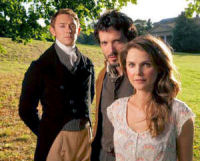
The heroine of the movie, Jane Hayes (Keri Russell) is a disheartened Jane Austen fan. Obsessed with the writer, she looks at her own life and sees failed relationships, a dead-end job and no future, so she decides to spend her life savings on a trip to England to resort called Austenland


Amadeus

A terrible way to triumph over God.

???????These are the words of 18th Century Italian composer Antonio Salieri (F. Murray Abraham) referring to his murder of the brilliant, meteoric Wolfgang Amadeus Mozart ((Tom Hulce). He tells the story to Father Vogler (Richard Frank) who has come to hear his confession at the insane asylum to which Salieri has been confined following a suicide attempt.

From an early age, Salieri was convinced that he could show God his love through composing music, but his father forbade it. When his father accidentally chokes to death, he becomes convinced that God had killed his father so that he could now compose music in His honor.  It seemed destined and his arrival in Vienna was followed by one success after another. By the time he was 24, he had been appointed court composer of Holy Roman Emperor Joseph II (Jeffrey Jones) and had attained fame for his operas and other works. As a child, Mozart was a prodigy and Salieri was very much aware of his budding genius. When Mozart arrived in Vienna, Salieri was eager to meet him. As he wandered around the palace looking for the young composer, he saw Mozart chasing a girl, Constanze (Elizabeth Berridge), giggling hysterically, and making vulgar jokes. Already aware of his own inferiority to Mozart, Salieri cannot understand why God would have chosen such a coarse vessel to express the most profound, holy music possible.

Mozart was presented to the Emperor in 1781, with a march of Salieri’s to welcome him, played by the Emperor himself. Mozart is clumsy socially and offends Salieri by playing the march back to them with perfect memory and then improvising to improve the composition into something great. Mozart thought “outside the box” and proposed to compose an opera in German, The Abduction from the Seraglio, that took place in a Turkish harem. Although the opera is a success, the Emperor proclaims that it “has too many notes” and that Mozart should “cut some out.” Mozart marries Constanze over the objections of his father, Leopold (Roy Dotrice). Although his opera has been a qualified success, Mozart struggles to earn enough money to support his lavish lifestyle. When Leopold comes to visit they go out on the town and end up at a costume ball, where Leopold dresses in black, with a mask of tragedy over his face and a mask of comedy on the back of his head. Playing musical chairs, Mozart loses and must pay a penalty. Although his father demands that he return to Salzburg, Mozart points out to him that the penalty must be served in the room. A friend makes him play in style of various composers and when he comes to Salieri, he makes a grim face and plays pompous music. Salieri, himself behind a mask, watches as Mozart ridicules him to the laughter of the entire party. He vows that he will get even with the boy somehow.

He hires a girl and gives her to the Mozart household anonymously as a servant so he can have a spy inside their apartment. Through her, he discovers that the young man is writing another opera, this one based on the play Figaro, which the Emperor has banned. Mozart is hauled before the royalty to explain himself and he is so brilliant and enthused that he convinces the Emperor to let him proceed. The Marriage of Figaro was destined to be a huge success, but when the Emperor yawns during the fourth act, it is doomed to a short run.

Salieri is so grieved that he turns his back on God and is determined to ruin His plans by ruining Mozart himself.  Every opportunity to ingratiate himself to the court is deftly put aside by Salieri, who continues to have the Emperor’s ear. Mozart’s debts grow deeper and he is thrown into an emotional landslide when his father dies. Drinking and carousing temporarily give way to work as Mozart composes the incandescent Don Giovanni, where the figure of his father appears to humble Mozart before him. With every brilliant advance of Mozart, Salieri’s hatred grows until he finally decided to do something about it. Appearing at Mozart’s door dressed in the same costume as Leopold at the party, Salieri commissions a Requiem (the Requiem Mass in D minor). Under the influence of this memory of his father and strapped for money, Mozart accepts the commission while at the same time promising a friend to compose something for the popular stage. With these two demands weighing him down, Mozart drinks more and burns himself out. When he goes out alone in the middle of the night to carouse until dawn with his friends, Constanze takes their son, Karl, and runs away. Grief-stricken, Mozart completes his friend’s commission, The Magic Flute, but is so worn out that he faints during the performance. Salieri sees this and escorts Mozart back to his apartment. Pretending to be his friend, Salieri goads him into finishing the Requiem, volunteering to help by writing down what Mozart dictates.

As they work through the night, Constanze returns to Vienna. When she arrives in the morning, she finds Salieri asleep on a sofa and Mozart passed out in bed. She orders Salieri to leave, but as they talk and argue, Mozart dies, his Requiem unfinished. He is buried in a pauper’s grave with other bodies, lye tossed in on top of him.

In the asylum, Salieri explains to Father Vogler that he had his victory over God in Mozart’s death and he forgives himself for his own mediocrity. Indeed, as he is wheeled away to his breakfast of sweets, he magnanimously forgives everyone for their mediocrity.

Does mediocrity always triumph?

What a brilliant concept to built a work of art!

This amazing screenplay was written by a terrific playwright, Peter Shaffer, based on his own stage play of the same name. The title could have been anything, but Shaffer’s choice of Mozart’s middle name was inspired. The translation of Amadeus is “God’s Beloved” and it serves as the basis of Shaffer’s thematic development. Salieri’s belief that God chose to speak through the vulgar Mozart served as his inspiration to impliment and drive this great tragedy to its conclusion. He serves himself up as an instrument of evil to bring about this “triumph over God.”

Director Miloš Forman, who saw the play before it opened, got in touch with Shaffer the moment the curtain went down and began to discuss the film he would make. Forman’s vision, combined with Shaffer’s script and Abraham’s performance combine to create one of the best films ever made. The movie won eight 1984 Academy Awards, including Best Picture (producer Saul Zaentz), Best Director, Best Adapted Screenplay, Best Actor (F. Murray Abraham), Best Art Direction (Karel Černý and Patrizia von Brandenstein), Best Costume Design (Theodor Pištěk), Best Makeup (Dick Smith and Paul LeBlanc), and Best Sound Mixing (Mark Berger, Thomas Scott, Todd Boekelheide and Christopher Newman). In addition, it was nominated for Best Cinematography (Miroslav Ondříček), Best Actor (Tom Hulce), and Best Film Editing (Nena Danevic and Michael Chandler).

With such an abundance of artistic contribution, it is hard to find a place to begin praising this movie, once you get beyond the writer and director, but the third wheel that accounts for its staggering success is F. Murray Abraham. Salieri, not Mozart represents the heart of the film and Abraham’s attention to detail in both time periods makes a two hour and forty minute tragedy actually work–and not just work, but work beyond what anyone might imagine as possible, especially for a plain, middle-aged actor. He infuses the character with such depth that he evokes sympathy for the villain, which is difficult under the best of scripts.

Added to this is sterling sound. With the brilliant music Mozart and Salieri on the soundtrack, the viewer is inundated with a variety of great listening pleasure. Salieri’s make-up in the asylum is terrific, the costumes are wonderful, and the art direction in general is first rate, creating 18th Century Vienna in glorious detail.

Although lengthy, the film moves quickly and time is not a factor. It passes so quickly, one hardly notices the length.

The only thing in the entire film that bothered me was the relentless American speech of Hulce and Berridge. They both give good, solid performances and Hulce was good enough to receive an Academy Award nomination, but throughout the film, I kept thinking that might have been from Cincinnati or Pittsburgh, but were definitely not Austrian.

Obviously, this didn’t bother me enough to ruin my enjoyment of the movie. It remains, today, one of the best films ever made and it will hold up long into the future. And it doesn’t matter if you don’t like classical music or not, the story is way strong enough to carry any viewer through till the end. It is a wonderful movie and a true tragedy that could be put up against any Greek tragedy and look good.

I highly recommend Amadeus as a classic that everyone should see!

The Worst Hard Time by Timothy Egan

Worst Hard Time DusterThe Worst Hard Time is terrific look at the dust-bowl days from the perspective of the people who lived through it. The epicenter, Boise City, Oklahoma is covered extensively, as is Dalhart, Texas, in the panhandle of that state.

In 1934, the panhandle was in its second year of drought. Wheat prices had fallen to the point where a farmer getting 25 cents a bushel was actually better off not planting any.  The Great Depression was already nearing five years deep and showing little improvement.  When Franklin D. Roosevelt assumed the Presidency in 1933, he immediately implemented plans to feed the starving, give conservation jobs to those where were down and out, stabilize stock prices by buying–and in many cases, killing–cattle that were starving, and eventually buying up land to fallow, replanting the grass that held it together once upon a time.  But by 1934, the unrestricted plowing of the Great Plains had created millions of acres of loose topsoil.  With no moisture to help hold it down, the relentless prairie winds picked it up, circulated it in the sky and then dumped it back down on the sodbusters, sometimes for days on end.  The dust was often finer than sifted flour, just constantly coming down, inhaled by cattle and people until it filled their lungs and stomachs and killed them.  When farmers were actually able to get a little something growing, it would be eaten by rabbits or grasshoppers who grew abundantly in the absence of their natural predators: birds, snakes, and coyotes.  Rabbit drives were organized to kill the rabbits, which provided at least one source of food outside government rations.  Seed sacks were saved and used to make clothing and some ranchers were so desperate that they harvested Russian thistle (tumbleweeds) to feed their cattle.  But the dust and sand storms were the true menace, piling up dunes of sand and soil that made it almost impossible to farm, to drive from town to town, to walk to school.  They filled the air with deadly particles and came relentlessly, sometimes for many days in a row, blackening the sky and creating midnight at noon

Author Timothy Egan does a masterful job of incorporating the stories of John McCarty, editor of the Dalhart Texan, cowboys Bam and Melt White, homesteaders Fred Folkers and Ike Osteen, Hazel Lucas, the undertaker’s wife, who struggled to have children in the land she loved, and a Nebraska farmer named Don Hartwell, who kept a diary of the decline and fall of the Great Plains.

The book also makes evident the government’s culpability in bringing about this catastrophe by encouraging settlers to farm on the arid high plains, an area that had previously been kept stable by Buffalo grass, bison, and Native Americans. By plowing under the grass, farmers invited the wind to pick up the soil, carry it high into the air, turn over in the atmosphere, and then dump it back down on them.  Not only was it the largest, shortest ecological disaster in American history, it was a medical nightmare with thousands dying from dust inhalation and children and elderly suffering from dust pneumonia.

Seeing this through the eyes of the settlers elevates the story far beyond a dry history recitation, into a powerful work of non-fiction.

The last 100 pages are full of a terrible irony, as hope for recovery from the drought is compounded by Black Sunday (a solid black cloud of dirt that rolled over the plains dumping tons of soil on the farmers until breathing was almost impossible) and those who had pledged to stay were driven from the land.

This is very powerful book, which I highly recommend.

Out of the Dust by Karen Hesse

Out of the Dust billie jo cover picOut of the Dust, by Karen Hesse (1997, Scholastic Press) is billed as a Young Adult novel. Although it certainly contains the structure of a novel, it sure doesn’t feel like one.  The reason for that is obvious and up-front: it is a collection of short, free verse poems in chronological order that collectively tell a coherent story.  Presented in the current Young Adult standard of first person present, the poems carry an immediacy that most poetry doesn’t and that immediacy is in the story itself.

Set in the Oklahoma panhandle near a small town, Joyce City, it comes at you in the voice of twelve year old Billie Jo Kelby, the only child in a family that struggles to survive the great Dust Bowl in 1934 and 1935.

The voice is clear and each small poem reveals more of her to us as we move forward. Some of the poems are only a few lines and some of them go on for two or three pages, but every single one is focussed in the girl’s heart.

Part of that heart is rooted in the land. In 1934, the Panhandle was in its second year of drought.  Wheat prices had fallen to the point where a farmer getting 25 cents a bushel was actually better off not planting any.  The Great Depression was already nearing five years deep and showing little improvement.  When Franklin D. Roosevelt assumed the Presidency in 1933, he immediately implemented plans to feed the starving, give conservation jobs to those where were down and out, stabilize stock prices by buying–and in many cases, killing–cattle that were starving, and eventually buying up land to fallow, replanting the grass that held it together once upon a time.  But by 1934, the unrestricted plowing of the Great Plains had created millions of acres of loose topsoil.  With no moisture to help hold it down, the relentless prairie winds picked it up, circulated it in the sky and then dumped it back down on the sodbusters, sometimes for days on end.  The dust was often finer than sifted flour, just constantly coming down, inhaled by cattle and people until it filled their lungs and stomachs and killed them.  When farmers were actually able to get a little something growing, it would be eaten by rabbits or grasshoppers who grew abundantly in the absence of their natural preditors: birds, snakes, and coyotes.  Rabbit drives were organized to kill the rabbits, which provided at least one source of food outside government rations.  Seed sacks were saved and used to make clothing and some ranchers were so desperate that they harvested Russian thistle (tumbleweeds) to feed their cattle.  But the dust and sand storms were the true menace, piling up dunes of sand and soil that made it almost impossible to farm, to drive from town to town, to walk to school.  They filled the air with deadly particles and came relentlessly, sometimes for many days in a row, blackening the sky and creating midnight at noon.

Hesse does an excellent job of creating her story in the midst of this environmental catastrophe. Billie Jo struggles to understand her father, who doesn’t talk much, but loves her mother desperately.  Her mother seems cold and hard, her few praises grudgingly given, probably because she envisioned more for herself than a dirt farm in the middle of nowhere.  Billie Jo learned to play piano from her mother and she remarks more than once that her mother has a beautiful, lilting voice.  Local musician Arley Wanderdale encourages Billie Jo to sit in with his band, the Black Mesa Boys at the Palace Hotel.  She has a serious crush on their singer, Mad Dog Craddock, who is a few years older, but she always has to approach her mother carefully to get her permission.  She plays with them whenever she can and picks up a few dimes that her mother sets aside for her.

Early in the book, her mother becomes pregnant and they all live in anticipation of a child in their household, but several compounded mistakes change their lives forever. Her father leaves a bucket of kerosene sitting near the stove and her mother, thinking it is water, begins to pour it into a pot to make coffee.  The heat of the stove ignites it and her mother runs outside to call her father.  Thinking it will burn the house down, Billie Jo grabs it and throws it out the door–just as her mother is turning to go back inside.  The effect is devastating.  Her mother suffers burns over most of her body and Billie Jo herself suffers terrible burns on her hands.  Her mother dies giving birth to her baby brother, who dies shortly afterward.

It seems to Billie Jo that she receives most of the blame, for throwing the pain, even though it was her father who should never have the kerosene anywhere near the stove. Blame is almost inconsequential.  Her father retreats into silence and Billie Jo suffers with her burned hands, unable to play the piano anymore.

To see how they cope with these trials, you will need to read the book, because I’m not going to give away any more information.

It is a novel. The way the poems are structured, the way the story unfolds, the arc of the characters, and the internal growth of Billie Jo–all this tells me that this is not only a novel, but a very good novel.

If the purpose of a novel is bring forth emotion in the reader, Out of the Dust is extremely successful.  Karen Hesse pulls us resolutely into Billie Jo’s world, brings us to deeply care about her character, and develops a coherent, beautifully written story.  The world feels real, but that world is only a backdrop for a landscape that exists inside a human being, coping with her own issues, trying to find herself in a moonscape that refuses to bring forth anything green.  That Hesse is able to find that wellspring inside the girl, to tap it, and bring it forth as if it were a gentle, soaking rain, is an admirable feat of writing!

A beautiful book. I highly recommend it, not only for Young Adult readers, but for everyone.

A Publisher’s Weekly Best Book of the Year

A School Library Journal Best Book of the Year

A Booklist Editor’s Choice

The Man Who Knew Too Much (1956)

Man Who Knew Too Much Stewart and DayNever endanger an American’s children. That is the advice given by a foreign minister to his English lackey when it is already too late for the villains in this remake of a film that Alfred Hitchcock originally directed in England before he crossed the pond.  Wishing to enlarge and improve on his earlier film, he teamed up with his signature actor and composer to produce this widescreen thriller in 1956.

An American family, Dr. Ben McKenna (James Stewart), his famous musical wife, Jo (Doris Day), and young son, Hank (Christopher Olsen) are touring Morocco after a medical convention in Paris, when Hank accidentally yanks the veil off of a Muslim woman and gets them in trouble. A Frenchman, Louis Bernard (Daniel Gelin) steps in helps them out of the jam, then invites them to dinner that evening.  Jo is suspicious of his many questions, but Ben shrugs it off.  Passing an English couple, Edward (Bernard Miles) and Lucy (Brenda De Banzie) Drayton at their hotel, Jo again suspects that they are being watched. That evening, a strange man appears at their door during cocktails and it excites Bernard enough that he leaves them.  They meet the Draytons at the restaurant and Lucy admits that she recognized Jo from a London concert and the two couples have dinner together.  When Bernard appears at the restaurant with a date and ignores them, Ben gets upset, but Jo soothes him, complaining that he gets upset too easily.

The next day, in the bazaar, Bernard, dressed in desert costume and make-up is stabbed in the back. As he is dying in Ben’s arms, he tells him that a statesman will be assassinated at Albert Hall in London and that he needs to tell the authorities there to beware of Ambrose Chapell.  Lucy offers to take Hank back to the hotel while the police question Ben and Jo.  Called aside to the phone, Ben is told that he must not tell anyone what the dying Bernard told him or Hank may suffer.  Later, Ben discovers that Lucy never returned to the hotel and that the Draytons have checked out.  Ben sedates Jo before he tells her that Hank is missing, but she is overwrought until the drug takes effect.  Determined to get Hank back, they go to London to follow up on the message that Bernard gave them–and a date with Albert Hall.

At two hours, this movie runs a little long for its thin plot. Some of that time is occupied with several songs the studio put in for Doris Day, some of it is frittered away in the Marikesh bazaar.  A good deal of the time is used in the Albert Hall music leading up to the attempted assassination.  When it is all added up, this film, among all of the Hitchcock canon, seems a little indulgent.  The suspense that the director is so well-known for is definitely present, but at a slightly lower key than in his other films.  The color seems a little too bright, the rear projection effects a little too stark.

Although many scenes in the beginning of the film were actually shot in Morocco, the studio cutaways feel like movie sets. In all, the pace is just a little too slow to be an altogether successful movie.

James Stewart is good as the American doctor and Doris Day, who was a popular singer at the time, not well-known for her acting, does quite well. The script handles the two roles quite well, inserting quirks that make them more human.  Jo’s outward calm, for example, is balanced by her inability to cope with the loss of their son.  Her husband, aware of this vulnerability, convinces her to take medication before revealing that their son has been kidnapped.  Ben himself is just the opposite.  He is easily angered and tends to respond without thinking, yet when the chips are down, he is calm and steady.  The two characters and the two actors are very good foils for each other.

The supporting acting and the script for the supporting characters is less well defined. Many times, I had the feeling that I was watching stock characters from the films of the forties.  The notable exception to that is the entourage of Jo’s friends in London, who all seem to be more interesting and well-developed, especially given that they have little time on the screen.

It is also unusual for Hitchcock that the comedy seems a little forced in this movie. The action in the restaurant, for example, where Stewart cannot fit his long legs under the short table seems funny and first, but then it is continued and grows old.  Likewise, the action in the taxidermist’s shop in London seems contrived and unnatural.  Normally, Hitchcock develops his comedy directly from the script–it is organic to the action and thus seems completely natural.

Although it is most interesting to see a concert at the Albert Hall, and is even more interesting to see Hitchcock’s musical collaborator, Bernard Herrmann, directing the London Symphony. Unfortunately, the sequence goes on much too long and the tension is not as heightened as it usually is in a Hitchcock film.  And that leads to the final, nearly torturous scene in the foreign embassy that climaxes with a gimmicky solution.

I generally love to watch Hitchcock’s movies, but any time I find myself looking at my watch during the show, then the movie has failed on the most fundamental level: keeping my interest.

The Best Years of Our Lives

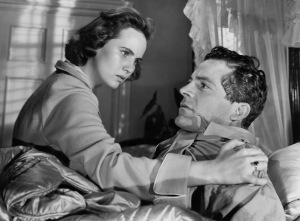
teresa wright & dana andrews - the best years of our lives 1946The stark reality of surviving life after war is best faced with the aid of friends and loved ones and that is story that is told in this 1946 film which remains one of the best films ever made.

At the end of World War II, three men meet hopping a military plane back to their home, a fictitious mid-western metropolis called Boone City. The officer in the group, Fred Derry (Dana Andrews) is returning to Marie (Virginia Mayo), a wife he barely knows, since they were married less than 20 days before he shipped out.  Although he was just a soda jerk before the war, his heroism as a bombardier in the Air Force brought him up to the rank of Captain.  Fellow passenger Al Stephenson (Frederick March), is a former banker who served as a Sergeant First Class in the Army.  The oldest and by far the wealthiest of the three, he is returning to his wife, Milly (Myrna Loy) and children, Peggy (Theresa Wright), who is in her early twenties, and Rob (Michael Hall) who is a freshman in college.  The third member of their party is Homer Parrish (Harold Russell), a Navy man who lost both of his hands when his aircraft carrier went down in the Pacific.  A former quarterback, he now uses two hook prosthetics that he is quite deft with, but when he left for the service, he was engaged to his childhood friend, Wilma (Cathy O’Donnell) and now he worries how she will accept his apparent disability.

Although all three men are looking forward to their return home, there is also a deep feeling apprehension. They’ve all seen intense action, watched friends die, and suffered the many tortures of war.  How will their civilian loved ones receive them?  Will they ever be able to relate to anyone who hasn’t experienced battle?

Taking a cab together, they look around their old home town and Homer tells them about his uncle Butch (Hoagy Carmichael) who runs the best bar and café in town. Attempting to avoid the reunion with his family, he suggests that they get a drink first, but the others agree to meet at Butch’s some time for a drink.  As Homer expected, his family is hyper-sensitive to the loss of his hands and he feels estranged from Wilma, although she shows him that she still loves him.  He is haunted by the feeling that everyone is ether staring at his hooks or purposely looking away–he is different and he feels that difference intensely.

After checking in with his parents (Gladys George and Roman Bohnen), Fred goes looking for his wife, but she is not at her apartment, having already gone to work at her nightclub job, so he ends up at Butch’s.

Al has a difficult time adjusting to the fact that his children have grown up while he was away and he is nervous and edgy. When Milly finds that they are out of liquor, Al decides to go out on the town with her and Peggy.  During the course of the evening, Al gets progressively drunker, but they finally end of Butch’s and find Fred, who is already pretty well tanked himself.  After Homer spills a glass of lemonade in front of Wilma and the two families, he leaves in frustration and also ends up at the bar.  The three of them are like people out of time and out of place and getting drunk seems the only way to deal with having to face this return to civilian life.  Peggy takes a shine to Fred, even though he is pretty well gone.  They take him back to his wife’s apartment building, but there is no answer when he rings the bell and he passes out in the doorway, so Milly and Peggy load him into the back seat of the car with Al, who is passed out.

Back at Al and Milly’s apartment, Peggy puts Fred in her room, loosening his tie, taking off his shoes and tucking him in while Milly does the same with Al in their bedroom. Peggy sleeps on the couch, but during the night she hears Fred calling out in his sleep.  He’s having a nightmare, reliving the loss of a friend’s life.  Peggy wakes him and calms him, wiping the sweat from his face and he falls back into his drunken sleep.  In the morning, he can’t remember where he is or that Peggy is Al’s daughter.  She enlightens him over breakfast.  When Milly joins them, Peggy gives Al a ride back to his wife’s apartment and Milly busies herself with trying to salve a very hungover Al.

Marie is a gorgeous blond and obviously lives in a completely different world of nightlife, money, and men, but when Fred tells her to quit her job, she agrees and tries to support him, even though he can’t find a job. When the money runs out, however, she can’t stand the idea of being poor and their relationship begins to suffer.  Finally, he takes a job working in his old drug store, spending part of his day at the perfume counter and part of it as a soda jerk.

Meanwhile, Al receives a call from his former boss at the bank, Mr. Milton (Ray Collins). They not only want to take him back, but to promote him to Vice President in charge of handling GI loans.  Al is uncertain about going back to work at the bank, but the offer is too good for him to pass up.  Early on, he receives an application from a former Navy officer who wants to buy some land to begin farming.  Although he has no collateral, Al approves the loan and is then counseled by Mr. Milton that they simply can’t do business that way.  Al tells him that the man’s collateral is in his heart, in his guts, and in his patriotism, but they part ways each seeing the situation differently.

When Peggy runs into Fred at the drugstore, he takes her out for lunch and then kisses her in the parking lot. They are in love, but the situation of his marriage is a firm impediment.  That afternoon, Peggy calls Marie and invites her and Fred to join she and her date for a night out, hoping that if she sees Fred and Marie together, she’ll get over her infatuation with him.  It coincides with a bank banquet at which Al is the guest of honor.  Before they all leave for the evening, Peggy confesses to her parents how she feels about Fred and that she is going to use the evening to get over her feelings.

At the banquet, Al again drinks too much. Milly watches him with apprehension and when he is invited to speak, he tells the assembled that the only way America won the war was by taking risks, by stepping in even when there was no collateral and getting the job done.  At the same time, Peggy is sizing up Marie and finding out that Fred is in a loveless marriage to a woman who is not worthy of him.  When she gets home, she tells her parents that she is intent on breaking up Fred’s marriage and having him for herself.  While all of this is going on, Homer has isolated himself, convinced that he is no longer worthy of Wilma.

This film comes with a stunning pedigree of collaborators. Producer Samuel Goldwyn got the original idea from a Time Magazine article about the difficulties of servicemen returning home.  He spoke with novelist McKinlay Kantor about writing a screenplay and Kantor produced a novella in blank verse called Glory for Me, which was adapted into the screenplay for The Best Years of Our Lives by the brilliant playwright Robert E. Sherwood.

Director William Wyler, who flew in combat missions over Europe during World War II as a cinematographer, was signed to direct. Although he assembled a top notch cast of well-known Hollywood actors to play most of the parts, he wanted to part of Homer Parrish to seem as real as possible, changing the character from a man with a psychological disorder to a tangibly physical manifestation.  It was this director’s decision that led to the casting of  Harold Russell, a non-actor in the critical role. Russell lost both of his hands while handling explosives making a training film.

The film taps deeply into human emotions. Almost from the very beginning, the viewer is led into the emotional landscape of each of the three men and feels a deeply human bond with them.  Wyler brings forth the best that each actor has to give in crafting a deeply felt, realistic portrayal of human being struggling with recovery after traumatic experiences. 

One might think that this film is all about the men, but it is definitely about the women, too. Frederick March and Dana Andrews give deep, emotionally valid performances as Al and Fred, but Myrna Loy and Theresa Wright are both amazing as Al’s wife and daughter.  Throughout the early scenes after the men return home, you can feel the women’s love and empathy as the stabilizing factors.  For an amateur, which Russell must be considered, his performance is beautiful and deep.  Never for a one moment does the viewer feel a false step in his acting, but the role of his fiancé Wilma has its own difficulties.  To be so good and true is almost impossible to achieve without seeming false, but Cathy O’Donnell’s eyes show the heart of the little girl who loved Homer and child and still holds him dear.

The movie is full of amazing little performances. Roman Bohnen as Fred’s father is mesmerizing in his brief few minutes.  Virginia Mayo gives unexpected depths to Maria, a part that might have been played as a simple tramp with no heart.  All of these performances add up to a movie that is completely compelling.

In glorious black and white.

I still consider this movie one of the ten best films ever made. It was certainly amply rewarded at the Academy Awards, taking Best Picture, Best Director, Best Actor (Frederick March), Best Screenplay, Best Supporting Actor (Harold Russell), Best Music (Hugo Friedhofer), and Best Film Editing (Daniel Mandell).  At two hours and forty-eight minutes, it’s a miracle that it even held anyone’s attention, but it is so well acted and directed, so well put together that time is no object here and time is something I take very seriously indeed.  For any movie to keep me engaged for much over an hour and a half, it must be a truly special film and there is no doubt that The Best Years of Our Lives is a very, very special film.

The emotional engagement is a such a level that once begun, it is difficult to disengage until it is over. Emotional involvement is so important, so much a part of what makes a good movie that it is truly elevating.

This is a very special film and as important and vibrant today as it was in 1946. It should be a part of every serious film buff’s film library and it should be watched every few years, just so we never forget what a truly great film can be.
The Big Sleep

The-Big-Sleep Bogart BacallThis 1946 film adaptation of Raymond Chandler’s hard-boiled detective novel remains one of the best films ever made for a variety of reasons.

Start with Chandler’s novel, written in a unique voice and style, that delved into the underworld of big city vice, using dangerous and edgy behavior that were normally hidden from the public eye: pornography, promiscuity, and homosexuality. Phillip Marlowe stood out as a character.  He was mature, worldly, manly, direct in a way that even criminals found disarming.  Finally, you have a plot that wastes no time on deliberation or description.  It moves forward relentless, with a certainty that is not obvious until the reader finds himself breathless in wonder.

The film is directed by the brilliant Howard Hawks, who understood the story arc and knew he wanted to make a film that wasted no time. He hired the same writers who had fashioned his 1944 adaptation of Ernest Hemingway’s To Have and Have Not, the great novelist William Faulkner and science fiction/crime wizard Leigh Brackett (one of the first women to break through into either genre) and told them to waste no time.  Unlike other screen adaptations, he wanted this one to leap directly from the page to the screen.  Working separately on different parts of the book, they finished the first screenplay in eight days.

Private eye Phillip Marlowe (Humphrey Bogart) is called to the mansion of wealthy retired General Sternwood (Charles Waldron). With two wealthy, bored daughters who move in a racy crowd, the old man finds himself blackmailed with the gambling debts of his youngest girl, Carmen (Martha Vickers).  Sternwood’s former detective, Sean Regan, an old acquaintance of Marlowe’s, has disappeared.  Before leaving, Sternwood’s older daughter, Mrs. Vivian Rutledge (Lauren Bacall) asks him if he has been hired to find Sean Regan, who had been seriously interested in Carmen, but he won’t tell her anything, but the wisecracking and banter between them creates a sexual tension that is palpable.

Marlowe begins by investigating the man who holds the gambling debts, a rare bookstore owner named Geiger, but he discovers the man’s assistant, Agnes Lowzier (Sonia Darrin) knows nothing about rare books and she stonewalls him on her boss. Hiding out in a rival bookstore across the street, he spends a rainy afternoon with the sexy proprietress (Dorothy Malone) before following Geiger home.  Waiting in the car, he hears gunshots, sees a car roaring away, and then finds Carmen inside, high as a kite, with Geiger’s body on the floor before her.  He finds a camera hidden inside a statue, but the film is missing.  Looking around, he finds Geiger’s notebook, filled with names and unreadable ceiphers.  Taking the book, he returns Carmen to the Sternwoods and finds that Mrs. Rutledge has no answers.

An old friend, Police Detective Bernie Ohls (Regis Toomey) brings Marlowe along when they fish a car out of the ocean just off a local pier. It belongs to the Sternwoods and the driver turns out to be a former Sternwood chauffer who had also been in love with Carmen.  It has been made to look like a suicide, but the driver had been killed before the car was driven off the pier.

Mrs. Rutledge appears at Marlowe’s office the next morning with scandalous photos of Carmen and a new blackmail demand from a small time gambler named Joe Brody (Louis Jean Heydt). She can get the money through her friend, gangster Eddie Mars (John Ridgely).  Marlowe says he will wait for her call that night before the $5,000 in blackmail money will be paid.  During the day, he tails Brody to his apartment.  That night, Mrs. Rutledge puts him off, but on a hunch, he goes to Brody’s and finds not only Agnes, but Mrs. Rutledge as well.  Although held at gunpoint, he puts together the sequence of events as he understands them.  The chauffer had actually killed Geiger and taken the photos, but Brody stopped him and confiscated them to bribe the Sternwoods, which he had done before.  Marlowe suspects that Brody killed the chauffer, but Brody maintains his innocence and that killing remains unsolved.  Carmen shows up with a gun, demanding the photos.  Marlowe easily disarms all of them, but before he can get more information from Brody the man is shot through the door.

It is a complicated and twisting plot, but it moves forward relentlessly. The smart, sharp dialogue crisply moves the story along and renders it secondary really to the underplot: the growing relationship between Marlowe and Mrs. Rutledge.

When Hawks directed To Have and Have Not, he knew he’d found the ideal screen couple in Bogart and Bacall, so he was determined to reunite them for this movie.  By that time, their off-screen romance was big news in Hollywood and the pairing was natural.  With a great script and an excellent cast, Hawks shot the film in 1944, but it was kept on the shelf for two more years, partly because Warner Bros. was working feverishly to release all of their wartime films before World War II was over and partly because there were problems with Bacall.  After the huge hit with To Have and Have Not, she was considered a hot property, but her follow-up film, Confidential Agent, was a flop and she’d been widely panned in reviews.  Her agent, Charles K. Feldman, wrote a letter to Jack L. Warner, asking that several scenes in The Big Sleep be re-shot and the film re-edited to take advantage of Bogart and Bacall’s screen chemistry.  Warner agreed and the two actors were called in to film additional scenes, including the now famous scene in the restaurant that is full of sexual innuendo.

The Big Sleep Martha Vickersbig-sleep-dorothy-malone-humphrey-bogart-toastingbig sleep_cab-driver

One thing that becomes apparent right from the beginning of this movie is that beautiful young women are used in abundance to help create a strong feeling of free sexuality. It begins when Marlowe arrives at the Sternwood residence and the gorgeous Carmen walks in wearing a really short skirt and throws herself into his arms.  Then, you meet Mrs. Rutledge and Lauren Bacall shines as a young urbanite living life on the edge.  It continues with the girl at Acme Books, played by Dorothy Malone, who unpins her hair and closes the store to spend an afternoon drinking rye whiskey with Marlowe.  Then there is the female taxi driver that Marlowe rides with who gives him her card and tells him to call her at night when she’s not working.

In the pivotal scene between Bogart and Bacall that was re-shot, the two of them are talking about having a relationship in terms of horse racing. She wonders just how far he will go and he replies that it depends on her.  Is she willing “to go all the way?”  This tightly wrapped sensuality, contrasted against the violence, the mystery of not knowing exactly what is happening in a plot that moves forward darkly, relentlessly creates a movie that almost impossible to stop watching.  It moves that way right to the end, when we finally sense that Marlowe and Mrs. Rutledge will be able to consummate their smoldering desires.

Shot in beautiful black and white, the film has been restored to allow modern viewers to see it as released in 1946. The DVD also includes a documentary on the two versions of the movie, showing scenes that were cut and added, so viewers can see how much the film was improved by the re-shoot.

It is every bit as strong and engaging today as when it was first released and that is one reason it will always be considered a classic, perhaps the very finest example of film noir and one of the best movies ever made.

Becoming Jane

Becoming JaneOur general fascination with all things Jane Austen continues with this 2007 fictional glimpse into one short period of her life: that time when she was attracted to Tom Lefroy and would have formed an engagement if not for the objections of his family. I say fictional because the filmmakers have taken considerable license with what we understand as historical fact.  This is something movies do all of the time, but with Jane Austen it is best to take special care because her fans are quite dedicated.

It is a Sunday morning in 1795 in Hampshire, England. At the cottage of the Reverend George Austen (James Cromwell), youngest daughter Jane (Anne Hathaway), toils away at her writing while her sister Cassandra (Anna Maxwell Martin) and the others sleep.  When the servants get to work, Jane begins to play her piano loudly to wake everyone up.  Cassandra has just become engaged to Robert Fowle (Tom Vaughan-Lawlor) who must travel to the West Indies to earn his pulpit.  The local grand dame, Lady Gresham (Maggie Smith) is resolved that her nephew, Mr Wisley (Laurence Fox) will marry Jane, despite her poverty, but Jane is much less certain.  She desires to marry for love, not money, as is the custom.

Meanwhile, in London, young law student Tom Lefroy (James McAvoy) drinks and carouses his way into the bad graces of his uncle, the Lord Chief Judge of the high court (Ian Richardson). Although he comes from a poor Irish family, his uncle is without heirs and Tom depends on the possible inheritance as the only way his family can survive.  After a night of drinking, Tom arrives late to court and his uncle berates him for his lack of decorum.  As punishment, and as a possible tonic for his Tom’s decadent lifestyle, his uncle sends him to the country to stay with relatives.

Arriving bored and angry, his friend Henry Austen (Joe Anderson) invites him to attend a tea to celebrate Cassandra and Robert’s engagement. Jane reads a lengthy, comedic tribute to the happy couple, but later overhears Tom disparaging her writing. In a pique of anger, she burns her marriage tribute and questions her other writing.  Henry, one of Jane’s older brothers who has just graduated from Cambridge, has also brought a priggish friend, John Warren (Leo Bill) to the party and he becomes smitten with Jane, although she finds his bumbling manner offensive.  Tom’s relations include his cousin, young Lucy Lefroy (Jessica Ashworth) who has a crush on Tom and hopes to make a match with him.  A member of the Austen party is Jane’s cousin, Eliza, the Comtesse de Feullide, who had been married to a French count, beheaded during the Revolution.  She takes a shine to Henry and hopes that her wealth will provide a means for him to become an officer in the English Navy.

Walking in the woods, Jane encounters Tom and they exchange uncivil words, but despite his criticism of her writing, Tom sees her intelligence and wit and is attracted to her. During an accidental meeting in the Lefroy library, he gives her a copy of Henry Fielding’s Tom Jones so that she can experience a more visceral form of writing.  When they discuss the morality of it, he remarks that good people can come to a bad end, but Jane has already grasped the prime purpose of what a good novel should be.  “A novel should reveal the true source of our actions,” she tells him.  This is the heart of good fiction: action must be organic.

Mr. Wisley finally asks to Jane to marry him, but she cannot in good conscience say yes to him. She doesn’t love him, although she is beginning to respect him.  Her mother (Julie Walters) is very distressed by this refusal, but her father takes it more in stride.  Even so, he is realistic about the world.  “Nothing destroys spirit like poverty,” he tells Jane.  But Jane wants to marry for love and gradually realizes that she loves Tom.  At a ball, Lady Gresham confronts Jane, telling her explicitly that her nephew’s offer of marriage is the best that Jane can ever expect in her life and that she has a duty to her impoverished family to accept.  Outside, by the fountain, she and Tom profess their love to each other and pledge that they will try to find a way to make it work.

On the way to visit Jane’s older brother, Edward, Tom invites Jane, Eliza, and Henry to stay with his uncle in London, hoping that Jane will make a good impression, but at dinner, Jane contradicts the Lord Justice on the nature of irony and falls into disfavor. Unable to sleep, Jane begins drafting a new story, First Impressions, which turned out to be the first draft of Pride and Prejudice.  Before Tom can tell his uncle that he wants to marry Jane, the Lord Justice receives a letter informing him that Jane is a penniless husband-hunter.  He turns his back on them and Tom has only one option if he wants to inherit his fortune: he must abandon Jane.

Directed by Julian Jarrold, the movie was filmed almost exclusively in Ireland, with assistance from the Irish Film Board, mostly because Hampshire had become too clean and modernized. It is a beautiful film, no doubt.  The cinematography by Eigil Bryld brings the English countryside to life, even if it was filmed in Ireland.  Trust me, you won’t notice the difference.

The script, drafted by Sarah Williams and finalized by Kevin Hood, was based on a the book, Becoming Jane Austen by Jon Hunter Spence, uses some historical facts, but mashes everything up to create a good romantic film.  The best of it provides terrific glimpses into influences on Austen’s writing, such as Lady Gresham’s remark that there is “a lovely-ish wood” nearby that Jane and Mr. Wisley could walk in or Wisley’s fragmentary remark that “it is a truth universally acknowledged.”  Certainly Lady Gresham bears a striking resemblance to Lady Catherine de Bourgh and there is evidence that she used her own mother and father as models for Mr. and Mrs. Bennet.  Jane’s relationship with Cassandra is compared to Lizzie and Jane, but they could also be Elinor and Marianne from Sense and Sensibility.  The bumbling John Warren is very close indeed to Mr. Collins.  All of this is extremely well done, if a trifle obvious in places.  It is a witty and emotional script, very well written.  However, if readers are seriously interested in Jane Austen’s life, I would recommend the biography Jane Austen: A Life, by David Nokes.  This is an excellent book and is much more factual than the movie.

The acting is first rate, especially the supporting cast. James Cromwell and Julie Walters as Jane’s parents are terrific, as are Maggie Smith, Ian Richardson, and Anna Maxwell Martin.  Helen McCrory is remarkable as Mrs Radcliffe, the author of The Mysteries of Udolpho, whom Jane meets on her stopover in London.

James McAvoy brings a lot of soul to Tom Lefroy, elevating him far beyond the carousing rascal he starts out as, into a man who must carry his own pain with him throughout his life.

Jane Austen Portrait

But the movie is centered around Jane Austen and Anne Hathaway’s performance is critical to the movie’s success. I have read that many English critics have found fault with her English accent and others are affronted by the fact that she is American and not English.  These things did not bother me.  And I found her performance to be very strong and very affecting.  She amused me and moved me and must be accorded as giving a very good performance.  My only issue is personal.  I have a certain view on Jane Austen that has been fostered by my own reading, by my study of her biography, and by the one picture that seems to capture her essence.  I think her weight was an essential part of her character, that her own roundness helped to reveal who she was.  Hathaway is thin, she looks harshly angular and skinny and despite her truly remarkable performance I simply could not accept her as Jane Austen.  Perhaps this is a failing on my part, but I would have much preferred to someone a little closer to Jennifer Ehle, who played Elizabeth Bennet in the BBC Pride and Prejudice.

anne-hathaway-becoming-jane-GC

I was also a little irked by the historical inaccuracies. For one thing, Jane Austen was incredibly well-read and was certainly familiar with Fielding’s Tom Jones as a classic of the times.  I also found it troublesome that she would consider eloping with Tom Lefroy.  Austen was a girl of her times and would not pull a Lydia Bennet.  Their daft brother, George, was secreted away and the family never saw him, yet here he is included as if they saw him every week.

These are, of course, minor objections in a movie that largely succeeds and makes a worthy addition to film canon of Jane Austen. Everyone who is deeply into Austen should see the film and make up their own minds.  For my part, I liked it in spite of myself.  I was moved by both Jane and Cassandra and I loved their relationship.  It is probably quite close to their real relationship and is very moving.  Overall, I found the movie to very affecting and I must recommend it.