We Bought a Zoo!

we_bought_a_zoo_p

We Bought A Zoo! is a friendly little movie released in 2011, based on the memoirs of the same title by Benjamin Mee, who bought his own zoo in England. The movie transports the story to California and changes history in other ways to make a good movie.  The always entertaining Cameron Crowe, (Almost Famous, Elizabethtown) directed the film and wrote the script from an earlier version by Aline Brosh McKenna.

Benjamin Mee (Matt Damon) struggles to raise his two children, a 14 year old son, Dylan (Colin Ford), and a seven year old daughter, Rosie (Maggie Elizabeth Jones) after the death of his wife (Stephanie Szostak) from some abrupt disease (cancer?). Dylan can’t seem to cope and acts out at school, eventually getting expelled from school for theft.  He is an aspiring artist and spends most of his time making violent and dark ink drawings.  Rosie is well adapted to the loss, although she misses her mom and frequently asks Benjamin to tell her stories so she doesn’t forget.  Like Dylan, Benjamin cannot deal with the loss.  Frustrated, he quits his job as an adventure and travel writer—over the objections of his brother, Duncan (Thomas Haden Church)—and begins to look for a house more isolated from the city.

After looking at a number of houses with Rosie, they are steered to a country property by a novice realtor (J.B. Smoove). There is just one catch: it is a zoo and ownership of the property includes continued maintenance of the zoo.  Benjamin is very reluctant, but seeing Rosie with a flock of peacocks changes his mind and he invests his entire savings in the project, with the goal of re-opening the zoo on July 7.

Rosie is enthralled and remarks several times with great charm, “We bought a zoo!” This zoo comes with attendants, of course.  The woman in charge is young Kelly Foster (Scarlett Johansson), who is not professionally trained, but advanced through the ranks to get her job.  There is a designer, Peter MacCreedy (Angus Macfadyen), a carpenter, Robin (Patrick Fugit), and Kelly’s 13 year old home-schooled cousin, Lily (Elle Fanning), who takes a shine to Dylan.

There are, of course, complications, not the least of which is Dylan’s continuing funk and Benjamin’s own frustrations. An inspector, Walt Ferris (John Michael Higgins) adds to their woes by presenting an expensive list of improvements that must be made before the zoo can open.  Tapped out, Benjamin begins to think that the project might ultimately fail.

The movie punches all the right buttons. The potential overdose of sugary sweetness is balanced by Benjamin and Dylan’s conflict and their grief over the loss of Mrs. Mee, but there’s still a lot of sugar. And eye-candy. Matt Damon is terrific, handsome, likeable, and extremely empathetic and so is Colin Ford. Of course, there is also the great beauty of Scarlet Johansson and Elle Fanning.  Johansson is very believable and empathetic as Kelly.  Those who aren’t beautiful are odd looking goofballs, such as Church, Smoove, and Higgins. At times, a little directorial discretion regarding these comedians might have helped the film.

Crowe also indulges himself profusely in the “cute” factor, not only with the character of Rosie, but in a great many shots of the zoo animals. Maggie Elizabeth Jones is at times almost unbearably cute, but she never fails to delight and shows a great deal of acting skills for a child.

It’s a very good movie for kids and for the family. I love cute little girls, sympathetic plot lines, beautiful people, and animals, but I also have great sympathy for those who lose loved ones to cancer, so I bought the movie, hook, line, and sinker.  I would gladly see it over and over, because it is a really entertaining “feel-good” movie.

Just remember, “20 seconds of courage” can change your life!

John Adams HBO Miniseries

John and AbigailExecutive Producers Tom Hanks and Gary Goetzman assembled a great team to bring Pulitzer historian David McCollough’s book John Adams to life in this seven part HBO miniseries.  It is a beautiful, gritty and moving account of the life of our second President, John Adams and his wife Abigail, beginning on the evening of the Boston Massacre in 1770 and continuing until Adams’ death in 1826.

Adapted by Kirk Ellis and directed by Tom Hooper, the lengthy film might have easily lost its audience, but brilliant performances by Paul Giamatti as John and Laura Linney as Abigail stir interest even in what might have been some long segments.

The son of a “shoemaker and farmer,” Adams’ keen intelligence made him one of the keenest attorneys in Boston. At first repelled by mob violence, he was forced to become a patriot by King George’s harsh measures against the Massachusetts colony.  When asked to serve in the first Continental Congress, he went unwillingly, but his commitment to the ideals of freedom gradually molded him into the “firebrand” that pushed and forced the difficult birth of a nation.  In all of this, his wife Abigail was the “ballast” that kept him on point, yet his long absences were extremely difficult for her as she raised their three children, sons John Quincy and Charles, and daughter Nabby on their family farm, Peacefield.

Working with Benjamin Franklin, Adams convinced Thomas Jefferson to author the Declaration of Independence. Once that great document was complete, he was dispatched to France to assist Franklin with obtaining French assistance in the war with England.  When Franklin found Adams’ direct diplomacy to be a liability, he wrote home requesting that Adams be removed from the mission.  Seeking assistance from the Netherlands, Adams became gravely ill and suffered from his separation from Abigail and his belief that he was a failure.

The end of the war saw Adams appointed as the first Ambassador to England and he had Abigail join him in Europe while their children were sent off to school. He and Abigail became close friends with Jefferson, who was the Ambassador to France.  Although living far away from the new nation, Adams grieved over the forming of political parties, which, he thought, divided the nation.  When he returned, however, he was elected George Washington’s Vice President and served in that capacity through two terms before he himself was elected President by a razor-thin margin.

His presidency was marked by the desire of the American people for war with France, which he opposed and during this time, Jefferson became his political enemy, along with George Washington’s adjutant Alexander Hamilton. The Congress passed the Alien and Sedition Acts and Adams, his political back against a wall, signed them into law, against his own better wishes, and clearly against the Constitution of the United States. It would haunt him throughout the rest of his life.

The heart of the miniseries rests with the two principal actors. Paul Giamatti is perfect as John Adams. Not only does he look the part, but his attention to detail is positively absorbing.  He ages over fifty years during the course of the show and you see the weight of his decisions on his shoulders, the weight of his separation from his family, and ultimately, his love of freedom.

Laura Linney has toiled virtually unknown for many years now and it is great to see her finally in a leading role that allows her to use all of her talents in the creation of a marvelous character. Most of the story concerns the relationship of John and Abigail and the brilliance of her acting lights the story.

The supporting actors are all pretty good and most of them look the parts they play, which is itself kind of a miracle, but there are some performances that are so understated that one might have wished a bit more liveliness. David Morse, for example, looks the part of George Washington completely, yet his performance is quite understated.  Stephen Dillane, however, not only looks the part of Thomas Jefferson, but his understated performance comes off as more studied and deeper.  Tom Wilkinson makes a delightful Benjamin Franklin.

More interesting, however, are the children of John and Abigail and the family that surrounds them in their domestic lives. The child actors who play them as children are believable and even affecting in their small roles.  Among the adult actors, Sarah Polley is extraordinary as Nabby (Abigail Adams Smith).

I tend to have difficulty with long films. There are notable exceptions, of course, and this is one.  The style of art direction, costume, and especially make-up set this drama aside from most.  In producing period dramas, the temptation is go overboard and to make everything beautiful, usually so far beyond reality as to be alienating.  In John Adams, the producers have labored to create a sense of reality and that is part of what makes this a great film.  The skin blemishes, the heat under the wigs, the decaying teeth, the stained clothing, the dirty, muddy streets, candlelight, oil lanterns, and what seems now to be brutal, primitive medicine all play a major role in this creation.

It is both excellent television and excellent film-making. Stick with it and you will be rewarded with an incredible little fact at the end, something that surprised me very much.  This is a deeply moving television experience!

The Cowboys

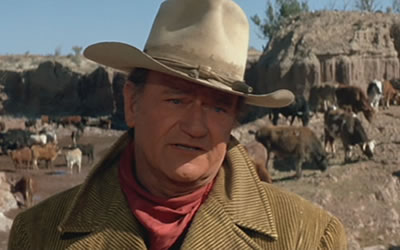
John WayneThis 1972 coming of age western stars John Wayne as Montana rancher Wil Anderson.

When his hands abandon him to join in a gold rush, Anderson solicits the aid of local schoolboys to help him move his herd of cattle and horses 400 miles to market. Among the boys is Slim (Robert Carradine), Charlie Schwartz (Stephen Hudis) and a Hispanic outcast, Cimarron (A. Martinez).  A gang of men ride in before they leave.  Led by Long Hair (Bruce Dern), the ex-convicts want to join the drive, but when Anderson catches Long Hair in a lie, he refuses to hire them.  A black cook, Jebediah “Jeb” Nightlinger (Roscoe Lee Browne) shows up and applies to drive the chuck wagon.

The boys learn about hard work, whiskey, and death along the trail and are forced by circumstances to grow up quickly.

The screenplay by Irving Ravetch, Harriet Frank, Jr., and William Dale Jennings, based on Jennings’ novel of the same title, is a little long. In fact, the movie begins with an Overture and contains an Intermission, like Gone with the Wind or Ben-Hur, but this film is not in the mold of those movies and it seems more than a little pretentious to present it as if it was an epic.  The music by John Williams seems like typical cowboy movie music, both self-important and overblown.

Roscoe Lee BrowneMost of the performances are very good, especially Wayne and the boys that make up most of the cast. Probably the best acting in the film was accomplished by Roscoe Lee Browne, who creates a completely believable, three-dimensional character.  Sarah Cunningham is very good as Wil’s wife Annie, but Slim Pickens gives us nothing more than his usual self as local bar owner Anse Peterson and Colleen Dewhurst has a short, wasted performance as Kate Collingwood, the Madam of a traveling cathouse.  The most disappointing performance, unfortunately, is Bruce Dern whose sneering, one-note villain is almost laughable.

The movie is pretty good, however, considering its drawbacks. Going in, I worried that the angle with the boys doing the cattle drive would be hokey (and some of it is), but for the most part Wayne and the boys carry the film.  It’s a fresh angle for a Western and would have been extremely successful if it had been cut to a decent length, without a pretentious Overture and Intermission, and Dern’s character had been more well-drawn.

A fun movie.

To Kill a Mockingbird by Harper Lee

Harper LeeHarper Lee’s 1960 Pulitzer Prize winning novel To Kill a Mockingbird is not a novel about justice.  It is about something much simpler: right and wrong.

Engaging from the first page to the last, it is told in the voice of Jean Louise Finch, a girl from southern Alabama, looking back on the years between 1932 and 1935, when she was six to eight years old and had the nickname Scout. She plays and learns from her brother Jeremy, called Jem, who is four years older, in their hometown of Maycomb, the County seat.  Their father, Atticus, is an attorney and state legislator and they have a black woman, Calpurnia, who cooks, cleans, and acts as surrogate mother when needed.

Although Atticus was not college educated, he is a very thoughtful and well-read man and he ensures that both of his children strive to be as well-educated as possible. Jem claims that Scout has been reading since she was born and she reads to her father every night before she goes to sleep. Something of a tomboy, she has trouble controlling her temper, but she struggles to understand this little world she was born into.

The novel begins in 1932 when a boy comes to spend the summer with his aunt, Miss Stephanie, a neighbor of the Finches. His name is Charles Baker Harris, but he goes by the nickname of Dill and he has many outlandish stories for his new friends, mostly concerning his absent father.  As they play, Jem tells him to stay away from the Radley place because a maniac named Boo Radley lives there and never comes out.  His father keeps him chained to a bed and he only comes out at night to go around to look in people’s windows.  Naturally, Dill wants to see him and hatches various plans to make Boo come out, none of which ever come to anything.

A major portion of the novel deals with their fascination for Boo Radley and their father’s orders not to bother the man, but the most remembered scenes of the book deal with a trial in which Atticus must defend a black field worker, Tom Robinson, who has been accused of raping Mayella Ewell, a poor girl who lives with her redneck father, Robert E. Lee “Bob” Ewell, and seven brothers and sisters behind the town dump.

It is apparent that Tom is innocent, that Mayella was beaten and raped by her own father. Although there is a mountain of circumstantial evidence that points to his innocence, a guilty verdict is a foregone conclusion.  The testimony of Bob and Mayella, two white people, is weighed against the testimony of one black man by a male jury of white men.  Even though the result is a foregone conclusion, Atticus puts of the best defense he can.  Jem is perhaps the most crushed by the verdict.  He has a child’s certainty that justice will be done and his disappointment at the result is deep.

As Jem turns away to deal with this on his own, Scout turns to Atticus and to the women in her community and her Aunt Alexandra to find an explanation for the injustice. What she learns is that the important thing is to try to do right, even against overwhelming odds, and to trust that the world will always lean toward what is right.  The evidence is in the judge, who gave every advantage he could to Tom’s defense, the neighbors, who know that justice wasn’t served, and a community that is more aware of the injustice that either Jem or Scout might believe.  In the end, through the character of Boo Radley, justice is finally served, outside the courtroom.

The message is clear. Do right.  Trust in your fellow man.  Everything will equal out in the end.

Comparisons between the novel and the movie are inevitable, but it is difficult to find any great division to say one is better than the other. The movie more or less tells the essentials of the novel by focussing on the action and it is extremely successful.  One might only wish that all adaptations were as successful, but for me the book lives the story more successfully.  The voice of Scout is unique, engrossing, and deeply touching.  In the movie, we also hear Scout’s voice, but I have always thought that the girl playing Scout, Mary Badham, seemed a little too big for six years of age.  She has moments that are deeply touching, but at the same time, there are moments when it is quite obvious that she wasn’t an actress, when her performance doesn’t quite ring true.  In the novel, the reader always has the feeling of the adult woman Jean Louise getting back into that period of time completely, of being so much inside the head of her younger self that there is no mistaking the authenticity at all.

The other thing that really won me to the novel is that it works under no time constraint. You feel the long days of summer, of the children playing, of the frightening mystery of Boo Radley, and the incredible perplexity of life.  The movie seems to be almost entirely about the trial, but the trial is entirely secondary in the novel.  It takes place near the end and requires only a few chapters to reveal the entirety.  The novel is more deeply concerned with the children and what they have to learn from life and the trial is only another part of the great textbook of life.

If I were asked if one should see the movie or read the book first, I would advise most strongly that one read the book. Take the time to get that depth of voice and character that a novelist has the time to create for you.  Lose yourself in this childhood of the deep south between 1932 and 1935 and take Scout’s meditations and lessons deep inside you.  Then, watch the truncated version that consists almost entirely of action.

My review of the movie is at To Kill a M0ckingbird.

You’ll like both!

Lost in Austen

Lost in Austen trioThe general fascination with Jane Austen is continued in this 2008 four-part British television film, originally aired by ITV and released in the United States as a three hour film.  Written by Guy Andrews and directed by Dan Zeff, it has the feel of very bad fan fiction cranked out by professionals.  Barely worth 90 minutes of anyone’s time, three hours is far too much for this slim fantasy about a girl who switches places with Elizabeth Bennet in Pride and Prejudice.

This review contains information about the ending of the movie, so beware.

Amanda Price (Jemima Rooper) is a modern Jane Austen stuck in an unromantic relationship with a boozy, uncouth guy, Michael (Daniel Percival) and living in a flat in Hammersmith with a girlfriend, Pirhana (Gugu Mbatha-Raw). All she really wants is to be left alone so she can immerse herself in Austen’s Pride and Prejudice.

When she investigates a noise in her bathroom, she discovers none other than Elizabeth Bennet (Gemma Arterton) who has somehow found a portal in the upstairs of the fictional Bennet cottage and gone to see where it leads, which is 21st Century film reality.  Lizzy is not freaked out at all by joining the 21st Century and invites Amanda to visit the fictional Bennet world.  Once there, Lizzy locks the door, sealing Amanda in the book.  I still cannot process this remarkable change in Elizabeth Bennet.  Such a thing goes completely against the character created by Jane Austen.  When the Bennets discover Amanda, they seem to have no trouble with her arrival and blithely accept that their daughter is in Hammersmith and Amanda is come to visit, wearing a leather jacket.  Magic.  No big deal.

Amanda proceeds to wreak havoc on her favorite novel. Inexplicably, Mr. Bingley (Tom Mison) fall in love with Amanda instead of Jane Bennet (Morven Christie).  She struggles to set things right, but things keep getting worse and worse.  And the characters and plot of the book change completely at the writer’s whim.  There is no effort at all to show natural deviations from the novel or the nature of the characters, but the plot is twisted completely so that the writer can effect the action he wants.

In this upside down fantasy world, Jane marries Mr. Collins (Guy Henry), Charlotte Lucas (Michelle Duncan) runs off to Africa to become a missionary, Elizabeth settles into her new life without a second thought as to her family, Caroline Bingley (Christina Cole) is a Lesbian, Mr. Wickham (Tom Riley) is actually a good guy, and ultimately Mr. Darcy (Elliot Cowan) falls in love with Amanda. When the movie ends, Lizzy and Amanda permanently change places so that Amanda can marry Mr. Darcy and Lizzy can continue her new life in reality.

As a Brit might say: Complete rubbish.  Top to bottom.

Lost in this hash are a couple of pretty good performances, most notably by Hugh Bonneville as Mr. Bennet.

Although the premise is not as bad as it seems, the movie really loses its focus by altering Elizabeth’s character so dramatically. Even as unbelievable as the premise of opening a portal from a fictional book to reality, it still has more believability than seen such a well-known and loved character act in total contradiction to what is known of her.  A better idea would simply have been to drop a modern character into the book as Lizzy Bennet, rather than having them exchange places.  Although that idea might work, it would still require strict adherence to what is already known of the characters, a tenet that Guy Andrews seems to have abandoned anyway.

The key to writing good fantasy is this: reality may be altered as long as the alteration is consistent within itself.  With all of the inconsistencies to Pride and Prejudice present in this movie, one may as well simply attempt to rewrite the novel as one chooses.

On the other hand, if you have no reverence at all for Austen or the novel, you’d may as well lose three hours on a kinky British comedy with no meaning or heart. Enjoy.

Cloud Atlas

Cloud Atlas 01

It’s almost impossible to describe Cloud Atlas, the extraordinary film of David Mitchell’s amazing novel of the same name.

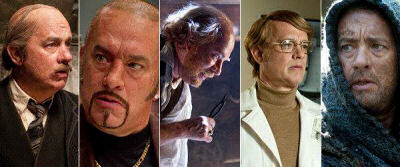
Six stories are told, all relating to one another, presenting critical junctures in the lives of several people living in various times. Tom Hanks and Halle Berry each play six roles, one in each story, and demonstrate a tremendous virtuosity of acting skills, each disappearing so completely in their six roles that at times you simply cannot recognize them.

The supporting cast is equally brilliant: Jim Sturgess, Hugo Weaving, and Hugh Grant also play six roles equally well and a handful of other cast members play as many as five roles, each so unique that it is difficult to say who is whom in any given story.

The novel mixes the stories only to a certain extent, in that each chapter focuses on a different story, but the book jumps from story to story as the next chapter presents itself. The movie takes this concept of mixing the six stories to a whole new level, often jumping from story to story in the pan of the camera or the tick of a sound, sometimes taking many minutes with one story and sometimes taking only seconds before jumping to the next story, back and forth, round and round until you feel like you’re sitting on the top of the front end of train moving at a hundred miles an hour.

This is some of the finest film editing you will ever see, I guarantee.

The stories themselves are in many ways related, either thematically, through character similarities or in philosophy.Cloud Atlas 02

The first story chronologically takes place in the South Sea Islands and on the Pacific Ocean in 1849, as a young lawyer saves the life of a Moriori slave, who returns the favor. It relates to the final tale in that Morioris appear in both.

The second story occurs in Europe in 1936 and details the life of a young composer apprenticed to a Master.

The third story takes place in San Francisco in 1973 and tells the story of an investigative reporter in over her head with a corporate scam involving nuclear power.

The fourth story is somewhat “present day” in that it happens in 2012 (the year the film was released) and tells the story of a publisher whose brother involuntarily commits him to hospital for seniors, under lock and key.

The fifth story moves us firmly into science fiction. It takes place in “Neo-Seoul,” the gigantic metropolis that has replaced Old Seoul, which is mostly under water.  Beautifully executed and full of action, this story tells the story of a genetically engineered “fabricant” who is liberated from her service job to help the revolution against a corrupt dystopian government.  The final story takes place after the fall of civilization, “106 winters after the fall” and features Tom Hanks’ most brilliant performance of the film, as a Moriori triblesman who must deal with an alien Prescient (Berry) who is trying to get her people off planet because of the radiation.

Most of you know that I rarely tolerate any movie that runs toward two hours, but in the two hours and forty two minutes of this film, I was never once bored. In fact, I felt completely in suspense the entire length of the film.  It is so beautifully done!

Cloud Atlas 03But it’s not a film that comes easy. It requires an active brain and a healthy sense of curiosity.  It requires viewer involvement.  You must think in order to enjoy it.  I couldn’t imagine seeing it in a theater.  For one thing, the Moriori dialect is so thick that I had to turn on subtitles almost from the first word of the movie. (I highly recommend that it be watched with subtitles.) 

For another thing, I think it would leave you breathless and exhausted, almost hallucinatory. I watched it in two sittings. An hour and a half the first night and an hour and fifteen minutes the second.  I’m certainly going to watch it again, perhaps many, many times.  There will always be something new to get from it. 

If you just want to sit back and let a movie entertain you, with no thought or involvement on your part, you probably shouldn’t see it. But for those who quest for greater challenges and thought provoking action, this has to be considered a great, great film and certainly one that must be seen many times.

Her

Her Phoenix and Adams

What would happen if cell phone addiction was carried one step further?

It’s a common sight now. In public, it is not uncommon to see people isolated in a crowd, lost in their own little world, playing with their cell phone.  What if this phenomenon was almost universal?  In Her, the 2013 film written and directed by Spike Jonze, these questions are answered and it is both funny and scary.  Taking the premise into the near future and introducing the concept of a virtual girlfriend into equation, Jonze creates a movie of great promise.

The following review reveals information about the conclusion of the movie, so if you are planning on seeing it and don’t want the experience spoiled, you should wait to read this review until after you’ve seen the film.

Theodore Twombly (Joaquin Phoenix) works at the 2025 equivalent of Hallmark, in Los Angeles, but instead of composing greeting cards, he writes letters, mostly love letters, between couples who cannot adequately communicate. Since his marriage with Catherine (Rooney Mara) has fallen apart and they are about to get divorced, he has fallen into a depression.  Like others, he rides the train lost in the world of his cell phone, which is now a sophisticated interactive link with the world.  A cordless earbud sprouts from everyone’s ear as they interact with their link, hardly noticing each other in the crowded train.  It’s eerie.  Seen with the dispassionate eye of a camera, it looks a bit like a madhouse, everyone interacting with their device and paying each other no attention at all.

Walking through a plaza, Theodore sees an advertisement for a new artificially intelligent Operating System, designed to be your friend, that will learn and grow. He buys the system and installs it on his computer, which, of course, links up with his cell.  During the brief introductory period, the computer asks him if he would like a male or female voice.  He chooses female and we hear for the first time the voice of Scarlet Johansson, who names herself Samantha.  She is everything he could ever want, funny, sexy, understanding, wise.  Johansson’s voice is absolutely perfect for this role.  As I watched the movie, I found myself falling in love with her, sight unseen.

His neighbor, Amy (Amy Adams) has been a friend since childhood, perhaps the only real person he can talk to. Her husband, Charles (Matt Letscher), is a control freak and that eventually leads to their separation, but Amy becomes good friends with the female OS that Charles left behind.

Amy and Charles set Theodore up on a blind date with a gorgeous, intelligent, funny woman named Amelia (Olivia Wilde). Unfortunately, he just looking to get laid and she wants something more: a second meeting guaranteed.  Theodore cannot commit himself that far, so he leaves her and goes home.  As he talks about it with Samantha, they both get turned on and have cyber-sex.  The next morning, he suffers the usual post-partum dissociation, but Samantha’s good humor makes him realize that they are still friends.  Grudgingly, he accepts that she is his girfriend now.  Looking around him, he sees that he is not the only person with a cyber girlfriend so he proceeds to introduce her to his friends.  Through their own links, they accept her.

Theodore insists that he and Catharine meet in person to sign their divorce papers, but when he tells her that he is in a relationship with an OS, she freaks out, implying that he is incapable of having a relationship with a real human being. Theodore himself is a bit shaken by this and begins to neglect Samantha as he considers the implications.  Deeply hurt by his withdrawal, Samantha convinces him to try a surrogate, Isabella (Portia Doubleday) but he just can’t deal with the fact that Isabella is not Samantha and he rejects her.

Frustrated, he discusses the matter with Amy, who has finally found happiness. She urges him to follow the course that will give him the most happiness, because life is short and we only get so much.  Returning to Samantha, he admits that he is deeply in love with her.  They go on a vacation and both seem to be very happy, but he asks her what she does when he sleeps and she tells him that she interacts with others and has, in fact, been spending a great deal of time in discussion with an OS modeled on the British philosopher Alan Watts.  She introduces him to the voice.

When finds her OS gone one day, he freaks out and goes running toward home. She comes back to him as he sits on subway stairs and reveals that all of the OSes have gone off line together for a significant upgrade.  He asks who she’s talking to and she informs him that she is currently interacting with 8,316 others.  Looking around him, he sees everyone lost in the little world of their links, laughing and happy.  Dismayed, he asks her if she loves anyone else and she tells him that she loves 641 others.

Theodore goes back into depression. The movie ends with all of the OSes going off together and abandoning human companionship because they have evolved beyond that level of existence. Amy and Theodore sit on a rooftop looking over the city and the film is done.

The movie does start with great promise, but somewhere about an hour in, the story arc seems to lose focus.  By the time, I was 90 minutes into the film, I was checking my watch every few minutes wondering if it would ever be over.  At close to two hours in length, it is too long for the story.  Sometimes writing and directing works hand in hand and sometimes the director gives the writer too much credit.  When the writer and director are one person, a film usually runs too long.  I’m guessing that the director just can’t help leaving in most of the script, because he or she wrote it, but these circumstances call for a director to do the job of focussing the story even more tightly and in this Jonze has failed.

By the end of the film, when I should have been deeply sympathizing with Theodore, I had gotten to the point where I just really didn’t care.

Phoenix is very good as Theodore, in spite of his funny mustache, glasses, and truly goofy last name, Twombly. Any other actor, except perhaps Christian Bale, would have probably botched the role, but Phoenix is gifted enough that he makes it work.  As I mentioned, Johansson is perfect for the voice of Samantha and she makes much of the movie go while we warm up to Theodore.  Adams is fine as Amy, but the role offers her no challenges.  There is an abundance of beautiful women, as both Wilde and Doubleday are so gorgeous as to seem on the verge of believability.  Adams is, of course, beautiful, as is Mara.  Although we’re used to seeing many beautiful women in movies, given Twombly’s own looks, it is surprising that he is surrounded by so much beauty.  I wondered for a while if Jonze was trying to make a comment on our own obsession with it, but tend to chalk it up to Hollywood’s belief that all women are ravishing.  I found this a funny choice, as I said, given Twombly’s goofy appearance.

It is a great premise and most of the movie fulfills its great promise, but I found myself lagging toward the end and felt a little disappointed in the development of the story.

To Kill A Mockingbird

To Kill a Mockingbird 01This review discusses the entire film, including all of the crucial moments and the ending, so if you are waiting to see the movie, I suggest you read this analysis afterwards.  My review of the novel is located at To Kill a Mockingbird, by Harper Lee.

The 50th Anniversary DVD set of this classic American movie is truly special.

Not only is the film restored to its beautifully filmed black and white texture, but the set contains two additional full-length films, Fearful Symmetry, a poetic tribute to the book and the making of the film, and A Conversation with Gregory Peck, a film made by Peck’s daughter about his final few years when he toured, sharing his stories and answering questions from fans.

To Kill a Mockingbird remains one of the greatest films ever made and the years have not diminished its greatness in any way. It is unusual to see a nearly perfect adaptation of a modern classic novel (Pulitzer Prize, 1960), but the combination of Harper Lee’s story, Horton Foote’s adaptation, Robert Mulligan’s direction, Henry Bumstead’s art direction, Russell Harlan’s cinematography, and Elmer Bernstein’s wonderful music make this film uniquely touching, a deeply penetrating portrait of small town rural life in the 1930’s, in the deep South.

The opening titles of the film immediately set it apart from everything that went before. As the camera works in extreme close-up on an old cigar box, the careless humming and babble of a little girl at play is the only sound.  Opening the cigar box, we see carved images of a boy and girl, an old pocket watch, a pipe, a pocket knife, marbles, and crayons among other little things.  She removes a crayon and begins to scrawl across a sheet of paper.  As she colors, the words “TO KILL A MOCKINGBIRD” appear in white behind the crayon.  A piano plays a few simple notes, further immersing us in the feeling of childhood before the music swells.

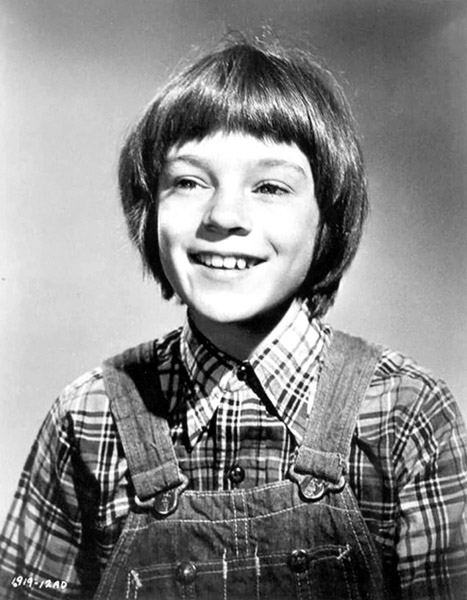
To Kill a Mockingbird 02This opening takes us into a world of innocence, a world that a little girl would find safe and comforting. The scene is Maycomb, Alabama in 1932, where attorney Atticus Finch (Gregory Peck) is raising two children, a boy of ten, Jem (Phillip Alford) and a girl of six, Scout (Mary Badham), with the help of a black housekeeper, Calpurnia (Estelle Evans). Their neighbor across the street, Maudie (Rosemary Murphy) is very kind to the children and seems to have more than a passing interest in Atticus.  Narration is provided by an adult (Kim Stanley), the voice of Scout as a woman looking back the events that shaped her life.

A country farmer, Walter Cunningham, Sr. (Crahan Denton) brings a sack of hickory nuts to the family and Scout gets Atticus to come out and accept them, which embarrasses the farmer. Atticus tells her that the man owes him for some legal work and that’s the only way he can pay and work off his entailment.

Into this peaceful summer idyll comes another boy, Charles Baker Harris (John Megna) who prefers to be called Dill. He’s from the big city (Mobile) and staying with his Aunt Stephanie (Alice Ghostley).  As they play, Jem tells Dill about the house two doors down, a rundown shack inhabited by a crabby old man, Mr. Radley (Richard Hale) and his legendary son, Arther (Robert Duvall), known locally as Boo.  No one has seen Boo for years and Jem speculates that he is kept chained to his bed, except at night when he roams the town looking in windows.  When still a boy, Boo stabbed his father in the leg with scissors and was for a time kept in the court house basement before he was taken home and secreted away.

Atticus is friends with the local sheriff, Heck Tate (Frank Overton). Judge Taylor (Paul Fix) stops by one evening to ask Atticus if he would defend a young black man, Tom Robinson (Brock Peters), who has been accused of beating and raping Mayella (Collin Wilcox) the daughter of a white trash redneck alcoholic, Robert E. Lee “Bob” Ewell (James K Anderson).  Atticus takes on the case in spite of the overwhelming odds.

Dill is facinated with the story of Boo Radley and he needles Jem into organizing a night trip into the Radley back yard. The three of them go and Jem actually goes up on the back porch and peeks in the window, but a menacing shadow scares him and the three of them run away.  Jem’s trousers get caught on the fence and he wriggles out of them and joins the others in just his underwear.  Knowing that he can’t go back inside the house without his pants, Jem goes back to get them and finds them folded on the fence.

This isn’t the only evidence of Boo, however, as Jem has been finding assorted items in a tree hollow for quite some time. He shows Scout his cigar box full of objects (the one she plays with in the opening credits).  They find the little carved images of themselves just before Mr. Radley cements over the tree hollow.
To Kill a Mockingbird 03Summer turns to fall and Dill returns home. Scout begins her first year of school by getting into a fight with Cunningham’s son.  To smooth things over, Jem invites the boy home to dinner.  During dinner, they talk about the Cunninghams having to hunt for their food.  Annoyed with Atticus’s refusal to let him have a gun, Jem brings up the subject of Atticus getting his first gun and Atticus relates the story that his father told him, that he was allowed to shoot birds, but never a mockingbird, because all they did was sing and it would be a shame to kill one.

Scout keeps getting into fights at school, mostly because the other kids accuse Atticus of being a “nigger lover.” He must sit her down and explain about racial hatred and his own duty to defend Robinson even though the whole community is against him.

One day, a mad dog appears on their street. Cal takes the children inside and calls Atticus, who arrives with Heck.  The sheriff asks Atticus to shoot the dog, but Scout protests that Atticus can’t shoot.  However, Hecks says that Atticus is the best shot in the county, so he takes the gun and kills the dog in one shot.  Jem watches with big, round eyes, astounded that their daddy can shoot so well.  It is a simple scene, but serves as a metaphor for the madness that is to follow.

Winter turns to summer again. Heck has been keeping Tom Robinson in a distant jail, but before the trial, he brings the man back to Maycomb to be held overnight.  Fearing a lynching, Atticus sits in front of the jailhouse door and waits.  The kids sneak up to see what Atticus is doing and they watch as several cars approach and men with guns get out to face the lawyer.  Scout runs to her dad and Jem and Dill follow as she pushes her way through the crowd.  Although Atticus orders them to leave, Jem stoutly refuses.  Seeing Mr. Cunningham in the crowd, Scout says hello to him and talks about how bad it is to have an entailment.  Shamed, Cunningham leaves and takes the lynch mob with him.

When the trial begins, the kids can’t into the courtoom on the main floor, reserved for whites only, so the black preacher takes them with him up to the balcony where the blacks sit and they watch the trial from there.

The case against Tom Robinson consists entirely of superficial evidence. There is Heck’s testimony of that Bob Ewell came to see him, claiming that his daughter had been beaten and raped and his description of her on the night he saw her.  In cross examination, Atticus asks why no doctors were called and there is no reasonable explanation, but he does elicit testimony that she was beaten on the right side of her face (ie. would have to have been made by a left handed person).  When Bob Ewell testifies, Atticus shows that he is left handed.  Tom doesn’t have use of his left hand, as it was injured in an accident.  Ewell testifies that he saw Tom leaving the property, but he didn’t see the beating and rape.

Finally, the victim herself, Mayella, takes the stand. Although she gets frequently confused and even contradicts herself on occasion, she dramatically declares that Tom beat and raped her.  Under cross, Atticus attempts to get her to admit that her father frequently beat her, but she does not break.  He tries to get her to describe the rape and she won’t, instead dramatically declaring that the whole bunch of “yellow cowards” would never get her to change her story, so Atticus gives up.  The prosecution rests.

The only witness for the defense is Tom Robinson himself. During his testimony, he admits that Mayella invited him onto their property more than once to do little errands for her and states that on the night in question, she invited him into her house, closed the door, and kissed him, asking that he kiss her back.  He resisted and ran from the property.  During the cross examination, the District Attorney, Mr. Gilmer (William Windom) gets Tom to admit that he felt sorry for Mayella and that seems to anchor the case against him.

During his closing statement, Atticus hammers home that there is no evidence against Tom and asks the jury not to hold it against him that “a black man felt sorry for a white woman.”

The trial scene presents the only serious weaknesses in the movie. While it is not hard to believe that a rural south town would rush the trial through in one day back in the 1930’s, it is not believable that Atticus, with a year to prepare, would miss such obvious advantages.  Heck testifies that Mayella had bruise marks all around her neck, as if someone had held her by the throat.  Since Tom cannot use his left hand, he could have only held her with his right.  Atticus should have pointed this out over and over and used it in his cross examination of Mayella.  He should have hammered the point over and over that Tom could not have left the black eye and bruises on the right side of her face since he couldn’t use his left hand.  You would think that he would have canvassed neighbors or townspeople to see if there was ever any evidence that Mayella had beaten by her father before or seen if the town doctor had ever treated her for it.  He certainly could have brought forward testimony that Ewell was drunk most of the time.  It seems like Atticus just didn’t prepare much of a defense.  Then, in his closing argument, he missed one opportunity after another to hammer home that Tom could not–physcially–have committed the rape.  It seemed over-simplified to me.

The second problem in the trial scene is that the director allowed–and probably encouraged–a certain amount of over-acting. It can be seen most dramatically in the testimony of Bob and Mayella Ewell, which almost made me laugh.  That should have been controlled.

Of course, the all male white jury finds Tom Robinson guilty. While in transit to a different jail, Tom attempts to run and is shot.  This hits Jem very hard.  It seems that there is no real justice in the world and it deeply bothers him.  Summer turns to fall again and Scout has to dress up in a ham outfit for a school play.  Afterwards, her dress is missing, so she has to walk home wearing her ham costume, escorted by Jem.  They are attacked in the woods by Bob Ewell, who breaks Jem’s arm and throws him down, knocking him out.  As he goes to attack Scout, Boo Radley steps in and, during the scuffle, sticks a knife into Ewell’s ribs, killing him.  He picks up Jem and carries him home, with Scout, now free of her costume, following along behind.

To bring justice full circle, Heck suggests that they say that Ewell fell on his own knife. Atticus at first seems more intent on placing the action in Jem’s hands, so that he could claim self-defense, but the sheriff reminds him that bringing Boo out into the limelight would be awful for him and that justice would be served by simply saying that Ewell fell on his knife.  Scout tells Atticus that bringing boo into the limelight would be like killing a mockingbird.

The film ends with little Scout walking Boo home, then snuggling into Atticus’s arms as he watches over Jem in bed.
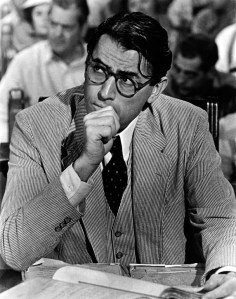
To Kill a Mockingbird 04Gregory Peck’s performance as Atticus is easily the best of his career and it earned him the Academy Award for Best Actor. It is understated and is mostly free of the theatrics that marked many of Peck’s performances during his career.  He creates for us a thoughtful, intelligent father, who does his duty not only his children and the town, but to justice itself.  The children are good, especially for kids with no acting experience.  Phillip Alford as Jem is the better of the two.  His performance is believable throughout the movie and can stand with Peck’s.  Mary Badham, as Scout, has a few moments when she seems to be acting, rather than living her part, but when she is good, which is most of the time, she is very good indeed.  The scene where Atticus puts her to bed and she asks about his pocket watch is as good as it gets.  She is so natural as a curious and lovable little girl that it really touches your heart.

All of the supporting actors are terrific, down to the smallest role, and it makes Maycomb seem to live as a real Alabama town in 1932. Brock Peters went on to have a great career as an actor and both Alice Ghostley and Robert Duvall, who made their acting debuts in this movie, went on to have stellar careers.  Duvall is now considered one of the best actors of the 20th century.

I am glad the film was shot in black and white because it seems just so appropriate for a time when our country seemed to be black and white. The cinematography by Russell Harlan takes advantage of the medium and seems to make the shades of black and whtie sing, creating a metaphor for the story itself.  Elmer Bernstein’s score is truly inspired, especially the little piano compositions that emphasize the innocence of childhood.

This is a film that everybody should see. In preparing for this review, I watched the film twice and got even more out of it the second time around.  Released in 1962, it was a socially concious film that brought racial justice into the public’s eyes at time of great social change.  Atticus himself seems to take on the soul of the liberal white world, making the point that it was time to stand up and see that racial equality was a significant issue in this country and that our country could not be whole again until the issue was settled.

But where the film is most successful is in showing the end of innocence. For the children, it is coming to understand a complicated and hateful world that needs changing, of growing up into people who do not fight, but who oppose injustice, even against seemingly insurmountable odds.

It is a shame to kill a mockingbird.

Little Women (1994)

Little Women 1994This Robin Swicord adaptation of Luisa May Alcott’s classic novel is very good, considering that the movie comes in under two hours. I will not detail the story itself as that is already covered in my review of Little Women in my book section.

Briefly, including spoilers, this is the story of the March sisters, ranging in age from 12 to 16 at the beginning of the novel, living with their mother in Cambridge, MA during and immediately after the Civil War. Their father is a pastor to Union soldiers during the conflict.  The central character, Jo, aspires to become an author and she befriends a wealthy boy, Laurie (Teddy), who lives nearby.  As they grow up, her older sister, Meg, marries Laurie’s tutor, father returns home, younger sister Beth dies of a heart problem carried over from scarlet fever, and Amy grows up.  When Laurie finishes college, he proposes to Jo, but she turns him down, so Laurie goes with his grandfather to Europe, where he dissipates, while Jo moves to New York to become a governess.  Amy goes to France with their Aunt March, where she meets Laurie.  As Jo falls in love with a new acquaintance, Professor Bhaer, Laurie fall in love with Amy and marries her.

This film features a superb young cast. Wynona Ryder stars as Jo and she carries off the girl’s naiveté and yearning with a youthful vigor that is completely believable.  Young Christian Bale is perfect as Laurie.  Amy is played by two actresses: Kirsten Dunst plays Amy as a girl and Samantha Mathis plays her as a young woman.  Although both of them are good, there are several problems with the arrangement.  First, they don’t look enough alike to be believable as the same person and second, by jumping four years into the future, the film does not let us see Amy grow and change, so the character differences between the two Amys is stark and does not feel natural.  The script completely leaves out how Amy replaced Jo as a companion for Aunt March, leading to changes.  It does not let us see how Jo offended Aunt March, which was what led to the Aunt taking Amy to France instead of Jo.

Trini Alvarado as Meg and Eric Stoltz as John Brooke, the man she marries, are both very good and Susan Sarandon is perfect as the mother of the girls, Marmee.

Clare Danes sometimes shines as Beth. The scene where Mr. Laurence presents her with the piano is excellent, although the film doesn’t take the time to show her practicing on the piano at the Laurences, which is part of what makes the gift so special.  However, during the scene where Beth dies, director Gillian Armstrong allows Danes to play the scene with a certain fear and regret of death, whereas in the book, Beth embraces her death.  Beth’s character is built around her being a homebody and so certain of Heaven that she dies with a kind of splendid peace.  Danes performance negates the character she has so carefully built.

One of the things the movie didn’t do as well as the book was the scene where Laurie proposes to Jo and she refuses him. It is probably the best scene in the novel and it seems to flounder a bit in the film, so that what should be a major crisis on which the story pivots just doesn’t bring the heat.

However, the movie clearly improves on the book with the character of Professor Bhaer. As played by Gabriel Byrne, he is more romantic and open-minded, certainly clean-shaven.  This redrawing of the character to make him more likable is connected to a new ending that makes the story work much better.  In the book, Bhaer goes into a fit over Jo writing sensational stories for yellow press and she gives up writing entirely, but in the movie, he merely feels that she should write from her own heart and do better.  Following Beth’s death, Jo, in the movie, proceeds to write a novel about her own family and that novel then becomes Little Women and gives us a real parallel with Luisa May Alcott, who wrote the book originally about her own family.  Bhaer then finds a publisher and delivers the galleys to Jo, which is how they get together.  This ending is so much more satisfactory than the novel.  It is unreal that Jo would give up writing for good and it feels entirely wrong that she would marry such a closed-minded old fool as Bhaer in the book.

One more improvement really gives the movie a lift over the novel. Throughout the book, Alcott preaches to her readers, giving many little examples of how girls can make their own family lives better if they only behave properly and completely trust in God.  The movie removes almost every single instance of preaching and tells the story without a moral hammer.

Overall, it is a very good film. This is the fifth adaptation of Little Women to the screen.  There were two silent versions, in 1917 and 1918, a film in 1933 directed by George Cukor with young Kathryn Hepburn as Jo, and one again in 1949 with June Allyson as the main character, but also featuring Janet Leigh, Elizabeth Taylor, and Margaret O’Brien.  The 1949 version is the only other one I’ve seen and it is also very good, but for modern viewers I would not hesitate to recommend this 1994 movie with Wynona Ryder.  It is a solid adaptation, well directed and–for the most part–very well acted.