Broken for You by Stephanie Kallos

Broken for You, by Stephanie Kallos is a rare treat, a first novel with profound depth, detailed, individual characters that are extremely compelling, and a theme that permeates the story,  deeply layered through every scene.

Broken for YouWanda Shultz (“Tink”) is a professional stage manager with a deeply broken past.  Her mother, Gina, was a highly disturbed artist who left her family because of her emotional instability.  Her father, Michael, a Dubliner émigré, was so deeply in love with her that he went searching for her, dropping Wanda off at her aunt Maureen’s place in Chicago at the age of six.  She quickly learned the art of negotiation by dealing with her eight cousins, a trait that would serve her well in her profession.  When her lover, Peter, leaves her alone in New York and disappears, she is bereft, until she receives a postcard from Seattle with no message.  Believing the postcard to be from Peter, she quickly wraps up her life in NYC and departs for Seattle to look for him.

In Seattle, wealthy septuagenarian Margaret Hughes finds out she has a brain tumor.  Living alone in the mansion she inherited from her art-dealer father, the revelation prompts her to change her life in a profound way.  She puts an ad in the paper seeking a roommate and newly arrived Wanda answers it.  She is a bit surprised to find a mansion full of antique porcelain figurines and dishware with such a pedigree that they are literally worth millions of dollars.  Wanda gets a job stage managing a production of Eugene O’Neill’s A Touch of the Poet and begins looking for Peter, disguising herself as Detective Lorenzini (her mother’s maiden name).

The relationship between these two women is at the heart of the novel, but really it is their individual broken pasts and presents that drive the story.  As their lives intertwine and they search for ways to deal with their broken lives, a friendship evolves that runs far deeper.  They begin to pick up other people with broken lives to live in the mansion with them and become a family, not in the traditional sense, but in the way that modern families evolve–made of friends, ex-lovers, strangers just weird enough to relate to you, and other broken souls whose path intersects yours.

There’s a great deal of love in this novel, but it is not easy love.  It’s love that you have to work for, love that you have to assemble from the broken parts of you lying around on the grass, love that regenerates like a chopped off tail.  It’s a book that will take you into this family and make you a part of it through a disengaged narrator that might be part you-part author, a voice that bridges the distance between us.

If someone pressed me to find a flaw in this book, I’d have to squirm and admit that it is a little bit long, like a terrific two hours and fifteen minute movie that probably should have been cut to one hour and forty-five minutes, but that the director loved so much she left in a few extra scenes.  Make no mistake, there are great movies and great novels that are a little long, but if I’ve learned anything in the business of writing it is that the author and/or a skilled editor sometimes needs to take the helm and trim that wonderful artistic work just a bit.

Stephnaie Kallos from her web siteThat being said, this is among the best and most engaging novels I’ve read in the last ten years.  In places, I wept in the beauty of the writing.  I’ve now been writing myself for three years and this novel is inspiring me to work harder and do better.  I think that everyone who has even a modest interest in contemporary literature needs to read this novel.  In one swift move, Stephanie Kallos has joined the elite in her field.  I have no hesitation in mentioning her in the same breath as Barbara Kingsolver–she is that good!

Read this book!

Deepsix by Jack McDevitt


DeepsixSpoiler Alert!  This review contains detailed information on the plot and resolution of the novel Deepsix.  It is recommended that you read the novel before you read this review.  Although it is not absolutely necessary to read The Engines of God,the first novel in the Academy series, before Deepsix, I think it is much more satisfying to read the entire series in sequence.  

For those who have read neither novel, a detailed introduction to the Academy novels is available HERE.  Additionally, my review of The Engines of God is available HERE.

Deepsix is the second of Jack McDevitt’s Academy novels, chronologically following The Engines of God by about 20 years.  All of the same conventions of McDevitt’s Academy universe apply equally to Deepsix, with the advancements from The Engines of God added on, namely that Omega clouds have now become an accepted (although still not understood) part of the universe – still under investigation – and that the planet Beta Pacifica III has now become a major archeological site following its discovery by Hutch and Frank Carson.

Hutch still works for the Academy as a superluminal pilot, but she is now nearing the age of fifty.  Of course, thanks to advancements in medicine, she still looks and feels like a twenty-something “babe”.  As the novel opens, she has just made a drop at the archeological site on Pinnacle and is picking up an exobiologist, Randall Nightingale, and some others for a return trip to Earth.  Nightingale was the team leader for the first mission to Maleiva III twenty years before and was held responsible for the deaths of several of his colleagues, even though it was not primary his fault.  His return to Earth at this time coincides with an expedition to Maleiva III (now renamed Deepsix) to observe its destruction as it collides with a rogue gas giant.

In fact the Wendy Jay, captained by Marcel Clairveau, an old friend of Hutch, is currently orbiting Deepsix with a large group of scientists.  The onboard scientific community, there to observe the cosmic carnage about to occur, finds previously unnoticed ruins, evidence of an intelligent life form.  Since no other ships or archeologists are available to the Academy on such short notice, they send Hutch to investigate.  She brings Nightingale and several others to the surface with her and the novel takes off.

Each chapter is introduced with a quote from one of the world’s most revered critics (and one of McDevitt’s deepest characters), Gregory MacAllister.  He begins as a pompous, self-centered elitist who takes great pride in attacking those as conceited as himself, especially religious leaders and anyone else (besides himself) who makes pronouncements about the state of the world or the nature of existence.  But I would strongly advise against taking these little quotes for granted, because there are amazing nuggets of wisdom hidden there – they demonstrate that MacAllister is not all hot air and that he has actually thought some things out.  I have taken excerpts from these quotes and sprinkled them around this review to show how McDevitt has worked thematic development into introductory quotations.

Prologue

Consistent with many of McDevitt’s works, the novel begins with a Prologue, which is a flash to the past: October, 2204 (two years after the incidents described in The Engines of God).  In this case, it describes Nightingale’s first trip to Deepsix, detailing the deaths of the six mission members who were killed by swarms of red birds with large beaks.  It sets up Randall Nightingale as one of the novel’s protagonists and tells the true story of the incident, which would later be distorted to implicate Nightingale as the Academy’s public scapegoat for the mission’s failure.

This is fairly important because around that very time, Gregory MacAllister lambasted Nightingale as a coward: 

…when his people most needed him, Randall Nightingale fainted dead away.  He was rescued by Sabina Coldfield and dragged to safety by that estimable woman at the cost of her own life… Coldfield… was worth a dozen Nightingales.

Obviously, MacAllister had no idea what actually happened on Deepsix, nor did he care.  As long as he could find someone to make his point, “Mac” did not care what happened to his or her life as a result of his writing.

Normally, I do not especially like the use of an opening flashback.  It is, of course, a quite valid and well-used technique of novel writing, but it has become a handy crutch that is way over-used.  And McDevitt does use it over and over in his novels.  That being said, he used it extremely effectively in The Engines of God and does so again here.  I think telling the true story of the original incident on Deepsix really does help to set the stage and particularly to set up the later relationship between Nightingale and MacAllister.

Beyond the Prologue, the book is broken into three parts.

Part 1 – Burbage Point

The first part launches the novel into the “present time” of November, 2223.  The remainder of the novel occurs over three weeks, ending shortly after December 9, 2223, except for an Epilogue, which wraps up the story at the end.

The story covered in Part 1 establishes the scientific team, Hutch’s mission to look for artifacts, the arrival of the luxury liner, Evening Star, the stranding of Hutch’s team on the surface of Deepsix (along with MacAllister) and the evil that Ian Helm does.

Yes, McDevitt trots out his villain from The Engines of God.  Although Helm was portrayed as an unlikable character in the former novel, at least his motivation was believable and somewhat understandable.  Here, he comes across as one-dimensional and flat.  In fact, the entire sequence where he purposely disposes of the only lander that could come to Hutch’s rescue feels forced and entirely unneeded.  I think it might have been better to simply say that no ship possessing a lander was close enough to arrive in time for the rescue.  This act of omission would have saved a few pages in a very long book and would have eliminated one of the only flaws in an otherwise amazing narrative.

The first part of the novel brings us quickly to the important things that McDevitt wants us to think about in Deepsix.  These themes were partially opened up in The Engines of God, but McDevitt develops them to a very high level in this novel.

Extraterrestrial archeology sounds glamorous because its perpetrators dig up transistor radios used by creatures who’ve been gone a quarter million years.  Therefore it carries an aura of mystery and romance.  But if we ever succeed in outrunning the radio waves, so we can mine their broadcasts, we’ll undoubtedly discover that they, like ourselves, were a population of dunces.” ~ Gregory MacAllister

One of the primary assumptions of the Academy universe is that the people are very, very much like us in some fundamental respects, mainly that there is a ceiling to cultural development and we’ve already reached it.  Technology might change some of the situations, such as the sims replacing television, but participation in a three-dimensional sim does not bring any kind of awareness or elevated sense of being.  Indeed, the sims only tend to reinforce our basic cultural iconography.  Instead of watching a romance or a war drama, you are allowed to <I>participate</I> as your icon replaces a character.  It’s still a romance or war drama, essential in every other respect to a television show or movie.

McDevitt’s characters are still concerned with the same things we are: ego, relationships, career, dining, and death.

Coming together on Deepsix are Hutch, Randall Nightingale, Kellie Collier and Chiang Harmon (two volunteers from the Wendy Jay) and, of course, Gregory MacAllister.  He was added to the mix when he brought a young journalist and pilot from the Star to the surface.  An earthquake killed the journalist and pilot, as well as one of Hutch’s volunteers, and destroyed both landers, stranding these five on the surface with the cosmic collision less than three weeks away.

The fragility of Nightingale’s ego, contrasted against the overpowering ego of MacAllister, is established in this first part of the book as they are brought face to face.  Mac was clearly a part of the failure of Nightingale’s career and Randy very much resents that.  Mac, on the other hand, feels fully justified in his action and this matter festers as time passes.

The inability of Hutch to establish a stable relationship that was developed in the first novel is not really pursued here.  Instead, Kellie comes to represent relationship frustration.  An attractive young black woman, she is pursued by a number of the men on board <I>Wendy</I>, in particular by Chiang, yet she seems ambivalent about getting involved with someone.

Marriage in the early 23rd century is a contractual affair, which requires re-certification periodically.  Most people do not renew.  People live a lot longer and look younger throughout most of their lives, but ennui begins to set in early and people tend to live more boring lives over all.  People are also generally good-looking and most work out religiously to keep their bodies in shape.  This also squares with where we are at today.  Although we don’t live as long as McDevitt’s characters, the visible society tends to be more and more attractive, young-looking and physically fit.  And most of our lives are still boring – or perhaps uneventful would be a better description.

There is very little brilliance here and it is generally restricted to a small gene pool.  The ugly or overweight people are – by and large – not seen on TV and we tend to elevate beauty.  And, for the most part, we are a very boring species.

It’s customary to argue that intelligence grants an evolutionary advantage.  But where is the evidence?  We are surrounded by believers in psychic healing, astrology, dreams and drugs.  Are we to accept the premise that these hordes of unfortunates descended from intelligent forebears? ~ Gregory MacAllister

I’ve read the criticism of McDevitt that his characters are rather flat and boring, but in the Academy universe that is just the way people are.  In fact, honestly, I am hard put to find ten extremely well-rounded characters in all of science fiction, so I generally find this complaint spurious, but in this case I believe it is completely unfounded.  Especially considering the introduction of Gregory MacAllister, who begins as an inflated version of the flat people surrounding him, but is forced to develop a conscience by the events that are about to occur.

Self-importance is closely tied to career development.  McDevitt’s people spend an amazing amount of time thinking about their jobs, their prospects and their ambitions.  Nightingale has essentially given up twenty years of his life because of the loss of his professional reputation.  He was working in obscurity on Pinnacle because he couldn’t really get a good job on Earth.  He plans on retiring to an isolated part of Scotland where he will never have to see anyone again. 

And then there is Nicholson, the captain of the Evening Star.  He is devastated at the death of a passenger and a crewmember, but not because he regrets the loss of life.  He is worried because it is his fault and it could mean the end of his career.  John Drummond, a brilliant mathematician, hasn’t produced a major breakthrough since his early twenties and he meditates on how everyone views him and his failure.

In our time, it can be argued that we have entered the age where a person’s career is of paramount importance, where a great deal of ego growth and sense of well-being depends on money and power earned through job performance.  I would think that much is self-evident.

Mac, of course, glows in the public adulation of his writing.  It feeds him and keeps him alive.

Which brings us to food, which is a constant topic in the worlds of McDevitt.  In one sense, it’s not surprising.  People who must spend a great deal of time on starships must think about food quite a bit.  It’s a way to fight boredom.  But it’s more than that; most every event, whether starship bound or Earth bound, is celebrated with food and drink.  When Nicholson prepares himself to face a rebellious bunch of wealthy passengers, the first thing he does is order snacks and beverages to be delivered as he arrives on the scene.

Food is a part of the overall comfort of society – both our society and in the universe of the Academy.

Nothing kills the appetite quite as effectively as a death sentence. ~ Gregory MacAllister

But in Deepsix, for the people who are stranded, food is literally part of the landscape.  They are short on rations and must figure out which of the local population is edible and non-toxic.

The last item that McDevitt sets up in thematic development is the importance of death.

Hutch has a much more intimate knowledge of death than anyone else in Deepsix.  Those of us who have read The Engines of God are familiar with the death of Hutch’s close friend, the archeologist, Richard Wald.  In addition, she was part of the group separated from their lander on Beta Pac III, when George and Maggie were killed.  Finally, she faced death straight-on twice herself, both in the damaged starship as oxygen ran out and as part of the group relentlessly stalked by the Omega Cloud.

Some critics argue that McDevitt kills off too many characters.  Just as soon as you get to like a character, they get killed.  But all of the deaths in the Academy series have a point, usually to force some of the other characters to realize something important – such as how sweet it is to be alive or how impulsive behavior can lead to tragedy or even how cold and unfeeling nature is.  It proves its point – and does so more dramatically in Deepsix really than any other of the Academy novels.

By the end of Part 1, the body count is already at nine, counting the six who were killed in the Prologue to make Nightingale’s career fall apart and three more in this first part, two due to MacAllister’s ego and one to that cold face of nature.  All nine died to advance the story and the theme as concisely as possible, but we’ll only count the three of “present day”.

Equally as important as the fear of death, however, is the speed of recovery from grief.  There’s a lot of grief in the Academy series, but none of it lasts very long.  Part of it, of course, is the same thing that makes us recover from our grief quickly.  We are concerned with life and when death interrupts living, we are anxious to get the grieving over with and get back to celebrating being alive.

Part of the speedy recovery of grief is that the characters are rooted so squarely in their egos – as are we.  Even if a death is our fault, we need to put it behind us quickly so that we can begin to feel good about ourselves as quickly as possible.  For that is much of what life in the 21st or 23rd centuries is made up of:  concern for our own well-being, safety and comfort.

Of course, in Deepsix, the grieving is short because our stranded characters are facing their own survival.  They don’t really have the luxury to wallow in grief.

Part 2 – Overland

Although Mac doesn’t think much of him, it is Nightingale who remembers that the original mission had left a lander behind during their withdrawal.  It is their only hope for survival once Ian Helm has done his evil.  They remove capacitors from one of the damaged landers and secure them at the site.  In order to reach the remaining lander, however, the party will have to cross 175 kilometers of icy, alien land and hostile native creatures.

It is mostly during this trek that the novel centers itself and fleshes out the various themes.

When struggling to survive in a hostile environment, people are literally stripped to their essence.  Fear can be a powerful motivator, for both cowards and heroes.  When they first learn that there is no way off the planet, MacAllister’s fear seems to betray the coward in him, yet throughout the march, when push comes to shove, Mac always steps up and faces danger with aplomb.

By contrast, Nightingale thinks of himself as a coward and so must test that assumption at every step.  Even though he often reacts heroically to situations, he still thinks of himself as a humiliated man.

As the group marches across Deepsix, Captain Nicholson decides that he will blame the entire incident on the pilot who lost his life on the surface and will thus manage to save his career.  Captain Clairveau demands that the scientists on the <I>Wendy</I> use their talents to come up with alternative rescue plans.  This is the ultimate intelligent-monkey challenge: you are presented with an engineering problem – come up with a workable solution.  It is John Drummond, the mathematician whose brilliant career has fizzled, who works out the details of salvaging the remains of a Maleivan skyhook and using it as a scoop to skim the atmosphere and pick up the damaged lander.  Like Mac, he behaves heroically without actually realizing he is doing so.

If there is one characteristic that marks all sentient creatures, it is their conviction of their own individual significance.  One sees this in their insistence on leaving whatever marks they can of their passing… we pay schools and churches to name wings, awards and parking areas after us.  Every nitwit who gets promoted to supervisor thinks the rest of creation will eventually happen by and want breathlessly to know everything about him that can possibly be gathered.  ~ Gregory MacAllister

On the surface of Deepsix, Chiang tries to tell Kellie that he loves her, but it is an awkward moment.  She tries not to hurt his feelings, but her ambivalence is obvious.  The question becomes moot when the group is attacked by what remains of the one intelligent race thought to exist on Deepsix.  Chiang goes down in the first volley of rocks and dies almost immediately.  Kellie’s ambivalence turns into deep regret.  She admits to Mac that she probably didn’t love Chiang, but nonetheless was filled with deep emotions.  “Sometimes,” Mac tells her, “I think life is just one long series of blown opportunities.”

While romantic relationships never develop, friendship does.  Hutch and Kellie bond on a deep personal level.  The two women in this group are the leaders, the pilots.  They are both in great physical shape and they can make this difficult trek easily.  The scene where they are bathing in ice-cold water and hugging each other is terrific writing.

On the other hand, the men are two fairly old guys that are out shape, an academic and a pontificating airbag, who are sworn enemies at the beginning of the ordeal.  But the trek slows them down, shows them their physical weaknesses and brings them much closer together philosophically.

It is not surprising that the four survivors form a lifelong bond.

Mac, in particular, gains a lot of compassion during the ordeal and is forced to relax his pomposity.  He sees the direct effect of his words on others.  He stretches himself and grows as a character.  So does Nightingale.  A man who wanted nothing more than to retreat from life is forced to face it square on.

They learn to kill the local wildlife, but each experience calls upon one of them to taste the food and wait to see if it will kill them.  This part of the novel forces all of them to face their own mortality.  The capacitors they had set aside are lost to the floods that begin to build, along with the fury of the world around them being torn apart.  They are forced to rely on Clairveau’s backup plan.

Part 3 – Skyhook

When misfortune strikes the true believer, he assumes he has done something to deserve punishment, but isn’t quite certain what.  The realist, recognizing that he lives in a Darwinian universe, is simply grateful to have made it to another sunset.  ~ Gregory MacAllister

One problem that I had about the final plan to rescue Hutch and the others was that in spite of the amount of wordage expended on it, I still could not visualize how the three ships manipulated the skyhook.  I just couldn’t see it in my imagination.  Normally, McDevitt is terrific with his description, so I’m inclined to think that it is my own failure.  But I’ve now read the book four times (twice in a row in preparation for writing this review) and I just can’t see it.

This is a very long novel and I’ve heard complaints from other reviewers about the length.  I tend to agree, but with some reservations.  Not only is the Ian Helm part extraneous, but I also feel that too much time is expended on the ultimate rescue plan, the Outsiders, the captains huddling and so on.  From the time the two landers are destroyed, the real story is the five people stranded on the planet and their own struggle for survival.  I do see the value of people pulling together for a common cause, but the narrative could have been tightened up considerably.

One of the most striking statements comes near the end of the novel as Hutch is investigating the building on top of Mt. Blue, which at one time housed the base of the skyhook.  She remembers Kellie asking if anyone believed in an immortal soul.  “Certainly, Hutch didn’t,” McDevitt writes.  The world was a cold, mathematical machine that produced hydrogen, stars, mosquitoes and superluminal pilots without showing the slightest concern for any of them.” (My emphasis.)

While investigating the building, Hutch and Randy find themselves trapped in an elevator that is gliding shakily down the mountain on uncertain rails.  Kellie pilots the lander around to attempt a rescue, but Nightingale freezes up.  Faced with the prospect of dropping hundreds of meters to the ground, he cannot move forward.  Hutch manages to manipulate him into the rescue, but time is wasted and they cannot get Hutch out.  Aside from worrying about Hutch, Nightingale feels a deep humiliation that he was the cause of her becoming stranded.  He realizes that perhaps Mac was right and that he really is a coward.

Stranded on the metal scaffolding in the middle of a lightening storm, Hutch must construct a sling from rope and dangle in the skies to prevent electrocution.  She hangs there all night in order to be rescued in the morning.  Sometimes it’s amazing how much a human being can put up with to hang onto life.

The dénouement is a real tour de force of writing.  From the moment when Hutch, Kellie, Randy and Mac realize that the scoop is too snarled for the lander to safely enter, they are faced with the immediate prospect of death.

Hutch understands that they will have one chance, but that she must sacrifice herself for the others to jump to safety.  As pilot, she must stay at the controls to ensure that the other three make it.  By the time she will be ready to jump, the lander will already be falling back into Deepsix.  While Mac and Kellie jump to safety, Randy seems to be stalling.  Hutch suspects that he has frozen up again, but he is actually digesting the fact that Hutch is giving up her life for them and he is formulating a way to give her a chance.

He removes a cable and ties it around her waist on one end and his own on the other.  He jumps, then Hutch follows, tethered to him with the cable.  But she is well below him and her gravity is pulling her down and dragging at Nightingale hanging from the net.

What it comes down to is the will to live, to fight for life with your last breath – and in this case to hang on regardless of desperate pain.  For Randy, the flesh is being torn off his hands and his arms are being nearly pulled from their sockets, yet he manages to hold on and to save Hutch’s life.  At last, Nightingale becomes a hero and is able to throw off the coward’s mantle.  Its pretty amazing writing and it sums up the book rather nicely.

Earlier in the novel, there was another quote from MacAllister that also sums up the various threads of thematic development and that shows he really understands what life is all about:

Most of us sleepwalk through out lives.  We take all its glories, its wine, food, love and friendship, its sunsets and its stars, its poetry and fireplaces and laughter for granted.  We forget that experience is not or should not be a casual encounter, but rather an embrace.  ~ Gregory MacAllister

After the amazing rescue, the Epilogue is certainly anticlimactic, but it does explain what happens afterward and there is some satisfaction in that.  With the death of a shuttle pilot the “present day” body count is a mere five (eleven including the prologue).  Not too bad really for a book about facing death.

Deepsix is a not really a book about harrowing escapes, the ingenuity of people in a crisis, or the awesomeness of cosmic events, although certainly all of these things happen in the novel.  Ultimately, this is a book about the sweetness of life.  It is about the preciousness of individual existence in a cold, mathematical universe and about the fight to hold on to life at all costs.

Perhaps the best tribute one can give to Jack McDevitt is acknowledgment that he shared this truth with us in a big, captivating, and awesome story.  Deepsix is an entertaining, page-turning, and thoughtful exploration of the sweetness of existence. 

Thanks, Jack!

The Engines of God by Jack McDevitt

Spoiler Alert! This review contains detailed information on the plot and resolution of the novel The Engines of God. It is recommended that you read the book before you read this review.BlackstoneAudioEnginesOfGod

In the realm between hard science fiction and space opera there is a zone where some of the rules of science may be broken very carefully, but the author may still make his or her universe look and feel realistic.

The works of Jack McDevitt certainly belong in that zone and none more squarely than The Engines of God, the first of six novels in what has come to be called “the Academy series”. The novels begin in 2197 and continue deep into the 23rd century.

The Academy of the title is the space exploration arm of the North American Union (NAU), with the primary purpose of charting the star systems of our neighborhood along the Orion spiral arm of the galaxy. Each mission clock runs from about a month to a year. Recent discoveries of both a living, alien pre-atomic population on one planet, Inokademeri (Nok) and archeological ruins on two others (Pinnacle and Quraqua) have led to bigger ships, designed to ferry massive equipment and archeologists to study these planets.

Along with faster than light space travel, humans now have air cars (similar to the skimmers of the Alex Benedict novels), three-dimensional interactive simulations called simmies (replacing movies) and force fields that may be used in hostile environments (replacing space suits).

The protagonist is a pilot named Priscilla Hutchins (everyone calls her Hutch), a diminutive, black-haired beauty imbued with her own particular hang-ups and fears. Hutch is a well-realized character from the beginning. She’s not terribly complicated, but then no one is in this existence nearly 200 years ahead of us and that is part of what gives the novel an edge of realism. Let’s face it, we aren’t very complicated, much as we’d prefer to think otherwise. But there is something in her struggle simply to have a life that we eagerly identify with and we instinctively support her throughout the novel.

She is close friends with Dr. Richard Wald, a archeologist and author, who prefers to have her as pilot on his explorations. The archeologists of the future have discovered gigantic sculptures scattered here and there along the Orion rim. Perhaps the most fascinating is an alien’s self-portrait left on the snow-covered surface of Iapetus, the third largest of Saturn’s moons, that is nearly 24,000 years old.

It is at this point, on February 12, 2197, that The Engines of God begins. Hutch has piloted Dr. Wald to view the Iapetus sculpture and the opening words of the novel paint a chilling picture:

“The thing was carved of ice and rock. It stood serenely on that bleak, snow covered plain, a nightmare figure of gently curving claws, surreal eyes and lean fluidity. The lips were parted, rounded, almost sexual… stamped on its icy features was a look she could only have described as philosophical ferocity.”

The Prologue is soulful writing, as Hutch and Dr. Wald view the sculpture on Iapetus, walk around it and meditate on who the Monument Makers might have been. It is eerie and introduces a mood of almost spiritual reverence for time and space.

As an introduction, it sets up the central question of the book: Why did the Monument Makers create their sculptures? Although the novel is divided into five sections, each advances the story significantly and brings us a little closer to answering the question.

Part One: Moonrise jumps us ahead in the timeline over five years to April 29, 2202. On the mission to extract the scientists at Quraqua, Hutch and Dr. Wald stop to inspect a Monument on Oz, one of Quraqua’s moons. This sculpture is as large as a city – and in fact looks like a city, though pocked and scarred from some sort of catastrophe. Although the city is almost complete made of right angles, there are two round towers, one at each end of the sculpture and each with a roof sloping away from the Monument. On one of the towers, there is an inscription, unreadable to the scientists, but containing figures from an ancient Quraquan language that has been named Casumel Linear C.

An important character is introduced in Part One in the form of Frank Carson, the administrator of the Quraqua project. An ex-Army man, who works for the Academy, Frank meets Hutch and Dr. Wald at Oz and shows them the inscription.

In Part Two: Temple of the Winds, nearly the entire scientific team is imperiled attempting to remove print chase that might contain enough Casumel letters to reconstruct the language enough so that translations can be made. Dr. Wald gives his life attempting to save this artifact which might contain the key to understanding the inscription on Oz. Although an exciting part of the novel, Part Two does not actually advance the plot that much, except to emphasize the importance of cracking the language.

Understanding the language occurs in Part Three: Beta Pac when the exophilologist, Maggie Tufu, manages to translate the inscription on Oz. It is a message from the Monument Makers to the Quraqua to “seek us by the Horgon’s eye.” The Horgon was a mythical Quraquan beast, who was also represented in a constellation.

Figuring this out, Frank and Hutch manage to calculate star movements over the thousands of years between times and narrow down the possibilities as to which one it might actually be. Training massive radio telescopes on these celestial objects, they discover a transmission which might confirm that they have found the Horgon’s eye – the home of the Monument Makers.

A mission is mounted, but the results are not satisfactory. Perhaps the best part of this section is the period of time when their ship is disabled and they watch their oxygen disappear with little hope of rescue. It is tight and very intense – quite well written. But it doesn’t really advance the story. Once they are rescued, however, they discover that the period of intelligence for the Monument Makers has past and that the race has disappeared, their planet left barren. There is another successful action sequence as the group is attacked by crab-like creatures on the planet, but this also does not advance the story.

What does move it forward is evidence that this world has also suffered multiple catastrophes – and at almost precise intervals of 8,000 years. There is a connection between disasters on Quraqua, Nok, and the Monument Makers’ home world – and there may even be a connection with Earth.

At last, we arrive at Part Four: The Engines of God

Hutch is once again the impetus for hurling the plot forward. She discovers that there is a connection between disasters on Quraqua, Nok, and Beta Pacifica III, each separated by 8,000 years – and there may even be a connection with Earth. It is Hutch who makes a further intuitive leap by associating these catastrophes with the Monuments. She hypothesizes that the Makers created the monuments as a diversion – an attempt to lure these catastrophes that love right angles away from planets with civilizations.

By calculating light year distances, elapsed time and the periods between appearances of whatever phenomenon has created these disasters (they are now calling them dragons), Hutch and Frank are able to accurately predict about where the catastrophe would be due to happen in their time frame. Their mission is detoured from Beta Pac to a system known as LCO4418, where they hope to encounter a catastrophe.

Since there are no right angles in the LCO4418 system, Frank and Hutch decide to emulate the Monument Makers by creating their own diversion. They set about cutting right angles into some existing mesas on a moon covered in ice, hoping to lure a dragon. As if on cue, two ominous clouds are sighted moving into the system and one of them changes direction to approach the icy moon. The phenomena are eventually called Omega clouds and they, more than anything else, form the basis for the entire series of Academy novels.

The Omega cloud unleashes a violent attack on the moon and even chases down the box-like form of Hutch’s lander and destroys it, as well. This confirms Hutch’s suspicion that someone or something is sending out a force every 8,000 years with the intention of destroying civilizations. The Monument Makers, having figured this out thousands of years before, had attempted to divert the Omegas from destroying intelligent life and then had apparently fled the galaxy to avoid them.

The final assumption of the novel is that in about 1,000 years, an Omega will find its way into the solar system and mankind had better be ready. It begins an architectural revolution as all man’s structures are redesigned into circular or ovoid shapes.

Of course, the greater question is left hanging: why would anyone deliberately plot the destruction of sentience and create gigantic machines to accomplish the purpose? That question will have to hang until much later in the Academy series for an answer.

The title of this novel is taken from a Quraquan poem, which is in itself a fine example of Jack McDevitt’s writing. One can imagine a Quraquan poet contemplating an Omega cloud as he or she set down the words:

In the streets of Hau-kai, we wait
Night comes, winter descends
The lights of the world grow cold
And, in this three-hundredth year
From the ascendency of Bilat
He will come who treads the dawn
Tramples the sun beneath his feet
And judges the souls of men
He will stride across the rooftops,
And he will fire the engines of God.

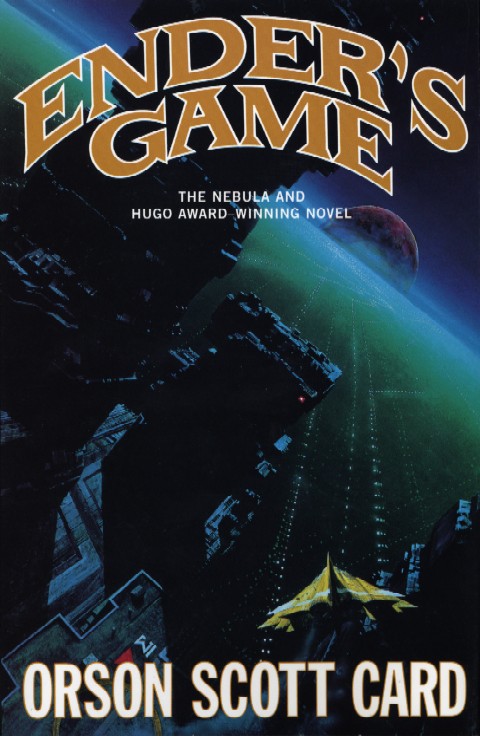
Ender’s Game by Orson Scott Card

Ender’s Game is a terrific science fiction novel, but it should and does have a much wider appeal. You could put it in a general literature category and it would still be highly ranked.enders-game

 It is the story of a boy in the future who must train to be the commander of a force that will save humanity. After being attacked by aliens (known as buggers) and barely surviving the attack, the military of Earth are planning to prevent a second wave by sending forces to the bugger home world to destroy them.

 Ender Wiggins is recruited at the age of six and goes through a grueling battle school in orbit of Earth, learning to develop new strategies and techniques to defeat the enemy. The school is set up as a series of games that the initiates play together. They are both brutal and instructive—and Ender prospers, growing from outcast to commander of his own group. What sets him apart is his ability to think outside the box and develop new strategies. It is thoroughly engrossing as Ender moves from one level to another, fighting his psychological programming as he puts together his own army, built on his own unique approach.

 Larger issues, especially government manipulation of individuals for its specific agenda, are dealt with in stunning detail. A second manipulation takes place as the author maneuvers his readers into rooting for a boy who is manipulated into becoming a mass murderer without even realizing that he is killing billions.

Winner of both the Hugo and Nebula Awards for Science Fiction, it raises more questions than it answers, but sometimes that’s what great works of art do—bring you into the conversation, but allow you to find your own answers. If you are looking for a book to really make you think, this would be it. And that, in the end is partly what makes great science fiction.

Insurgent by Veronica Roth

This review contains spoilers!

Insurgent, by Veronica Roth, is the second installment of the Divergent Trilogy, which had a very promising beginning with the first novel, Divergent.InsurgentHC-jkt-des4

This second novel, however, has a very rushed feel to it, as if it wasn’t properly thought out. I wouldn’t be at all surprised if Ms. Roth was working under some pressure to get the second novel out. This is a common problem in the industry–and also in recordings and movies. A creator will spend years creating something wonderful, but when it becomes a success, the demand for more is so high that new product gets rushed to the market without the benefit of time and thought, so it fails to meet the standards of the first creation. This, in turn, is usually not good for the creator. In the rush of success, they become sloppy artists and suffer in the long run.

The story does not really have an arc, but rather seems to be pulled to and fro with very little logic. Rather than developing one event upon another, I had the sense that Roth herself wasn’t sure what would happen next and just kind of went with whatever came to her.  (Indeed, I’ve learned that she doesn’t outline–and if you’ve got plenty of time for rewrites, that works well, but when you’re rushed, you can end up with something sloppy.)

Unfortunately, the same is true of for Tris, a character that I loved in the first book. She seems way unduly overcome by the death of her parents. Maybe I’m being cold in this analysis, but all of the traits that she developed throughout the first book would seem to leave her stronger and more able to bear this pain. Instead, she constantly loses control of herself. At times, it seemed like she cried every other page for weeks on end and that really, really wore on me. At some point in the book, it crossed over and actually became funny. I’m sure that was not intended in a saga that takes itself so completely seriously.

Part of the problem with the book is that we find the characters doing almost inexplicable things, putting themselves needlessly into dangerous situations. This has become a pet peeve of mine that I think we see all too much today. If a writer can’t really figure out what to do–how to organically develop plot–they simply have their characters do something really stupid. In this novel, it is Tris going to Erudite Headquarters in an attempt to commit suicide by placing herself in harm’s way.

Considering as much time as Roth invested in the first novel in making Tris strong, it just seems totally weird that she would do this. She seems to be overwhelmed by having killed Will–and that seems to drive her as much as feeling responsible for her parents’ deaths. At a certain point, between all the whining, the death wish, doing stupid things, I really lost respect for Tris and when that happened, I lost respect for the whole story.

With all of these preposterous events, I could not suspend my disbelief.

Much as I love the world and the characters that Roth created in Divergent, I must say this was a very disappointing follow-up.

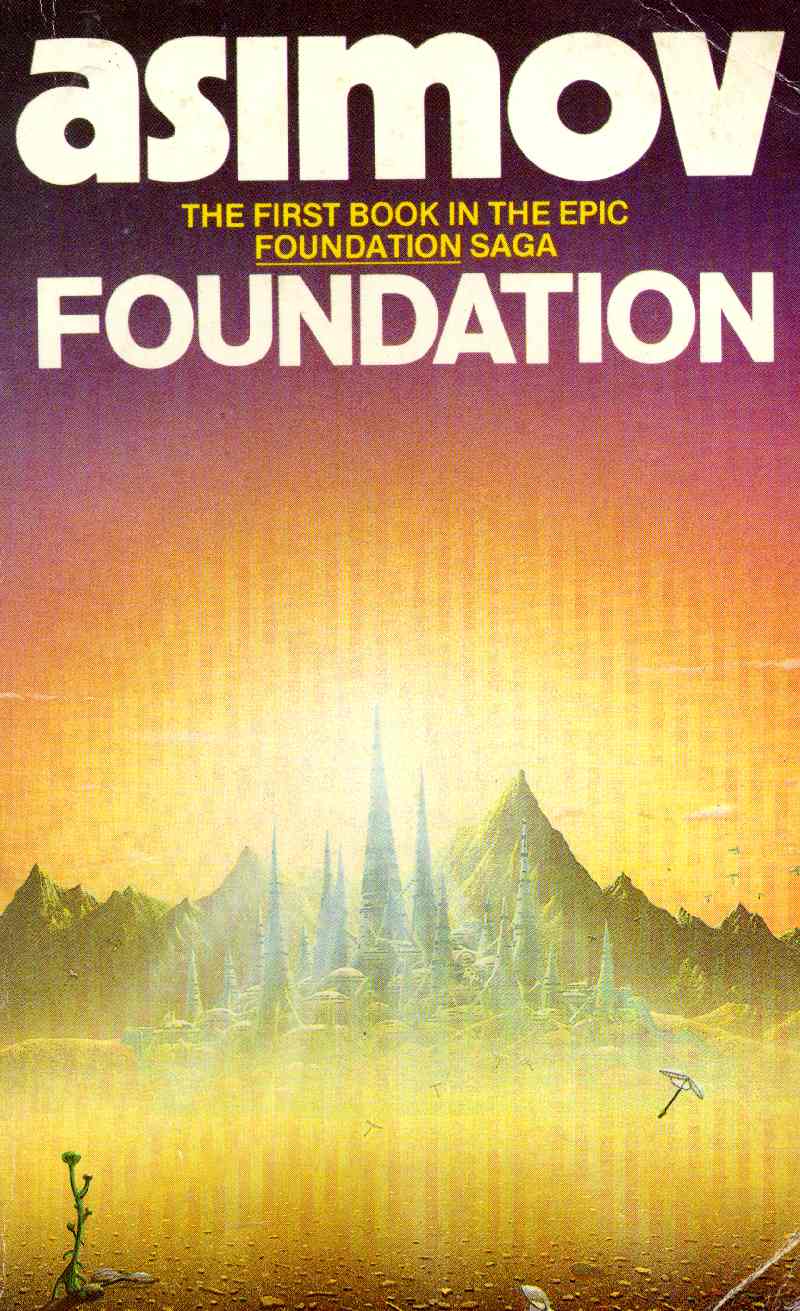
Foundation by Isaac Asimov

Spoiler Alert!

Isaac Asimov 1951 Foundation Isaac+Asimov

Foundation is the first in a series of novels by the esteemed Science Fiction Grand Master Isaac Asimov. It evolved from a series of short stories first published in Astounding Magazine beginning in 1942, under the direction of John W. Campbell. It reflects the very beginning of Asimov’s career as a writer and has been hailed as the beginning of one of the greatest space operas of all time. Indeed, the Foundation Trilogy was voted the Hugo Award in 1966 for “Best All-Time Series”.

The first book written in the series takes place many years in the future when the galaxy has been completely populated by humans due to faster than light speed travel. A Galactic Empire now rules the political spectrum and has ruled with an iron first for 12,000 years. However, much like the Roman Empire, the Galactic Empire has started to fall.

A mathematician by the name of Hari Seldon has created a new branch of science called psychohistory which combines statistical analysis with sociopolitical prediction. Seldon predicts the fall of empire and a dark age to last 30,000 years before a new galactic empire arises.

Naturally, the Emperor, on the home planet of Trantor, is disturbed by this prediction and arrests Seldon and some of his colleagues. Seldon believes that the length of time of dark ages can be reduced by creating an Encyclopedia Galactica that will allow mankind to pass on the civilization and scientific knowledge to future generations. In order to rid itself of Seldon, the Empire allows him and his followers to create their Foundation on a planet called Terminus circling a sun at the very edge of the galactic rim.

We later learn that Seldon actually manipulated the Empire into doing what he wanted them to do all along and that the Encyclopedia was merely a ploy for him to create a political body destined to eventually become the Second Empire. Manipulation itself becomes a major theme in the novel.

The book is divided into the following sections: The Psychohistorians, The Encyclopedists, The Mayors, The Traders and The Merchant Princes, following the development of the Foundation through a series of crises. These crises are invariably solved by a shrewd leader who generally uses the folly of their enemies against themselves. And every so often, Hari Seldon himself appears in the form of a hologram to give them hints as to where they are at and where they are going.

The book’s story is completely dedicated to political machinations and involves an inordinate amount of dialogue to serve the plot. The characters are sparsely drawn and serve specific functions in the development of the story.

The theme of the novel may be found in one of Mayor Salvor Hardin’s favorite slogans, “Violence is the last refuge of the incompetent.” Throughout the novel, one character in each section must overcome the greed and arrogance of a Foundation adversary that is bent on taking over Terminus.   In each case, the protagonist is able to manipulate the adversary into failure – and this is usually accomplished despite the wishes of most of the citizens of the Foundation. I see this as a flaw in the novel, in that psychohistory is based upon predicting the reactions of great masses of people over time. By having an individual outsmart the rest of the Foundation, it would seem that Seldon’s predictions are skewed completely by individual actions and that psychohistory is pure bunk. I can’t quite grasp how the actions of masses determine the future, yet one individual’s actions fuel the change. I don’t get that part.

The other problem I find with Foundation and with much of Asimov’s writing is his dependence on dialogue to tell a story. I was taught that a writer must show and never tell a story, yet Asimov’s characters constantly explain and argue back and forth for pages on end, with the only action being one character smoking a cigar or the other standing up and turning around. As a writer, I find this style highly problematic.

One of the basic issues with most science fiction writers is failing to see the future in any kind of creative way. Generally, the Masters and those others who have written very far in the past are given a pass because it would have been difficult for them to envision even the technology that we have today, let alone to envision it so many thousands of years in the future. I am inclined to grant that pass most of the time, but I also have some issues with Asimov’s future technology and society in Foundation.

I find it hard to believe that 20,000 years in the future people will still be reading newspapers, smoking cigars and watching “book-films”. I find it short-sighted to believe that atomic power would be propelling starships and running cities. Surely, something better would have been developed by then – and must have been. And I can’t really see a future in which leadership structures resemble that of the middle-ages. Even in 1942, even with Hitler and Mussolini, it should have been fairly obvious that mankind just wouldn’t continue with kings and dukes. Perhaps I’m being too harsh, but I see it essentially as a failure of imagination.

Ultimately, I don’t find Foundation to be among the very best of science fiction novels. Perhaps it has other, more historical accomplishments to recommend it. But I find the novel to be slow, bogged down in way too much dialogue, shallow in characterization and short on imagination.

Divergent by Veronica Roth

movies-divergent-shailene-woodley-trisDivergent, by Veronica Roth, is another in a growing list of YA Dystopian novels (trilogies, to be more specific) written in the first person present voice of a teenage girl. Like the others (Delirium, Hunger Games, etc. this book is set in the fairly near future when the United States has devolved into a ruling society and a bunch of outcasts. In this particular case, there are five factions, Dauntless, Erudite, Abnegation, Amity, and Candor. These names suggest the traits of the groups, intended by these ruling elite to balance each other.

Beatrice Prior, a 16 year old girl, tells the story, beginning shortly before her evaluation. She starts out in Abnegation, but, like all young people graduating high school, she must be evaluated to decide which faction she is best suited for–and then she must choose which faction she will devote her life to. The problem that turns up during her evaluation is that she is suited for more than one faction and this makes her Divergent. In a choice that shocks her family, she chooses Dauntless, the brave faction, known for wearing dark clothing, running around jumping on and off trains, wearing tattoos and lots of piercings. When she arrives, she changes her first name to the shortened version of Beatrice: Tris.

The book really moves quick, the characters are well-defined, Tris’s voice is unique and interesting, and even though the future world is a little far-fetched, Roth makes it work. The only thing that really bothered me was that Erudite emerge as the villains and I always wonder at writers to seem to feel that being smart automatically makes you untrustworthy. This is a weird thing that permeates America today: the notion that it is so much better to be dumb than smart. Another thing that bothered me–and it was a minor problem in Delirium as well–is that Tris seems to break down and cry a lot. I’d really like my teenage girl heroines to be a little tougher. It seems a more pronounced problem here, where Dauntless are supposed to be tough as nails.

I haven’t finished the trilogy yet, but I currently rank this at #3 in my YA Dystopian First Person Present Girl Heroine trilogies.

Anyway, once you get started, you won’t want to put it down.

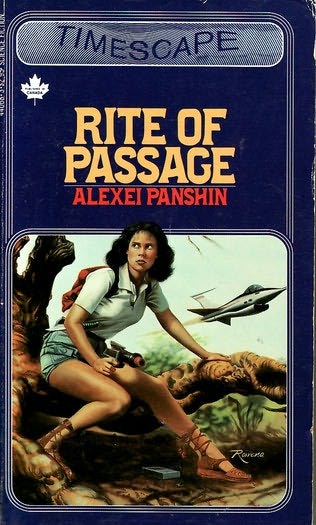
Rite of Passage by Alexei Panshin

Rite of Passage is an easy book to pigeon-hole as a “coming of age” novel, but to do so would be a mistake and a disservice to this excellent little science fiction novel that steps beyond the genre.

The book is written first person past through the eyes of the central character, Mia Havero, looking back at herself from the ages of twelve through fourteen. She is the daughter of the elected leader of a group of scientists and engineers who live on a spaceship at the end of the twenty-second century.rite-of-passage

Through internal strife, Earth has essentially destroyed itself. The ships were created to ferry passengers from Earth to new worlds that they might colonize to continue the existence of humanity. But the ships’ leaders have made a conscious decision to separate themselves – and their knowledge and expertise – from the farmers who are actually carving out the new worlds. These elitists decided that the knowledge they possess would be useless on worlds barely hanging on for survival, that the knowledge would be lost if they joined in that fight for survival, so they stay on their ships and merely trade bits of knowledge to the farmers (“Mudeaters” they are called) for supplies.

Mia herself, after being separated from her parents for years, recently left the common dormitories to live with her father. She is a precarious character at the beginning, having suffered from her separation, nervous to a fault around others, and easily frightened. At the beginning of the novel, her father is moving them to a different part of the ship and she is losing her tenuous hold on security.

But she begins her new existence by being teamed with a boy named Jimmy Dermently, precocious and just a few months older. They are assigned a tutor who is very old and who has been an opponent of Mia’s father. He teaches them to think outside the box and they both jump at the chance. Their major line of study becomes ethics and that leads to the central crisis of the novel.

How nice it is to have an entire novel based around a major ethical crisis.

During the next two years Mia and Jimmy educate themselves and prepare for the Trial that they must endure when they turn fourteen years old. The Trial is a survival ordeal that all juveniles on the ship must undergo to reach adulthood. They are dropped individually onto a planet’s surface, supplied with a horse, a gun, a knife and a tent and they must survive for thirty days until they are picked up. Many do not survive the “savagery” of the Mudeaters.

As Mia gains confidence through her survival training, she also studies the great philosophies of Earth’s past, picking each one apart, finding things that she can relate to and ideas that she must outright reject. She is forced to think and to make a major decision that will separate her from her family permanently. It is this part of the novel that it seems many critics completely ignore. But Panshin had some big ideas when he wrote this book and I think it is important that I share at least some of Mia’s thoughts:

“I’ve always resented the word maturity, primarily, I think, because it is most often used as a club. If you do something that someone doesn’t like, you lack maturity, regardless of the actual merits of your action. Too, it seems to me that what is most often called maturity is nothing more than disengagement from life [my emphasis]. If you meet life squarely, you are likely to make mistakes, do things you wish you hadn’t, say things you wish you could retract or phrase more felicitously, and, in short, fumble your way along. Those “mature” people whose lives are even without a single sour note or a single mistake, who never fumble, manage only at the cost of original thought and original action.”

To readers more accustomed to slam-bang action (which is, I think, a major pitfall in the writing of science fiction), this book may appear slow and way too thoughtful for them. What is mature deliberation is mistaken for plodding and a reader can miss all of the salient points that the novel is meticulously honing.

When a novel wins the coveted Nebula Award and is nominated for the Hugo, it usually means there is something very, very good about the book. I have now had the opportunity to read many reviews of this novel and most of them are frankly superficial and miss the point of the novel. But this is a fine little book, filled with the inner life of a fully realized character struggling to attain confidence and finding it at the point of a knife called ethics.

(As a side note, I read the Timscape paperback by Pocket Books, March 1982, with a terrific cover painting by acclaimed illustrator Rowena Morrill. It captures the absolute essence of Miva Havero, especially in the eyes and the wary set of her face. Great cover art can really help a book to come alive!)

As I said at the beginning of this review, it is a mistake to pigeon-hole this book. It is a much larger and more challenging novel. I strongly recommend Rite of Passage, not just to science fiction readers, but to the general reading audience.

Dragonsong by Anne McCaffrey

The following review contains spoilers, so if you’re looking for a surprise in the book, please read thisImage after you finish!  Thanks!

I first came onto Dragonsong after I had read The Dragonriders of Pern trilogy (which sets up the entire series of Pern books). I read the trilogy in a gulp, as the world of Pern and the life of the Weyr totally fascinated me. I immediately went looking for anything more about Pern and I encountered Dragonsong.

Menolly was a minor supporting character in the third volume of the Dragonriders trilogy, The White Dragon, and I was surprised to find a complete novel built around the character, but I jumped in with no preconceptions.

Menolly is the youngest daughter of Yanus, Holder of Half-Circle Sea Hold on the wild Eastern part of the northern continent on Pern and she is 15 years old at the beginning of the novel. Petiron, the Hold Harper, had found her to have an exceptional musical talent when she was very young. Even though girls were not allowed to be Harpers, he taught her how to play all of the instruments, to sing the traditional songs and eventually to write music. He even sent some of her music to Robinton, the Masterharper of Pern, for evaluation.

The novel begins with Petiron’s death and the subsequent abuse of Menolly by her family, who believe a musical daughter is disgraceful. Her father forbids her to write music and even beats her when she disobeys. When the replacement Harper arrives, Menolly is hidden from him, even though he is seeking the composer of the wonderful music sent to the Masterharper. After she badly cuts her hand, her mother intentionally mistreats the wound so that Menolly believes she will never play music again. Menolly falls into a deep depression.

Caught out during threadfall and stuck in a cave, Menolly witnesses the hatching of wild fire-lizards (miniature dragons). To prevent them from dying, she feeds the small creatures and bonds (or imprints with) nine of them, who will then be her friends for life, linked telepathically. Deciding that she will not return to the hold, Menolly makes a life for herself on the coast, living in the fire-lizard cave, spending most of her time just finding food for the ravenous creatures. She makes herself a set of pipes and the fire-lizards learn to sing with her. During a later threadfall, she is caught away from the cave and must run for cover in her worn boots, tearing her feet to ribbons in the process. Fortunately, she is rescued by a dragonrider, who brings her to Benden Weyr.

For the first time in her life, Menolly begins to understand what it is like to be treated with respect and affection. Her nurse is Mirrim, one of the most enigmatic characters throughout the saga. They are about the same age and quickly become friends. Afraid that she will be sent home, Menolly hides her fire-lizards until she is found out by Weyrwoman Lessa. Breaking down, she begs not to be returned home and is asked to stay in the weyr.  Once accepted, she becomes overwhelmed by all of the attention.

It is at this point that events from the novel Dragonquest become interwoven into Dragonsong, most notably, Brekke’s recovery from the death of her dragon and Jaxom’s impression of the little white dragon, Ruth. For those familiar with the earlier novel, it is really great to see the same events from a very different point of view.

The book ends with Masterharper Robinton’s discovery of Menolly as the composer of the songs that Petiron had sent him. Overjoyed, he asks her join the Harper Hall. At last, she will be able to pursue her love of music and to begin her new life as a musician.

McCaffrey tells the story of a hero overcoming adversity extremely well. It is completely believable that Menolly suffers unbearably in order to pursue her dream. Her suffering is even more poignant in that it is at the hands of her own family, those who should love and support her. McCaffrey takes the time to detail these familial characters, so that they do not feel two-dimensional and so that their mistreatment of Menolly is understandable, if not agreeable.

Menolly’s love of music is treated in such a way that the reader develops an amazing sympathy for her plight. Everyone should have such a love of something that it would be the whole purpose of his or her life. This is a terrific foundation for the rest of the novel and also for the sequel, Dragonsinger.

When she realizes that she has left her hold for good, there is a miraculous sense of freedom, which is punctuated by the miracle of the fire-lizard hatching. Menolly literally saves their lives, as she has saved her own, and both she and her fire lizards may live free. This freedom is referenced again several times in Dragonsinger when, under the pressures of life in the Harper Hall, she remembers the complete freedom of living in the cave.

After her rescue, Menolly can scarcely believe her luck – she almost always worries that what she is doing is wrong or that someone will come down on her for her actions. This is the result of her mistreatment at the hands of her family. She has been conditioned into believing that she is always in the wrong. Part of the poignancy of the story is that the weyrfolk and harpers have to convince her of her own worth. And when she realizes that she can both play and write music to her heart’s content and to the joy of others, she feels an amazement and gratitude that the reader can share in completely. It is cathartic.

For me, Dragonsong is a perfect little novel.