The English Patient

Feel free to disagree with me on this one!  🙂

The English Patient is a highly overblown World War II romance. Based on the novel by Michael English PatientOndaatje, the movie was adapted and directed by Anthony Minghella. It tells a rather choppy story that uses lots of flashbacks to flesh out (literally) the illicit romance between cartographer Count László de Almásy (Ralph Fiennes) and the wife of his benefactor, Katherine Clifton (Kristin Scott Thomas).

The main story deals with Canadian nurse Hana (Juliette Binoche) tending to the badly burned body of de Almásy in an abandoned Italian monostary.   Supposedly, he doesn’t remember who he is and since he speaks English as his first language, they refer to him simply as “the English patient” and there is the title of the film. To little purpose, Hana has a relationship with Kip (Naveen Andrews), a Sikh who serves in the British Army sweeping mines, while David Carravagio (Willem Defoe) hangs around hoping to pin de Almásy as the third man responsible for his thumbs being cut off (he’s already killed the first two).

The back story is revealed through de Almásy’s memories. He was on an archeological and cartographic expedition in Egypt prior to World War II and they discover the “Cave of Swimmers” in the desert. The expedition’s benefactors, Katherine and Geoffrey Clifton (Colin Firth) join them and while Geoffrey goes off to spy, de Almásy and Katherine begin an affair that Geoffrey ultimately finds out about. As one might discern from the plot described above, everything is doomed to end badly.

The first major problem with the movie is that it is at least an hour too long. As I began to hope and pray that this overblown romantic drama might end, it continued to linger on and on and on. By the time the movie finally ended, I was perfectly content and happy that everyone but Juliet Binoche was dead.

The second major problem of the film is that both Fiennes and Thomas are terribly cold fish. The movie hinges on the viewer being able to understand and relate to their torrid affair, but they were both so unemotional that I just couldn’t get involved. Most of the other performances are okay. If the movie had been trimmed to a sleek 90 minutes I probably could have been able to tolerate the lousy romance more, but as it dragged on and on, I simply began to resent the filmmakers wasting my time with this tawdry and unbelievable little potboiler.

It is difficult to understand how it won so many Academy Awards. Hollywood loves long, overblown, beautifully photographed love stories. If you look back over the history of the awards, a huge number of undeserving films have been honored and this is certainly in that category. The Golden Globe Awards are usually a much better measuring stick of a film’s real values, but even they gave it two out of the seven nominations (the Academy generously gave it a whopping nine awards out of twelve nominations).

Another thing that Hollywood loves is steamy romances where either a husband or a wife is unfaithful. I have always failed to see the romance in betrayal. There are a great many times during the movie where Katherine could–and should–have revealed her affair to her husband. Rather, she prefers to go on hurting him, eventually driving him to suicide. I just don’t see any way that this behavior could be deemed as admirable or romantic. It is possessed of its own unique evil and yet Hollywood seems to love it. Perhaps it’s because this is somewhat a way of life in Hollywood and actors and actresses can relate to it. I find it impossible to see the betrayers as heroes or heroines.

I can’t honestly recommend this film. It takes nearly three hours (2:42 to be exact) to spin its tedious, tawdry tale and there is no return on your investment of time. Pass.

Lovelace

Amanda Seyfriend as Linda LovelaceThis film is a 2013 biographical picture about the life of Linda Boreman, beginning at the age of 20 and going through her marriage to Chuck Traynor and the release of her biography, . Under the trade name of Linda Lovelace, she starred in the 1972 pornographic breakthrough movie Deep Throat and that is her lone claim to fame aside from her biography, Ordeal.

When Linda (Amanda Seyfriend) and her friend Patsy (Juno Temple) dance at the bowling alley on a lark, they are spotted by Chuck Traynor (Peter Sarsgaard), a young man into drugs and pornography. Although he treats her like a gentleman at first, Linda is having serious trouble at home with her repressive parents John (Robert Patrick) and Dorothy (Sharon Stone). After an incident with her mother, Linda moves in with Chuck and eventually marries him.

Although the film doesn’t show us any kind of abuse throughout the beginning, later flashbacks show us that he raped her over and over and forced her into prostitution against her will, essentially using her sexuality as a way to make money. He takes it to the ultimate level when he forces her to appear in a porno movie, Deep Throat.

While Chuck intended to make a great deal of money from her, the scheme backfires in several ways. In the first place, she was only paid $1,250 for her performance, which made the movie somewhere in the neighborhood of $600 million dollars worldwide. The second problem created by the success of the movie was that Linda Lovelace became an overnight celebrity and it became more difficult to control her. But control her he did, forcing her to use her name on blow-up dolls, dildos, and other paraphernalia while holding out for a bigger film deal.

At one point in the movie, Linda tells Phil Donohue that she was only in the porn industry for 17 days, yet it was the one thing she was always remembered for.

Desperate for money, Traynor sells her to five men. He locks her in a motel room with them so they can beat and sodomize her for hours. At her wits end, she finally runs away and makes a new life for herself.

Directed by Rob Epstein and Jeffrey Friedman, the movie achieves a very high level of filmmaking and it is not hyperbole to say that is a very powerful movie. Amanda Seyfriend is truly outstanding as Linda Lovelace, bringing just the right level of belief in her husband to keep forgiving him until things got so far out of hand that she had to escape. Sharon Stone gives perhaps her best performance ever as her mother Dorothy. Sarsgaard is good as Traynor, but the role is pretty one-note so it’s difficult to give him much more credit.

If the movie suffers from any problem, it is in the way the story is laid out. I understand what the filmmakers were trying to do by showing the story in two different takes. In the first part, they were attempting to show us what people saw at the time—the history we know—then in the second part, they show us what really happened. While I understand the device, I’ve got to say that it wasn’t entirely successful. I think a straight, chronological story line might have worked better or even a retelling beginning with the book Ordeal showing what really happened. I just don’t know. These aesthetic questions are really splitting hairs, but even if you consider this a potential problem, it doesn’t take away any of the power of the movie at all.

 As one might suspect, this is an Adults Only film, for mature audiences, not only because of nudity and simulated sex, but because the subject of domestic rape and psychological control requires a certain amount of maturity to understand and deal with.

A very good film. I highly recommend it.

Shakespeare in Love

Written by Tom Stoppard (author of Rosencrantz and Guildenstern are Dead) and Marc Norman, this 1998 film is both a comedy and a romance–and it is very successful at both.

Viola and Shakespeare in bedUsing the premise that Romeo and Juliet was Shakespeare’s breakthrough drama, the movie begins with Will Shakespeare (Joseph Fiennes) as a poor player in Lord Chamberlain’s Men struggling to write a comedy for Philip Henslowe (Geoffrey Rush), owner of the Rose Theater, to be called Romeo and Ethel, the Pirate’s Daughter. As was the custom in those days, they began to cast the play before it was completed–or in this case–even started. Viola de Lesseps (Gwyneth Paltrow), the daughter of a wealthy merchant, disguises herself as a man so she can audition. When Shakespeare sees her, he chases after her and follows her back to her palatial home, remaining to watch the ball, hoping to get a glance at the boy who had impressed him. When he sees Viola dancing, he insinuates himself into it and falls hopelessly in love with her. Viola, however, is slated to marry Lord Wessex (Colin Firth) and go off with him to the new world where he plans to run a successful tobacco plantation. Shakespeare, now deeply in love, changes his play from a comedy to a drama and renames his heroine Juliet.

The film won seven Academy Awards, including Best Picture. Gwyneth Paltrow won Best Actress and Judi Densch won Best Supporting Actress for her portrayal of Queen Elizabeth. The cinematography is terrific, as are the costumes, and the set, which was built specially for the movie. The direction by John Madden is tight, with terrific editing.

But the star of the movie is the script, which incorporates hilarious scenes, counterbalanced by wonderful romantic scenes. It is extremely witty, incorporating quotes and references to Shakespeare’s life and inspirations throughout, and liberally sprinkled with quotations. Although Norman had the original idea, it was Stoppard’s masterful rewrite that makes the movie work. The marvelous parallel of Romeo and Juliet with the tragedy of Will and Viola works like a charm, as many of the scenes between the young couple actually make it into the play. The final and most wonderful element is the substitution of Viola as Juliet, performing before Queen Elizabeth, in a time when all women’s roles were played by men. Equally powerful is the idea at the very end that Viola inspired Shakespeare to write Twelfth Night in her honor. Although most this story is completely made up–and abounds in historical inaccuracies–it remains a wonderful movie and it inspired me to go back and reread some of Shakespeare’s plays and poetry.

I highly recommend this movie to everyone!

Mystic River

Mystic River is a hard-hitting blue collar crime movie by the amazing Clint Eastwood and the cast is packed with great actors.936full-mystic-river-photo

Released in 2003, it tells the story of three boyhood friends forever changed by an incident in 1975. Jimmy Markum, Sean Devine, and Dave Boyle are writing their names into wet cement in the slums of Boston, when a car pulls up with two men in it. One of the men gets out and implies that he is a cop. He intimidates Dave until the boy gets into the car with them. Of course, they aren’t cops, but pedophiles and they abuse him for four days until he escapes.

Twenty-five years later, Jimmy (Sean Penn) is running a convenience store, Dave (Tim Robbins) lives near him, permanently scarred by his experience, and Sean (Kevin Bacon) is a police detective.   Jimmy’s 19 year old daughter, Katie (Emmy Rossum) tells him that she is going out with friends and will be home late. While drinking in a local bar, Dave sees Katie getting drunk and dancing on the bar. He doesn’t get home until 3:00 AM and he is covered in blood, his hand hurt. He tells his wife, Celeste (Marcia Gay Harden), that he was accosted by a mugger and that he beat the man to a pulp, maybe killed him.

The next morning, a Sunday, Jimmy discovers that Katie has not been home all night and Sean is called to a crime scene that is centered on Katie’s car, parked awkwardly on the street, with the door open and blood on the inside. Katie is found dead in a nearby park, her body marked with lacerations and gunshot wounds. Jimmy and his wife, Annabeth (Laura Linney) are inconsolable and he recruits several shady neighborhood characters to investigate the murder at the same time that Sean and his partner (Laurence Fishburne) are also investigating.

While the movie is a murder mystery–and a good one–it goes much deeper than that. Eastwood is concerned with tortured souls, guilt and retribution, and he works the script by Brian Helgeland (based on the novel by Dennis Lehane) for all it is worth. Penn gives a heartfelt performance that won him the Oscar for Best Actor and Robbins is terrific as the tortured Dave Boyle. All of the supporting performances are deep and well nuanced, especially Laura Linney. The Jersey feel is solid, the lighting moody, and music–composed by Eastwood–perfect for the film’s worrisome and tragic plot.

I thought the movie was a little long and might have benefited from some judicious cutting, but it never left me feeling bored. Justice is not served and Eastwood makes a point of the fact that things do not add up–it is part of the appeal of the movie. And it is usually a fact of life that most filmmakers do not worry themselves over. For Clint Eastwood, however, the fact that life doesn’t add up is the very point of the movie. If you’re looking for an outstanding drama, I highly recommend the film.

Across the Universe

Across the Universe is a real accomplishment, for both film and music.Across_the_Universe_3lg

Conceived, produced and directed by the eclectic Julie Taymor, this film is a romantic musical that incorporates parts of 34 songs composed by John Lennon and Paul McCartney, George Harrison, and the three of them plus Ringo Starr (“Flying”). Most of the songs are sung on-screen by the characters, though there are some instrumentals. This places the film in the category of old-style musicals where people seem to burst into song as a part of the story. To everyone’s credit, it actually seems to work very well indeed.

The story concerns Jude (Jim Sturgess), a young dockworker in Liverpool who goes to the United States to look for his American father (who had a fling with his mom during World War II. The very first few frames of film show Jude sitting on a beach singing Lennon and McCartney’s “Girl,” an auspicious beginning because it also tells us that we are not going to be sitting through “copies” of Beatles’ songs. Throughout the entire movie, pretty much every song has been reinterpreted and rearranged which gives them all a brand new and exciting feel.

The movie is definitely concerned with the radical changes brought about during the turbulent 1960’s. Jude provides an outside perspective, while his girlfriend, Lucy (Evan Rachel Wood) and her brother, Max (Joe Anderson) provide the viewpoint of America’s youth. Max drops out of college and gets drafted. While waiting for his induction, the three of them go to New York where they become embroiled in the hippie scene. The other major characters are Sadie (Dana Fuchs), Jojo (Martin Luther McCoy), and Prudence (T. V. Carpio). Where Sadie reminds one of Janis Joplin, Jojo reminds us of Jimi Hendrix.Lucy Across the Universe

An accomplished artist, Julie Taymor brings a sophisticated and stimulating range of graphic beauty to the film, not only in the psychedelic sequences, but in almost every scene. I’ll never forget the way she illustrates “Strawberry Fields Forever” by having Jude pin strawberries to canvas, literally bleeding against the white, while a television shows Max in Vietnam singing with Jude and even superimposed over his face. Another sequence that really carries a punch is Max’s physical in which grotesque sargents stamp out the recruits to “I Want You/She’s So Heavy” with giant troops carrying the Statue of Liberty above them as they stomp on palm trees in Southeast Asia. “Being for the Benefit of Mr. Kite” is full of great images, camera tricks, and bizarre imagery reminiscent of the Beatles own movie Magical Mystery Tour.

All of the young actors are superb, giving heartfelt performances and wonderful vocals. The film is also spiked with a special performance of Bono as Dr. Robert and Eddie Izzard as Mr. Kite, as well as great cameos by Salma Hayek and Joe Cocker.Across the Universe Max Physical

It’s one of those films you excuse for running a little long because it’s all worth it. Great music reinterpreted, fine acting, an excellent script, great direction, and unbelievable graphic art. I will definitely see it again and again.

Save The Last Dance

Save the Last Dance is a surprisingly well-thought out film. Although it is primarily concerned with dance, it also deals with some big issues.

save-the-last-danceWhen high school student Sara Johnson (Julia Stiles), an aspiring ballet dancer, auditions for Julliard, she pushes her mother into ducking out of her busy job to come watch and support her. In her hurry, her mother drives right into a serious freeway accident and is killed. Grief-stricken, Sara gives up ballet, feeling that her mother’s death is all her fault, and moves in with her dad, a jazz trumpeter, in Chicago.

Although her new high school isn’t composed completely of African-American students, it seems to be around 95% black. On her first day, she clashes with Derek Reynolds (Sean Patrick Thomas), a very bright boy, in her English class, then she is befriended by Chenille Reynolds (Kerry Washington), Derek’s sister. Chenille is a single mother as well as a high school student, and she and Derek live with their grandmother.

Chenille sets of an evening with Sara at Stepps, a local hip-hop club, where Derek and his friend Malakai hang. However, Malakai is into dealing and drugs and puts himself into pretty dangerous situations. While Derek teaches Sara how to dance hip-hop, many of the other black kids at the school begin to resent Sara’s taking one of the most eligible black boys at the school and even Chenille is not supportive in that respect. When Derek talks Sara into doing another audition for Julliard, she begins working seriously toward that goal.

The film is immensely entertaining, not only in its exploration of the racial themes, but in its use of music and dance, employing great classical music and lots of wonderful hip-hop songs. We get to see a Joffrey Ballet performance, professional hip-hop dancing, and a mixed program where the two forms are joined together in one dance. All of the hip-hop songs are very well-chosen, including Ice Cube’s “You Can Do It,” one of my favorite hip-hop songs.

Stiles and Thomas are both wonderful in their roles and all of the supporting case is excellent, especially Washington. The direction by Thomas Carter is spot-on and the editing and cinematography are first rate. I highly recommend this movie!

The Blind Side

the-blind-side-22-550x366The Blind Side, written and directed by John Lee Hancock, is a biographical drama that tells the story of how Michael Oher (Quinton Aaron), a rather large African-American, gets adopted into a white family, defeats his educational issues, and goes on to develop into a terrific left tackle on the football field (protecting the quarterback’s blind side, hence the title).

Born into a broken family in the projects of Memphis, Tennessee, with a mother who is a drug addict and no father, Oher was taken into child protective services and spent time with a number of foster parents that he always ran away from. At the beginning of the film, he has been sleeping on the couch of a friend’s family. The father, in an attempt to help the boy out, asks Burt Cotton (Ray McKinnon), the coach of the football team at Wingate Christian School, to see if he can get Michael admitted to play on his team. Although academically ineligible, Cotton nonetheless convinces the school to take a chance on him–not because of his abilities as a football player, but simply as the Christian thing to do.

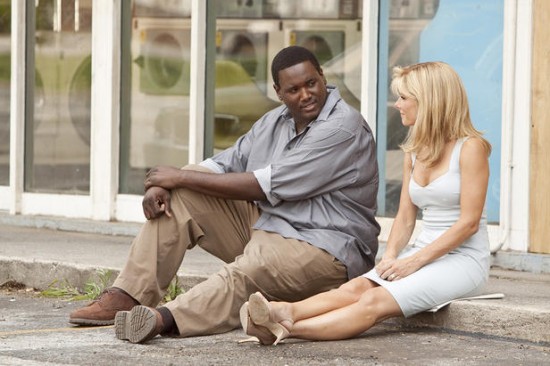
When Michael hears the family he is staying with arguing over him, he leaves and takes to the streets, sleeping in a Laundromat. Leigh Anne Tuohy (Sandra Bullock), whose two children attend the school, sees Michael on the street and brings him home to sleep on their sofa. She and her husband, Sean (Tim McGraw) decide to give him a permanent home and to help him in school so that he can improve himself and play football.

Sandra Bullock is wonderful as Leigh Anne, giving the best performance of her career, for which she won both the Academy Award and Golden Globe for Best Actress of 2009. She creates a lovely Southern infused accent that’s not too heavy and very believable   Tough, yet very loving, she carries the film by herself. Quinton Aaron is very believable as Oher, playing him moody, quiet, and yet growing to trust Tuohy family, becoming very close to their son, SJ (Jae Head) and daughter Collins (Lily Collins). The other actors are all very good, especially Kathy Bates as Miss Sue, a teacher they recruit to tutor Michael. 

The script is tight, it is very well edited, and the cinematography is excellent. Although the film was nominated for Best Picture of 2009, it did not win.

I highly recommend this film to everyone!

Cheyenne Autumn

Cheyenne Autumn was the last western film in the great career of director John Ford. Released in 1964, it was the first big Hollywood film to portray Native Americans as human beings, people who were not only more than primitive savages to be killed and driven off their lands by the white man, but people who were victims of the bigoted and corrupt government of the United States of America. For Ford, making such a film was a mea culpa for his entire career of westerns that depicted Native Americans as savages to be killed and driven off their land. Although I certainly approve of its historic context, it is definitely a movie with a lot of flaws.Cheyenne Autumn

The story concerns the remnants of the Cheyenne tribe who were relocated to Oklahoma from their native Montana. Ford, of course, relocates them to Monument Valley so he can capitalize on the scenery (almost every Ford western was shot in Monument Valley, which is part of the Navajo Nation). By 1878, most of the tribe had been decimated by starvation and small pox, so that the mighty group had been reduced to around 300 people, mostly women and children. Rather than watch the rest of the tribe die, they set off to return home, a trek of over 1,5000 miles, some on horse, but most on foot, and dogged by the U.S. Army most of the way.

The story is told from the perspective of Captain Thomas Archer, played mostly with restraint by Richard Widmark. He narrates the story, but Ford keeps his voice-overs spare, only filling what little detail is required for the story. There are times when he–and others in the cast–over-act and you know you’re watching a Hollywood movie. In point of fact, you always know you are watching a Hollywood movie. All of the extras are Navajo and they all speak in their native language rather than Cheyenne. And all of the Indian leaders are played by Anglo or Hispanic actors in make-up. Vying to replace the dying chief are Dull Knife (Gilbert Roland) and Little Wolf (Ricardo Montalban). Off to the side, Red Shirt (Sal Mineo) is attempting to steal Little Wolf’s second wife and generally making a hot-headed nuisance of himself.

The best performance in the movie is given by Carroll Baker as a Quaker school teacher who joins with the tribe on their journey north so that she can help take care of the children she’s been teaching. Edward G. Robinson is also quite good as the Secretary of the Interior.

The worst performance is given by the venerable Karl Malden as Captain Oscar Wessels, a commander who wears his German descent on his sleeve. Commanding Fort Robinson, where some of the Cheyenne have turned themselves in rather than starve along the road, he claims to have respect for the Indians, but at the same time he locks them up in a cabin without food or heat because they will not follow orders from back east to turn around and return their reservation in Oklahoma (Monument Valley). These conflicting emotions in the Captain lead to a great deal of theatrical histrionics that really take away from the film.

Epic in proportion, it is nearly three hours in length. There is much that should have been cut before the film was released, but at that point in his career, Ford had a little too much clout. The entire sequence with James Stewart as Wyatt Earp, Arthur Kennedy as Doc Holliday, and John Carradine as Major Blair should have been cut, despite the star power. Stewart looks bored, playing Earp as a half-sotted poker addict. The extremely long scene meanders and does nothing but distract from the movie. Plus, there’s at least another 45 minutes that could have been cut elsewhere to improve the film.

On the DVD that I watched, there was also a pretty good special feature. James Stewart narrates a documentary film in which three members of the Cheyenne tribe, presumably in 1964 or 1965, drive along the route of the Cheyenne Trail, retracing the steps of their ancestors in an RV. It gives an interesting perspective on the tribe with nearly a 100 year distance between them and their epic walk.

Although the film has historical importance–and sometimes it’s just fun to watch a hammy old Hollywood western–it really isn’t very good. So, if you’re going to watch it, put aside three hours, make a big bowl of popcorn, and understand what’s coming up on the screen. Have fun!

Adventureland

AdventurelandAdventureland is a funny and moving teen romance written and directed by Greg Mattola about a group of teens working at a summer carnival. The main character, James Brennan, is a student who has just graduated from a small college and is saving up his money to go to the Columbia School of Journalism so he can begin a career in travel writing. Played with both humor and angst by Jesse Eisenberg, James is trying to find romance, but his own geekiness stands in his way.

It doesn’t take long after meeting Em for him to start falling for her. Older and wiser, she is a student who lives and studies in New York (NYU) during the school year, but works as a carny in the summer. She’s also having an affair with Mike (Ryan Reynolds), a guitar player who also fills in there in the summer as a maintenance man. Married, his one claim to fame is that he is rumored to have jammed with Lou Reed, James’ hero.

The film is a period piece, set in the summer of 1987 and Mattola has gone to great lengths to make the film of its time. The park seems quite old by today’s standards and the costumes and hair styles all reflect the late 80’s very well. Although some of the humor is a bit juvenile, it generally works well. The supporting characters are sharply defined and quirky. Kristen Wiig as the park manager and Bill Hader as her husband and assistant are both quite funny and Martin Starr is quite good as James’ pal Joel.

Both Eisenberg and Stewart are very good and this is probably Stewart’s best performance. They are the only two characters in the movie who have serious scenes and they carry them off very well. It’s a fun movie and worth spending the time watching.