Rivers and Tides Andy Goldsworthy: Working with Time

Goldsworthy 01The violent colors of autumn leaves, an iron-rich rock that turns water blood red, blackened stalks, great slabs of ice, thorns, chipped rocks: these are the materials that Andy Goldsworthy uses to create his ephemeral art.

One of the most creative artists in the world, Goldsworthy purposely creates beauty from nature that nature herself will destroy sooner or later and mostly sooner.  He is also a photographer, which is essential to document the works of art that sometimes last only moments and sometimes years before they are gone.  Working from his home base in Penpont, Scotland, he travels the world interacting with water, stone, and growth to form both small and massive creations that inspire and delight.

Goldsworthy 02This beautiful documentation of his work was lovingly created by German writer, director, and cinematographer Thomas Riedelsheimer for Mediopolis and Fernsehproduktion Gmbh with incredible music by Fred Frith.

Beginning on the isolated shores of Nova Scotia, Goldsworthy acclimatizes himself by building a twisting line from icicles, bending and shaping them into what appears to be the lazy oxbow of a river, gleaming white in the sun as it slips into and out of a rock on the shoreline, waiting only for the sun to melt it.  Riedelsheimer’s camera lingers on the swirls as a river rushes into the sea and the tide moves in to smother it.  On another day, Goldsworthy builds a gigantic pine cone from rocks along the shore, but the balance is so delicate that it keeps falling apart and he must start over again.  The tide is out, but it will come back in by 3:00 PM so he must work fast to get it finished.  There is not enough time, so he must give up.  He explains that as he works with the rocks, he gets to know them, to understand how they fit together.  On the third day, his giant pine cone stands on the shore and he watches as the tide comes in, completely covering it with sea water, but when the tide goes back out, it is revealed again, still standing.  Gathering driftwood, he creates a hemisphere of sticks on the rocks, building and coming together with a perfectly round hole in the top.  A man wanders by and the two of the watch as the tide rises, swirling the wood back out into the sea that threw it up on the shore in the first place.

Goldsworthy 03At home, in Penpont, he works on a hillside, among the long-haired oxen, pulling reeds from the ground and arranging them on the hill with brilliant bronze points flowing away from a jet black circle in the center.  Using thorns, he tacks sticks to the branch of a tree, intersecting them until they form a perfect center in the middle.  He wraps leaves tightly around themselves to create a gigantic snail.

Working on a commission at Storm King Arts Center in Mountainville, N.Y., Goldsworthy directs workers in the creation of a wall that snakes like a river through the trees, disappearing down into a pond and re-emerging on the other side to continue on.  Splashing through a stream, he finds red rocks with a high iron content and breaks them down into dust.  He either mixes the dust with water that pools in holes in rocks, creating a blood red circle, or he tosses a ball of the dust into the river, making large, bright red splotches in the stream.  Using thorns, he connects a train of leaves that unwinds in the river like a large, green snake.

Standfoto RIVERS AND TIDESRiedelsheimer’s camera follows him as he makes a huge volume of art, most of it destined for immediate destruction by the world from which it is created.  Along the way, Goldsworthy talks about the philosophy of his art and the nature of time and existence.  Creation and destruction are obviously at the heart of his work, but the two acts work within a given time.  For example, creating his gigantic cone of rocks on the beach before the tide comes in to cover it or listening to the wind as he works on his tree sculpture, knowing that in the space of minute the delicate structure can fall.  Nature itself is in a constant rhythm of creation and destruction.  Goldsworthy looks at the example of his iron rock, how it solidified over the eons, how it even now contains the water that runs through everything and how, once pulverized, he can return it to the river as dust, knowing that it will again coalesce in the riverbed.

Time is like the images of the river that are a recurring motif in Goldsworthy’s work.  It swirls around us constantly from moment to moment, pulling in something here, discarding something there.  Existence, like Goldsworthy’s creations, is ephemeral.

Goldsworthy 05We are like the river that passes through it.

I admit that documentaries have never been my favorite form of film, but recently, due to the influence of my friend, Harlan Heald, I have begun to watch more and more of them, especially films about artists–and this is one of the best, because it is not just about art, but it exists as a work of art in itself.  It is a film that I can watch over and over and every time it makes me feel more a part of the natural universe I inhabit.  It is a creation of great beauty.

The DVD contains two disks.  Disk 1 contains the film, plus a number of short films about some of the individual projects, as well as information about Goldsworthy, Riedelsheimer, and the production company.  Disk 2 contains a very interesting film about a project where Goldsworthy created 13 gigantic snowballs, each containing a different texture (one contained pine cones and another contained cow hair) that were deposited on various streets throughout London at mid-summer, to melt during the longest day of the year.  Riedelsheimer followed the process as well as filming the reaction of a great many Londoners to finding this monstrosities on their streets.  It also contains an in-depth interview with Riedelsheimer.

Goldsworthy 06This is a DVD that could easily be a part of anyone’s collection as it can be viewed over and over again with enjoyment.  The colors a beautiful, the cinematography is wonderful, and the philosophy is very enlightening.

I highly recommend Rivers and Tides: Andy Goldsworthy (Working with Time).
The Spectacular Now

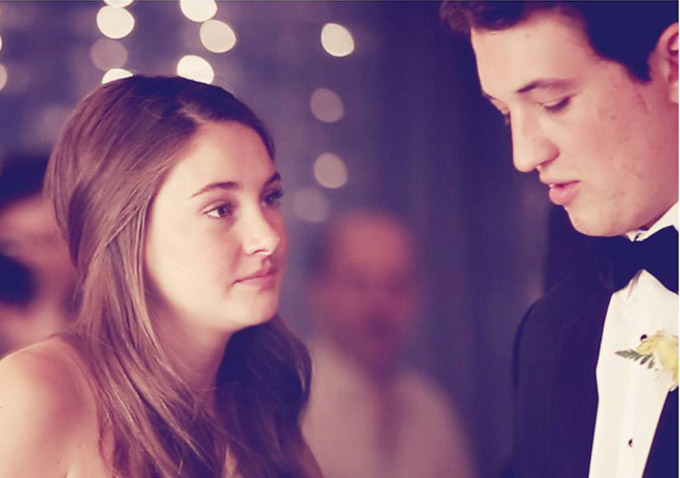
Shailine Woodley int The Spectacular NowThe Spectacular Now aims much higher than any run-of-the-mill teen romance and its success in achieving a film that goes beyond the limits of genre is to be highly commended, yet there are problems in the movie and it would make the film an excellent study for any film theory class.  Because this is a special film in many ways, this review contains spoilers, so beware if you haven’t seen the movie.

Sutter Keely (Miles Teller) is a high school senior who is the life of the party.  His girlfriend, Cassidy (Brie Larson), just happens to be the coolest girl in school.  He sits down at his computer to answer an essay question for a college entrance exam.  What was your greatest challenge and how did you face it?

His answer centers around how Cassidy has just dumped him.  Always helpful, he had been trying to set up a friend with a girl, but she happened to come with another girl and he just happened to be sitting with her in his car at lakeside drinking when Cassidy discovered them.  He’s almost always drinking, but he doesn’t see that as a problem and he figures that he’ll get Cassidy back pretty quickly, but she has already hooked up with the star athlete, Marcus (Dayo Okeniyi) and has left Sutter in her dust.

He goes out to party and ends up enormously drunk.  The next morning, he is awakened by a girl who finds him laying in someone’s yard passed out.  The girl, Aimee Finecky (Shailene Woodley) is also a senior at his school, although he doesn’t remember her name.  A semi-geeky girl who likes science fiction and graphic novels, Aimee is way too normal for Sutter, but he can’t find his car so he helps her do her mother’s paper route and ends up having a lot of fun.  He asks her out to lunch, then to a party.  He still isn’t over Cassidy, but she can no longer deal with his lack of ambition and drinking.  Aimee, who has never had a boyfriend, is just happy that he likes her.  He might be a good student, but he just doesn’t care.  There is a certain ennui about him, even though he puts up a good front.  Part of his problem is that his mother, Sara (Jennifer Jason Leigh) is a single parent and she keeps him apart from his father.  Sutter remembers playing baseball with his dad and completely blames his mother for “kicking him out of the house.”  His sister, Holly (Mary Elizabeth Winstead), who is married to a lawyer, doesn’t really care about their father.

Aimee falls in love with Sutter, but he continues to drift, fantasizing about getting back together with Cassidy.  He gradually comes to love Aimee as well, but he does not think he is good enough for her.  The sad thing is that he’s right.  Sutter doesn’t know what to do with himself.  He’s drifting through high school, he doesn’t want next year to happen, and he doesn’t want to make any plans.  In a scene with Cassidy, she begs him to think about the future, but he tells her that all that matters is the “now,” enjoying each moment as it happens.

Accepted into a college in Philadelphia, Aimee tells him that she can’t go because her mother won’t let her so they make a pact: if Aimee will stand up to her mother about going to college, then Sutter will confront his own mother about seeing his dad.  He asks her to the prom and gets her to start drinking alcohol, giving her a personalized flask when he picks her up.  Later, she tells him that she has decided to go to Philadelphia and tells him he should go there with her, that they could get a place together and get jobs while she goes to school.  He doesn’t commit himself to it, but he also doesn’t tell her “no.”  Marcus confronts Sutter about Cassidy, but Sutter tells him that there’s nothing between them.  When Marcus wishes he could make her laugh like Sutter does, Sutter advises him that all he needs to do is relax, to live in the “now.”

When Aimee badgers him into investigating his father, Holly finally gives him the phone number.  Sutter calls his dad (Kyle Chandler) and arranges a meeting, bringing Aimee with him when he goes to visit, but when he discovers that his father is an alcoholic skirt chaser, he sees his own future.  Depressed, he drinks heavily as he drives them back home.  Aimee tries to comfort him, telling him that she loves him, but he belligerently tells her to get out of the car.  When she does, she gets hit by another car.

Although she’s not seriously injured, Sutter’s depression reaches a whole new level.  They graduate, but he feels no joy in it.  She waits at the bus station for him to join her, but he drives by and lets her go off on her own.  Drunk again, he plows down the mailbox in front of his house and gets into a violent argument with his mother.  When he screams at her that she doesn’t love him, she comforts him and tells him that he is a gentle and giving man.  Sutter breaks down and sobs in her arms.

Confronting the computer screen and the question of what his greatest challenge is and how he overcame it, he types in a confession that he is his own greatest problem and that it is a problem he must solve every day going forward, finally recognizing that the “now” will come again tomorrow.  In the final scene, he joins Aimee in Philadelphia.

Even though this film is riddled with problems, there are also many things to like about it.  There is a simplicity in the script by Scott Neustadter and Michael H. Weber (adapted from the novel of the same name by Tim Tharp) that is quite engaging and the realistic approach of director James Ponsoldt keeps the viewer constantly involved in the story.  Sutter is a complex person and I have to give high marks to the creative team for making such a deeply layered character and wonderfully consistent throughout the entire film.  Surely, the temptation to make the film a pure romance must have been quite strong, but the movie works hard to keep Sutter real and to deal realistically with his problem, which is immense for a boy of his age.

It is dramatic, it contains a theme that is built and explored in a way that many other films should aspire to, it is very carefully written and well-thought out.

In addition, there are a couple of excellent performances in the movie by Jennifer Jason Leigh (I didn’t even recognize her) as Sutter’s mother and Kyle Chandler as his father.  Each of these actors brings a depth and a reality to their roles that goes even beyond the well-crafted script.  All of the other supporting actors do a good job as well.

The problems are mostly in the production, but one problem in the writing really holds the movie back.  There is nothing likable about Sutter.  As I watched the movie, it was easy to identify him as the protagonist and to feel a certain amount of angst for him, but the writers did nothing to help me like him or really care about him.  My first instinct was to blame the performance of Miles Teller, but I realized at some point that the story should have shown something else to make me care about what happened to him.  That was missing.

Shailene Woodley gives a fine performance as Aimee, but I believe she may have been miscast.  Given the beauty of the actress and Aimee’s terrific personality, I found it simply impossible to believe that she never had a boyfriend or that she was a wall flower.  Girls that special rise to the top because those around them inevitably recognize what’s great about them and give them a special position in the social order.  In fact, Aimee is so special that it is really difficult to believe that in her isolation she could love someone like Sutter.

In his desire to make the movie realistic, I believe that Ponsoldt must have encouraged Teller and Woodley to improvise much of their dialogue because it seems so genuine, however, the constant use of “awesome” and “amazing” and “cool” becomes almost funny at some points.  Sure, it’s probably realistic.  One can imagine real teens talking this way, but it sure makes them seem a lot less intelligent.  There should be an argument on this point because the question of realistic dialogue comes up over and over again.  My own personal opinion is that the clever screenwriter will use just enough teen clichés to make the dialogue believable, but back off before it becomes a running gag.  I think what happened in this movie was improvisation on the actor’s parts.  I don’t know that for a fact, but it feels that way.  Good and bad.

The ending probably should have been retooled as well.

Although the scene of Sutter writing his new answer is effective, I never had the feel of a real denouement, a crystal moment of realization in which Sutter knows how he needs to change his life and dedicates himself to doing so.  Maybe it is more realistic that he has a hint of what he needs to do and points himself in the right direction, but in the interval between breaking down with his mother and writing his new answer, I would have liked to see something that really gave him a positive direction.

Even given all of these problems, I still recommend this film, not only to film students, but to people who want to see a teen romance that has some backbone to it, a film that challenges itself to do better and makes a very positive footprint in the right direction.

The good outweighs the bad.

Pretty in Pink

Pretty-in-Pink-Duckie-AndieIt’s very rare in the realm of popular movies (outside of period pieces) that costumes play a major role, but Marilyn Vance is largely responsible for the success of the 1986 John Hughes script Pretty in Pink.  The third of the “Brat Pack” trilogy of movies, following Sixteen Candles and The Breakfast Club, it closely resembles the first film, Sixteen Candles, and if Hughes had had his way by casting Anthony Michael Hall in the pivotal role of Duckie, it might have been even closer.

The following review contains total plot spoilers, so beware.

The film is about a high school  senior, Andie (Molly Ringwald), with a great fashion sense.  Coming from the poor side of the tracks–a fact that is bluntly stated in the opening shot when the camera actually crosses the said tracks–Andie lives with her father (Harry Dean Stanton) and struggles against the conformity in her high school.  By frequenting thrift shops, she puts together an amazingly fresh and offbeat ensemble every day.  Of course, the rich girls at her school are complete snobs and they all wear expensive (or looks expensive) clothing and they make fun of her attire.  Her best friend, since they were kids, Phil “Duckie” Dale (Jon Cryer) is also loose from head to toe, wearing outfits as outlandish as Andie’s are stylish.  Also poor and outside the circle of the rich kids, he follows Andie around like a puppy dog and seems oblivious that she’s not interested in him romantically.

In spite of her outcast status among the girls at school, she seems to be an object of interest to some of the wealthiest boys, including Steff (James Spader), who she rejects near the beginning of the movie, and Blane (Andrew McCarthy), who seriously interests her.  She works at a record store called Trax, for a beautiful, outlandish girl in her thirties, Iona (Annie Potts) and she seeks Iona’s advice a lot.  Blane shows up at the store one day and seems to be returning Andie’s feelings.  When he asks her to go out with him, Duckie is cut to the quick, goes into a serious depression, and even backs out of his friendship with her.

Blane takes her to a party at Steff’s where the girls’ antipathy toward her is obvious and makes her totally uncomfortable.  Taking her upstairs, they blunder into a room where Steff is lolling around with the coolest girl in the school, Bunny (Kate Vernon) who makes fun of her.  They leave and go to a club that Andie hangs out at, but Duckie is there with Iona and he picks a fight with Blane, so they leave.  He asks her to the prom and she gets excited about going with him.  They commit themselves to the relationship, but Steff keeps bothering Blane about it until Blane finally backs out and embarrasses Andie in school.

Her father buys her a pretty ugly prom dress and she combines it with Iona’s old prom dress to make a new creation that is pretty cool.  She goes to the prom alone, but sees Duckie there and they go into the prom together.  Blane, who has also come alone, both apologizes and at the same time blames her for their relationship not working and tells her that he loves her.  In a reversal of character, Duckie tells her to go after Blane, then a beautiful girl, the Duckete (Kristy Swanson) gets his attention and he’s off with her.  The movie ends with Blane kissing Andie in the parking lot.

If some of this plot seems a little muddled, it’s partly because the entire ending was re-written and re-shot after preview audiences booed the ending.  In the original script, Andie ends up with Duckie.  It’s really weird and creates a lot of confusion.  For one thing, the entire film has built toward Blane’s complete screw up with Andie and her moving beyond him–and that includes his blaming her at the end for something that was entirely his own fault.  How she could go with him after that is anybody’s guess.  Part of the issue, too, is that while her friendship with Duckie is strong and deep, there isn’t any romantic attraction on her part, which negates the original ending.  In an interview on the DVD, Molly Ringwald admits that Robert Downy, Jr. almost got the role of Duckie and that she had a strong chemistry with him that would have made the original ending work, but that she herself did not like ending up with Jon Cryer because they didn’t have any kind of romantic chemistry.

So the ending is compounded by multiple mistakes and it really screws up an otherwise engaging, funny, and hip movie.

The script by John Hughes was written for Molly Ringwald and the character of Andie is fully realized, fueled by a dynamic and engaging performance by the actress.  The direction by first time director Howard Deutch is loose and fun.  He creates a great little, believable world for Hughes’ characters to inhabit.  Jon Cryer is outstanding as Duckie, always funny and charming.  Harry Dean Stanton is terrific as Andie’s father and Annie Potts gives an amazing performance as Iona–probably the best performance of her career.  James Spader is both beautiful and slimy, a combination that he has made into lifetime’s work.  And the cast is sprinkled with terrific cameos, including Andrew Dice Clay, Dweezil Zappa, and Kristy Swanson.

Molly Ringwald and Jon Cryer’s costumes are wonderful.  The only other movie I can think of that made such a fresh fashion statement was Woody Allen’s Annie Hall.  The use of pink in all of Molly’s costumes tactfully underscores the title of the movie and every outfit is innovative and fun.  The final ingredient that makes the movie special is the well chosen soundtrack that captures that great late eighties indie rock sound.

The DVD contains many special features that enhance viewing pleasure and they go into fine detail on the problems of the ending.

Even though the movie is deeply derivative of Hughes’ earlier success Sixteen Candles, it remains fresh and charming, but the uncertainty of the filmmakers regarding the ending creates a true confusion that was simply never addressed, either by Hughes or Deutch, and that makes it difficult to enjoy.

Even so, I highly recommend this movie for an evening’s light entertainment.

Marnie

Marne 01Marnie is undoubtedly Alfred Hitchcock’s most unusual film.  There’s no murder, no spies, no sabotage, and practically no suspense.  It is a straight up psychological drama.

The movie begins with a theft.  A young woman, Marnie (Tippi Hedren) goes under various aliases as she moves from one company to another gaining trust and then stealing money from their safe before disappearing into a new identity.  She has just robbed an accounting firm that represents Rutland and Co., owned by Mark Rutland (Sean Connery), who remembers seeing the girl on a visit.  Following her robbery, Marnie washes the black dye from her hair to reveal her own stunning natural blonde.  She makes her way into the country where she has a standing relationship with a stable and a horse all ready for her to ride.  She also visits her mother (Louise Latham) in Baltimore, where we see her acute jealousy for a little girl that her mother looks after.  She wonders why her own mother hates her so much.

Throughout the early set-up of the film, we are shown glimpses of Marnie’s fears and phobias.  The color of bright red, for example, puts her into a blind, mindless panic.  Her mother urges her to stay away from men, because they will only hurt her and Marnie acknowledges that she’s never had a relationship with a man and never will.

In Philadelphia, she begins her life as a thief yet again, this time taking a job at the Rutland Company, not realizing Rutland’s relationship with the accounting firm she’s recently robbed.  Mark decides to hire her over the objections of his manager.  A woman named Susan (Mariette Hartley) is secretary to the manager, who keeps the combination to the safe in her locked desk.  On her first day in the office, she meets Mark’s former sister-in-law Lil (Diane Baker) who obviously has designs on Mark.  He asks Marnie to come into his office on a Saturday to work, but they are disturbed by a thunderstorm.  The lightning terrifies Marnie and sends into another blind panic.  Mark comforts her and drives her home.  Discovering her love of horses, he arranges a date with her at the horse races in Atlantic City.  Afterwards, he drives her home to meet his family.

Finally seeing her opportunity, she steals the key to Susan’s desk, stays late in the office, and steals a substantial amount of money from the safe.  Realizing the situation, Mark replaces the money and tracks her down at the stable where she rides her horse.  He blackmails her into marrying him and takes her away for a honeymoon cruise, where he rapes her.  Lil becomes suspicious of Marnie.  Snooping around while Mark and Marnie are away, she discovers that Mark has paid off the accounting firm where Marnie previously stole money.  Upon their return, she invites the manager of that firm to a party at the Rutlands.  When Marnie sees her former boss, she freaks out and tries to leave.

Ultimately, Mark must force her to re-live her past and come to terms with the reason for all of her fears.

This is a very uneven film, even though Marnie’s character offers the kind of drama that might have intrigued Tennessee Williams.  The first problem is the length of the movie.  At two hours and 11 minutes, it is simply too long for the subject matter and it becomes deeply bogged down and very difficult to watch.  It seems to me that as Hitchcock became more and more popular as a director, he allowed himself to include many things in his movies that were not essential to the film.  Not only does Marnie suffer from this, but so does North by Northwest, The Man Who Knew Too Much, and others.  These films all required a firm hand in the cutting room, but Hitchcock was a demanding director and editor George Tomasini, who worked with him a large number of his American films, was quite obliging.

There are other technical issues as well.  Hitchcock’s reliance on rear projection and matte painting fails him quite dramatically here, especially in the scenes where Marnie is riding a horse, coming off as very unrealistic.

Marnie 03Although he was dedicated to the elevation of model Tippi Hedren to stardom, her fine performance in The Birds does not carry over well into this psychological drama.  At times she seems rather wooden and signals her emotions, rather than using nuance to fill in the blanks.  Sean Connery, a very accomplished actor, does okay in the movie, but one is always aware that he is Sean Connery.  I don’t think there was a single spot in the movie where I actually thought he was Mark Rutland.  In addition, I don’t sense any kind of chemistry between the two stars in this movie and I didn’t really care what happened to them.  Without any real suspense to drive the movie–and with constantly looking at my watch and wondering when it would be over–it really felt forced.

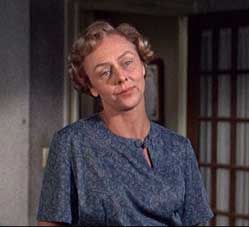
Marnie 02There are two really good performances in the film.  Louise Latham is simply outstanding as Marnie’s mother, bringing the kind of nuance that makes for a starkly realistic character.  And Diane Baker is excellent as Lil, the jilted sister-in-law.

This might have been a great film, with sufficient editing, perhaps with a different leading actress as Marnie and maybe an American actor as Mark, with some of the action sequences done more realistically.  As it is, the movie looks like an overblown Hollywood version of what should be a compelling drama.

I have to rank this near the bottom of Hitchcock’s American films and I find it hard to recommend it to anyone but die-hard Hitchcock fans.

Shadow of a Doubt

Shadow of a DoubtIs this Alfred Hitchcock’s best movie?  The Master thought so.  Of all the films Hitchcock made in his lifetime, this was his very favorite.  It combines many of his best filmmaking techniques, it is tremendously suspenseful, and the very heart of the movie is loss of innocence.  This review contains plot spoilers, so beware reading the entire summary below if you want to be surprised!

The opening credits show a ballroom with couples dancing to “The Merry Widow Waltz,” an image that will be reprised throughout the movie.

Charlie Oakley (Joseph Cotton) lies on his bed in some nameless Eastern city, a pile of money laying on his bedside table.  His landlady tells him that two men have been looking for him, so he languidly gets himself together, goes downstairs and immediately loses the two men who are following him.  He sends a telegram to his family in Santa Rosa, California, informing them that he will soon arrive for a visit.

His niece, Charlotte “Charlie” Newton (Teresa Wright) lies around her bedroom bored to tears with her life in the small town and wonders if anything exciting will ever happen.  Her father, Joseph (Henry Travers) can’t understand her, but promises that things will get better.  Charlie decides to send a telegram to her uncle Charlie hoping that he will come visit them to make things more exciting and she is stunned when the telegram from her uncle arrives–she calls it mental telepathy that they were thinking of the same thing at the same time.  Uncle Charlie’s sister, Emma (Patricia Collinge) is young Charlie’s mother and the family is completed with brainy little sister Ann (Edna May Wonacott) and a younger brother.  When Uncle Charlie arrives by train, they are all excited to see him, especially Charlie who feels that they are like twins, partly because she was named after him and partly because he seems to bring that excitement that she really wants out of life.  During dinner that night, Emma begins to hum “The Merry Widow Waltz,” but no one can remember what it is called.  Uncle Charlie distracts them so that no one does actually give us the title.

Uncle Charlie gives everyone gifts, including a ring to Charlie that has an inscription inside, but one from someone else to someone else.  A neighbor, Herbie (Hume Cronyn) shows up to discuss crime fiction with Joseph.  Uncle Charlie finds something in the newspaper that disturbs him.  He pretends to play a game with Ann where he tears up the section of the paper he was reading.  Stuffing it into his pocket, he goes upstairs, but Charlie is curious.  Claiming that they have nothing to hide, she steals the bit of paper, but can’t make anything out of it.  Ann tells her that the library is open until 9 PM, so Charlie runs down and finds the paper.  There is an article about the “Merry Widow Killer,” a man who marries rich widows and then kills them for their money.  When two government agents, Jack Graham (Macdonald Carey) and Fred Saunders (Wallace Ford), show up posing as a national survey team, Uncle Charlie gets nervous and refuses to have his picture taken, but Charlie agrees to go out with Jack to show him Santa Rosa and he admits that he is a detective on the trail of the “Merry Widow Killer.”   Uncle Charlie is one of two suspects they are investigating.

Suspicious and torn between family loyalty and fear that Uncle Charlie really is the killer, she proceeds cautiously.  When the suspect on the East Coast is killed trying to run away, it is assumed that the man was the killer, but Uncle Charlie begins to arrange “accidents” for Charlie, including a broken stair step and finally locking her inside their garage with the car running and the key in his pocket, trying to kill her with carbon monoxide poisoning.  The family all go off to a speech that Uncle Charlie is giving, so Charlie tries to call the government agents to no avail.  Later Uncle Charlie announces that he is leaving.  He has carefully arranged to run off with a family friend, who just happens to be a rich widow.

As the train moves off, he holds Charlie prisoner and tries to throw her off the moving train, but as the struggle, he loses his balance.  A little push from Charlie and he falls into the path of an oncoming train.  The final scene shows Charlie talking with Jack at Uncle Charlie’s funeral.  She remarks that Uncle Charlie thought the world was an evil place, but Jack tells her that there is only some evil in the world.

One can understand, especially from a thematic point of view, why this would Hitchcock’s favorite film of his entire canon.  The story develops Charlie’s arc from being an innocent, bored with her simple hometown life, to understanding that evil can lurk in the most unexpected places.  The viewer sees her grow as a person from an immature girl into a mature woman and that is always eminently satisfying.  But the film offers much more than this.  Uncle Charlie and Emma’s wistful view of the past as a beautiful waltz contrasts sharply with his perception that the world has grown into an awful place, full of stupid people who only eat and talk and display their jewelry.  His own bitterness at the world fuels his murder spree and when he sees his hope of that innocence of youth, his niece Charlie, turning cold to him, he can only respond with the despair that leads him to try to kill her.

In addition, the suspense is so finely crafted in this film that the viewer is pulled to the edge of their seat, waiting to see what happens to the girl Charlie.

The performances are uniformly good, but Joseph Cotton is magnificent as Uncle Charlie.  He leads us through all of his moods, from that painful yearning for innocence to the fear of being caught, to the despair of losing his niece’s good graces.  It is a powerful performance.  Teresa Wright is wonderful as the girl Charlie, capturing the essence of a soul at the turning point of her life between childhood and maturity.  Hume Cronyn is delightful as the family friend Herbie, who is always trying to find the perfect murder.  One of the best performances in the film is given by Patricia Collinge as Emma, who may miss the innocent past even more than Uncle Charlie and whose love of him creates the central challenge to Charlie’s struggle about revealing her uncle’s identity as the killer.

However, Macdonald Carey failed to make an impression on me as Jack.  Perhaps the character was written with too many contradiction or maybe I just didn’t buy his romantic interest in Charlie.  For whatever reason, his performance did not ring true for me.  It is the only blip in an otherwise great cast.

All of Hitchcock’s best film techniques are present in Shadow of a Doubt, some of them never more finely executed, and it will remain as one of the best films he ever made.  His best?  That question is still open for debate.

The Lady Vanishes

The Lady Vanishes (1938)Set in the fictitious European country of Bandrika, this 1938 British comedy-mystery  remains one of Alfred Hitchcock’s best movies.  Based on the 1936 novel The Wheel Spins by Ethel Lina White, the script by Sidney Gilliat and Frank Launder is truly funny, even the suspenseful parts.  Enhanced by Hitchcock’s own wit, it emerges as a truly entertaining popular film that reaches well beyond his normal confines of mystery and suspense.

A group of English tourists and businessmen is trapped at an inn in Bandrika by an avalanche that has covered the railroad tracks.  Young, beautiful Iris Henderson (Margaret Lockwood) has been visiting her friends, Blanche (Googie Withers) and Julie (Sally Stewart) before returning to England to marry a blueblood with lots of money.  She isn’t terribly excited about the prospect, but at the same time she can’t really find anything to get excited about.  Two apparently gay British businessmen, Charters (Basil Radford) and Caldicott (Naunton Wayne) are desperately trying to get back to England to see a cricket match.

Upstairs from Iris, a young English folk music enthusiast, Gilbert (Michael Redgrave) has several Bandrikans clogging a folk dance.  Along with her neighbor, Miss Froy (Dame May Whitty), a governess also returning to England, Iris complains about the noise and has Gilbert evicted from his room.  In retaliation, he comes to her room with his things and announces he’s moving in.  Forced to capitulate, she calls the manager and gets his room back.  In the meantime, Charters and Caldicott can’t get a regular room, so the manager has to put them up in the maid’s room, with the lewd suggestion that the maid will have to change her clothes there.  The two men are appalled and go out of their way to avoid seeing the young woman naked.

The next day on the train, Miss Froy befriends Iris who has been hit on the head by an object falling from a window.  The coach they are sitting in includes a Baroness and a magician.  After Iris takes a nap, she wakes up to discover that Miss Froy has disappeared.  The others seated in the coach deny having ever seen Miss Froy at all, so Iris begins to canvas the train trying to find anyone who remembers seeing the woman.  Along the way, she meets back up with Gilbert, who is determined to help her, even if he isn’t convinced that such a woman existed.  She meets Dr. Hartz (Paul Lukas), a Bandrikan neurosurgeon who tries to convince her that she’s been hallucinating, but she can’t let herself believe that Miss Froy wasn’t real.  When Gilbert sees a porter throwing out the trash and notices the brand of tea that Iris told him Miss Froy gave to them, he becomes convinced and helps her to turn the train upside down looking for her friend.  The trains stops to pick up a special patient for Dr. Hartz and Gilbert begins to suspect that Miss Froy has been substituted for the patient.

Part of what makes the movie special is the terrific chemistry between Margaret Lockwood and Michael Redgrave.  A noted actor on the British stage, this was Redgrave’s first starring role and he definitely made the most of it.  His offbeat humor teamed so well with Lockwood that the two are completely engaging throughout the movie.  The rest of the cast is also quite good, but Radford and Wayne as Charters and Caldicott practically steal the show.  Their stiff British correctness, combined with their obviously gay relationship and obsession with cricket, despite the hijinks going on around them is hilarious.  In fact, the two went on to reprise their characters in other British movies after The Lady Vanishes.

Coming as it did, after several unsuccessful films, this major box office hit was what convinced American producer David O. Selzni,k to sign Hitchcock to a contract that would bring him to America and lead him to become one of the most respected directors in film history.

The Lady Vanishes contains many of the elements that were staples of Hitchcock’s movies: the uncertainty of relationships, a long train ride, slanted camera angles to emphasize important objects in the frame, long takes contrasted with fast montage, his fascination with spies, his fear of the police, and, of course, the humor that colored many of his later American films.  This film also carries more political weight than most of his movies, as it was made during the period of time that Chamberlain was capitulating Czechoslovakia to Hitler and the situation is alluded to obliquely throughout the film, but especially near the end when the English on board the train must make a decision to either capitulate to the Bandrikian government or to make a stand.  The one man who decides to capitulate is shot dead holding his white flag, while those who hold fast persevere.

The film showcases many of the great filmmaking techniques that Hitchcock had learned and mastered.  It was given a low budget and restricted to a very small studio at Islington.  No matter.  Hitchcock built one train car in the studio and shot virtually the entire train footage, which takes up most of the film, on his one set, using superb rear projection, camera angles, and masterful dissolves to keep the film moving and make it realistic.

With its great humor, charismatic cast, fine script, and showcasing most of the plot elements and camera techniques that were Hitchcock staples, this stands out among the best of his British films and one of his best films over all.

I highly recommend this movie for all audiences!

Dial M for Murder

Dial_M_For_Murder_Grace KellyIt might be easy to plan the perfect murder, but actually doing it is something else entirely.  That is the theme of Dial M for Murder, Alfred Hitchcock’s 1954 movie adapted by Frederick Knott from his own successful stage play of the same name.

The film opens by showing us the double life led by Margot (Grace Kelly).  We see her first with her husband, Tony (Ray Milland), as she reads a Times article announcing arrival of American crime novelist Mark Halliday (Robert Cummings) on the Queen Mary, then segue to a steamy kiss between her and Mark in the same flat that she shares with her husband.  Through their dialogue, we learn that after meeting Margot and Mark exchanged letters, all of which she burned but one, which she kept with her.  She decided to break it off with him after Tony gave up his professional tennis career to spend more time with her, but then one day her purse was stolen.  She received a blackmail letter from the thief demanding money in exchange for the evidence of her unfaithfulness, but the culprit never returned the letter.

Mark comes home and tells them that he can’t go to the theater with them as he’d planned because of a business meeting, so he sends them off together.  After they leave, he calls a man about buying a car and asks the man to stop over to see him.  When the man, Mr. Swann (Anthony Dawson) arrives, Mark reveals that he’d known him back at Cambridge and was aware that he’d stolen some funds at the time.  In fact, Mark has been following him closely and has substantial information on the man’s criminal career, including a few current schemes.  He explains that when his tennis career was over, he was not well off financially, but that Margot is independently wealthy and that she’s named him in her will as the benefactor of her fortune.  He tells Swann about noticing his wife’s letter, then stealing her purse himself and sending her the blackmail requests.  Removing the letter, he casually drops it to the floor and Swann picks it up.  He then tells Swann that he wants him to murder Margot or he will reveal all he knows about the man’s criminal activities.  When Swann threatens to take the matter to the police, Mark tells him that since his fingerprints are now on the letter, he can claim that Swann was the blackmailer and was trying to extort money from him.  When Mark offers to pay him a thousand pounds for the deed and then explains his foolproof plan, Swann agrees to commit the murder the next evening when Tony will take Mark to his club for men-only party.

Things immediately begin to fall apart the next night as Tony tries to maneuver Margot into following his plan, then Swann bungles the murder.  He is not a professional killer and uses a clumsy scarf to try to strangle her.  She fights back and plunges her scissors into his back.  He falls on the scissors driving them further into his body and dies.  Then the movie becomes all about Tony trying to salvage himself and establish that Margot murdered Swann when he threatened her with the letter.  Unfortunately, for him, Chief Inspector Hubbard (John Williams) is suspicious when the clues just don’t add up.

This is one of Hitchcock’s best suspense films and stands out from the rest because the audience is placed in the murderer’s shoes almost from the beginning.  The suspense is generated from our misplaced sympathy for Tony’s attempts to cover his tracks and we both fear and hope that he will be caught.  It is a masterpiece of suspense filmmaking.

Ray Milland is perfect as Tony.  His suave and compliant demeanor covers his cold-blooded plan for murder and we feel his tension as the plan unravels and then changes, as he works to cover his tracks and convince everyone of a different reality.  Grace Kelly is her usual beautiful self, so easily winning the audience that we hate and regret our sympathy for Tony.  Robert Cummings is fine in his supporting role.

The color, in the restored print used for the DVD, is excellent and allows Hitchcock to weave his spell beautifully with Robert Burks’ stunning cinematography.

Dial M for Murder is a classic of the suspense genre and must be ranked among Hitchcock’s greatest achievements.

Mr. and Mrs. Smith


mr and mrs smithThis 1941 “screwball comedy” was the first of two comedies that Alfred Hitchcock directed during his long and distinguished career, the other being the black comedy, “The Trouble with Harry.”  The script, by Academy Award winning screenwriter Norman Krasna, found its way to Carole Lombard, the actress who actually gave the name “screwball” to this kind of comedy, and she backed the project.  Before leaving England, Hitchcock had expressed a desire to work with Lombard and he got his wish in this film.

David (Robert Montgomery) and Ann (Carole Lombard) are a devil-may-care married couple in New York City.  He is a partner in a law firm with Jeff (Gene Raymond), but is sometimes absent for days as the couple holes up in their bedroom trying to make up after an argument.  It’s one of Ann’s rules that they have to stay in the bedroom until they make up.  When the film opens, they have been there for three days and they finally reconcile.   Over breakfast, she asks him if he would marry her if he had it all to do over.  Following her rule of complete honesty, he tells her that he wouldn’t.

However, when David goes to work, an official from Idaho, Harry Deever (Charles Halton) informs him that because the county they got married in is actually in Nevada, their marriage is null and void.  David calls Ann and asks her to dinner at Momma Lucy’s, a restaurant they used to eat at before they were married.  Mr. Deever, an old family friend of Ann’s stops by their apartment and tells her what he’s told David.  Certain that David will ask her to marry him again at the restaurant, she meets him full of expectation.  When they arrive at the restaurant, they find that Momma Lucy has gone back to the old country and it is now a seedy dive.  They arrive back home and David gets ready for bed, putting champagne on ice.  Upset that he still hasn’t asked her to marry him, she throws him out of the apartment and he has to go sleep at his club, the Beefeater.

Without Ann’s rule in place to keep them in the bedroom, they cannot make up.  David, regretting his earlier statement that he wouldn’t marry her if he had it all to do over, begins to follow her around begging her to forgive him and remarry, but perversely, it is Ann who likes her new freedom.  She takes a job, which David gets her fired from.  He tries to get Jeff to talk to her, hoping they can work something out, but Ann simply hires Jeff to be her attorney and then accedes when he asks her to go out with him.

At the Beefeater, David makes friends with Chuck (Jack Carson), who has also been thrown out of his home.  Chuck sets him up on a double date with a couple of low end dames and when they appear at the restaurant, David sees Ann with Jeff and tries to make her jealous.  Desperate, he follows them to Lake Placid and begins a series of machinations designed to pull the couple apart and bring him back together with Ann.

In spite of Hitchcock’s very capable direction, there are several things in the movie that are bothersome and I believe the issues belong to the script.  For one thing, it seems very cold of Ann to simply turn away from David the way she does.  I expected to see her plotting to intentionally wound him with the objective of getting him back eventually, yet it isn’t until the very end of the movie that she capitulates and realizes that she really does love him.  If she had, for example, discussed with Jeff her plan for getting him to apologize and re-marry her, it would have made perfect sense.  Krasna (or Hitchcock) leaves us to guess at her motivation for wanting to marry Jeff.  Toward the end, we see that she is fighting against her instinct to love him, but it is actually Jeff who pushes her back toward David.  It seems a little weird to me.

Another problem is that aside from a very few moments, I didn’t find the movie to be particularly funny.  At times, it goes begging for laughs.  Carole Lombard’s superb comic timing is never really used to great effect in the script and Robert Montgomery actually mugs at times looking for laughs.  This was Lombard’s next to last movie before her life ended in a plane crash while on a War Bond tour.  It’s really too bad, because Hitchcock and Lombard would have made a terrific combination.

I guess it says something that Hitchcock himself was disappointed in Mr. and Mrs. Smith in spite of its big box office success.

It’s not a bad movie, but I was hoping for a lot more than I got.

Divergent

shailene_woodley_divergent-wideAdapted by Evan Daugherty and Vanessa Taylor from the novel of the same name by Veronica Roth, this 2014 movie is remarkably faithful to the original book, which is both good and bad.  See my review of the novel.

At an unspecified time in a dystopian future, the city of Chicago has been walled in to protect its citizens from the chaos outside.  Their society has been divided into five sects, supposedly to emulate traits that are desirable in this new society, Abnegation (selfless), Erudite (wise), Dauntless (brave), Candor (honest), and Amity (friendly).  Teenagers Beatrice Prior (Shailene Woodley) and her brother, Caleb (Ansel Elgort), must be tested before they make their declaration of which faction they will choose for life.  Their mother, Natalie (Ashley Judd), and father, Andrew (Tony Goldwyn), who serves on the ruling council, are both Abnegation and want them to choose their own faction.  Beatrice, however, shows a strong regard for Dauntless and looks ready to take risks.

During the test, which consists of the administration of a hallucinogenic drug that simulates a series of choices, Beatrice tests out positive for more than one faction (Abnegation, Dauntless, and Erudite).  The woman administering the test, Dauntless Tori (Maggie Q) tells her that she is Divergent, but that she must keep this a secret, claiming only that she tested out as Abnegation.  The next day, Caleb declares himself Erudite.  Caught in a dilemma as to which faction to choose, Beatrice takes Dauntless and is immediately thrown into a new life of daring exploits.  Jumping off the train at Dauntless headquarters, she volunteers to be the first to make a three story leap into a gaping hole in a roof and she does so effortlessly.  Although she is obviously quite brave, her physical training falls short and she is near the bottom of her class.  Putting in extra hours, her training leader, Four (Theo James), gives her extra instruction and she quickly rises in the ranks.  During a field exercise, she demonstrates that she can use her mind to help overcome obstacles, then, when she is again administered a hallucinogenic in order to face her worst fears, she finishes in record time.  Four grows close to her and protects her.

The Erudite are in the process of planning the overthrow of Abnegation and have developed a serum that will place all of the Dauntless soldiers under their mind control, but Four and Beatrice (who goes by the Dauntless name Tris) are immune to the serum and must find a way to defeat the evil Erudite leader Jeanine (Kate Winslet).

If all this sounds a bit far-fetched, it’s because it is quite unbelievable.  The book has the same problem in that the factions with their self-important purposes just doesn’t hold up to close scrutiny.  Although it’s true that Americans are definitely prone to conformity, I find the concept of their adherence, especially among the young, to a single faction to be pretty ludicrous.  The very idea that dividing your society in such a way will lead to peace and prosperity is laughable.

That being said, once a reader or a viewing audience buys into the concept and becomes willing to suspend their disbelief, the story becomes quite compelling, especially the first half where Tris is fighting to be accepted into the Dauntless faction.  We love to see an underdog growing and changing, developing, and showing the big bad bullies that she can hold her own.  We also delight in her ability to be divergent and to live more than one faction.  The direction by Neil Burger is really tight and the movie is smartly edited, but the movie owes most of its success to the two performances by Shailene Woodley and Theo James.  Each of them, in their own way, possess a kind of offbeat beauty that is terrifically attractive, but their acting talents are undoubtedly very strong and they carry the film through its absurd premise.

It’s beautiful to watch.  The cinematography, art direction, and music are all superb and the editing carries the viewer along at a fantastic clip.  Although it runs an astounding two hours and 19 minutes, no time is wasted.  It might have been a better movie if 30 minutes had been cut, but it is fine at its current length.

A very entertaining film, quite well done, if based on a patently absurd premise.