Chocolat

Chocolat VienneMost things that give enjoyment are not bad. In fact, most things in life that we enjoy are entirely without sin, even if they do induce sensual pleasure, such as, let us say, chocolate, that most wonderful of confections.

My review contains information about the story, so if you haven’t seen the movie, beware. Reading this review may spoil the ending for you!

It is 1959, in a French village surrounded by a wall and a river, barricaded from the world as if it hadn’t changed since the Renaissance. On a Sunday morning when everyone is at church, a woman, Vianne (Juliette Binoche), and her young daughter Anouk (Victoire Thivisol), trudge through the wind and snow to open a chocolaterie. Vianne is destined to wander from town to town, as her mother did, dispensing the joy of chocolate.  She carries her mother’s ashes with her and she knows that Anouk will also be destined for the same fate.

 The mayor, Comte Paul de Reynaud (Alfred Molina) finds it sinful to open such a business during Lent and he encourages the villagers to boycott it and their young priest, Pere Henri (Hugh O’Conor) to preach sermons against it.  When he discovers that Anouk is an illegitimate child and that Vianne will not attend mass, he becomes even more consumed with driving her out of business.  He has his own problems: his wife has gone to Italy and it looks like she isn’t coming back and he is also struggling with his own desires for food as he starves himself in his sorrow.

chocolat anoukIn order to coax the villagers to buy her chocolate, Vianne gives away free samples, winning over Guillaume Blerot (John Wood), an older man whose little dog Charlie likes the treats. Blerot pines after a WWI widow, Madame Audel (Leslie Caron) and he wins her over with little chocolate treats.  Vianne’s first real friend comes in the form of her landlady, Armande (Judi Dench), who also doesn’t go to church.  She is estranged from her daughter, Caroline (Carrie-Anne Moss), who works for the Comte and keeps her son, Luc (Aurélien Parent-Koenig), away from his grandmother. Vianne arranged for Luc to spend some time with Armande at the chocolaterie under the pretense of his drawing a portrait of her.  Vianne wins another friend when the owner of the café, Serge (Peter Stormare) beats his wife Josephine (Lena Olin) who runs to the chocolaterie for sanctuary.  She stays and becomes Vianne’s assistant.  The Comte attempts to force Serge to get himself together, making him abstain from alchohol, teaching him manners, sending him to catechism classes.

The town is thrown into chaos when a band of gypsies arrives by boat, docking along the river front. Led by a charismatic young man, Roux (Johnny Depp), the gypsies want nothing more than to trade, but the Comte forbids it and mounts a campaign to have the villagers boycott the gypsies.  Of course, Vianne is intrigued and makes friends with Roux.  When Serge assaults the chocolaterie in a drunken rage, breaking open the door, the women fight him off and Josephine knocks him out with a skillet. Roux volunteers to repair Vianne’s door and she agrees to hire him, thus breaking the boycott.  The Comte takes his fight with her to a new level as he tells all of the villagers that to consort with her is to consort with the devil and he makes Pere Henri do the same thing from the pulpit.

Vianne feels that the whole world is against her and considers leaving, but Armande requests that she throw her a party for her 70th birthday.  Vianne also has planned a Festival for Easter Sunday. Most of Vianne’s friends attend, including Luc and Roux, but dessert is to be served on Roux’s boat and they all retire there to dance and enjoy the evening.  Caroline comes in search of Luc, but when she sees him dancing with his grandmother, she doesn’t interfere.  However, Serge brings the Comte to see the party and the mayor tells him, “Something must be done.”  When the party winds down, a fire erupts on the boats.  Seeing the damage, Vianne decides that it is time to leave, so she packs, over Josephine’s pleas that she stay, and forces to Anouk to join her, but they fight and her mother’s ashes are spilled.  There is laughter and she looks into her kitchen to find Josephine leading the villagers in the preparation for the Easter Festival.  She abandons her plans to leave.

On the night before Easter, Serge confesses to the Comte that he started the boat fire because the Comte had told him that “something must be done.” In a fit of rage, the Comte banishes Serge from the village, then goes to pray, confessing that he is so starved and so weak of spirit that he must do something.  Taking up a knife, he breaks into the chocolaterie to destroy the confections in the window display, but a bit of chocolate splashes onto his lip and he licks it up. In one moment, he loses his composure and begins to eat every bit of chocolate he can get his hands on.  The next morning, Pere Henri sees the mayor passed out in the window display, covered in chocolate.

It’s hard to imagine anyone crusty enough not to love Chocolat.  It is a wonderful movie, beautifully and movingly directed by Lasse Hallström, the Swedish director who also gave us The Cider House Rules (and, by the way, Lena Olin’s husband).  The music by Rachel Portman, part gypsy, part Hispanic, part French, is absolutely perfect for every scene in the film.  Adapted by screenwriter Robert Nelson Jacobs from the novel by Joanne Harris, the story is strong and true, moving, funny, and uplifting.

All of the actors are wonderful and it would be hard to single out one performance that stands out above the other, but I must mention that Judi Dench is amazing as Armande and that Johnny Depp’s guitar adds a great deal to the fun. Binoche is lovely as Vianne and it is good to see her teamed with Lena Olin, the first time the two women have worked together since The Unbearable Lightness of Being.

This is an incandescent story of freedom. No matter how firm oppression may seem, if you are good and true and give love back to the world, the world will eventually come to you.

Silver Linings Playbook

“The world will break your heart ten ways to Sunday. That’s guaranteed. I can’t begin to explain that. Or the craziness inside myself and everyone else. But guess what? Sunday’s my favorite day again. I think of what everyone did for me, and I feel like a very lucky guy.”

Cooper and Lawrence Silver Linings PlaybookThis delightful comedy/drama was written and directed by David O. Russell, adapted from the book The Silver Linings Playbook by Matthew Quick.  Centered around two quirky people, both at a crossroads in their lives, the film presents bi-polar disorder as a condition that can be overcome.

Pat Solatano, Jr. (Bradley Cooper), a former high school teacher, is held in a Baltimore psychiatric hospital for an episode in which he beat another teacher after finding him in the shower with his wife Nikki (Brea Bee). After serving his court-ordered eight months, his mother Dolores (Jacki Weaver) gets him out.  In the parking lot, a fellow inmate, Danny (Chris Tucker) jumps in the car, announcing that he has been released, too, but Dolores gets a call from the hospital asking that Danny be returned.  Arguing with his mother, Pat grabs the steering wheel and almost gets them in an accident.

Returning home, Pat stops by the library to pick up all of the books in Nikki’s literature syllabus, intending to read all of the books. He is determined that their marriage can be saved, even though Nikki has moved and taken out a restraining order against him.  Pat’s father, Pat, Sr. (Robert De Niro) has recently lost his job and is supporting the family working as a bookie, although he intends to open a restaurant so that he can look legitimate.  Family and neighbors are all passionate Philiadelphia Eagles fans and Pat, Sr. is hopelessly superstitious about wearing the right jersey, putting his remote controls in certain positions, and rubbing a green handkerchief so that the can bring good luck, “juju” to the Eagles.  He also has a temper and is barred from actually attending Eagles games because of his violent behavior.  His friend, Randy (Paul Herman), is a Cowboys fan and tries to make money in bets off of Pat, Sr. by gaoding him into making foolish bets.

Pat stays up all night reading Ernest Hemmingway’s novel A Farewell to Arms and then blows up at 4 AM because it doesn’t have a happy ending.  He throws the book out the window and harangues his parents.  Pat believes that the key to overcoming his illness is to find a silver linings in his every day life.  He tries to live by the motto Excelsior (ever upwards) and shares this vision with his therapist, Dr. Cliff Patel (Anupam Kher), who replies that he must get a strategy to live with his illness.

His friend, Ronnie (John Ortiz), invites him to a Sunday dinner. Married to a beautiful girl, Veronica (Julia Stiles), and with a baby, Ronnie is a broker who is suffering anxiety from fluctuations in the market.  Veronica’s sister, Tiffany (Jennifer Lawrence), whose cop husband was recently killed, shows up at the dinner and she and Pat find that they can talk about their various medications.

Tiffany agrees to deliver a letter to Nikki if Pat will dance with her in a competition and he reluctantly agrees. They begin to rehearse, but the dance competition takes on a new meaning when Pat, Sr. and Randy make a parlay bet that the Eagles will beat the Cowboys and that Tiffany and Pat can score at least a 5 in the dance competition.

The story is completely engaging. Even though the film runs nearly two hours, every single moment is compelling and one doesn’t notice the time.  Cooper and Lawrence are both really terrific, portraying characters that are complicated and yet disarmingly simple.  Lawrence won Best Actress for her role as Tiffany.  DeNiro is at his very best as Pat, Sr. and Jacki Weaver gives wonderfully believable and warming performance as Dolores.  All of the supporting cast are terrific.

Russell’s script and direction are spot on. The editing is amazing, as is the use of music and sound.

It is a movie that deserved all of its nominations and it should be seen by everyone. It is funny, full of pathos, and very moving.

Nick & Norah’s Infinite Playlist

Nick and Norah PhotoWhen a movie has as its basis such an incredible novel as Rachel Cohn and David Levithan’s Nick & Norah’s Infinite Playlist, there should be no way that it could fail, yet this insipid teen comedy manages to toss aside all of the best stuff from the novel, including, amazingly, some of the best comedy.  It changes the course of events, and ends without a single note of the beauty that gave the book such raw power.

Cute, geeky Nick (Michael Cera) mopes around his house in suburban New Jersey, leaving long voice mails and making mix disks for his ex-girlfriend Tris (Alexis Dziena), a beautiful senior at a Catholic high school. Nick plays bass in an indie band called “The Jerk Offs” with gay musicians Dev (Rafi Gavron) and Thom (Aaron Yoo) who beg him to play this gig they have lined up and look for clues to the “secret” show that the band “Where’s Fluffy” will be playing somewhere in NYC later that night.  At the Catholic school, Norah (Kat Dennings) plans the evening with her ditzy friend Caroline (Ari Graynor) and tries to avoid Tris.  When Tris throws away the latest “break-up mix” CD from Nick, Norah picks it out of the trash, as she has done many times before, because she loves the way he mixes songs.  Even though she’s never met him, she knows she likes him because of the CDs.

They all show up at The Jerk Offs’ gig, Norah hits on Nick, Caroline gets drunk, and Tris shows up with her new boyfriend. Dev and Thom offer to give Caroline a ride home while Nick takes Norah out in his Yugo to look for Where’s Fluffy.  An evening of hijinks ensues as Norah avoids her ex, Tal (Jay Baruchel), Tris tries to get Nick back, and the gay guys drive around in the band’s van, losing Caroline, hooking back up with Nick and Norah, looking for Caroline, and getting back together.  When they finally locate the Where’s Fluffy show, Tal claims Norah, Tris claims Nick, and are both rejected as Nick and Norah head off on their own.

The movie itself is a failure on its own merits. It’s not funny or charming or even remotely romantic.  However, when compared against the original novel, it must be seen as one of the most seriously blown opportunities in the history of filmmaking.

The novel is steeped in punk music, not indie music, and the writing makes the reader feel like they are inside the insane mosh pit. Nick is an edgy bass player in the group called The Fuck Offs, not a cute, geeky guy.  The miscasting of Michael Cera, perhaps the result of the hideous screenplay by Lorene Scafaria or the Happy Days directing of Peter Sollett, dooms the movie from the very beginning and keeps it dredging the bottom throughout the 90 minutes of the film.  The gay sexuality in the book, which was absolutely electric, is completely absent and the homosexual characters are made to look like harmless dolts.  The book had serious balls on teenage gays, but the movie totally emasculates them.  One of the best characters in the book, Tony, the transvestite bouncer dressed in a Playboy bunny costume was cut from the movie.

There is breathless feeling in the novel, partly derived from the thrashing punk and partly from the sparks that fly back and forth between Nick and Norah. The movie has no spark to it at all.  Where the novel thrashed, the movie bounces.  The plot of the book bowls along on a story arc that is lightning tight, but the film plot is unnecessarily convoluted, mostly because Dev, Thom, and Caroline and brought back time and again.  When it should have been focussed on Nick and Norah, it was wasting its time trying to be funny and failing miserably.

The one bright spot in the movie is Kat Dennings’ performance as Norah. While the filmmakers eviscerated Nick, they almost left Norah her own quirky self.  She also has the best line in the movie when she calls The Jerk Offs a fistful of assholes and Dev and Thom realize they’ve just found a new name for the band.  (That’s not in the book.)

Don’t waste your time on this movie. Read the book.

My review of the book is located at Nick & Norah’s Infinite Playlist, by Rachel Cohn and David Levithan.

Gravity

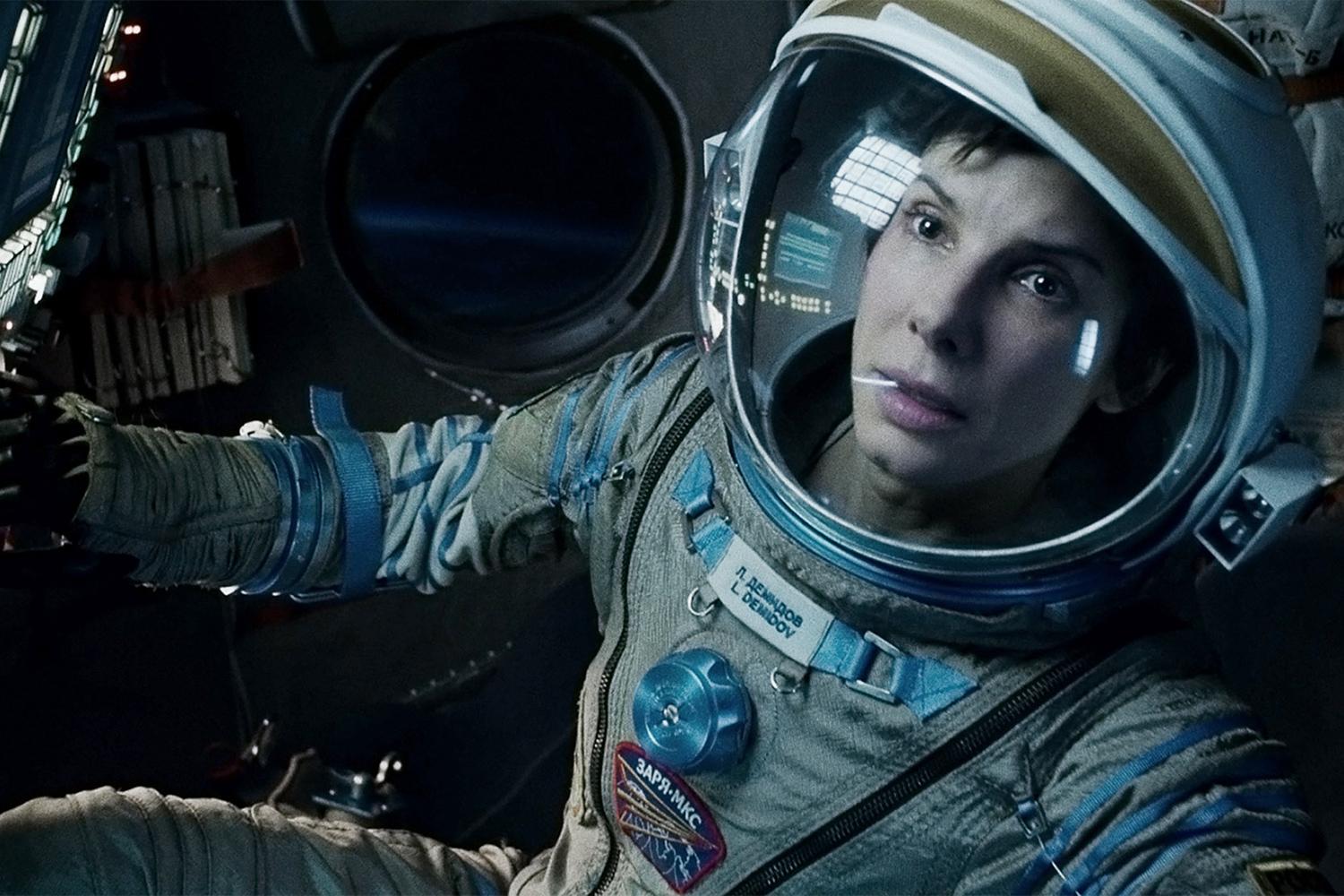
Gravity Sandra BullockAlfonso Cuarón’s 2013 science fiction film Gravity is extremely well-made, a tight thriller that will keep you on the edge of your seat for an hour and twenty-four minutes holding on for dear life.  It is almost a perfect movie.

This review includes vital information about the plot that may prevent a first-time viewer from enjoying the movie. Please read on if you’ve already seen the film.

On a mission to the Hubble Space Telescope, Dr. Ryan Stone (Sandra Bullock), on her first space shuttle mission, works to install upgrades to the system. Veteran astronaut Matt Kowalski (George Clooney) flits around her using his maneuvering back pack as he attempts to break the record for the longest space walk, knowing he will never have enough time to do it.  Mission Control interrupts them to abort the mission.  Apparently, Russia has demolished one of their satellites using a missile and debris is now hurtling through space toward them.  As they make their way back to the shuttle, Houston tells them that the debris is taking out other satellites and they will probably lose contact, which happens almost immediately.

Before they can get back into shuttle to return to earth, the junk comes shooting through their area. Although it misses the two astronauts, the shuttle is destroyed and the other mission specialists are killed.   Kowalski and Stone must now take a very long space walk to reach the International Space Station (ISS).  Time is of the essence because the debris will returns once it has made its way around the earth.  Unfortunately, the ISS has also suffered damage.  One of the two Soyuz escape modules has been used to evacuate the station and the other has been rendered useless because the parachute has already been deployed.  In spite of this Kowalski believes that they can use this useless module to reach the Chinese space station and use their escape module to return to earth.  Their approach is fast and they bounce off the craft, but finally Stone’s foot becomes entangled in the chute lines.  As Kowalski flies by her, she grabs his tether and holds him tight, but Kowalski’s momentum means pulls against her hold.  To save her, he unhooks his tether and drifts away.

From that point on, the film is sharply focussed on Stone’s survival from the Soyuz capsule to the Chinese space station, which is disintegrating in the upper atmosphere, to her entry into its escape module and flight to earth.

Obviously, in winning seven Academy Awards, including Best Director, Best Cinematography, Best Visual Effects, Best Film Editing, Best Original Score, Best Sound Editing and Best Sound Mixing, it was clearly the best movie of the year and probably should have won Best Picture as well.

Cuarón’s hand is in most of the movie. Not only did he direct it, but he co-wrote the script with his son, Jonás, co-produced and co-edited it, so he deserved all of his awards, which also included six BAFTA Awards, including Outstanding British Film and Best Director, the Golden Globe Award for Best Director, and seven Critics Choice Awards.  The other artists that he surrounded himself with all made major contributions to the success of this movie.  The score by Steven Price is amazing, complimenting the action exactly as it should to keep the suspense at a high level.  The sound was so good that it was breathtaking at times.  Emmanuel Lubezki’s cinematography is both flawless and inspired and the special effects by British artists Framestore is simply stunning.  Considering that nearly 80% of the movie consists of computer generated graphics, they certainly deserve a huge share of the praise for this awesome movie.

The human heart of the movie exists in Sandra Bullock’s inspired performance. Although George Clooney contributes somewhat to the action, his character is gone by the time the action really gets rolling and the only other in the movie is Dr. Stone.  This is Bullock’s film and she carries it from beginning to end with a high-energy emotional presence perfectly in compliment with the music, sound, cinematography.  Bullock has grown tremendously as an actress in the last ten years, especially with her role in Blind Side, but she tops that performance in Gravity.

Although it must be considered one of the best space films ever made, right up there with Apollo 13, there were a few things that bothered me and would probably keep the movie out of the top ten best science fiction films on my list.

There are many inaccuracies in the film, most of which can be easily overlooked, but not all. First, I do not believe that neither Kowalski’s mass, nor their speed would have realistically created the situation that forced him to un-tether himself so that Stone might be saved.  Their attempt to grab onto the ISS, hurtling into it and bouncing off, is a violent scene.  When Stone finally makes it inside, I expected to see bruises and contusions all over her body, but instead, she emerges from her space suit looking squeaky clean.  When she finally boards the Chinese space station, the same thing happens, but her grabbing a handhold while hurting at a prohibitive speed with the clumsy glove is extremely unrealistic.  The final problem for me occurred during her attempts to figure out how to operate the Chinese capsule as she pushed buttons at random and finally found the one that magically allowed her to re-enter earth’s atmosphere at the proper angle to avoid a complete burn-up.

I might be overly critical on these scenes—I’m sure most people wouldn’t have an objection—but I thought that all of these problems, with a little tweaking, could have been easily made more realistic and would have really made it a flawless film.

This is still a great and powerful film, a rollercoaster of a movie that shoots its way along an arc that is tightly plotted, with every aspect of the film working in complete harmony, and it does it with no discernable fat in terms of scenes or timing. Everybody should see this movie!

Broken Arrow

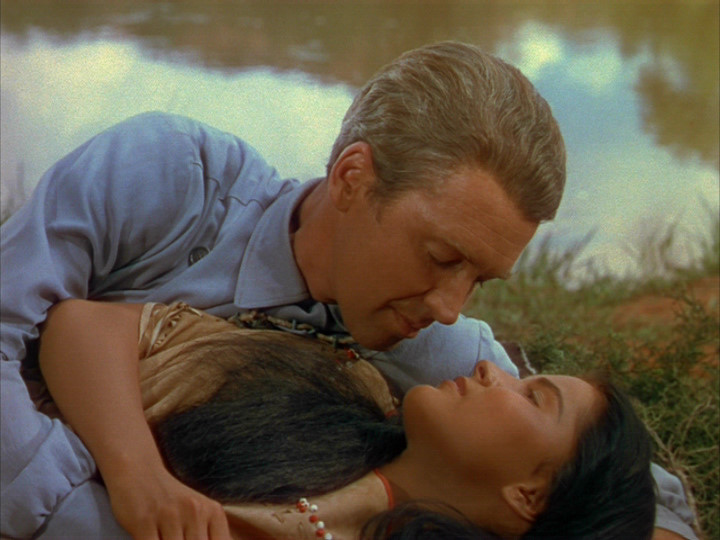
Broken Arrow Stewart PagetThis 1950 movie was one of the first to portray western Native Americans in a balanced manner and carries as its message racial equality and peaceful relations between Indians and Anglos. Based on the popular novel, Blood Brother, by Elliott Arnold, the film adaptation by Michael Blankfort dramatizes the historical relationship between Tom Jeffords (James Stewart) and Chiricahua Apache leader Cochise (Jeff Chandler).

When Jeffords goes panhandling for gold in Apache territory, he runs across a boy who is dying from buckshot wounds. He nurses the lad back to health, but is discovered by members of the tribe.  The boy intervenes on his behalf and they decide to spare him.  They are interrupted by the arrival of prospectors.  The Indians tie up and gag Jeffords while they ambush the prospectors, killing most of them.  When the melee is over, Jeffords is released.

In Tucson, he hears one of the prospectors who survived the raid giving a false picture of it and he corrects the man, then must describe what happened to him. The men berate him for being friendly to the Indians, but Jeffords has a plan to bring peace between the Chiricahuas and Whites.  He learns to speak Apache and is taught smoke signals by a member of the tribe living in the city, then he travels to meet Cochise face to face.  Impressed with Jeffords bravery and honesty, he agrees to let the mail go through unmolested.  While in the Apache camp, he meets a young girl, Sonseeahray (Debra Paget) and falls in love.

An Army unit, attempting to catch Cochise off-guard, goes into Apache territory and gets caught in an ambush. Although many of the soldiers are killed and their wagons stolen, General Oliver Otis Howard (Basil Ruysdael) survives and returns to Tucson, just in time to save Jeffords from being lynched as a collaborator with the Apaches.  The general has been dispatched from Washington to negotiate a peace with Cochise that will give the tribe 50,000 acres of land as a reservation.

Directed by Delmer Daves, the film strives for historical accuracy, but succeeds only in a Hollywood-skewed way. It was filmed near Sedona, Arizona, although the action should have been filmed hundreds of miles south near Tucson.  Even so, hundreds of Apaches from the Fort Apache Indian Reservation were used as extras. 

It is very unfortunate that Hollywood did not trust real Indian actors to accomplish most of the major Apache roles, although the venerable Jay Silverheels (“Tonto”) played the renegade Geronimo in the movie. Although both Jeff Chandler and Debra Paget are not completely believable as Indians, they are the only two Anglos to portray Native Americans in the film.  Paget, by the way, was only 15 years old at filming.  The actors were aided by a script that readily swapped out English for the assumption that they were all speaking Apache.  At least, no one spoke the broken English that ruled in films of the day.  Paget may have been misdirected to speak too proper English, but it doesn’t detract from the movie.

Most of the performances are quite acceptable, although none stands out as being a great performance.

The true value of the film is in its message, that we can all live side by side in peace. In 1950, this was rather a brave stand.  The film goes out of its way to make the point that there are both good and bad Indians and Anglos and it is more important to be true to an ideal than to condemn a man based on his ethnicity.  This was also a complete break from other Westerns.

The music in the film is unobtrusive, which is a good thing in a movie like this. There is no Hollywood orchestra playing some hackneyed Anglo version of an Indian war song, thank goodness.  The scenes with Indian music and dancing feel authentic, perhaps because they are being performed by real Indians. 

Broken Arrow claims high ground in the Western genre of filmmaking. The presence of James Stewart certainly adds weight to the message of racial equality and justice.  It’s a very good film that I would recommend for the entire family.


Warm Bodies

WARM-BODIES_510x317There are few films that boast a truly original premise, but Warm Bodies is one of them.  What genre is it?  Well, it’s the only zombie romantic comedy I’ve ever seen.  Written and directed by Jonathon Levine, it was adapted from a Young Adult novel of the same name by Isaac Marion.  I haven’t read the novel yet, but the movie carries that “first person present” feel to it that is omnipresent in YA dystopian books.

The movie is narrated by a teenage zombie, R (Nicholas Hoult), who knows there’s something missing in his death, but just can’t figure out what. He lives in an abandoned airplane that he has appropriated for his use and stocked with lots of stuff that he has collected, including a stereo with a turntable and an impressive collection of disks, because he values the purity of the sound.  By day, he shuffles around the airport groaning, occasionally grunting with his “friend” M (Rob Corddry) and going out to eat with him.  The food, of course, is human and R cherishes human brains because they allow him to vicariously experience life by re-living the memories of the deceased.

Ultimately, the zombies turn into living skeletons called Boneys. Although the skeletons leave the zombies alone, they also exist by eating humans and they are extremely deadly.

In a city within the city, protected by towering walls, humans live under the authoritarian leadership of Colonel Grigio (John Malkovich). The Colonel’s daughter, Julie (Theresa Palmer), her boyfriend, Perry (Dave Franco), and her best friend, Nora (Analeigh Tipton) volunteer to go outside the walls to search for medical supplies and this expedition coincides with a search for human food by R and M (the initials are all they can remember of their former names) and some of their zombie friends.

During the fight that ensues, R is attacked by Perry and kills him. As he eats the boys brains, he relives memories of Perry’s time with Julie and he develops a soft spot for her, so when the raid is over, he rescues Julie and brings her back to his airplane.  Unsure what to do next, he plays music for her and rescues her again when she tries to escape.  As he attempts to talk to her and finds a few human words, she wonders why he keeps saving her.  During the next few days, they talk, play games, and listen to music, but finally she convinces him that she must go back to her father.  When M and the other zombies see them holding hands, they begin to develop feelings, too, and allow them to go.  The zombies are beginning to regain their humanity.

If there are a few things here that seem a little familiar, it’s because there are some similarities to Shakespeare’s Romeo and Juliet.  Yes, R and Julie suggest that.  So does the story of “two houses divided” in a great city.  And yes, there is even a balcony scene, but that is where the similarity ends.  There is nothing tragic in this “feel-good” dark comedy.

Hoult and Palmer are splendid as the young lovers. Hoult’s voice and narration are both hilarious and oddly touching at the same time.  It’s the only zombie movie where you will find yourself identifying with the zombies.  Hoult is English and Palmer is Australian, yet they are perfectly believable American teens.  Palmer is beautiful and sexy, yet very down-to-earth.  They should both have terrific film careers.

Malkovich is a little one-note as Colonel Grigio, but the role was written that way. Tipton may be the big surprise in the film.  Although her role is fairly small, she seems consistently to get the best lines not given to Hoult and she is laugh-out-loud funny in places.  Corddry gives a very restrained and heart-felt performance as M.

It’s hard to do the movie the credit it deserves in a short review, but it is the kind of film that should have a big crossover audience. The characters are well-drawn, the situation bizarre and hilarious and the film-making is first rate from the beginning to the end.  At 91 minutes, it is the perfect length and that shows that director-writer Levine was really in tune with the material.  Many other directors might have cluttered up this charming film with all kinds of nonsense or overplayed the comedy, but he hits the right note in every scene.  The cinematography, art direction, costume, and make-up are all spot on.

I highly recommend this movie!

We Bought a Zoo!

we_bought_a_zoo_p

We Bought A Zoo! is a friendly little movie released in 2011, based on the memoirs of the same title by Benjamin Mee, who bought his own zoo in England. The movie transports the story to California and changes history in other ways to make a good movie.  The always entertaining Cameron Crowe, (Almost Famous, Elizabethtown) directed the film and wrote the script from an earlier version by Aline Brosh McKenna.

Benjamin Mee (Matt Damon) struggles to raise his two children, a 14 year old son, Dylan (Colin Ford), and a seven year old daughter, Rosie (Maggie Elizabeth Jones) after the death of his wife (Stephanie Szostak) from some abrupt disease (cancer?). Dylan can’t seem to cope and acts out at school, eventually getting expelled from school for theft.  He is an aspiring artist and spends most of his time making violent and dark ink drawings.  Rosie is well adapted to the loss, although she misses her mom and frequently asks Benjamin to tell her stories so she doesn’t forget.  Like Dylan, Benjamin cannot deal with the loss.  Frustrated, he quits his job as an adventure and travel writer—over the objections of his brother, Duncan (Thomas Haden Church)—and begins to look for a house more isolated from the city.

After looking at a number of houses with Rosie, they are steered to a country property by a novice realtor (J.B. Smoove). There is just one catch: it is a zoo and ownership of the property includes continued maintenance of the zoo.  Benjamin is very reluctant, but seeing Rosie with a flock of peacocks changes his mind and he invests his entire savings in the project, with the goal of re-opening the zoo on July 7.

Rosie is enthralled and remarks several times with great charm, “We bought a zoo!” This zoo comes with attendants, of course.  The woman in charge is young Kelly Foster (Scarlett Johansson), who is not professionally trained, but advanced through the ranks to get her job.  There is a designer, Peter MacCreedy (Angus Macfadyen), a carpenter, Robin (Patrick Fugit), and Kelly’s 13 year old home-schooled cousin, Lily (Elle Fanning), who takes a shine to Dylan.

There are, of course, complications, not the least of which is Dylan’s continuing funk and Benjamin’s own frustrations. An inspector, Walt Ferris (John Michael Higgins) adds to their woes by presenting an expensive list of improvements that must be made before the zoo can open.  Tapped out, Benjamin begins to think that the project might ultimately fail.

The movie punches all the right buttons. The potential overdose of sugary sweetness is balanced by Benjamin and Dylan’s conflict and their grief over the loss of Mrs. Mee, but there’s still a lot of sugar. And eye-candy. Matt Damon is terrific, handsome, likeable, and extremely empathetic and so is Colin Ford. Of course, there is also the great beauty of Scarlet Johansson and Elle Fanning.  Johansson is very believable and empathetic as Kelly.  Those who aren’t beautiful are odd looking goofballs, such as Church, Smoove, and Higgins. At times, a little directorial discretion regarding these comedians might have helped the film.

Crowe also indulges himself profusely in the “cute” factor, not only with the character of Rosie, but in a great many shots of the zoo animals. Maggie Elizabeth Jones is at times almost unbearably cute, but she never fails to delight and shows a great deal of acting skills for a child.

It’s a very good movie for kids and for the family. I love cute little girls, sympathetic plot lines, beautiful people, and animals, but I also have great sympathy for those who lose loved ones to cancer, so I bought the movie, hook, line, and sinker.  I would gladly see it over and over, because it is a really entertaining “feel-good” movie.

Just remember, “20 seconds of courage” can change your life!

The Cowboys

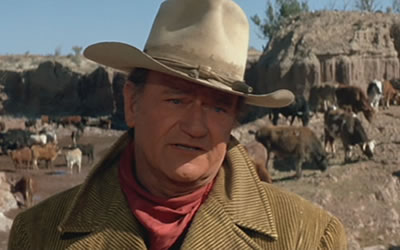
John WayneThis 1972 coming of age western stars John Wayne as Montana rancher Wil Anderson.

When his hands abandon him to join in a gold rush, Anderson solicits the aid of local schoolboys to help him move his herd of cattle and horses 400 miles to market. Among the boys is Slim (Robert Carradine), Charlie Schwartz (Stephen Hudis) and a Hispanic outcast, Cimarron (A. Martinez).  A gang of men ride in before they leave.  Led by Long Hair (Bruce Dern), the ex-convicts want to join the drive, but when Anderson catches Long Hair in a lie, he refuses to hire them.  A black cook, Jebediah “Jeb” Nightlinger (Roscoe Lee Browne) shows up and applies to drive the chuck wagon.

The boys learn about hard work, whiskey, and death along the trail and are forced by circumstances to grow up quickly.

The screenplay by Irving Ravetch, Harriet Frank, Jr., and William Dale Jennings, based on Jennings’ novel of the same title, is a little long. In fact, the movie begins with an Overture and contains an Intermission, like Gone with the Wind or Ben-Hur, but this film is not in the mold of those movies and it seems more than a little pretentious to present it as if it was an epic.  The music by John Williams seems like typical cowboy movie music, both self-important and overblown.

Roscoe Lee BrowneMost of the performances are very good, especially Wayne and the boys that make up most of the cast. Probably the best acting in the film was accomplished by Roscoe Lee Browne, who creates a completely believable, three-dimensional character.  Sarah Cunningham is very good as Wil’s wife Annie, but Slim Pickens gives us nothing more than his usual self as local bar owner Anse Peterson and Colleen Dewhurst has a short, wasted performance as Kate Collingwood, the Madam of a traveling cathouse.  The most disappointing performance, unfortunately, is Bruce Dern whose sneering, one-note villain is almost laughable.

The movie is pretty good, however, considering its drawbacks. Going in, I worried that the angle with the boys doing the cattle drive would be hokey (and some of it is), but for the most part Wayne and the boys carry the film.  It’s a fresh angle for a Western and would have been extremely successful if it had been cut to a decent length, without a pretentious Overture and Intermission, and Dern’s character had been more well-drawn.

A fun movie.

Lost in Austen

Lost in Austen trioThe general fascination with Jane Austen is continued in this 2008 four-part British television film, originally aired by ITV and released in the United States as a three hour film.  Written by Guy Andrews and directed by Dan Zeff, it has the feel of very bad fan fiction cranked out by professionals.  Barely worth 90 minutes of anyone’s time, three hours is far too much for this slim fantasy about a girl who switches places with Elizabeth Bennet in Pride and Prejudice.

This review contains information about the ending of the movie, so beware.

Amanda Price (Jemima Rooper) is a modern Jane Austen stuck in an unromantic relationship with a boozy, uncouth guy, Michael (Daniel Percival) and living in a flat in Hammersmith with a girlfriend, Pirhana (Gugu Mbatha-Raw). All she really wants is to be left alone so she can immerse herself in Austen’s Pride and Prejudice.

When she investigates a noise in her bathroom, she discovers none other than Elizabeth Bennet (Gemma Arterton) who has somehow found a portal in the upstairs of the fictional Bennet cottage and gone to see where it leads, which is 21st Century film reality.  Lizzy is not freaked out at all by joining the 21st Century and invites Amanda to visit the fictional Bennet world.  Once there, Lizzy locks the door, sealing Amanda in the book.  I still cannot process this remarkable change in Elizabeth Bennet.  Such a thing goes completely against the character created by Jane Austen.  When the Bennets discover Amanda, they seem to have no trouble with her arrival and blithely accept that their daughter is in Hammersmith and Amanda is come to visit, wearing a leather jacket.  Magic.  No big deal.

Amanda proceeds to wreak havoc on her favorite novel. Inexplicably, Mr. Bingley (Tom Mison) fall in love with Amanda instead of Jane Bennet (Morven Christie).  She struggles to set things right, but things keep getting worse and worse.  And the characters and plot of the book change completely at the writer’s whim.  There is no effort at all to show natural deviations from the novel or the nature of the characters, but the plot is twisted completely so that the writer can effect the action he wants.

In this upside down fantasy world, Jane marries Mr. Collins (Guy Henry), Charlotte Lucas (Michelle Duncan) runs off to Africa to become a missionary, Elizabeth settles into her new life without a second thought as to her family, Caroline Bingley (Christina Cole) is a Lesbian, Mr. Wickham (Tom Riley) is actually a good guy, and ultimately Mr. Darcy (Elliot Cowan) falls in love with Amanda. When the movie ends, Lizzy and Amanda permanently change places so that Amanda can marry Mr. Darcy and Lizzy can continue her new life in reality.

As a Brit might say: Complete rubbish.  Top to bottom.

Lost in this hash are a couple of pretty good performances, most notably by Hugh Bonneville as Mr. Bennet.

Although the premise is not as bad as it seems, the movie really loses its focus by altering Elizabeth’s character so dramatically. Even as unbelievable as the premise of opening a portal from a fictional book to reality, it still has more believability than seen such a well-known and loved character act in total contradiction to what is known of her.  A better idea would simply have been to drop a modern character into the book as Lizzy Bennet, rather than having them exchange places.  Although that idea might work, it would still require strict adherence to what is already known of the characters, a tenet that Guy Andrews seems to have abandoned anyway.

The key to writing good fantasy is this: reality may be altered as long as the alteration is consistent within itself.  With all of the inconsistencies to Pride and Prejudice present in this movie, one may as well simply attempt to rewrite the novel as one chooses.

On the other hand, if you have no reverence at all for Austen or the novel, you’d may as well lose three hours on a kinky British comedy with no meaning or heart. Enjoy.