The Breakfast Club

Breakfast ClubYelling one minute, giggling the next, while cool music plays throughout.  Welcome to The Breakfast Club, John Hughes’ 1985 comedy-drama about five teenagers confined to a Saturday detention in the Shermer High School library in Shermer, Illinois, a suburb of Chicago.

Each one of the five kids represents a different kind of high school culture.  Although wrestler Andrew Clark (Emilio Estevez), teen beauty Claire Standish (Molly Ringwald), and brainy Brian Johnson (Anthony Michael Hall) come from wealthy families, they each represent a separate segment of high school society.  Likewise, rebellious John Bender (Judd Nelson) and spooky Allison Reynolds (Ally Sheedy) come from the wrong side of the tracks, but one is brash and outgoing while the other is quiet and shy.

The teacher who rides herd on the five of them is Richard “Dick” Vernon (Paul Gleason), an assistant principal who is rough and disillusioned with his profession.  The only other adult character of any consequence is the philosophical janitor, Carl Reed (John Kapelos) who enlightens both Dick and the kids.

John creates the drama as he pushes against the rich kids and makes fun of the dork, both strutting his anger at coming from a poor, ignorant family and concealing his own fear for his future.  He teases Claire about being a virgin, Andrew about being a dumb jock, and Brian about not fitting in.  As the day goes on, they gradually become friends, laughing, dancing, shouting, and opening up about their deepest truths and fears.

There isn’t much of a plot here, but that’s not important.  Most of the movie dedicates itself to the theme that in spite of outside differences, we’re all pretty much the same, a pretty good message in any time or place.  The generous ensemble script allows room for each character to bloom.

Most of the acting is excellent, although the emotional outbursts now seem a little over the top, as are the stock characters.  The movie is really excellent except when it tries to go deep.  Of the five teens, Ally Sheedy really stands out as the best and that is partly because her character doesn’t fit into a mold and partly because she infuses it with a great deal of originality.

The best part of the film is the comedy and when it’s good, it’s really laugh out loud good and it carries the movie beyond the simple teen angst that colors the drama.  A fun movie.  At an hour and a half, the timing is perfect and it is almost impossible to stop watching once you start, always a sign that a movie is doing its job.

The Spectacular Now

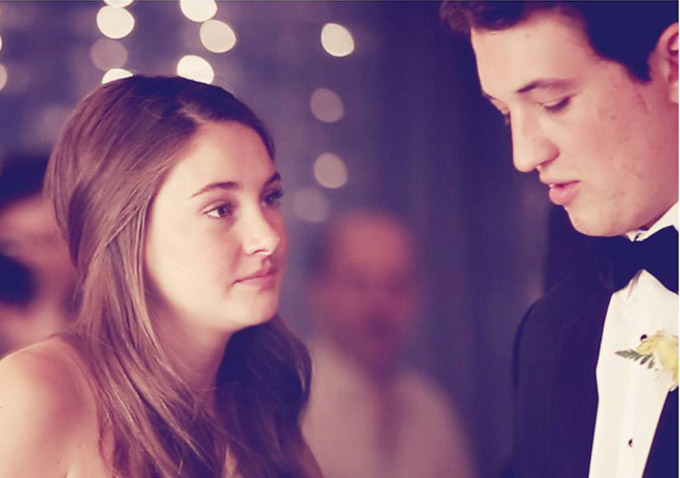
Shailine Woodley int The Spectacular NowThe Spectacular Now aims much higher than any run-of-the-mill teen romance and its success in achieving a film that goes beyond the limits of genre is to be highly commended, yet there are problems in the movie and it would make the film an excellent study for any film theory class.  Because this is a special film in many ways, this review contains spoilers, so beware if you haven’t seen the movie.

Sutter Keely (Miles Teller) is a high school senior who is the life of the party.  His girlfriend, Cassidy (Brie Larson), just happens to be the coolest girl in school.  He sits down at his computer to answer an essay question for a college entrance exam.  What was your greatest challenge and how did you face it?

His answer centers around how Cassidy has just dumped him.  Always helpful, he had been trying to set up a friend with a girl, but she happened to come with another girl and he just happened to be sitting with her in his car at lakeside drinking when Cassidy discovered them.  He’s almost always drinking, but he doesn’t see that as a problem and he figures that he’ll get Cassidy back pretty quickly, but she has already hooked up with the star athlete, Marcus (Dayo Okeniyi) and has left Sutter in her dust.

He goes out to party and ends up enormously drunk.  The next morning, he is awakened by a girl who finds him laying in someone’s yard passed out.  The girl, Aimee Finecky (Shailene Woodley) is also a senior at his school, although he doesn’t remember her name.  A semi-geeky girl who likes science fiction and graphic novels, Aimee is way too normal for Sutter, but he can’t find his car so he helps her do her mother’s paper route and ends up having a lot of fun.  He asks her out to lunch, then to a party.  He still isn’t over Cassidy, but she can no longer deal with his lack of ambition and drinking.  Aimee, who has never had a boyfriend, is just happy that he likes her.  He might be a good student, but he just doesn’t care.  There is a certain ennui about him, even though he puts up a good front.  Part of his problem is that his mother, Sara (Jennifer Jason Leigh) is a single parent and she keeps him apart from his father.  Sutter remembers playing baseball with his dad and completely blames his mother for “kicking him out of the house.”  His sister, Holly (Mary Elizabeth Winstead), who is married to a lawyer, doesn’t really care about their father.

Aimee falls in love with Sutter, but he continues to drift, fantasizing about getting back together with Cassidy.  He gradually comes to love Aimee as well, but he does not think he is good enough for her.  The sad thing is that he’s right.  Sutter doesn’t know what to do with himself.  He’s drifting through high school, he doesn’t want next year to happen, and he doesn’t want to make any plans.  In a scene with Cassidy, she begs him to think about the future, but he tells her that all that matters is the “now,” enjoying each moment as it happens.

Accepted into a college in Philadelphia, Aimee tells him that she can’t go because her mother won’t let her so they make a pact: if Aimee will stand up to her mother about going to college, then Sutter will confront his own mother about seeing his dad.  He asks her to the prom and gets her to start drinking alcohol, giving her a personalized flask when he picks her up.  Later, she tells him that she has decided to go to Philadelphia and tells him he should go there with her, that they could get a place together and get jobs while she goes to school.  He doesn’t commit himself to it, but he also doesn’t tell her “no.”  Marcus confronts Sutter about Cassidy, but Sutter tells him that there’s nothing between them.  When Marcus wishes he could make her laugh like Sutter does, Sutter advises him that all he needs to do is relax, to live in the “now.”

When Aimee badgers him into investigating his father, Holly finally gives him the phone number.  Sutter calls his dad (Kyle Chandler) and arranges a meeting, bringing Aimee with him when he goes to visit, but when he discovers that his father is an alcoholic skirt chaser, he sees his own future.  Depressed, he drinks heavily as he drives them back home.  Aimee tries to comfort him, telling him that she loves him, but he belligerently tells her to get out of the car.  When she does, she gets hit by another car.

Although she’s not seriously injured, Sutter’s depression reaches a whole new level.  They graduate, but he feels no joy in it.  She waits at the bus station for him to join her, but he drives by and lets her go off on her own.  Drunk again, he plows down the mailbox in front of his house and gets into a violent argument with his mother.  When he screams at her that she doesn’t love him, she comforts him and tells him that he is a gentle and giving man.  Sutter breaks down and sobs in her arms.

Confronting the computer screen and the question of what his greatest challenge is and how he overcame it, he types in a confession that he is his own greatest problem and that it is a problem he must solve every day going forward, finally recognizing that the “now” will come again tomorrow.  In the final scene, he joins Aimee in Philadelphia.

Even though this film is riddled with problems, there are also many things to like about it.  There is a simplicity in the script by Scott Neustadter and Michael H. Weber (adapted from the novel of the same name by Tim Tharp) that is quite engaging and the realistic approach of director James Ponsoldt keeps the viewer constantly involved in the story.  Sutter is a complex person and I have to give high marks to the creative team for making such a deeply layered character and wonderfully consistent throughout the entire film.  Surely, the temptation to make the film a pure romance must have been quite strong, but the movie works hard to keep Sutter real and to deal realistically with his problem, which is immense for a boy of his age.

It is dramatic, it contains a theme that is built and explored in a way that many other films should aspire to, it is very carefully written and well-thought out.

In addition, there are a couple of excellent performances in the movie by Jennifer Jason Leigh (I didn’t even recognize her) as Sutter’s mother and Kyle Chandler as his father.  Each of these actors brings a depth and a reality to their roles that goes even beyond the well-crafted script.  All of the other supporting actors do a good job as well.

The problems are mostly in the production, but one problem in the writing really holds the movie back.  There is nothing likable about Sutter.  As I watched the movie, it was easy to identify him as the protagonist and to feel a certain amount of angst for him, but the writers did nothing to help me like him or really care about him.  My first instinct was to blame the performance of Miles Teller, but I realized at some point that the story should have shown something else to make me care about what happened to him.  That was missing.

Shailene Woodley gives a fine performance as Aimee, but I believe she may have been miscast.  Given the beauty of the actress and Aimee’s terrific personality, I found it simply impossible to believe that she never had a boyfriend or that she was a wall flower.  Girls that special rise to the top because those around them inevitably recognize what’s great about them and give them a special position in the social order.  In fact, Aimee is so special that it is really difficult to believe that in her isolation she could love someone like Sutter.

In his desire to make the movie realistic, I believe that Ponsoldt must have encouraged Teller and Woodley to improvise much of their dialogue because it seems so genuine, however, the constant use of “awesome” and “amazing” and “cool” becomes almost funny at some points.  Sure, it’s probably realistic.  One can imagine real teens talking this way, but it sure makes them seem a lot less intelligent.  There should be an argument on this point because the question of realistic dialogue comes up over and over again.  My own personal opinion is that the clever screenwriter will use just enough teen clichés to make the dialogue believable, but back off before it becomes a running gag.  I think what happened in this movie was improvisation on the actor’s parts.  I don’t know that for a fact, but it feels that way.  Good and bad.

The ending probably should have been retooled as well.

Although the scene of Sutter writing his new answer is effective, I never had the feel of a real denouement, a crystal moment of realization in which Sutter knows how he needs to change his life and dedicates himself to doing so.  Maybe it is more realistic that he has a hint of what he needs to do and points himself in the right direction, but in the interval between breaking down with his mother and writing his new answer, I would have liked to see something that really gave him a positive direction.

Even given all of these problems, I still recommend this film, not only to film students, but to people who want to see a teen romance that has some backbone to it, a film that challenges itself to do better and makes a very positive footprint in the right direction.

The good outweighs the bad.

Grace, Tamar and Laszlo the Beautiful by Deborah Kay Davies

Grace Tamar and LaszloGrace, Tamar and Laszlo the Beautiful, the 2009 Wales Book of the Year, is officially listed as a book of short stories by the acclaimed Welsh author Deborah Kay Davies, but it is much, much more than that.  In fact, I struggle to use the term “book of short stories” because the connection of the stories featuring the sisters Grace and Tamar is so tight and integrated that I am inclined to call it a novel.  This is a mature and powerful work of art intended for adult readers.

The first story, “Stirrups,” actually begins with their mother on the event of Tamar’s birth, showing how the woman’s fragile mind tries to deal with the baby girl who is Grace’s younger sister by two years.  She struggles to give her love to more than one person at a time, missing Grace and wondering if she can ever relate to this new child.  The next story, “Point,” finds Grace at the age of six already somewhat ethereal and hating her four year old sister, Tamar, for being so feral.  It is a relationship newly formed, but one that will be a part of their lives until they are adults.

From one story to the next, told in chronological order, the relationship between the two sisters dominates the book as the point of view weaves back and forth.  As a child, Tamar spends most of her time alone, creating strange games for herself, becoming fascinated with the weird neighbors, pushing her sister Grace to exasperation.  Grace lives in a world where she was the only child.  She can barely stand Tamar, yet there is a bond between them that is extremely tight.  Grace pushes Tamar from a tree, Tamar beats on Grace, they push each other back and forth and stand united in only two things: first, their amusement that their mother seems to be going insane (“Radio Baby” is a powerful reminder that their mother’s hold on reality is tenuous at best) and second, the great common dream that they share of being together as adults with their own baby.

As they grow up, Tamar’s perversity is intensified by an incident with a brutal pedophile in “Whinberries” that turns out much different than one would expect in the follow-up story “Stones.”  That perversity comes back out in her childish sexual display to her bedridden grandfather in “Fun and Games.”  Grace’s reaction is to pull back away, growing more and more distant.  In her adolescence, she seems to have difficulty understanding the banal, meaningless action of the boys around her, especially so in “Laszlo the Beautiful,” a story about her first crush.  Tamar also has difficulty relating to boys, but she is far more open sexually.  Grace acts out her sexuality in “Kissing Nina,” “Thong,” “Negligee,” and “Grace and the Basset Hound” while maintaining a strange distance from it.  She becomes engaged, gets married and divorced and seems untouched by the whole cycle.  Tamar reaches out for life in “Thong,” “Whatever,” and “Wood.” 

There is a stark parallel to Grace’s retreat from the world and Tamar’s reach to embrace it.  The importance of Tamar’s dream of the baby comes full circle in the final story, “Cords,” a taut, emotional reach between the two adult sister.

The writing throughout is beautiful, a real pleasure to read.  Lean and well-constructed, the stories are each absolutely compelling portraits of two sisters adrift in the world.  The sentences are spare, concerned only with what is most important.  Sometimes they drift, like the sisters, but they drift with a singular intensity that always reaches back to the heart of the book.

And that’s really what makes me think of this is a novel.

In a novel, one looks to see a compelling story arc, from one place to another from the beginning to the end, with an integrated theme throughout the book.  Even though Grace, Tamar and Laszlo the Beautiful jerks from one story to another, I see a very powerful, overarching story arc that binds the stories together into one, long cohesive tale that stands up to the highest scrutiny.

The jacket contains the following epithet:  “moving, hilarious and terrifying.”  I found the book to be less hilarious and more moving, but, yes, at times it is also terrifying.  I found it to be one of the more emotionally disturbing and satisfying books that I’ve read over the last twenty years.  The combination of such beautiful, powerful writing with such original, distinctive characters is quite unusual.  In fact, after I finished reading the book, I found myself drawn back to one story or another just to lose myself in the prose.  I haven’t had that feeling since I first read Salman Rushdie.

This is a great book that I highly recommend to all adult readers.

Marnie

Marne 01Marnie is undoubtedly Alfred Hitchcock’s most unusual film.  There’s no murder, no spies, no sabotage, and practically no suspense.  It is a straight up psychological drama.

The movie begins with a theft.  A young woman, Marnie (Tippi Hedren) goes under various aliases as she moves from one company to another gaining trust and then stealing money from their safe before disappearing into a new identity.  She has just robbed an accounting firm that represents Rutland and Co., owned by Mark Rutland (Sean Connery), who remembers seeing the girl on a visit.  Following her robbery, Marnie washes the black dye from her hair to reveal her own stunning natural blonde.  She makes her way into the country where she has a standing relationship with a stable and a horse all ready for her to ride.  She also visits her mother (Louise Latham) in Baltimore, where we see her acute jealousy for a little girl that her mother looks after.  She wonders why her own mother hates her so much.

Throughout the early set-up of the film, we are shown glimpses of Marnie’s fears and phobias.  The color of bright red, for example, puts her into a blind, mindless panic.  Her mother urges her to stay away from men, because they will only hurt her and Marnie acknowledges that she’s never had a relationship with a man and never will.

In Philadelphia, she begins her life as a thief yet again, this time taking a job at the Rutland Company, not realizing Rutland’s relationship with the accounting firm she’s recently robbed.  Mark decides to hire her over the objections of his manager.  A woman named Susan (Mariette Hartley) is secretary to the manager, who keeps the combination to the safe in her locked desk.  On her first day in the office, she meets Mark’s former sister-in-law Lil (Diane Baker) who obviously has designs on Mark.  He asks Marnie to come into his office on a Saturday to work, but they are disturbed by a thunderstorm.  The lightning terrifies Marnie and sends into another blind panic.  Mark comforts her and drives her home.  Discovering her love of horses, he arranges a date with her at the horse races in Atlantic City.  Afterwards, he drives her home to meet his family.

Finally seeing her opportunity, she steals the key to Susan’s desk, stays late in the office, and steals a substantial amount of money from the safe.  Realizing the situation, Mark replaces the money and tracks her down at the stable where she rides her horse.  He blackmails her into marrying him and takes her away for a honeymoon cruise, where he rapes her.  Lil becomes suspicious of Marnie.  Snooping around while Mark and Marnie are away, she discovers that Mark has paid off the accounting firm where Marnie previously stole money.  Upon their return, she invites the manager of that firm to a party at the Rutlands.  When Marnie sees her former boss, she freaks out and tries to leave.

Ultimately, Mark must force her to re-live her past and come to terms with the reason for all of her fears.

This is a very uneven film, even though Marnie’s character offers the kind of drama that might have intrigued Tennessee Williams.  The first problem is the length of the movie.  At two hours and 11 minutes, it is simply too long for the subject matter and it becomes deeply bogged down and very difficult to watch.  It seems to me that as Hitchcock became more and more popular as a director, he allowed himself to include many things in his movies that were not essential to the film.  Not only does Marnie suffer from this, but so does North by Northwest, The Man Who Knew Too Much, and others.  These films all required a firm hand in the cutting room, but Hitchcock was a demanding director and editor George Tomasini, who worked with him a large number of his American films, was quite obliging.

There are other technical issues as well.  Hitchcock’s reliance on rear projection and matte painting fails him quite dramatically here, especially in the scenes where Marnie is riding a horse, coming off as very unrealistic.

Marnie 03Although he was dedicated to the elevation of model Tippi Hedren to stardom, her fine performance in The Birds does not carry over well into this psychological drama.  At times she seems rather wooden and signals her emotions, rather than using nuance to fill in the blanks.  Sean Connery, a very accomplished actor, does okay in the movie, but one is always aware that he is Sean Connery.  I don’t think there was a single spot in the movie where I actually thought he was Mark Rutland.  In addition, I don’t sense any kind of chemistry between the two stars in this movie and I didn’t really care what happened to them.  Without any real suspense to drive the movie–and with constantly looking at my watch and wondering when it would be over–it really felt forced.

Marnie 02There are two really good performances in the film.  Louise Latham is simply outstanding as Marnie’s mother, bringing the kind of nuance that makes for a starkly realistic character.  And Diane Baker is excellent as Lil, the jilted sister-in-law.

This might have been a great film, with sufficient editing, perhaps with a different leading actress as Marnie and maybe an American actor as Mark, with some of the action sequences done more realistically.  As it is, the movie looks like an overblown Hollywood version of what should be a compelling drama.

I have to rank this near the bottom of Hitchcock’s American films and I find it hard to recommend it to anyone but die-hard Hitchcock fans.

Elizabethtown


ElizabethtownIf ever there was a candidate for a movie that needed a Second Look, it is the 2005 Cameron Crowe romantic comedy-drama, Elizabethtown.  Crowe wrote and directed the film, which features music by his wife, Nancy Wilson, one-half of the musical duo Heart.

Drew Baylor (Orlando Bloom) is a rising young star in a world-beating athletic shoe company in Oregon (think Nike) working for a man named Phil (Alec Baldwin).  He has designed what the company has hyped as the next great shoe, Späsmotica, but just before it is released, the reviews start tumbling in and it turns out that it is the biggest turkey ever put out by the prestigious firm, doomed to loose the company close to a billion dollars.  He has to say goodbye to his job and his girlfriend Ellen (Jessica Biel).

When he gets home, Drew rigs his exercycle with a knife in an effort to kill himself, but before he can actually do the deed, his sister, Heather (Judy Greer) calls him to inform him that their father, Mitch (Tim Devitt) has died and that he must go to Elizabethtown, Kentucky, his father’s home town, to cremate the body so that he can bring the ashes back to Oregon.  As they talk, their mother, Hollie (Susan Sarandon) is freaking out trying to cook.  On the flight, he meets offbeat, perky flight attendant Claire Colburn (Kirsten Dunst) and they have an immediate affinity for each other.  She gives him directions on how to get from Louisville to Elizabethtown and gives him her phone number.

After arriving, his cousin, Jessie (Paul Schneider), a former member of country-rock band called Ruckus, greets him and re-introduces him to his dad’s friends and family, including Uncle Dave (Loudon Wainwright III) and Aunt Dora (Paula Deen).  They had planned on a burial in Elizabethtown and are completely against cremation.  He checks into his Louisville hotel and finds him in the middle of gigantic wedding party, “Chuck and Cindy: The Wedding.”  He tries to call Heather, Ellen, and Claire with no luck, then Heather calls him and tells him he needs to return at once to deal with Hollie, who is still freaking out.  Ellen calls him to break up and finally he gets on the line with Claire who is just returning home.  They begin a conversation that lasts all night long, discovering more and more how much they like each other and they finally meet half-way to watch the sun rise together.  They spend the day together and shop for his father’s urn.  Along the way, Drew becomes friends with Chuck and Claire practically joins the wedding party.

With so much going on around him, Drew just doesn’t have either the time or the inclination to grieve for his father’s loss, but he does keep revisiting the man in the form of flashbacks to his childhood.  At one point, Drew is ready to call off the cremation, but it is too late.  The deep has been done, so he collects the urn.  Claire shows up at his hotel again and they finally consummate their relationship, but the next morning, she prepares to leave.  Drew catches her in the hotel parking lot and explains about his monumental failure with the shoe company.  To her credit, Claire doesn’t care, but there is still something that keeps her from committing to him.  She explains several times that both of them are stand-ins, one side of an incomplete relationship and that this role is one they have to play.

As romantic comedies go, this is a very smart one, always entertaining, and deeper than it probably should be.  Crowe is an excellent screen writer and he really knows how to tell a story.  His characters get under your skin and you can’t help but root for them to have success.  Both Drew and Claire are extremely well-written and their romance is something that feels very special, maybe as special as Chuck and Cindy?  Could be.

However, even with such a great script and excellent director on hand, the movie could have easily failed—and nearly did.  The first actor cast as Drew, Ashton Kutcher, apparently had no chemistry at all with Dunst and was replaced after filming had started with Bloom.  It was a brilliant decision because the character of Drew must carry the film and Bloom is extraordinary in the role.  I don’t often rave about young actors suddenly fulfilling their promise, but Orlando Bloom is so engaging, both in the comedy and in the drama, that it is pretty much impossible not to like him and pull for him.  Dunst gives one of the best performances of her career and the worldly, carefree Claire, someone that every guy I know would love to meet.

I always love seeing Susan Sarandon in any movie she does and she is great once again as Drew’s mother Hollie, bringing a careless wonder to a woman trying to cope with the loss of beloved husband.  As if that wasn’t enough, the ensemble cast is terrific.  Paul Scheider is great as cousin Jessie, Bruce McGill is hilarious as Bill Banyan, and both Deen and Wainwright are wonderful in their cameos.

One staple of any Cameron Crowe film is great music and Nancy Wilson has obliged us with a big catalogue of mix and fill music, as well as her own film score that compliments the action and the mix music perfectly.

The end of the film is quite something and I find that I can watch Drew’s trip cross-country back to Oregon again and again for the footage of the great central United States.  And I love that Mitch’s final resting place isn’t one place, but rather an entire country.  I can’t help wishing that I had a son like Drew to help distribute me between Lincoln, Nebraska, Santa Fe, New Mexico, and San Francisco, California. 

What a way to go!

Calendar Girls

Calendar-Girls-001Even though the cinema is full of buddy movies and mindless stupid comedies, the joy of friendship, through good times and bad, isn’t celebrated enough in film, yet it is the heart and soul of this wonderful 2003 British comedy-drama.

A group of older friends in the small Yorkshire town of Knapely are members of the local Women’s Institute (WI), an organization dedicated to the advancement of women.  Every week, they attend lectures on various mundane topics and take place in the competitions for sewing and baking.  Chris (Helen Mirrin) is a buddy of Annie (Julie Walters) and she delights in making fun of these inane little events and the yearly calendar the WI puts out with pictures of flowers or bridges.  She helps her husband, Rod (Ciarán Hinds) run the local florist shop and they are raising a teenage son, Jem (John-Paul Macleod).  They decide to ask Annie’s husband, John (John Alderton), a connoisseur of flowers who works for the national park, to give a talk at the WI, but he reveals that he has cancer (leukemia).  Although he writes a lovely speech, comparing the women of Yorkshire to flowers, he dies before he can give it and Chris ends up reading it instead.  The combination of this writing and a the presence of a nude calendar at the local bicycle repair shop gives her the idea to do a nude WI calendar to raise money to replace the sofa in the family waiting room of the cancer wing at the local hospital.  She recruits Annie and their friends in the WI as models.

After many trials (including setting up a photoshoot with a trusted photographer, swilling a little wine to grease their courage, going through with the shoot, each getting naked, and somehow convincing the WI to go along with their idea), the calendar is finally released.  Not only is it a resounding success locally, but the British press pick up the story and the little town is beset with photographers and journalists.  Rod is a little put off by all the press and Jem is embarrassed that his mother has appeared naked in a calendar, but Hollywood calls and six of the women set off for Tinseltown to do an interview with Jay Leno.

With all of the exposure, Chris’s friendship with Annie is sorely tested and the two women must decide for themselves what is truly important in their lives.

Based on a true story, the screenplay by Tim Firth and Juliette Towhidi is truly funny, not at the expense of these middle-aged (or older) women who make a nude calendar, but in respect to the strain on family and friendship that such celebrity creates.  It treats the drama very tenderly, with respect and restraint.  The direction by Nigel Cole is so cozy and kindly it creates a sense of warm familiarity that draws the viewer inside the story.

The performances are uniformly beautiful.  Helen Mirrin and Julie Walters create true, believable, and very warm characters, so real that we wish we actually knew them.  The other women are all great, especially Linda Bassett as Cora, the piano player, and Penelope Wilton as Ruth, a woman whose husband has gone wandering.  Ciarán Hinds and John Alderton are both terrific as the understanding husbands.

The nudity is very brief, mostly suggested, and very tastefully done.  In a story about friendship, it may be the driving plot device, but it certainly isn’t what the movie is about.

This is a wonderful film that I am happy to recommend to everyone.

North by Northwest

north-by-northwest Samt and GrantMistaken identity, an innocent man, bloodthirsty spies, a long train trip, a beautiful, sexy blond, and suspense building to a nail-biting conclusion—all these staples of legendary director Alfred Hitchcock drive his epic 1959 film, North by Northwest.  This review assumes the reader has already seen the film, and thus reveals many plot details that might spoil the movie for a novice film viewer.  Beware!

New York advertising executive Roger O. Thornhill (Cary Grant) is about to conclude another busy day when he is kidnapped by two vaguely eastern European men (Adam Williams and Robert Ellenstein) and taken to a mansion in the country. An erudite Englishman, whom Thornhill assumes is the estate owner, Mr. Townsend (James Mason) has mistaken him for a George Kaplan, a mysterious man who moves about the country making short stays in hotels before moving on.  Townsend recites Kaplan’s complete itinerary, demanding information from him.  When Thornhill tells him of his real identity and refuses to cooperate, Townsend tells his henchman, Leonard (Martin Landau) to kill him.  They force a bottle of bourbon into Thornhill, then put him behind the wheel of a stolen car and aim it at the ocean, but Thornhill revives just enough to avoid the plunge and leads them on a wild car chase.

Arrested for drunken driving, Thornhill calls his mother (Jessie Royce Landis) and tries to explain about his kidnapping. On a return trip to the mansion, Mrs. Townsend tells the police that he was there for dinner, got drunk, and went off on his own.  Thornhill then takes his mother back to the hotel where Kaplan was staying and they find evidence of his presence, but none of the hotel employees have actually seen Kaplan.  When Townsend’s flunkies show up, Thornhill grabs a taxi and goes to the United Nations, where he discovers that the real Townsend knows nothing about his adventures.  As he speaks to Townsend, Leonard sneaks up and stabs the diplomat in the back, leaving Thornhill holding the knife.  A photographer takes a picture, then Thornhill drops the knife and runs off.

Hitchcock usually includes a scene in his movies where the audience learns something that his hero doesn’t know. In North by Northwest, that scene occurs in a Federal Government building (FBI? CIA? Hitchcock never says) where a group of executives led by the Professor (Leo G. Carroll) ponder Thornhill’s predicament and wonder if they should help him.  Kaplan, you see, doesn’t actually exist.  They created him in order to make the spies think that they were closing in on them, while actually they are simply trying to get them to reveal information.  They decide to allow Thornhill to sink or swim on his own.

Knowing that Kaplan’s next stop is in Chicago, Thornhill boards a train, the 20th Century Limited. With no disguise but dark glasses, he should be easy to spot, but the beautiful blond, Eve Kendall (Eva Marie Saint) appears and hides him in her private room.  While the porter is putting down the bed and Thornhill is hiding in her toilet, she slips a note to Luther Vandamm (James Mason), the man who had posed as Townsend earlier.  In Chicago, she pretends to help him by calling Kaplan to set up a meeting, but she gives him instructions to take a bus into the country.  That is where the famous scene with the crop-dusting plane occurs.  Waiting on the side of the highway, surrounded by bleak, empty fields, a small plane dives him, trying to run him down and spraying deadly poison on him.  He makes it to a field, then runs back onto the highway, stopping a tanker truck, which the plane then proceeds to hit, causing an explosion.  Stealing a pick-up left idling by a local, he returns to Chicago and goes to Kaplan’s hotel only to find out that Kaplan had checked out and left before Eve could have possibly talked to him.

Now that he knows she is working for his enemies, he goes to confront her at an art auction, only to find Vandamm and his henchmen. Disrupting the auction, he is able to save his own life by getting arrested.  Diverted to the airport, the police deliver him to the Professor who explains that Eve is actually working for the government, gathering information on Vandamm, and that Thornhill has now endangered her life.

North by Northwest - Saint on RushmoreFollowing the villains to Rapid City, South Dakota, Thornhill and the Professor have set up a little scene in the restaurant at Mt. Rushmore where Eve shoots him with a gun loaded with blanks, but when he finds out that Eve will be leaving the country with Vandamm, he eludes the Professor and goes off on his own to save Eve, resulting in the famous final scene at Mt. Rushmore where Thornhill and Eve clamor over the president’s faces running from Leonard and the others with a statue filled with microfilm.

At two hours and 16 minutes, this should feel like a very long movie, but Hitchcock keeps the tension building so that viewers will not notice the passing of time. Even so, I wonder if it couldn’t have been cut a bit to bring it down to a more realistic length.  As with most of Hitchcock’s films, there isn’t much in the story, but action and suspense.  When Ernest Lehman wrote the script, he definitely wanted this to be the best Hitchcock film of all time and there may have been a certain amount of collusion from all of Hitchcock’s collaborators to make this movie his “masterpiece,” resulting in a greater length than usual.  It is Hitchcock’s longest running film and although it was stunning at the time of its release, in retrospective, there are many other films that would better fit the description “masterpiece.”

Although Hitchcock pulls all the right strings to keep the audience involved, I thought that Cary Grant really just mailed in his performance. Aside from a few moments early in the film, I really didn’t care what happened to him.  Eva Marie Saint was considerably better, bringing a level of nuance that was involving, but Mason, Landau, and all of the other actors seemed to be on automatic pilot.

The opening credits by Saul Bass are quite captivating, especially with the music of Bernard Herrmann behind them. This may be one of Herrmann’s best scores for Hitchcock as it does much of the work of keeping the film moving along.  The cinematography by Robert Burks and the editing by George Tomasini, both long time Hitchcock collaborators are terrific.  The widescreen color by Vistavision is magnificent.

What makes the film most memorable are the two iconic scenes, by themselves kinetic masterpieces: the scene in the fields with the crop dusting airplane and the scramble across the President’s faces at Mt. Rushmore. The scenes between Grant and Saint on the train are also very sexy and quite suggestive for their time.

North by Northwest deserves its place as a iconic Hitchcock film and it should be seen anyone who is a fan of suspense movies, Hitchcock or 1950’s Hollywood. It is an outstanding film and it definitely has its place in film history.  Even so, I would not call it Hitchcock’s ultimate masterpiece, as Ernest Lehman called it, “the Hitchcock picture to end all Hitchcock pictures.” 

In fact, Hitchcock’s very next film, Psycho, would leave a much deeper impact on his audience.

Rachel Getting Married

RachelGettingMarried_9This is a film that is uncertain of its genre. It starts out and has the feel throughout of a slice of life movie, yet, underneath, a great tragedy is struggling to get out, and, at the end, it bursts into a kind of feel-good film.

In Stamford, Connecticut, Kym (Anne Hathaway) is given a weekend pass from her drug rehab center to attend the wedding of her older sister, Rachel (Rosemarie DeWitt) to Sidney (Tunde Adebimpe). She is picked up by her father, Paul (Bill Irwin) and stepmother, Carol (Anna Deavere Smith), so the presence of two inter-racial marriages is brought front and center.  As if that wasn’t interesting enough, the wedding has a East Indian theme, with a group of fascinating Middle-eastern musicians who provide a kind of world music backdrop to the action and featuring Robyn Hitchcock, singing and performing.

Right from the beginning, Rachel and Kym clash and it is a battle that will carry until nearly the conclusion of the film. Kym is totally self-absorbed and constantly turns what should be a joyous occasion for Rachel into a story about her own problems.  Recognizing the Best Man, Kieran (Mather Zickel), from Narcotics Anonymous, she has sex with him and he reveals that she is not to be Maid of Honor. Rachel has asked her best friend, Emma (Anisa George) for that honor and Kym becomes extremely upset, thinking that it should have been her.  Exasperated, Rachel asks Emma to step down and let Kym be Maid of Honor.

At the rehearsal dinner, where we finally meet their mother, Abby (Debra Winger), amid a great many toasts, Kym apologizes to Rachel for her screwed up life, but afterwards Rachel viciously attacks her for making the wedding all about her and not about Rachel and Sidney.

The next time Kym goes to her Narcotics Anonymous meeting, she explains how, when she was totally messed up on drugs, she drove off a bridge and killed her little brother, Ethan, who could not get out of his child seat. Once this is revealed, we see the real tragedy emerging: the blame from Rachel and the protectiveness of Paul now make perfect sense.  Kym’s inability to forgive herself is at the center of the movie.  It shouldn’t be any surprise that the very best part of the movie is the wedding itself.

First, the good news.

All of the acting is stunningly good, especially the two leads, Anne Hathaway and Rosemarie DeWitt, who deliver such a natural feel to their characters that they are absolutely beyond a doubt believable and empathetic. You really care about them and what happens to them and you root for them to solve their problems and find a way out of their problems.  There were times when one or the other of them nearly brought me to tears with their beautiful performances.  The supporting cast is also incredible.  Bill Irwin and Debra Winger are so honest and believable as the divorced parents of the girls that not once do you question their action.  Anna Deavere Smith is also terrific and every supporting character has the solid feel of being a real person.

Filmed in a cinema verité style using hand-held cameras, sparked by extensive improvisation by the actors, the film sparkles as a slice of life movie.  This is the way people talk and act, in kind of a haphazard way that just doesn’t feel scripted at all.  Much of the credit for this success belongs to director Jonathan Demme, who urged the cast to be acting all of the time as a cadre of cameras worked their way around the set and the musicians improvised a soundtrack that was recorded at the same time as the dialogue.

This film was written by Jenny Lumet, daughter of terrific director Sidney Lumet and granddaughter of Lena Horne. A middle school drama teacher, she has attempted several screenplays, but this is her first effort actually produced.  Since I haven’t seen the screenplay—and since director Jonathan Demme depends a great deal on actor improvisation in this movie—it is impossible for me to judge the quality of the script. 

That being said, the film has a few obvious problems and I’m inclined to ascribe them more to Demme’s direction and control over the editing than Lumet’s screenplay.

At one hour and 53 minutes, this movie is at least 30 minutes too long. Demme filmed long, improvised scenes at the rehearsal dinner, the musical portion of the dinner, and at the wedding itself where he simply fell in love with the ensemble and included much, much more than was needed in the final cut.  Everything that takes away from Kym’s and Rachels conflict should have been cut down to size.  A sampling would have done the job and put us back soundly into the main story.  Sometimes what is left on the cutting room floor will determine whether a movie is good or great and I’m inclined to think that is the case here.  If it had been tightened up, then perhaps the tragedy and feel-good ending would have come together to make a truly great film, but the slice of life aspect overcomes everything else and makes the film really drag in places.

Anne Hathaway was nominated for an Academy Award for her performance in the film and she certainly deserved it. In fact, there could have been multiple acting nominations because all of the actors are just that good.  Much of the directing is also excellent and all of the music is amazing.  All of the ingredients for a great film are present.

Ultimately, I think someone needed to step forward and say, “This is a about Kym and Rachel and we’re going to focus and hone the movie to that purpose.” The ending would have been much more poignant if it had been the natural outcome of a drama built steadily in that direction.  Perhaps the slice of life aspect of the movie would have suffered some, but I honestly believe that this movie has a great deal more in it and that great deal should have been more tightly focused.

The French Connection

French ConnectionIf you are looking for the meaning of life, this movie is not for you. Indeed, if you are looking for any meaning at all, this is not your movie.  Rather, it is a completely kinetic film.  Directed by William Friedkin, it echoes the French cinema of the 1950’s, which itself echoes the American gangster films of the 1930’s.  It is all movement and action, with practically no dialogue, moving in a steady arc of energy toward a violent ending.

In Marseille, a powerful French drug dealer, Alain Charnier (Fernando Rey) sets up a major deal in the United States by bringing in a famous French television star, Henri Devereaux (Frédéric de Pasquale), to be the front. An undercover policeman following him is assassinated by his heavy, Pierre Nicoli (Marcel Bozzuffi).  Meanwhile, in Brooklyn, two narcotics policemen, Jimmy “Popeye” Doyle (Gene Hackman) and Buddy “Cloudy” Russo (Roy Scheider) are sick of all their small busts and are looking for a big score.  Noticing that a local small-time hood, Salvatore “Sal” Boca (Tony Lo Bianco) and his young wife Angie (Arlene Farber) are courting the mafia, they begin to tail the couple and find that they are leading a double life, running a small neighborhood deli by day and carousing at night.  As they follow the Bocas around, they see Sal make a connection with Joel Weinstock (Harold Gary), a suspected big-time drug trafficker.  From their sources on the street, they find out that the city has been pretty dry, but a big connection is supposed to be arriving soon.  With this information, they convince their boss to wiretap the Bocas and find themselves saddled with Federal involvement, in the form of a man named Mulderig (Bill Hickman), who blames Popeye for the loss of a policeman on a different bust.

When the French arrive, they beef up their operation, putting permanent tails on both the Bocas and the French, but Charnier loses Doyle in the subway and flies to Washington to meet with Boca, who tries to stall him because Joel Weinstock is worried about the police. Charnier is determined that the deal will go through on his timetable.  Back in Brooklyn, Nicoli attempts to assassinate Doyle, but misses.  As he roars off on an El, Popeye follows him on the street using an appropriated automobile in a chase that comes off as one of the best ever done in film.  Nicoli loses control of the situation and shoots several operators on the train, then escapes when the train collides with the one in front of it, but Doyle is waiting below.  When Nicoli attempts to flee, Doyle shoots him in the back.

Henri Devereaux has brought his car, a Lincoln, to New York, so Doyle impounds it and they tear it apart looking for the junk, finally finding it in the rocker panels. Replacing it, they put the car back to together and return it to Devereaux, who loans it o Charnier as a part of their deal.  Charnier drives the car to Wards Island where the dope–several hundred pounds of world class heroin–is extracted from the rocker panels and replaced with the cash that Weinstock pays for it.  The dope is hidden in the old factory, but when Charnier attempts to drive back to New York, the bridge has been blocked off by Popeye, Cloudy, and the police.  Charnier returns to the Island, but a shootout follows in which Doyle follows him into an abandoned building and accidentally shoots the Federal agent.  Charnier escapes and most of the hoods get off, but the one innocent man, Devereaux, gets prison time.  Doyle and Russo get reassigned off of the narco squad.  As the French might say, “this is life.”

Any student of chase scenes or the building of tension in a movie can look to The French Connection almost as a textbook because it is done brilliantly.  The kinetic nature of the film won it a handful of Academy Awards, including Best Picture, Best Director, Best Actor (Hackman), Best Film Editing, and Best Adapted Screenplay (Ernest Tidyman).  It was nominated, but did not win, other awards, but neglected was the great score by Don Ellis.

For me, though, it just didn’t add up to anything. No real theme is explored, no light is shed on the dreary, meaningless lives of the cops or the dealers.  Hitchcock would have admired the extreme lack of dialogue and the way the tension built, but there is nothing to carry away with you except that life sucks.  I can recommend this movie to film students and to those whose only value in cinema is kinetic energy, but there is no depth.  It is a one hour and forty minute thrill ride, full of action, but with no meaning or real entertainment value whatsoever.