A terrible way to triumph over God.
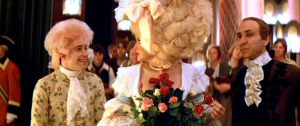 These are the words of 18th Century Italian composer Antonio Salieri (F. Murray Abraham) referring to his murder of the brilliant, meteoric Wolfgang Amadeus Mozart ((Tom Hulce). He tells the story to Father Vogler (Richard Frank) who has come to hear his confession at the insane asylum to which Salieri has been confined following a suicide attempt.
From an early age, Salieri was convinced that he could show God his love through composing music, but his father forbade it. When his father accidentally chokes to death, he becomes convinced that God had killed his father so that he could now compose music in His honor. It seemed destined and his arrival in Vienna was followed by one success after another. By the time he was 24, he had been appointed court composer of Holy Roman Emperor Joseph II (Jeffrey Jones) and had attained fame for his operas and other works. As a child, Mozart was a prodigy and Salieri was very much aware of his budding genius. When Mozart arrived in Vienna, Salieri was eager to meet him. As he wandered around the palace looking for the young composer, he saw Mozart chasing a girl, Constanze (Elizabeth Berridge), giggling hysterically, and making vulgar jokes. Already aware of his own inferiority to Mozart, Salieri cannot understand why God would have chosen such a coarse vessel to express the most profound, holy music possible.
Mozart was presented to the Emperor in 1781, with a march of Salieri’s to welcome him, played by the Emperor himself. Mozart is clumsy socially and offends Salieri by playing the march back to them with perfect memory and then improvising to improve the composition into something great. Mozart thought “outside the box” and proposed to compose an opera in German, The Abduction from the Seraglio, that took place in a Turkish harem. Although the opera is a success, the Emperor proclaims that it “has too many notes” and that Mozart should “cut some out.” Mozart marries Constanze over the objections of his father, Leopold (Roy Dotrice). Although his opera has been a qualified success, Mozart struggles to earn enough money to support his lavish lifestyle. When Leopold comes to visit they go out on the town and end up at a costume ball, where Leopold dresses in black, with a mask of tragedy over his face and a mask of comedy on the back of his head. Playing musical chairs, Mozart loses and must pay a penalty. Although his father demands that he return to Salzburg, Mozart points out to him that the penalty must be served in the room. A friend makes him play in style of various composers and when he comes to Salieri, he makes a grim face and plays pompous music. Salieri, himself behind a mask, watches as Mozart ridicules him to the laughter of the entire party. He vows that he will get even with the boy somehow.
He hires a girl and gives her to the Mozart household anonymously as a servant so he can have a spy inside their apartment. Through her, he discovers that the young man is writing another opera, this one based on the play Figaro, which the Emperor has banned. Mozart is hauled before the royalty to explain himself and he is so brilliant and enthused that he convinces the Emperor to let him proceed. The Marriage of Figaro was destined to be a huge success, but when the Emperor yawns during the fourth act, it is doomed to a short run.
Salieri is so grieved that he turns his back on God and is determined to ruin His plans by ruining Mozart himself. Every opportunity to ingratiate himself to the court is deftly put aside by Salieri, who continues to have the Emperor’s ear. Mozart’s debts grow deeper and he is thrown into an emotional landslide when his father dies. Drinking and carousing temporarily give way to work as Mozart composes the incandescent Don Giovanni, where the figure of his father appears to humble Mozart before him. With every brilliant advance of Mozart, Salieri’s hatred grows until he finally decided to do something about it. Appearing at Mozart’s door dressed in the same costume as Leopold at the party, Salieri commissions a Requiem (the Requiem Mass in D minor). Under the influence of this memory of his father and strapped for money, Mozart accepts the commission while at the same time promising a friend to compose something for the popular stage. With these two demands weighing him down, Mozart drinks more and burns himself out. When he goes out alone in the middle of the night to carouse until dawn with his friends, Constanze takes their son, Karl, and runs away. Grief-stricken, Mozart completes his friend’s commission, The Magic Flute, but is so worn out that he faints during the performance. Salieri sees this and escorts Mozart back to his apartment. Pretending to be his friend, Salieri goads him into finishing the Requiem, volunteering to help by writing down what Mozart dictates.
As they work through the night, Constanze returns to Vienna. When she arrives in the morning, she finds Salieri asleep on a sofa and Mozart passed out in bed. She orders Salieri to leave, but as they talk and argue, Mozart dies, his Requiem unfinished. He is buried in a pauper’s grave with other bodies, lye tossed in on top of him.
In the asylum, Salieri explains to Father Vogler that he had his victory over God in Mozart’s death and he forgives himself for his own mediocrity. Indeed, as he is wheeled away to his breakfast of sweets, he magnanimously forgives everyone for their mediocrity.
Does mediocrity always triumph?
What a brilliant concept to built a work of art!
This amazing screenplay was written by a terrific playwright, Peter Shaffer, based on his own stage play of the same name. The title could have been anything, but Shaffer’s choice of Mozart’s middle name was inspired. The translation of Amadeus is “God’s Beloved” and it serves as the basis of Shaffer’s thematic development. Salieri’s belief that God chose to speak through the vulgar Mozart served as his inspiration to impliment and drive this great tragedy to its conclusion. He serves himself up as an instrument of evil to bring about this “triumph over God.”
Director Miloš Forman, who saw the play before it opened, got in touch with Shaffer the moment the curtain went down and began to discuss the film he would make. Forman’s vision, combined with Shaffer’s script and Abraham’s performance combine to create one of the best films ever made. The movie won eight 1984 Academy Awards, including Best Picture (producer Saul Zaentz), Best Director, Best Adapted Screenplay, Best Actor (F. Murray Abraham), Best Art Direction (Karel Černý and Patrizia von Brandenstein), Best Costume Design (Theodor Pištěk), Best Makeup (Dick Smith and Paul LeBlanc), and Best Sound Mixing (Mark Berger, Thomas Scott, Todd Boekelheide and Christopher Newman). In addition, it was nominated for Best Cinematography (Miroslav Ondříček), Best Actor (Tom Hulce), and Best Film Editing (Nena Danevic and Michael Chandler).
With such an abundance of artistic contribution, it is hard to find a place to begin praising this movie, once you get beyond the writer and director, but the third wheel that accounts for its staggering success is F. Murray Abraham. Salieri, not Mozart represents the heart of the film and Abraham’s attention to detail in both time periods makes a two hour and forty minute tragedy actually work–and not just work, but work beyond what anyone might imagine as possible, especially for a plain, middle-aged actor. He infuses the character with such depth that he evokes sympathy for the villain, which is difficult under the best of scripts.
Added to this is sterling sound. With the brilliant music Mozart and Salieri on the soundtrack, the viewer is inundated with a variety of great listening pleasure. Salieri’s make-up in the asylum is terrific, the costumes are wonderful, and the art direction in general is first rate, creating 18th Century Vienna in glorious detail.
Although lengthy, the film moves quickly and time is not a factor. It passes so quickly, one hardly notices the length.
The only thing in the entire film that bothered me was the relentless American speech of Hulce and Berridge. They both give good, solid performances and Hulce was good enough to receive an Academy Award nomination, but throughout the film, I kept thinking that might have been from Cincinnati or Pittsburgh, but were definitely not Austrian.
Obviously, this didn’t bother me enough to ruin my enjoyment of the movie. It remains, today, one of the best films ever made and it will hold up long into the future. And it doesn’t matter if you don’t like classical music or not, the story is way strong enough to carry any viewer through till the end. It is a wonderful movie and a true tragedy that could be put up against any Greek tragedy and look good.
I highly recommend Amadeus as a classic that everyone should see!
 Across the Universe
 The Adjustment Bureau
 Adventureland
 All is Lost
 American Hustle
 The Art of Getting By
 Austenland
 Paul Wake Baker