Shakespeare in Love

Written by Tom Stoppard (author of Rosencrantz and Guildenstern are Dead) and Marc Norman, this 1998 film is both a comedy and a romance–and it is very successful at both.

Viola and Shakespeare in bedUsing the premise that Romeo and Juliet was Shakespeare’s breakthrough drama, the movie begins with Will Shakespeare (Joseph Fiennes) as a poor player in Lord Chamberlain’s Men struggling to write a comedy for Philip Henslowe (Geoffrey Rush), owner of the Rose Theater, to be called Romeo and Ethel, the Pirate’s Daughter. As was the custom in those days, they began to cast the play before it was completed–or in this case–even started. Viola de Lesseps (Gwyneth Paltrow), the daughter of a wealthy merchant, disguises herself as a man so she can audition. When Shakespeare sees her, he chases after her and follows her back to her palatial home, remaining to watch the ball, hoping to get a glance at the boy who had impressed him. When he sees Viola dancing, he insinuates himself into it and falls hopelessly in love with her. Viola, however, is slated to marry Lord Wessex (Colin Firth) and go off with him to the new world where he plans to run a successful tobacco plantation. Shakespeare, now deeply in love, changes his play from a comedy to a drama and renames his heroine Juliet.

The film won seven Academy Awards, including Best Picture. Gwyneth Paltrow won Best Actress and Judi Densch won Best Supporting Actress for her portrayal of Queen Elizabeth. The cinematography is terrific, as are the costumes, and the set, which was built specially for the movie. The direction by John Madden is tight, with terrific editing.

But the star of the movie is the script, which incorporates hilarious scenes, counterbalanced by wonderful romantic scenes. It is extremely witty, incorporating quotes and references to Shakespeare’s life and inspirations throughout, and liberally sprinkled with quotations. Although Norman had the original idea, it was Stoppard’s masterful rewrite that makes the movie work. The marvelous parallel of Romeo and Juliet with the tragedy of Will and Viola works like a charm, as many of the scenes between the young couple actually make it into the play. The final and most wonderful element is the substitution of Viola as Juliet, performing before Queen Elizabeth, in a time when all women’s roles were played by men. Equally powerful is the idea at the very end that Viola inspired Shakespeare to write Twelfth Night in her honor. Although most this story is completely made up–and abounds in historical inaccuracies–it remains a wonderful movie and it inspired me to go back and reread some of Shakespeare’s plays and poetry.

I highly recommend this movie to everyone!

The Engines of God by Jack McDevitt

Spoiler Alert! This review contains detailed information on the plot and resolution of the novel The Engines of God. It is recommended that you read the book before you read this review.BlackstoneAudioEnginesOfGod

In the realm between hard science fiction and space opera there is a zone where some of the rules of science may be broken very carefully, but the author may still make his or her universe look and feel realistic.

The works of Jack McDevitt certainly belong in that zone and none more squarely than The Engines of God, the first of six novels in what has come to be called “the Academy series”. The novels begin in 2197 and continue deep into the 23rd century.

The Academy of the title is the space exploration arm of the North American Union (NAU), with the primary purpose of charting the star systems of our neighborhood along the Orion spiral arm of the galaxy. Each mission clock runs from about a month to a year. Recent discoveries of both a living, alien pre-atomic population on one planet, Inokademeri (Nok) and archeological ruins on two others (Pinnacle and Quraqua) have led to bigger ships, designed to ferry massive equipment and archeologists to study these planets.

Along with faster than light space travel, humans now have air cars (similar to the skimmers of the Alex Benedict novels), three-dimensional interactive simulations called simmies (replacing movies) and force fields that may be used in hostile environments (replacing space suits).

The protagonist is a pilot named Priscilla Hutchins (everyone calls her Hutch), a diminutive, black-haired beauty imbued with her own particular hang-ups and fears. Hutch is a well-realized character from the beginning. She’s not terribly complicated, but then no one is in this existence nearly 200 years ahead of us and that is part of what gives the novel an edge of realism. Let’s face it, we aren’t very complicated, much as we’d prefer to think otherwise. But there is something in her struggle simply to have a life that we eagerly identify with and we instinctively support her throughout the novel.

She is close friends with Dr. Richard Wald, a archeologist and author, who prefers to have her as pilot on his explorations. The archeologists of the future have discovered gigantic sculptures scattered here and there along the Orion rim. Perhaps the most fascinating is an alien’s self-portrait left on the snow-covered surface of Iapetus, the third largest of Saturn’s moons, that is nearly 24,000 years old.

It is at this point, on February 12, 2197, that The Engines of God begins. Hutch has piloted Dr. Wald to view the Iapetus sculpture and the opening words of the novel paint a chilling picture:

“The thing was carved of ice and rock. It stood serenely on that bleak, snow covered plain, a nightmare figure of gently curving claws, surreal eyes and lean fluidity. The lips were parted, rounded, almost sexual… stamped on its icy features was a look she could only have described as philosophical ferocity.”

The Prologue is soulful writing, as Hutch and Dr. Wald view the sculpture on Iapetus, walk around it and meditate on who the Monument Makers might have been. It is eerie and introduces a mood of almost spiritual reverence for time and space.

As an introduction, it sets up the central question of the book: Why did the Monument Makers create their sculptures? Although the novel is divided into five sections, each advances the story significantly and brings us a little closer to answering the question.

Part One: Moonrise jumps us ahead in the timeline over five years to April 29, 2202. On the mission to extract the scientists at Quraqua, Hutch and Dr. Wald stop to inspect a Monument on Oz, one of Quraqua’s moons. This sculpture is as large as a city – and in fact looks like a city, though pocked and scarred from some sort of catastrophe. Although the city is almost complete made of right angles, there are two round towers, one at each end of the sculpture and each with a roof sloping away from the Monument. On one of the towers, there is an inscription, unreadable to the scientists, but containing figures from an ancient Quraquan language that has been named Casumel Linear C.

An important character is introduced in Part One in the form of Frank Carson, the administrator of the Quraqua project. An ex-Army man, who works for the Academy, Frank meets Hutch and Dr. Wald at Oz and shows them the inscription.

In Part Two: Temple of the Winds, nearly the entire scientific team is imperiled attempting to remove print chase that might contain enough Casumel letters to reconstruct the language enough so that translations can be made. Dr. Wald gives his life attempting to save this artifact which might contain the key to understanding the inscription on Oz. Although an exciting part of the novel, Part Two does not actually advance the plot that much, except to emphasize the importance of cracking the language.

Understanding the language occurs in Part Three: Beta Pac when the exophilologist, Maggie Tufu, manages to translate the inscription on Oz. It is a message from the Monument Makers to the Quraqua to “seek us by the Horgon’s eye.” The Horgon was a mythical Quraquan beast, who was also represented in a constellation.

Figuring this out, Frank and Hutch manage to calculate star movements over the thousands of years between times and narrow down the possibilities as to which one it might actually be. Training massive radio telescopes on these celestial objects, they discover a transmission which might confirm that they have found the Horgon’s eye – the home of the Monument Makers.

A mission is mounted, but the results are not satisfactory. Perhaps the best part of this section is the period of time when their ship is disabled and they watch their oxygen disappear with little hope of rescue. It is tight and very intense – quite well written. But it doesn’t really advance the story. Once they are rescued, however, they discover that the period of intelligence for the Monument Makers has past and that the race has disappeared, their planet left barren. There is another successful action sequence as the group is attacked by crab-like creatures on the planet, but this also does not advance the story.

What does move it forward is evidence that this world has also suffered multiple catastrophes – and at almost precise intervals of 8,000 years. There is a connection between disasters on Quraqua, Nok, and the Monument Makers’ home world – and there may even be a connection with Earth.

At last, we arrive at Part Four: The Engines of God

Hutch is once again the impetus for hurling the plot forward. She discovers that there is a connection between disasters on Quraqua, Nok, and Beta Pacifica III, each separated by 8,000 years – and there may even be a connection with Earth. It is Hutch who makes a further intuitive leap by associating these catastrophes with the Monuments. She hypothesizes that the Makers created the monuments as a diversion – an attempt to lure these catastrophes that love right angles away from planets with civilizations.

By calculating light year distances, elapsed time and the periods between appearances of whatever phenomenon has created these disasters (they are now calling them dragons), Hutch and Frank are able to accurately predict about where the catastrophe would be due to happen in their time frame. Their mission is detoured from Beta Pac to a system known as LCO4418, where they hope to encounter a catastrophe.

Since there are no right angles in the LCO4418 system, Frank and Hutch decide to emulate the Monument Makers by creating their own diversion. They set about cutting right angles into some existing mesas on a moon covered in ice, hoping to lure a dragon. As if on cue, two ominous clouds are sighted moving into the system and one of them changes direction to approach the icy moon. The phenomena are eventually called Omega clouds and they, more than anything else, form the basis for the entire series of Academy novels.

The Omega cloud unleashes a violent attack on the moon and even chases down the box-like form of Hutch’s lander and destroys it, as well. This confirms Hutch’s suspicion that someone or something is sending out a force every 8,000 years with the intention of destroying civilizations. The Monument Makers, having figured this out thousands of years before, had attempted to divert the Omegas from destroying intelligent life and then had apparently fled the galaxy to avoid them.

The final assumption of the novel is that in about 1,000 years, an Omega will find its way into the solar system and mankind had better be ready. It begins an architectural revolution as all man’s structures are redesigned into circular or ovoid shapes.

Of course, the greater question is left hanging: why would anyone deliberately plot the destruction of sentience and create gigantic machines to accomplish the purpose? That question will have to hang until much later in the Academy series for an answer.

The title of this novel is taken from a Quraquan poem, which is in itself a fine example of Jack McDevitt’s writing. One can imagine a Quraquan poet contemplating an Omega cloud as he or she set down the words:

In the streets of Hau-kai, we wait
Night comes, winter descends
The lights of the world grow cold
And, in this three-hundredth year
From the ascendency of Bilat
He will come who treads the dawn
Tramples the sun beneath his feet
And judges the souls of men
He will stride across the rooftops,
And he will fire the engines of God.

Mystic River

Mystic River is a hard-hitting blue collar crime movie by the amazing Clint Eastwood and the cast is packed with great actors.936full-mystic-river-photo

Released in 2003, it tells the story of three boyhood friends forever changed by an incident in 1975. Jimmy Markum, Sean Devine, and Dave Boyle are writing their names into wet cement in the slums of Boston, when a car pulls up with two men in it. One of the men gets out and implies that he is a cop. He intimidates Dave until the boy gets into the car with them. Of course, they aren’t cops, but pedophiles and they abuse him for four days until he escapes.

Twenty-five years later, Jimmy (Sean Penn) is running a convenience store, Dave (Tim Robbins) lives near him, permanently scarred by his experience, and Sean (Kevin Bacon) is a police detective.   Jimmy’s 19 year old daughter, Katie (Emmy Rossum) tells him that she is going out with friends and will be home late. While drinking in a local bar, Dave sees Katie getting drunk and dancing on the bar. He doesn’t get home until 3:00 AM and he is covered in blood, his hand hurt. He tells his wife, Celeste (Marcia Gay Harden), that he was accosted by a mugger and that he beat the man to a pulp, maybe killed him.

The next morning, a Sunday, Jimmy discovers that Katie has not been home all night and Sean is called to a crime scene that is centered on Katie’s car, parked awkwardly on the street, with the door open and blood on the inside. Katie is found dead in a nearby park, her body marked with lacerations and gunshot wounds. Jimmy and his wife, Annabeth (Laura Linney) are inconsolable and he recruits several shady neighborhood characters to investigate the murder at the same time that Sean and his partner (Laurence Fishburne) are also investigating.

While the movie is a murder mystery–and a good one–it goes much deeper than that. Eastwood is concerned with tortured souls, guilt and retribution, and he works the script by Brian Helgeland (based on the novel by Dennis Lehane) for all it is worth. Penn gives a heartfelt performance that won him the Oscar for Best Actor and Robbins is terrific as the tortured Dave Boyle. All of the supporting performances are deep and well nuanced, especially Laura Linney. The Jersey feel is solid, the lighting moody, and music–composed by Eastwood–perfect for the film’s worrisome and tragic plot.

I thought the movie was a little long and might have benefited from some judicious cutting, but it never left me feeling bored. Justice is not served and Eastwood makes a point of the fact that things do not add up–it is part of the appeal of the movie. And it is usually a fact of life that most filmmakers do not worry themselves over. For Clint Eastwood, however, the fact that life doesn’t add up is the very point of the movie. If you’re looking for an outstanding drama, I highly recommend the film.

Across the Universe

Across the Universe is a real accomplishment, for both film and music.Across_the_Universe_3lg

Conceived, produced and directed by the eclectic Julie Taymor, this film is a romantic musical that incorporates parts of 34 songs composed by John Lennon and Paul McCartney, George Harrison, and the three of them plus Ringo Starr (“Flying”). Most of the songs are sung on-screen by the characters, though there are some instrumentals. This places the film in the category of old-style musicals where people seem to burst into song as a part of the story. To everyone’s credit, it actually seems to work very well indeed.

The story concerns Jude (Jim Sturgess), a young dockworker in Liverpool who goes to the United States to look for his American father (who had a fling with his mom during World War II. The very first few frames of film show Jude sitting on a beach singing Lennon and McCartney’s “Girl,” an auspicious beginning because it also tells us that we are not going to be sitting through “copies” of Beatles’ songs. Throughout the entire movie, pretty much every song has been reinterpreted and rearranged which gives them all a brand new and exciting feel.

The movie is definitely concerned with the radical changes brought about during the turbulent 1960’s. Jude provides an outside perspective, while his girlfriend, Lucy (Evan Rachel Wood) and her brother, Max (Joe Anderson) provide the viewpoint of America’s youth. Max drops out of college and gets drafted. While waiting for his induction, the three of them go to New York where they become embroiled in the hippie scene. The other major characters are Sadie (Dana Fuchs), Jojo (Martin Luther McCoy), and Prudence (T. V. Carpio). Where Sadie reminds one of Janis Joplin, Jojo reminds us of Jimi Hendrix.Lucy Across the Universe

An accomplished artist, Julie Taymor brings a sophisticated and stimulating range of graphic beauty to the film, not only in the psychedelic sequences, but in almost every scene. I’ll never forget the way she illustrates “Strawberry Fields Forever” by having Jude pin strawberries to canvas, literally bleeding against the white, while a television shows Max in Vietnam singing with Jude and even superimposed over his face. Another sequence that really carries a punch is Max’s physical in which grotesque sargents stamp out the recruits to “I Want You/She’s So Heavy” with giant troops carrying the Statue of Liberty above them as they stomp on palm trees in Southeast Asia. “Being for the Benefit of Mr. Kite” is full of great images, camera tricks, and bizarre imagery reminiscent of the Beatles own movie Magical Mystery Tour.

All of the young actors are superb, giving heartfelt performances and wonderful vocals. The film is also spiked with a special performance of Bono as Dr. Robert and Eddie Izzard as Mr. Kite, as well as great cameos by Salma Hayek and Joe Cocker.Across the Universe Max Physical

It’s one of those films you excuse for running a little long because it’s all worth it. Great music reinterpreted, fine acting, an excellent script, great direction, and unbelievable graphic art. I will definitely see it again and again.

Ender’s Game by Orson Scott Card

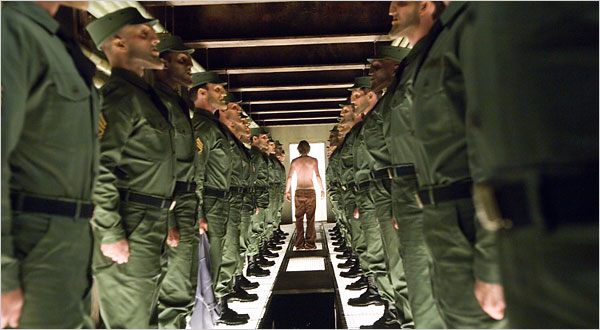
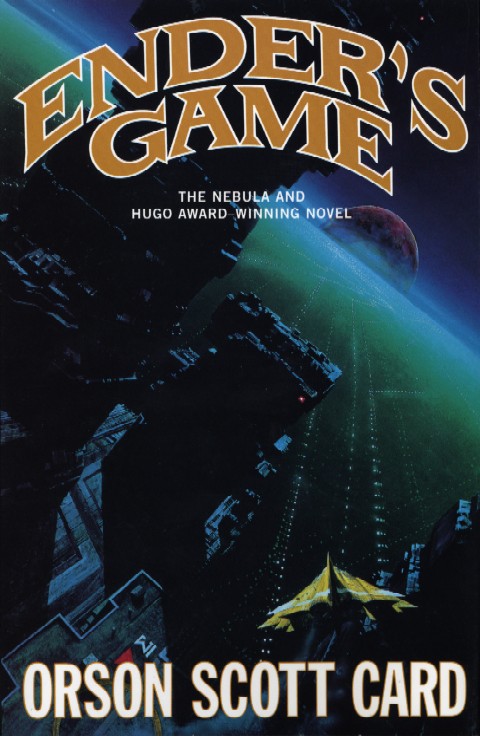
Ender’s Game is a terrific science fiction novel, but it should and does have a much wider appeal. You could put it in a general literature category and it would still be highly ranked.enders-game

 It is the story of a boy in the future who must train to be the commander of a force that will save humanity. After being attacked by aliens (known as buggers) and barely surviving the attack, the military of Earth are planning to prevent a second wave by sending forces to the bugger home world to destroy them.

 Ender Wiggins is recruited at the age of six and goes through a grueling battle school in orbit of Earth, learning to develop new strategies and techniques to defeat the enemy. The school is set up as a series of games that the initiates play together. They are both brutal and instructive—and Ender prospers, growing from outcast to commander of his own group. What sets him apart is his ability to think outside the box and develop new strategies. It is thoroughly engrossing as Ender moves from one level to another, fighting his psychological programming as he puts together his own army, built on his own unique approach.

 Larger issues, especially government manipulation of individuals for its specific agenda, are dealt with in stunning detail. A second manipulation takes place as the author maneuvers his readers into rooting for a boy who is manipulated into becoming a mass murderer without even realizing that he is killing billions.

Winner of both the Hugo and Nebula Awards for Science Fiction, it raises more questions than it answers, but sometimes that’s what great works of art do—bring you into the conversation, but allow you to find your own answers. If you are looking for a book to really make you think, this would be it. And that, in the end is partly what makes great science fiction.

Save The Last Dance

Save the Last Dance is a surprisingly well-thought out film. Although it is primarily concerned with dance, it also deals with some big issues.

save-the-last-danceWhen high school student Sara Johnson (Julia Stiles), an aspiring ballet dancer, auditions for Julliard, she pushes her mother into ducking out of her busy job to come watch and support her. In her hurry, her mother drives right into a serious freeway accident and is killed. Grief-stricken, Sara gives up ballet, feeling that her mother’s death is all her fault, and moves in with her dad, a jazz trumpeter, in Chicago.

Although her new high school isn’t composed completely of African-American students, it seems to be around 95% black. On her first day, she clashes with Derek Reynolds (Sean Patrick Thomas), a very bright boy, in her English class, then she is befriended by Chenille Reynolds (Kerry Washington), Derek’s sister. Chenille is a single mother as well as a high school student, and she and Derek live with their grandmother.

Chenille sets of an evening with Sara at Stepps, a local hip-hop club, where Derek and his friend Malakai hang. However, Malakai is into dealing and drugs and puts himself into pretty dangerous situations. While Derek teaches Sara how to dance hip-hop, many of the other black kids at the school begin to resent Sara’s taking one of the most eligible black boys at the school and even Chenille is not supportive in that respect. When Derek talks Sara into doing another audition for Julliard, she begins working seriously toward that goal.

The film is immensely entertaining, not only in its exploration of the racial themes, but in its use of music and dance, employing great classical music and lots of wonderful hip-hop songs. We get to see a Joffrey Ballet performance, professional hip-hop dancing, and a mixed program where the two forms are joined together in one dance. All of the hip-hop songs are very well-chosen, including Ice Cube’s “You Can Do It,” one of my favorite hip-hop songs.

Stiles and Thomas are both wonderful in their roles and all of the supporting case is excellent, especially Washington. The direction by Thomas Carter is spot-on and the editing and cinematography are first rate. I highly recommend this movie!

Insurgent by Veronica Roth

This review contains spoilers!

Insurgent, by Veronica Roth, is the second installment of the Divergent Trilogy, which had a very promising beginning with the first novel, Divergent.InsurgentHC-jkt-des4

This second novel, however, has a very rushed feel to it, as if it wasn’t properly thought out. I wouldn’t be at all surprised if Ms. Roth was working under some pressure to get the second novel out. This is a common problem in the industry–and also in recordings and movies. A creator will spend years creating something wonderful, but when it becomes a success, the demand for more is so high that new product gets rushed to the market without the benefit of time and thought, so it fails to meet the standards of the first creation. This, in turn, is usually not good for the creator. In the rush of success, they become sloppy artists and suffer in the long run.

The story does not really have an arc, but rather seems to be pulled to and fro with very little logic. Rather than developing one event upon another, I had the sense that Roth herself wasn’t sure what would happen next and just kind of went with whatever came to her.  (Indeed, I’ve learned that she doesn’t outline–and if you’ve got plenty of time for rewrites, that works well, but when you’re rushed, you can end up with something sloppy.)

Unfortunately, the same is true of for Tris, a character that I loved in the first book. She seems way unduly overcome by the death of her parents. Maybe I’m being cold in this analysis, but all of the traits that she developed throughout the first book would seem to leave her stronger and more able to bear this pain. Instead, she constantly loses control of herself. At times, it seemed like she cried every other page for weeks on end and that really, really wore on me. At some point in the book, it crossed over and actually became funny. I’m sure that was not intended in a saga that takes itself so completely seriously.

Part of the problem with the book is that we find the characters doing almost inexplicable things, putting themselves needlessly into dangerous situations. This has become a pet peeve of mine that I think we see all too much today. If a writer can’t really figure out what to do–how to organically develop plot–they simply have their characters do something really stupid. In this novel, it is Tris going to Erudite Headquarters in an attempt to commit suicide by placing herself in harm’s way.

Considering as much time as Roth invested in the first novel in making Tris strong, it just seems totally weird that she would do this. She seems to be overwhelmed by having killed Will–and that seems to drive her as much as feeling responsible for her parents’ deaths. At a certain point, between all the whining, the death wish, doing stupid things, I really lost respect for Tris and when that happened, I lost respect for the whole story.

With all of these preposterous events, I could not suspend my disbelief.

Much as I love the world and the characters that Roth created in Divergent, I must say this was a very disappointing follow-up.

Foundation by Isaac Asimov

Spoiler Alert!

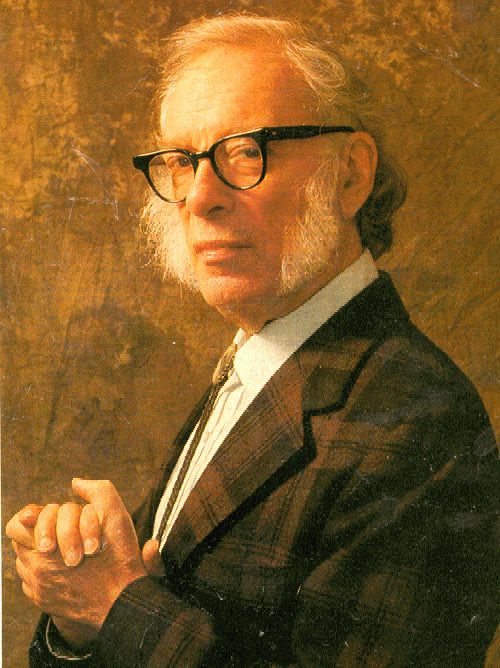
Isaac Asimov 1951 Foundation Isaac+Asimov

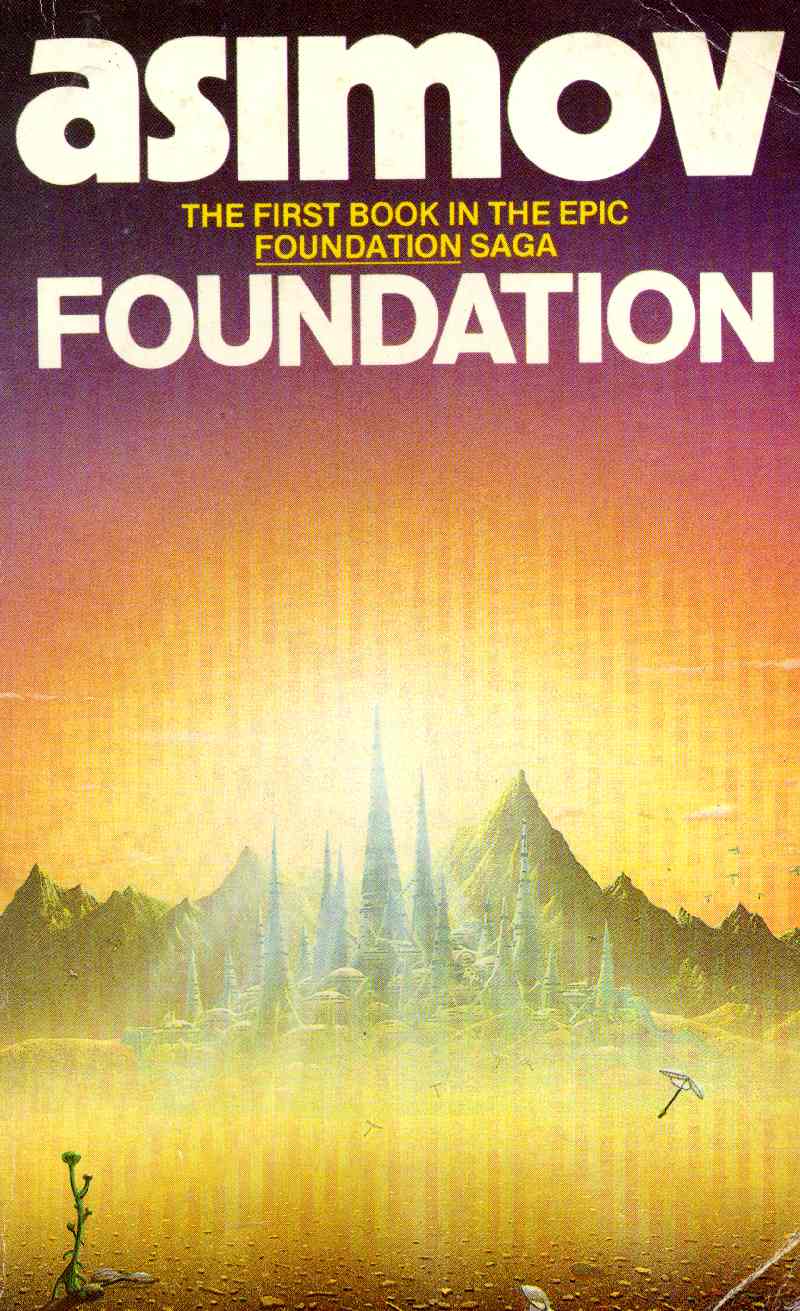
Foundation is the first in a series of novels by the esteemed Science Fiction Grand Master Isaac Asimov. It evolved from a series of short stories first published in Astounding Magazine beginning in 1942, under the direction of John W. Campbell. It reflects the very beginning of Asimov’s career as a writer and has been hailed as the beginning of one of the greatest space operas of all time. Indeed, the Foundation Trilogy was voted the Hugo Award in 1966 for “Best All-Time Series”.

The first book written in the series takes place many years in the future when the galaxy has been completely populated by humans due to faster than light speed travel. A Galactic Empire now rules the political spectrum and has ruled with an iron first for 12,000 years. However, much like the Roman Empire, the Galactic Empire has started to fall.

A mathematician by the name of Hari Seldon has created a new branch of science called psychohistory which combines statistical analysis with sociopolitical prediction. Seldon predicts the fall of empire and a dark age to last 30,000 years before a new galactic empire arises.

Naturally, the Emperor, on the home planet of Trantor, is disturbed by this prediction and arrests Seldon and some of his colleagues. Seldon believes that the length of time of dark ages can be reduced by creating an Encyclopedia Galactica that will allow mankind to pass on the civilization and scientific knowledge to future generations. In order to rid itself of Seldon, the Empire allows him and his followers to create their Foundation on a planet called Terminus circling a sun at the very edge of the galactic rim.

We later learn that Seldon actually manipulated the Empire into doing what he wanted them to do all along and that the Encyclopedia was merely a ploy for him to create a political body destined to eventually become the Second Empire. Manipulation itself becomes a major theme in the novel.

The book is divided into the following sections: The Psychohistorians, The Encyclopedists, The Mayors, The Traders and The Merchant Princes, following the development of the Foundation through a series of crises. These crises are invariably solved by a shrewd leader who generally uses the folly of their enemies against themselves. And every so often, Hari Seldon himself appears in the form of a hologram to give them hints as to where they are at and where they are going.

The book’s story is completely dedicated to political machinations and involves an inordinate amount of dialogue to serve the plot. The characters are sparsely drawn and serve specific functions in the development of the story.

The theme of the novel may be found in one of Mayor Salvor Hardin’s favorite slogans, “Violence is the last refuge of the incompetent.” Throughout the novel, one character in each section must overcome the greed and arrogance of a Foundation adversary that is bent on taking over Terminus.   In each case, the protagonist is able to manipulate the adversary into failure – and this is usually accomplished despite the wishes of most of the citizens of the Foundation. I see this as a flaw in the novel, in that psychohistory is based upon predicting the reactions of great masses of people over time. By having an individual outsmart the rest of the Foundation, it would seem that Seldon’s predictions are skewed completely by individual actions and that psychohistory is pure bunk. I can’t quite grasp how the actions of masses determine the future, yet one individual’s actions fuel the change. I don’t get that part.

The other problem I find with Foundation and with much of Asimov’s writing is his dependence on dialogue to tell a story. I was taught that a writer must show and never tell a story, yet Asimov’s characters constantly explain and argue back and forth for pages on end, with the only action being one character smoking a cigar or the other standing up and turning around. As a writer, I find this style highly problematic.

One of the basic issues with most science fiction writers is failing to see the future in any kind of creative way. Generally, the Masters and those others who have written very far in the past are given a pass because it would have been difficult for them to envision even the technology that we have today, let alone to envision it so many thousands of years in the future. I am inclined to grant that pass most of the time, but I also have some issues with Asimov’s future technology and society in Foundation.

I find it hard to believe that 20,000 years in the future people will still be reading newspapers, smoking cigars and watching “book-films”. I find it short-sighted to believe that atomic power would be propelling starships and running cities. Surely, something better would have been developed by then – and must have been. And I can’t really see a future in which leadership structures resemble that of the middle-ages. Even in 1942, even with Hitler and Mussolini, it should have been fairly obvious that mankind just wouldn’t continue with kings and dukes. Perhaps I’m being too harsh, but I see it essentially as a failure of imagination.

Ultimately, I don’t find Foundation to be among the very best of science fiction novels. Perhaps it has other, more historical accomplishments to recommend it. But I find the novel to be slow, bogged down in way too much dialogue, shallow in characterization and short on imagination.

The Blind Side

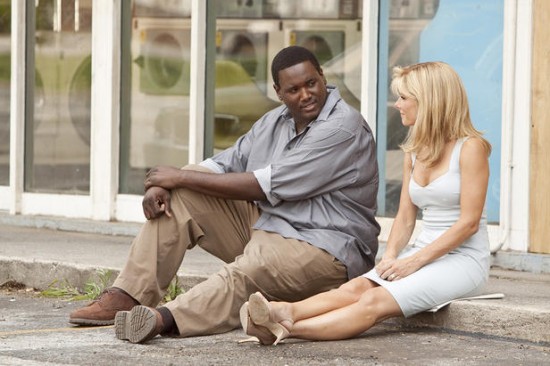
the-blind-side-22-550x366The Blind Side, written and directed by John Lee Hancock, is a biographical drama that tells the story of how Michael Oher (Quinton Aaron), a rather large African-American, gets adopted into a white family, defeats his educational issues, and goes on to develop into a terrific left tackle on the football field (protecting the quarterback’s blind side, hence the title).

Born into a broken family in the projects of Memphis, Tennessee, with a mother who is a drug addict and no father, Oher was taken into child protective services and spent time with a number of foster parents that he always ran away from. At the beginning of the film, he has been sleeping on the couch of a friend’s family. The father, in an attempt to help the boy out, asks Burt Cotton (Ray McKinnon), the coach of the football team at Wingate Christian School, to see if he can get Michael admitted to play on his team. Although academically ineligible, Cotton nonetheless convinces the school to take a chance on him–not because of his abilities as a football player, but simply as the Christian thing to do.

When Michael hears the family he is staying with arguing over him, he leaves and takes to the streets, sleeping in a Laundromat. Leigh Anne Tuohy (Sandra Bullock), whose two children attend the school, sees Michael on the street and brings him home to sleep on their sofa. She and her husband, Sean (Tim McGraw) decide to give him a permanent home and to help him in school so that he can improve himself and play football.

Sandra Bullock is wonderful as Leigh Anne, giving the best performance of her career, for which she won both the Academy Award and Golden Globe for Best Actress of 2009. She creates a lovely Southern infused accent that’s not too heavy and very believable   Tough, yet very loving, she carries the film by herself. Quinton Aaron is very believable as Oher, playing him moody, quiet, and yet growing to trust Tuohy family, becoming very close to their son, SJ (Jae Head) and daughter Collins (Lily Collins). The other actors are all very good, especially Kathy Bates as Miss Sue, a teacher they recruit to tutor Michael. 

The script is tight, it is very well edited, and the cinematography is excellent. Although the film was nominated for Best Picture of 2009, it did not win.

I highly recommend this film to everyone!