Alfred Hitchcock

alfred-hitchcock

I am endeavoring to review as many Alfred Hitchcock films as I can, so please be patient as the bodies pile up.
Hitchcock The Birds 02The Birds

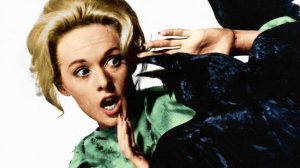
I was thirteen years old in 1963 when I went to a movie theater to Alfred Hitchcock’s latest move, The Birds, and I can still remember the effect it had, the tension it engendered, the thrill of fright, and my jangled nerves when I left the theater and stepped out into the sunlight.


Dial_M_For_Murder_Grace KellyDial M for Murder

It might be easy to plan the perfect murder, but actually doing it is something else entirely.  That is the theme of Dial M for Murder, Alfred Hitchcock’s 1954 movie starring Ray Milland and Grace Kelly as a husband who has the perfect murder on his mind and the wife who seems to be the intended victim.


The Lady Vanishes (1938)The Lady Vanishes

Set in the fictitious European country of Bandrika, this 1938 British comedy-mystery  remains one of Alfred Hitchcock’s best movies.  Based on the 1936 novel The Wheel Spins by Ethel Lina White, the script by Sidney Gilliat and Frank Launder is truly funny, even the suspenseful parts.


Man Who Knew Too Much Stewart and DayThe Man Who Knew Too Much

Never endanger an American’s children.  That is the advice given by a foreign minister to his English lackey when it is already too late for the villains in this remake of a film that Alfred Hitchcock originally directed in England before he crossed the pond.  Wishing to enlarge and improve on his earlier film, he teamed up with his signature actor and composer to produce this widescreen thriller in 1956. 


Marne 01Marnie

Marnie is undoubtedly Alfred Hitchcock’s most unusual film.  There’s no murder, no spies, no sabotage, and practically no suspense.  It is a straight up psychological drama.


 mr and mrs smithMr. and Mrs. Smith

This 1941 “screwball comedy” was the first of two comedies that Alfred Hitchcock directed during his long and distinguished career, the other being the black comedy, “The Trouble with Harry.”  The script, by Academy Award winning screenwriter Norman Krasna, found its way to Carole Lombard, the actress who actually gave the name “screwball” to this kind of comedy, and she backed the project.


 North by Northwest - Saint on RushmoreNorth by Northwest

Mistaken identity, an innocent man, bloodthirsty spies, a long train trip, a beautiful, sexy blond, and suspense building to a nail-biting conclusion—all these staples of legendary director Alfred Hitchcock drive his epic 1959 film, North by Northwest.


Notorious 02Notorious

The sexiest and most mature of all Alfred Hitchcock’s films, Notorious is also one of his most suspenseful movies.  It’s a torchy love story set among dangerous ex-Nazis in Rio de Janeiro, with Ingrid Bergman putting her life in danger to prove to the American agent she loves that she has become an honest woman.  Beautifully shot in black and white, all of Hitchcock’s mastery drives a story that is thrilling right up to the end.


Psycho 1Psycho

The line between suspense and horror is blurred anyway, but when director Alfred Hitchcock and screen writer Joseph Stefano adapted master horror writer Robert Bloch’s 1959 novel Psycho for the screen, and composer Bernard Herrmann was brought on board, they changed the horror film genre forever, creating ripples that are still felt by filmmakers today.


Rear-Window-pic-2Rear Window

A nation of Peeping Toms.  That’s us, according to home care nurse Stella in Alfred Hitchcock’s 1954 masterpiece Rear Window.  She’s complaining to photographer James Stewart as he sits in his wheelchair staring out the rear window of his apartment in Greenwich Village.  His left leg is encased in a great white cast bearing the inscription, “Here lie the broken bones of L. B. Jefferies.”


To Catch a Thief 01To Catch a Thief

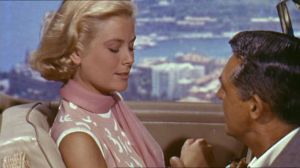
This is Alfred Hitchcock’s most visually beautiful movie.  Filmed on the French Riviera, the gorgeous hills, dotted with old mansions overlooking the Mediterranean Sea vie with the stark beauty of Grace Kelly and chiseled features of Cary Grant to provide enough eye candy to last a lifetime.


 Torn Curtain 3Torn Curtain

Alfred Hitchcock’s 1966 cold war thriller is unique among his films because it contains some of the best filmmaking since he moved to America and also some of the worst.  The film as a whole has too many problems to be considered one of his best: a flabby script, lenient editing, and way too much time at the end.  


Vertigo_1958_trailer_Kim_Novak_at_Golden_Gate_Bridge_Fort_PointVertigo

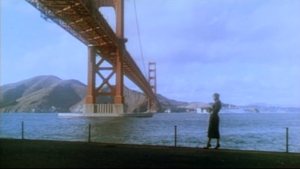
Acrophobia is a perfect psychological ploy for a Hitchcock movie.  Always fascinated with little psychological motivations, Hitchcock used fear of heights as the guiding principle of his 1958 movie Vertigo.  The plot, so detailed and involving, has become nearly iconic as the film has worked its way into the American psyche.

The Man Who Knew Too Much (1956)

Man Who Knew Too Much Stewart and DayNever endanger an American’s children. That is the advice given by a foreign minister to his English lackey when it is already too late for the villains in this remake of a film that Alfred Hitchcock originally directed in England before he crossed the pond.  Wishing to enlarge and improve on his earlier film, he teamed up with his signature actor and composer to produce this widescreen thriller in 1956.

An American family, Dr. Ben McKenna (James Stewart), his famous musical wife, Jo (Doris Day), and young son, Hank (Christopher Olsen) are touring Morocco after a medical convention in Paris, when Hank accidentally yanks the veil off of a Muslim woman and gets them in trouble. A Frenchman, Louis Bernard (Daniel Gelin) steps in helps them out of the jam, then invites them to dinner that evening.  Jo is suspicious of his many questions, but Ben shrugs it off.  Passing an English couple, Edward (Bernard Miles) and Lucy (Brenda De Banzie) Drayton at their hotel, Jo again suspects that they are being watched. That evening, a strange man appears at their door during cocktails and it excites Bernard enough that he leaves them.  They meet the Draytons at the restaurant and Lucy admits that she recognized Jo from a London concert and the two couples have dinner together.  When Bernard appears at the restaurant with a date and ignores them, Ben gets upset, but Jo soothes him, complaining that he gets upset too easily.

The next day, in the bazaar, Bernard, dressed in desert costume and make-up is stabbed in the back. As he is dying in Ben’s arms, he tells him that a statesman will be assassinated at Albert Hall in London and that he needs to tell the authorities there to beware of Ambrose Chapell.  Lucy offers to take Hank back to the hotel while the police question Ben and Jo.  Called aside to the phone, Ben is told that he must not tell anyone what the dying Bernard told him or Hank may suffer.  Later, Ben discovers that Lucy never returned to the hotel and that the Draytons have checked out.  Ben sedates Jo before he tells her that Hank is missing, but she is overwrought until the drug takes effect.  Determined to get Hank back, they go to London to follow up on the message that Bernard gave them–and a date with Albert Hall.

At two hours, this movie runs a little long for its thin plot. Some of that time is occupied with several songs the studio put in for Doris Day, some of it is frittered away in the Marikesh bazaar.  A good deal of the time is used in the Albert Hall music leading up to the attempted assassination.  When it is all added up, this film, among all of the Hitchcock canon, seems a little indulgent.  The suspense that the director is so well-known for is definitely present, but at a slightly lower key than in his other films.  The color seems a little too bright, the rear projection effects a little too stark.

Although many scenes in the beginning of the film were actually shot in Morocco, the studio cutaways feel like movie sets. In all, the pace is just a little too slow to be an altogether successful movie.

James Stewart is good as the American doctor and Doris Day, who was a popular singer at the time, not well-known for her acting, does quite well. The script handles the two roles quite well, inserting quirks that make them more human.  Jo’s outward calm, for example, is balanced by her inability to cope with the loss of their son.  Her husband, aware of this vulnerability, convinces her to take medication before revealing that their son has been kidnapped.  Ben himself is just the opposite.  He is easily angered and tends to respond without thinking, yet when the chips are down, he is calm and steady.  The two characters and the two actors are very good foils for each other.

The supporting acting and the script for the supporting characters is less well defined. Many times, I had the feeling that I was watching stock characters from the films of the forties.  The notable exception to that is the entourage of Jo’s friends in London, who all seem to be more interesting and well-developed, especially given that they have little time on the screen.

It is also unusual for Hitchcock that the comedy seems a little forced in this movie. The action in the restaurant, for example, where Stewart cannot fit his long legs under the short table seems funny and first, but then it is continued and grows old.  Likewise, the action in the taxidermist’s shop in London seems contrived and unnatural.  Normally, Hitchcock develops his comedy directly from the script–it is organic to the action and thus seems completely natural.

Although it is most interesting to see a concert at the Albert Hall, and is even more interesting to see Hitchcock’s musical collaborator, Bernard Herrmann, directing the London Symphony. Unfortunately, the sequence goes on much too long and the tension is not as heightened as it usually is in a Hitchcock film.  And that leads to the final, nearly torturous scene in the foreign embassy that climaxes with a gimmicky solution.

I generally love to watch Hitchcock’s movies, but any time I find myself looking at my watch during the show, then the movie has failed on the most fundamental level: keeping my interest.

M

 Man Who Knew Too Much Stewart and DayThe Man Who Knew Too Much

Never endanger an American’s children.  That is the advice given by a foreign minister to his English lackey when it is already too late for the villains in this remake of a film that Alfred Hitchcock originally directed in England before he crossed the pond.  Wishing to enlarge and improve on his earlier film, he teamed up with his signature actor and composer to produce this widescreen thriller in 1956.


Marnie 03Marnie

Marnie is undoubtedly Alfred Hitchcock’s most unusual film.  There’s no murder, no spies, no sabotage, and practically no suspense.  It is a straight up psychological drama.  This might have been a great film, with sufficient editing, perhaps with a different leading actress as Marnie and maybe an American actor as Mark, with some of the action sequences done more realistically.  As it is, the movie looks like an overblown Hollywood version of what should be a compelling drama.


Midnight Cowboy 03Midnight Cowboy

This classic 1969 John Schlesinger film, adapted by Waldo Salt, from the novel by James Leo Herlihy, won three Academy Awards, for Best Picture, Best Director and Best Adapted Screenplay.  It is the only X-Rated film to ever win Best Picture.  Starring Jon Voight and Dustin Hoffman, in what many consider his signature role, the film is about what happens to our dreams when they are tested against harsh reality.


 Miss PettigrewMiss Pettigrew Lives for a Day

London in 1939 was a hodgepodge of pre-war jitters.  Depression era soup kitchens operated down the block from posh nightclubs for the rich and the middle class worked to scratch out a decent living.  This is a rip-roaring comedy filled with delightful performances by Frances McDormand and Amy Adams.


mr and mrs smithMr. and Mrs. Smith

This 1941 “screwball comedy” was the first of two comedies that Alfred Hitchcock directed during his long and distinguished career, the other being the black comedy, “The Trouble with Harry.”  The script, by Academy Award winning screenwriter Norman Krasna, found its way to Carole Lombard, the actress who actually gave the name “screwball” to this kind of comedy, and she backed the project.


Much Ado About NothingMuch Ado About Nothing

If you buy the cliché that young people who argue and harp at each other are actually flirting, then William Shakespeare’s Much Ado About Nothing might have been the first great play to use it.  In Joss Whedon’s modern dress adaptation, he has whittled the play to under two hours and presented it in a witty original format.


936full-mystic-river-photoMystic River

Mystic River is a hard-hitting blue collar crime movie by the amazing Clint Eastwood.  Released in 2003, it tells the story of three boyhood friends forever changed by an incident in 1975.  Eastwood makes a point of the fact that things do not add up–it is part of the appeal of the movie.  And it is usually a fact of life that most filmmakers do not worry themselves over.  For Clint Eastwood, however, the fact that life doesn’t add up is the very point of the movie.