D

Descendants Clooney and WoodleyThe Descendants

Although this movie might not be suitable for all ages because of language and some adult situations, it is nonetheless a family movie.  It deals with the issues people face, both as parents and as children, and ultimately it addresses the responsibility of generations to their family.  George Clooney and Shailene Woodley star in the beautiful film set in beautiful Hawaii.


Devil-Wears-Prada-3The Devil Wears Prada

Based on the novel The Devil Wears Prada, by Lauren Weisberger, the 2006 film of the same name brings a great deal to the table, namely moral, ethical, and economic issues usually absent from a comedy more concerned with appearance than reality.


Dial_M_For_Murder_Grace KellyDial M for Murder

It might be easy to plan the perfect murder, but actually doing it is something else entirely.  That is the theme of Dial M for Murder, Alfred Hitchcock’s 1954 movie adapted by Frederick Knott from his own successful stage play of the same name.


shailene_woodley_divergent-wideDivergent

Adapted by Evan Daugherty and Vanessa Taylor from the novel of the same name by Veronica Roth, this 2014 movie is remarkably faithful to the original book, which is both good and bad.  Shailene Woodley is brilliant as Tris, the Abnegation girl who is diagnosed as Divergent: she’s not only Abnegation, but also Erudite and Dauntless.  At her choosing ceremony, she chooses Dauntless and begins a life of courage and risk.

French Kiss


Sometimes the charm of two charismatic actors with great chemistry, combined with a smart, talented director, can make even the most banal of screenplays work to perfection. Such is the case with Lawrence Kasdan’s 1995 romantic comedy, French Kiss.

Kate (Meg Ryan) is a history teacher whose fear of flying goes far beyond what most of us would think of as terror, but she has a serious problem that involves flight. An American history teacher, she is engaged to Canadian Charlie (Timothy Hutton), residing in Toronto on a Resident Visa and waiting until her Canadian citizenship comes through before they get married.  Charlie is a doctor who is about to fly to Paris for a medical convention and he begs her to come with him, even though she isn’t supposed to leave the country because of citizenship issues, but the point is moot because Kate just can’t board a plane.  When a great house becomes available, they go to look at it.  Charlie fears it will be too expensive for them, but Kate reveals that she has a considerable savings that she hadn’t told him about yet.

A few days later, Charlie calls her in a drunken stupor and reveals that he has fallen in love with a French girl, Juliette (Susan Anbeh) and won’t be coming home. In spite of her fears, Kate decides to board an Air Canada flight and go to Paris to get him back.  The guy sitting next to her, Luc Teyssier (Kevin Kline) is a French thief who is illegally smuggling a small American grape vine back into France in order to create a new hybrid wine.  However, tucked into the cheesecloth padding the root ball is a stolen diamond necklace.  Luc begins an argument with Kate to distract her from her fear of flying, plying her with little bottles of liquor he has stolen from the flight attendants’ cart.  He hides his vine in her travel bag so he can successfully smuggle it back into France.  At customs, he meets his old friend Inspector Jean-Paul Cardon (Jean Reno), whose life he once saved.  Returning from a vacation, Jean-Paul gives him a ride with his family so he can inspect Luc’s bags to make sure he isn’t smuggling anything.

Kate goes to Charlie’s hotel to find him, but a smarmy desk clerk won’t reveal his room number to her. Another petty thief, Bob (François Cluzet), tries to hustle her as she sits on a sofa in the lobby waiting for Charlie to come down.  When she sees him kissing Juliette, she passes out and Bob steals her bag.  Luc arrives, passing Bob at the door, to discover Kate passed out on the floor.  He revives her and when he realizes that Bob has her bag, he takes her, steals a car, and drives to Bob’s apartment where they find he has already disposed of everything but her bag and the vine.  Thinking he has now recovered the necklace, they leave, but have an argument on the street and separate.  Kate goes to the American Embassy to get a duplicate passport, but they stonewall her because she is a permanent Canadian resident.  At the Canadian Embassy, they won’t give her a duplicate Resident Visa because she was once arrested for possession of pot.  Alone, penniless on the street, she reluctantly returns to Charlie’s hotel.  In the interim, Luc has searched the root ball of his vine and finds the necklace is gone, so he goes back to Bob who proclaims that he didn’t take the necklace, that it must still be in Kate’s bag.

When Kate makes a scene at the hotel, the desk clerk tells her that Charlie and Juliette have gone to the south of France where they intend to get married, so she sets off for the train station. Bob arrives at the hotel to fleece more guests, but is arrested by Jean-Paul who is interrogating him trying to find a “big fish,” a more important criminal.  At that moment, Luc arrives and forces the clerk to tell him where Kate has gone.  Bob points out Luc to Jean-Paul and tells him that Luc has stolen a diamond necklace.  Jean-Paul now chases Luc to the train station where they lose him.

Aboard the train, Luc finds Kate and volunteers to help her get Charlie back, so he can buy time to inspect her bag. Over the next few days, both of their affections begin to turn toward each other as Luc tries to help her reunite with Charlie, even though he now loves her himself.  She reveals that she actually has the necklace and slowly gives in to her feelings for Luc.

Although the screenplay by Adam Brooks is certainly not a ground-breaking story, Kasdan does a marvelous job of telling it. The cinematography and editing are both terrific and they aid determined performances by Kevin Kline, who is almost always brilliant, and Meg Ryan, who, despite a few hammy scenes, is her usual charming self.  The two of them bring a lot of chemistry to the romance, which is essential in a romantic comedy and their performances take a simple story and make it memorable.  France has never looked so good on film, not just Paris, with both gaudiness and grit, but the countryside and vineyards of Luc’s birth really shine, not to mention the French Riviera.

It is a tight, fast moving film that engages the viewer constantly during the one hour and 51 minutes of length. Colorful, skillfully directed, with wonderful, engaging cast, this is one romantic comedy that should be on your shelf.  I highly recommend it!

C

 Calendar-Girls-001Calendar Girls

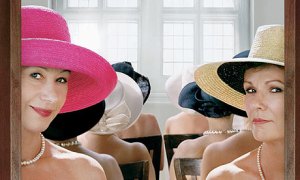
Even though the cinema is full of buddy movies and mindless stupid comedies, the joy of friendship, through good times and bad, isn’t celebrated enough in film, yet it is the heart and soul of this wonderful 2003 British comedy-drama.


 Philip-Seymour-Hoffman-CapoteCapote

Bennett Miller’s film Capote is a well-crafted, thoughtful look at the process by which Truman Capote sculpted his novel In Cold Blood.  The restrained control of color, minimal sets and costumes, and stark cinematography make this film so good that it should be studied in film schools as a masterful use of time and funding.


Cheyenne AutumnCheyenne Autumn

Cheyenne Autumn was the last western film in the great career of director John Ford.  Released in 1964, it was the first big Hollywood film to portray Native Americans as human beings, people who were not only more than primitive savages to be killed and driven off their lands by the white man, but people who were victims of the bigoted and corrupt government of the United States of America.


 Chocolat VienneChocolat

Most things that are good are not necessary bad.  In fact, most things in life that we enjoy are quite without sin, even if they do induce sensual pleasure, such as, let us say, chocolate, that most wonderful of confections.


 John WayneThe Cowboys

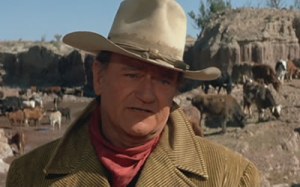
This 1972 coming of age western stars John Wayne as Montana rancher Wil Anderson.  When his hands abandon him to join in a gold rush, Anderson solicits the aid of local schoolboys to help him move his herd of cattle and horses 400 miles to market.


Rear Window

Rear Window - James Stewart and Grace KellyA nation of Peeping Toms.

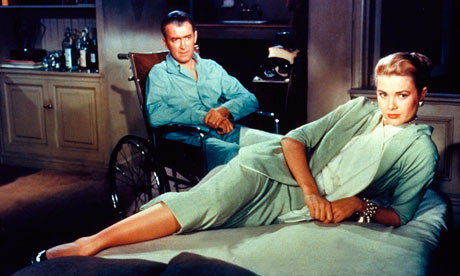
That’s us, according to home care nurse Stella (Thelma Ritter) in Alfred Hitchcock’s 1954 masterpiece Rear Window.  She’s complaining to photographer L. B. Jefferies (James Stewart) as he sits in his wheelchair staring out the rear window of his apartment in Greenwich Village.  His left leg is encased in a great white cast bearing the inscription, “Here lie the broken bones of L. B. Jefferies.” He’s been housebound for six weeks recovering from an accident that occurred in the middle of a raceway as he attempted to photograph a racecar breaking apart.

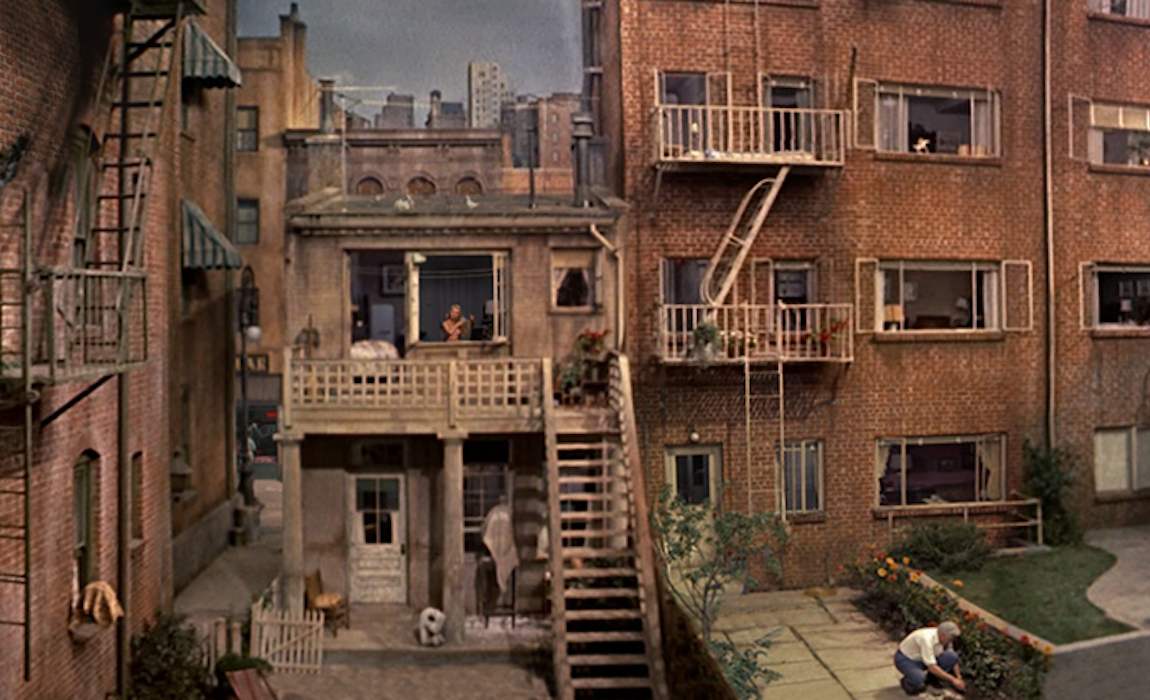
Not only is he broken apart, but a long, slow pan at the opening of the film shows a camera lying in pieces in front of the photograph he took. The small apartment is full of his equipment, past photos, and magazine spreads, and presents a kind of homey messiness in the middle of New York City.  His entertainment is watching his neighbors. rearwindowloop2Through the back window, he can see several little adjoining patios and up to four stories of the apartment houses that abut his. It is a little world of its own. Across the way, Miss Lonelyheart (Judith Evelyn) fantasizes about having a romance, while directly above her traveling salesman Lars Thorwald (Raymond Burr) argues with his invalid, bedridden wife. On the top floor, a man and his sleep outside in the sweltering summer heat.  They have a little dog that they let down into the patio in a basket on a pulley.  To the left, a young dancer, Miss Torso (Georgine Darcy) exercises and fends off a spate of young admirers, while right below a middle-aged sculptress works on her latest project. At the upper right, a songwriter struggles to find a melody, while frequently entertaining his friends in show business. And on the far left, a newlywed couple honeymoons with the shade drawn most of the time.

Rear-Window-pic-2Jefferies hates his confined existence, but he has to live with the cast for one more week. After learning his trade in the Army taking photos from an airplane with his buddy Doyle (Wendell Corey), he is accustomed to traveling the world and putting himself in danger to get his award winning photographs. It is his life and he loves it. Unfortunately, he is in a serious relationship with Lisa Fremont (Grace Kelly), a fashionista who works in one of the big stores downtown. Convinced that their lifestyles are too different for anything to work between them, he puts her off. She’s simply too perfect for him. Beautiful, worldly, she seems unreal, but she loves him and is willing to sacrifice her safe, cozy world to be with him.

One night, as Jefferies dozes in his chair, he hears a glass shatter and a woman scream, but is too tired even to look out his window. Later, it begins to rain and he stirs himself, noticing Thorwald leave in the middle of the night with his sample suitcase, not once but twice. In the early morning hours, as he dozes we see Thorwald and a woman leaving their apartment. The next day, he sees a change in the accustomed pattern.  The shades are drawn across the way and he can’t see Mrs. Thorwald, but later he sees the man cleaning a saw and a knife with a long, curved blade and his suspicion turns into a belief that Thorwald killed his wife. At first, no one believes him, but when Lisa sees the mattress rolled up and a trunk tied together, she also becomes convinced and finally Stella comes around. The only one who doesn’t believe that a murder has occurred is Detective Doyle.

The film contains everything Hitchcock does best and it is therefore the best example of all of his filmmaking techniques. In addition, it is a first rate suspense film with great comic relief that induces edge-of-your-seat tension. In other words, it’s a really good movie purely on its own merits.

Based on a short story, “It Had to Be Murder” by Cornell Woolrich, the story unfolds in a confined space. The script, written by John Michael Hayes in conjunction with Hitchcock, initially contained one scene outside this confined space, at the office of his editor (Gig Young), but faithful and creative Assistant Director Henry Bumstead pointed this out to Hitchcock and the scene was not used in the final cut, although Young’s voice is heard over the telephone. By restricting the scene to Jefferies’ apartment and only what he can see through his rear window, Hitchcock has confined the universe to just one small area and everything you need to see is present and accounted for.

The world is further narrowed to just two points of view. The first and most significant point of view is that of the audience. Like a voyeur, we are allowed to see into Jefferies’s private life, his affair with Lisa, the care given him by Stella, his arguments with Doyle, and his phone calls, but nothing else. We are in the position of looking through our own little window into his life. The second point of view is Jefferies’, as he peers into the courtyard and the windows of his constricted little universe. Only once in the film are we allowed to see something he doesn’t–and that is when Thorwald leaves his apartment in the early morning accompanied by a woman. Jefferies is asleep when that happens. It is a little thing, but it makes us realize that Thorwald may have actually taken his wife away, rather than killing her. It implants a little seed of doubt that Jefferies may be wrong.

Part of the point that Hitchcock makes with this restriction of point of view is that we are all constricted, each in our own way. Jefferies is literally constricted. He cannot move from his chair. Lisa is constricted in that she is tied to a man who is pushing her away and it seems like the main event of her life takes place in this little apartment. Doyle is constricted because he can’t investigate something on such restricted circumstantial evidence.

The only evidence of the outside world is in one narrow view of the street and in the people who come and leave from his own apartment and those of the other characters in his rear window. Those connections are tenuous. Miss Lonelyheart is looking for romance, but the only man who responds to her wants her only for sex. Miss Torso can’t accept a steady man into her life, but we don’t discover why until the end of the movie. The songwriter is restricted by the creative process. And Thorwald is restricted by his wife and he takes violent action to escape to freedom.

The movie also says a lot about human relationships, as described above, and the relationships between men and women. Jeffries and Lisa are the prime example of two people who are miles apart in view and who find a common ground through the action of a murderer. Only when Jefferies sees that Lisa can be adventurous and take chances does he truly reveal his love for her. Even though she appears ready to embrace his adventurous lifestyle, she makes a statement for her feminity in the end.

But the best of this movie lies in the camera work and the way Hitchcock moves point of view through the lens. He uses the camera relentlessly to build suspense, moving in a steady arc that starts slow, languid almost, and accelerates into rapid montage by the end of the movie. The comic parts are organic, derived from the situation and the characters’ natural involvement with the story. When I saw this movie on its first run in theaters, I was moved by the shared tension of the audience in the theater, each person so involved in the story that we all seemed to react as one person as it raced toward its conclusion.

At the end of the film, you want to go outside and breathe fresh air, to walk around see what exists beyond your four walls.

Every element of the movie works, including the sound. Although it begins with a jazz score, denoting Greenwich Village in the 1950’s, and there are snippets of score dropped in throughout, most of the movie sound appears natural: the songwriter’s piano, the babbling of neighbors, the laughter of children and the traffic in the street. It is all slightly muted, as if we are hearing what Jefferies hears.

If I had to recommend one Hitchcock movie–and only one–for everyone to see, this would be it. It is absolutely representative and might very well be his best film.

A

 Across_the_Universe_3lgAcross the Universe

Conceived, produced and directed by the eclectic Julie Taymor, this film is a romantic musical that incorporates parts of 34 songs composed by John Lennon and Paul McCartney, George Harrison, and the three of them plus Ringo Starr (“Flying”).  Most of the songs are sung on-screen by the characters, though there are some instrumentals.  This places the film in the category of old-style musicals where people seem to burst into song as a part of the story.  To everyone’s credit, it actually seems to work very well indeed.


1-adjustment-bureau-copyThe Adjustment Bureau

The Adjustment Bureau, based on a Phillip K. Dick story, is a far-fetched, but very engaging film.  David Norris (Matt Damon) is a Brooklyn politician who meets a fascinating woman, Elise Sellas (Emily Blunt) on the night that he has just lost the Senate election.  When she runs away, he is motivated to give a galvanizing concession speech that will reenergize his career.


AdventurelandAdventureland

Adventureland is a funny and moving teen romance written and directed by Greg Mattola about a group of teens working at a summer carnival.  The main character, James Brennan, is a student who has just graduated from a small college and is saving up his money to go to the Columbia School of Journalism so he can begin a career in travel writing.  Played with both humor and angst by Jesse Eisenberg, James is trying to find romance, but his own geekiness stands in his way.


All is Lost RedfordAll is Lost

A man sleeps peacefully aboard his small yacht when it suddenly bangs into some sea debris, tearing a hole in the side.  This begins a great survival story where one problems piles upon another as he is tossed across the Indian sea toward shipping lanes and possible rescue.  But he must first face storms, sharks, and other menaces.  And even when he reaches the shipping lanes, will anyone see him?


???????
Amadeus

A terrible way to triumph over God.  These are the words of 18th Century Italian composer Antonio Salieri (F. Murray Abraham) referring to his murder of the brilliant, meteoric Wolfgang Amadeus Mozart ((Tom Hulce). He tells the story to Father Vogler (Richard Frank) who has come to hear his confession at the insane asylum to which Salieri has been confined following a suicide attempt.


 american-hustle-posters-sonyAmerican Hustle

Loosely based on the FBI ABSCAM sting operation, this 2013 film was written by David O. Russell and Eric Warren Singer and directed by Russell of The Fighter and  Silver Linings Playbook fame.  Bringing along Christian Bale and Amy Adams from The Fighter and Bradley Cooper and Jennifer Lawrence from Silver Linings Playbook, he has created a brilliant sting comedy that takes place at the height of disco mania, 1978.


Art of Getting By3The Art of Getting By

In The Art of Getting By (2011), George (Freddie Highmore), a high school senior living in New York City, falls into a fatalistic funk.  Although he is a gifted artist, he realizes that he’s going to die some day and asks himself: What is the point of trying?  Seeing no point, he gives up working on his school assignments, skips class and tests and just skates by as a loner.  Facing this failure, he is placed on academic probation.


Austenland PictureAustenland

The heroine of the movie, Jane Hayes (Keri Russell) is a disheartened Jane Austen fan. Obsessed with the writer, she looks at her own life and sees failed relationships, a dead-end job and no future, so she decides to spend her life savings on a trip to England to resort called Austenland


The Man Who Knew Too Much (1956)

Man Who Knew Too Much Stewart and DayNever endanger an American’s children. That is the advice given by a foreign minister to his English lackey when it is already too late for the villains in this remake of a film that Alfred Hitchcock originally directed in England before he crossed the pond.  Wishing to enlarge and improve on his earlier film, he teamed up with his signature actor and composer to produce this widescreen thriller in 1956.

An American family, Dr. Ben McKenna (James Stewart), his famous musical wife, Jo (Doris Day), and young son, Hank (Christopher Olsen) are touring Morocco after a medical convention in Paris, when Hank accidentally yanks the veil off of a Muslim woman and gets them in trouble. A Frenchman, Louis Bernard (Daniel Gelin) steps in helps them out of the jam, then invites them to dinner that evening.  Jo is suspicious of his many questions, but Ben shrugs it off.  Passing an English couple, Edward (Bernard Miles) and Lucy (Brenda De Banzie) Drayton at their hotel, Jo again suspects that they are being watched. That evening, a strange man appears at their door during cocktails and it excites Bernard enough that he leaves them.  They meet the Draytons at the restaurant and Lucy admits that she recognized Jo from a London concert and the two couples have dinner together.  When Bernard appears at the restaurant with a date and ignores them, Ben gets upset, but Jo soothes him, complaining that he gets upset too easily.

The next day, in the bazaar, Bernard, dressed in desert costume and make-up is stabbed in the back. As he is dying in Ben’s arms, he tells him that a statesman will be assassinated at Albert Hall in London and that he needs to tell the authorities there to beware of Ambrose Chapell.  Lucy offers to take Hank back to the hotel while the police question Ben and Jo.  Called aside to the phone, Ben is told that he must not tell anyone what the dying Bernard told him or Hank may suffer.  Later, Ben discovers that Lucy never returned to the hotel and that the Draytons have checked out.  Ben sedates Jo before he tells her that Hank is missing, but she is overwrought until the drug takes effect.  Determined to get Hank back, they go to London to follow up on the message that Bernard gave them–and a date with Albert Hall.

At two hours, this movie runs a little long for its thin plot. Some of that time is occupied with several songs the studio put in for Doris Day, some of it is frittered away in the Marikesh bazaar.  A good deal of the time is used in the Albert Hall music leading up to the attempted assassination.  When it is all added up, this film, among all of the Hitchcock canon, seems a little indulgent.  The suspense that the director is so well-known for is definitely present, but at a slightly lower key than in his other films.  The color seems a little too bright, the rear projection effects a little too stark.

Although many scenes in the beginning of the film were actually shot in Morocco, the studio cutaways feel like movie sets. In all, the pace is just a little too slow to be an altogether successful movie.

James Stewart is good as the American doctor and Doris Day, who was a popular singer at the time, not well-known for her acting, does quite well. The script handles the two roles quite well, inserting quirks that make them more human.  Jo’s outward calm, for example, is balanced by her inability to cope with the loss of their son.  Her husband, aware of this vulnerability, convinces her to take medication before revealing that their son has been kidnapped.  Ben himself is just the opposite.  He is easily angered and tends to respond without thinking, yet when the chips are down, he is calm and steady.  The two characters and the two actors are very good foils for each other.

The supporting acting and the script for the supporting characters is less well defined. Many times, I had the feeling that I was watching stock characters from the films of the forties.  The notable exception to that is the entourage of Jo’s friends in London, who all seem to be more interesting and well-developed, especially given that they have little time on the screen.

It is also unusual for Hitchcock that the comedy seems a little forced in this movie. The action in the restaurant, for example, where Stewart cannot fit his long legs under the short table seems funny and first, but then it is continued and grows old.  Likewise, the action in the taxidermist’s shop in London seems contrived and unnatural.  Normally, Hitchcock develops his comedy directly from the script–it is organic to the action and thus seems completely natural.

Although it is most interesting to see a concert at the Albert Hall, and is even more interesting to see Hitchcock’s musical collaborator, Bernard Herrmann, directing the London Symphony. Unfortunately, the sequence goes on much too long and the tension is not as heightened as it usually is in a Hitchcock film.  And that leads to the final, nearly torturous scene in the foreign embassy that climaxes with a gimmicky solution.

I generally love to watch Hitchcock’s movies, but any time I find myself looking at my watch during the show, then the movie has failed on the most fundamental level: keeping my interest.

The Big Sleep

The-Big-Sleep Bogart BacallThis 1946 film adaptation of Raymond Chandler’s hard-boiled detective novel remains one of the best films ever made for a variety of reasons.

Start with Chandler’s novel, written in a unique voice and style, that delved into the underworld of big city vice, using dangerous and edgy behavior that were normally hidden from the public eye: pornography, promiscuity, and homosexuality. Phillip Marlowe stood out as a character.  He was mature, worldly, manly, direct in a way that even criminals found disarming.  Finally, you have a plot that wastes no time on deliberation or description.  It moves forward relentless, with a certainty that is not obvious until the reader finds himself breathless in wonder.

The film is directed by the brilliant Howard Hawks, who understood the story arc and knew he wanted to make a film that wasted no time. He hired the same writers who had fashioned his 1944 adaptation of Ernest Hemingway’s To Have and Have Not, the great novelist William Faulkner and science fiction/crime wizard Leigh Brackett (one of the first women to break through into either genre) and told them to waste no time.  Unlike other screen adaptations, he wanted this one to leap directly from the page to the screen.  Working separately on different parts of the book, they finished the first screenplay in eight days.

Private eye Phillip Marlowe (Humphrey Bogart) is called to the mansion of wealthy retired General Sternwood (Charles Waldron). With two wealthy, bored daughters who move in a racy crowd, the old man finds himself blackmailed with the gambling debts of his youngest girl, Carmen (Martha Vickers).  Sternwood’s former detective, Sean Regan, an old acquaintance of Marlowe’s, has disappeared.  Before leaving, Sternwood’s older daughter, Mrs. Vivian Rutledge (Lauren Bacall) asks him if he has been hired to find Sean Regan, who had been seriously interested in Carmen, but he won’t tell her anything, but the wisecracking and banter between them creates a sexual tension that is palpable.

Marlowe begins by investigating the man who holds the gambling debts, a rare bookstore owner named Geiger, but he discovers the man’s assistant, Agnes Lowzier (Sonia Darrin) knows nothing about rare books and she stonewalls him on her boss. Hiding out in a rival bookstore across the street, he spends a rainy afternoon with the sexy proprietress (Dorothy Malone) before following Geiger home.  Waiting in the car, he hears gunshots, sees a car roaring away, and then finds Carmen inside, high as a kite, with Geiger’s body on the floor before her.  He finds a camera hidden inside a statue, but the film is missing.  Looking around, he finds Geiger’s notebook, filled with names and unreadable ceiphers.  Taking the book, he returns Carmen to the Sternwoods and finds that Mrs. Rutledge has no answers.

An old friend, Police Detective Bernie Ohls (Regis Toomey) brings Marlowe along when they fish a car out of the ocean just off a local pier. It belongs to the Sternwoods and the driver turns out to be a former Sternwood chauffer who had also been in love with Carmen.  It has been made to look like a suicide, but the driver had been killed before the car was driven off the pier.

Mrs. Rutledge appears at Marlowe’s office the next morning with scandalous photos of Carmen and a new blackmail demand from a small time gambler named Joe Brody (Louis Jean Heydt). She can get the money through her friend, gangster Eddie Mars (John Ridgely).  Marlowe says he will wait for her call that night before the $5,000 in blackmail money will be paid.  During the day, he tails Brody to his apartment.  That night, Mrs. Rutledge puts him off, but on a hunch, he goes to Brody’s and finds not only Agnes, but Mrs. Rutledge as well.  Although held at gunpoint, he puts together the sequence of events as he understands them.  The chauffer had actually killed Geiger and taken the photos, but Brody stopped him and confiscated them to bribe the Sternwoods, which he had done before.  Marlowe suspects that Brody killed the chauffer, but Brody maintains his innocence and that killing remains unsolved.  Carmen shows up with a gun, demanding the photos.  Marlowe easily disarms all of them, but before he can get more information from Brody the man is shot through the door.

It is a complicated and twisting plot, but it moves forward relentlessly. The smart, sharp dialogue crisply moves the story along and renders it secondary really to the underplot: the growing relationship between Marlowe and Mrs. Rutledge.

When Hawks directed To Have and Have Not, he knew he’d found the ideal screen couple in Bogart and Bacall, so he was determined to reunite them for this movie.  By that time, their off-screen romance was big news in Hollywood and the pairing was natural.  With a great script and an excellent cast, Hawks shot the film in 1944, but it was kept on the shelf for two more years, partly because Warner Bros. was working feverishly to release all of their wartime films before World War II was over and partly because there were problems with Bacall.  After the huge hit with To Have and Have Not, she was considered a hot property, but her follow-up film, Confidential Agent, was a flop and she’d been widely panned in reviews.  Her agent, Charles K. Feldman, wrote a letter to Jack L. Warner, asking that several scenes in The Big Sleep be re-shot and the film re-edited to take advantage of Bogart and Bacall’s screen chemistry.  Warner agreed and the two actors were called in to film additional scenes, including the now famous scene in the restaurant that is full of sexual innuendo.

The Big Sleep Martha Vickersbig-sleep-dorothy-malone-humphrey-bogart-toastingbig sleep_cab-driver

One thing that becomes apparent right from the beginning of this movie is that beautiful young women are used in abundance to help create a strong feeling of free sexuality. It begins when Marlowe arrives at the Sternwood residence and the gorgeous Carmen walks in wearing a really short skirt and throws herself into his arms.  Then, you meet Mrs. Rutledge and Lauren Bacall shines as a young urbanite living life on the edge.  It continues with the girl at Acme Books, played by Dorothy Malone, who unpins her hair and closes the store to spend an afternoon drinking rye whiskey with Marlowe.  Then there is the female taxi driver that Marlowe rides with who gives him her card and tells him to call her at night when she’s not working.

In the pivotal scene between Bogart and Bacall that was re-shot, the two of them are talking about having a relationship in terms of horse racing. She wonders just how far he will go and he replies that it depends on her.  Is she willing “to go all the way?”  This tightly wrapped sensuality, contrasted against the violence, the mystery of not knowing exactly what is happening in a plot that moves forward darkly, relentlessly creates a movie that almost impossible to stop watching.  It moves that way right to the end, when we finally sense that Marlowe and Mrs. Rutledge will be able to consummate their smoldering desires.

Shot in beautiful black and white, the film has been restored to allow modern viewers to see it as released in 1946. The DVD also includes a documentary on the two versions of the movie, showing scenes that were cut and added, so viewers can see how much the film was improved by the re-shoot.

It is every bit as strong and engaging today as when it was first released and that is one reason it will always be considered a classic, perhaps the very finest example of film noir and one of the best movies ever made.

Becoming Jane

Becoming JaneOur general fascination with all things Jane Austen continues with this 2007 fictional glimpse into one short period of her life: that time when she was attracted to Tom Lefroy and would have formed an engagement if not for the objections of his family. I say fictional because the filmmakers have taken considerable license with what we understand as historical fact.  This is something movies do all of the time, but with Jane Austen it is best to take special care because her fans are quite dedicated.

It is a Sunday morning in 1795 in Hampshire, England. At the cottage of the Reverend George Austen (James Cromwell), youngest daughter Jane (Anne Hathaway), toils away at her writing while her sister Cassandra (Anna Maxwell Martin) and the others sleep.  When the servants get to work, Jane begins to play her piano loudly to wake everyone up.  Cassandra has just become engaged to Robert Fowle (Tom Vaughan-Lawlor) who must travel to the West Indies to earn his pulpit.  The local grand dame, Lady Gresham (Maggie Smith) is resolved that her nephew, Mr Wisley (Laurence Fox) will marry Jane, despite her poverty, but Jane is much less certain.  She desires to marry for love, not money, as is the custom.

Meanwhile, in London, young law student Tom Lefroy (James McAvoy) drinks and carouses his way into the bad graces of his uncle, the Lord Chief Judge of the high court (Ian Richardson). Although he comes from a poor Irish family, his uncle is without heirs and Tom depends on the possible inheritance as the only way his family can survive.  After a night of drinking, Tom arrives late to court and his uncle berates him for his lack of decorum.  As punishment, and as a possible tonic for his Tom’s decadent lifestyle, his uncle sends him to the country to stay with relatives.

Arriving bored and angry, his friend Henry Austen (Joe Anderson) invites him to attend a tea to celebrate Cassandra and Robert’s engagement. Jane reads a lengthy, comedic tribute to the happy couple, but later overhears Tom disparaging her writing. In a pique of anger, she burns her marriage tribute and questions her other writing.  Henry, one of Jane’s older brothers who has just graduated from Cambridge, has also brought a priggish friend, John Warren (Leo Bill) to the party and he becomes smitten with Jane, although she finds his bumbling manner offensive.  Tom’s relations include his cousin, young Lucy Lefroy (Jessica Ashworth) who has a crush on Tom and hopes to make a match with him.  A member of the Austen party is Jane’s cousin, Eliza, the Comtesse de Feullide, who had been married to a French count, beheaded during the Revolution.  She takes a shine to Henry and hopes that her wealth will provide a means for him to become an officer in the English Navy.

Walking in the woods, Jane encounters Tom and they exchange uncivil words, but despite his criticism of her writing, Tom sees her intelligence and wit and is attracted to her. During an accidental meeting in the Lefroy library, he gives her a copy of Henry Fielding’s Tom Jones so that she can experience a more visceral form of writing.  When they discuss the morality of it, he remarks that good people can come to a bad end, but Jane has already grasped the prime purpose of what a good novel should be.  “A novel should reveal the true source of our actions,” she tells him.  This is the heart of good fiction: action must be organic.

Mr. Wisley finally asks to Jane to marry him, but she cannot in good conscience say yes to him. She doesn’t love him, although she is beginning to respect him.  Her mother (Julie Walters) is very distressed by this refusal, but her father takes it more in stride.  Even so, he is realistic about the world.  “Nothing destroys spirit like poverty,” he tells Jane.  But Jane wants to marry for love and gradually realizes that she loves Tom.  At a ball, Lady Gresham confronts Jane, telling her explicitly that her nephew’s offer of marriage is the best that Jane can ever expect in her life and that she has a duty to her impoverished family to accept.  Outside, by the fountain, she and Tom profess their love to each other and pledge that they will try to find a way to make it work.

On the way to visit Jane’s older brother, Edward, Tom invites Jane, Eliza, and Henry to stay with his uncle in London, hoping that Jane will make a good impression, but at dinner, Jane contradicts the Lord Justice on the nature of irony and falls into disfavor. Unable to sleep, Jane begins drafting a new story, First Impressions, which turned out to be the first draft of Pride and Prejudice.  Before Tom can tell his uncle that he wants to marry Jane, the Lord Justice receives a letter informing him that Jane is a penniless husband-hunter.  He turns his back on them and Tom has only one option if he wants to inherit his fortune: he must abandon Jane.

Directed by Julian Jarrold, the movie was filmed almost exclusively in Ireland, with assistance from the Irish Film Board, mostly because Hampshire had become too clean and modernized. It is a beautiful film, no doubt.  The cinematography by Eigil Bryld brings the English countryside to life, even if it was filmed in Ireland.  Trust me, you won’t notice the difference.

The script, drafted by Sarah Williams and finalized by Kevin Hood, was based on a the book, Becoming Jane Austen by Jon Hunter Spence, uses some historical facts, but mashes everything up to create a good romantic film.  The best of it provides terrific glimpses into influences on Austen’s writing, such as Lady Gresham’s remark that there is “a lovely-ish wood” nearby that Jane and Mr. Wisley could walk in or Wisley’s fragmentary remark that “it is a truth universally acknowledged.”  Certainly Lady Gresham bears a striking resemblance to Lady Catherine de Bourgh and there is evidence that she used her own mother and father as models for Mr. and Mrs. Bennet.  Jane’s relationship with Cassandra is compared to Lizzie and Jane, but they could also be Elinor and Marianne from Sense and Sensibility.  The bumbling John Warren is very close indeed to Mr. Collins.  All of this is extremely well done, if a trifle obvious in places.  It is a witty and emotional script, very well written.  However, if readers are seriously interested in Jane Austen’s life, I would recommend the biography Jane Austen: A Life, by David Nokes.  This is an excellent book and is much more factual than the movie.

The acting is first rate, especially the supporting cast. James Cromwell and Julie Walters as Jane’s parents are terrific, as are Maggie Smith, Ian Richardson, and Anna Maxwell Martin.  Helen McCrory is remarkable as Mrs Radcliffe, the author of The Mysteries of Udolpho, whom Jane meets on her stopover in London.

James McAvoy brings a lot of soul to Tom Lefroy, elevating him far beyond the carousing rascal he starts out as, into a man who must carry his own pain with him throughout his life.

Jane Austen Portrait

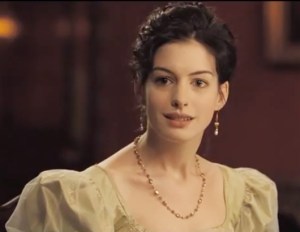
But the movie is centered around Jane Austen and Anne Hathaway’s performance is critical to the movie’s success. I have read that many English critics have found fault with her English accent and others are affronted by the fact that she is American and not English.  These things did not bother me.  And I found her performance to be very strong and very affecting.  She amused me and moved me and must be accorded as giving a very good performance.  My only issue is personal.  I have a certain view on Jane Austen that has been fostered by my own reading, by my study of her biography, and by the one picture that seems to capture her essence.  I think her weight was an essential part of her character, that her own roundness helped to reveal who she was.  Hathaway is thin, she looks harshly angular and skinny and despite her truly remarkable performance I simply could not accept her as Jane Austen.  Perhaps this is a failing on my part, but I would have much preferred to someone a little closer to Jennifer Ehle, who played Elizabeth Bennet in the BBC Pride and Prejudice.
anne-hathaway-becoming-jane-GC

I was also a little irked by the historical inaccuracies. For one thing, Jane Austen was incredibly well-read and was certainly familiar with Fielding’s Tom Jones as a classic of the times.  I also found it troublesome that she would consider eloping with Tom Lefroy.  Austen was a girl of her times and would not pull a Lydia Bennet.  Their daft brother, George, was secreted away and the family never saw him, yet here he is included as if they saw him every week.

These are, of course, minor objections in a movie that largely succeeds and makes a worthy addition to film canon of Jane Austen. Everyone who is deeply into Austen should see the film and make up their own minds.  For my part, I liked it in spite of myself.  I was moved by both Jane and Cassandra and I loved their relationship.  It is probably quite close to their real relationship and is very moving.  Overall, I found the movie to very affecting and I must recommend it.

Waitress

waitress keri russell with babyFunny, touching, tough: three words that truly describe this vastly underrated 2007 comedy-drama, written and directed by the late Adrienne Shelly.

Jenna (Keri Russell) is an amazing pie-maker in some unnamed southern town. She works at Joe’s Pie Diner with her friends, Becky (Cheryl Hines) and Dawn (Adrienne Shelly), under the management of Cal (Lew Temple) and the ownership of Joe (Andy Griffith).  She’s married to a domineering redneck man named Earl (Jeremy Sisto), who takes all of her tip money and bullies her relentlessly, but she’s been hiding away some of the money and she hopes to enter a pie contest where the prize is $25,000–with the intention of leaving him as soon as she can.  This plan gets derailed at the very beginning of the movie when she discovers she’s pregnant.

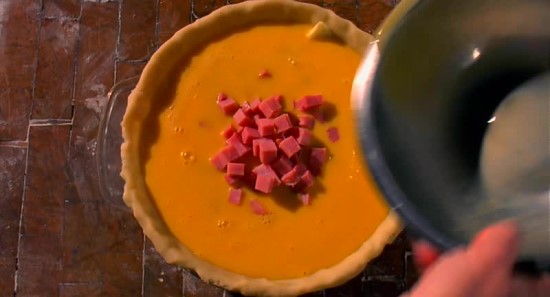
waitress I don't want earl's baby pieThis brings on the inspiration for her to make tomorrow’s featured pie, the “I Don’t Want Earl’s Baby Pie.” Dawn remarks that she shouldn’t probably write that on the menu board, so Jenna changes the name to the “Bad Baby Pie,” a quiche with Brie cheese and a smoked ham center.

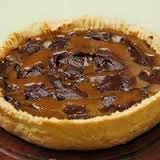
waitress I hate my husband pieShe considers making an “I Hate My Husband Pie” made of bittersweet chocolate–unsweetened–made into a pudding and drowned in caramel. Deciding to keep the baby, she goes to see her doctor only to find that her gynecologist has gone into semi-retirement and most of her cases have been taken over by young, attractive Dr. Jim Pomatter (Nathan Fillion).  When he congratulates her, she tells him that she doesn’t really want the baby, but is having it anyway, so please don’t be all happy for her.  “It’s not a party.”

Her mother taught her to bake as a child, singing this little song (written by Adrienne Shelly):

Baby, don’t you cry, gonna make a pie
Gonna make a pie with a heart in the middle
Baby, don’t be blue, gonna make for you
Gonna make a pie with a heart in the middle
Gonna be a pie from heaven above
Gonna be filled with strawberry love
Baby, don’t you cry, gonna make a pie
Hold you forever in the middle of my heart.

waitress marshmallow-mermaid-pieEverything is about pie creation. She brings the doctor her “Marshmallow Mermaid Pie” that she created when she was nine years old.  She makes a “Falling In Love Pie” (chocolate mousse) for Dawn’s date, and she fantasizes about new pies night and day.  At one point, she considers making a “Baby Screaming Its Head Off in the Middle of the Night and Ruining My Life Pie” that would be a New York cheesecake brushed with brandy and topped with pecans and nutmeg.

waitress earl wants to kill me pie

“I Can’t Have An Affair Because It’s Wrong and I Don’t Want Earl to Kill Me Pie”

Finding Dr. Pomatter irresistible, she begins an affair with him and considers making an “Earl Murders Me ‘Cause I’m Having An Affair Pie” made with smashed blackberries and raspberries in a chocolate crust, but decides it would be better to make an “I Can’t Have An Affair Because It’s Wrong and I Don’t Want Earl to Kill Me Pie” with vanilla custard and banana–no–hold the banana. Among the other pies mentioned in the movie are the “Spanish Dancer Pie,” the “Naughty Pumpkin Pie,” the “Singing Tuna Casserole,” and “Jenna’s Special Strawberry Chocolate Oasis Pie.”

After she discovers that Becky is having an affair with Cal, she asks him, “Are you happy?” He answers, “I’m happy enough.  I don’t expect much, give much.  I don’t get much.  I generally enjoy whatever comes up.”  Dawn finds happiness with a little accountant named Ogie, but Earl continues to make Jenna’s life miserable, forcing her to have sex with him, slapping her around, and controlling her.  In fact, she conceives of the “Pregnant, Miserable Self-Pitying Loser Pie,” made of lumpy oatmeal with fruitcake mashed in and served flambé.

In spite of the comedy, the movie holds a very dark side. Earl, for example, though an ignorant bully, has unexpected depth.  He’s never really been loved and he depends on his control over Jenna to give meaning to his life.  Joe, the owner of the Pie Shop, is himself an old loser, but he advises Jenna to leave Earl and start all over.  “This life will kill you,” he says.  “Make the right choice.”

The script contains many unexpected depths and Shelly’s deft direction and control of the story arc keep the movie on point through its one hour and forty-eight minutes. Keri Russell is beautiful, with a big heart that makes you love and root for Jenna to find a way out of her mess.  Nathan Fillion is charming as the nervous, tender Dr. Pomatter.  Cheryl Hines and Adrienne Shelly are funny and poignant as her waitress friends and Andy Griffith is terrific as Joe–again providing unexpected depths.

But the pies are magnificent. Every pie in the movie looks absolutely beautiful and each one acts like a Greek chorus, providing commentary on the action.

waitress adrienne shellyUnfortunately, Adrienne Shelly did not live to see her movie appear at the Sundance Film Festival or to see its critical success. Three months before it was due to open, Shelly discovered a thief in her apartment.  The man panicked and killed her.  A foundation has since been established in her name to help young female filmmakers fulfill their dreams and you man contribute at The Adrienne Shelly Foundation.

Everyone should see this movie! It’s a film that can be seen over and over again with a kind of sensual culinary pleasure, with laughter and tears, and lots and lots of love.

Funny, touching, tough.