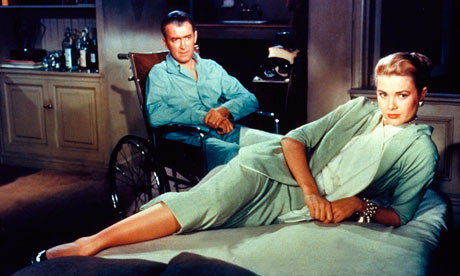
 A nation of Peeping Toms.
That’s us, according to home care nurse Stella (Thelma Ritter) in Alfred Hitchcock’s 1954 masterpiece Rear Window. She’s complaining to photographer L. B. Jefferies (James Stewart) as he sits in his wheelchair staring out the rear window of his apartment in Greenwich Village. His left leg is encased in a great white cast bearing the inscription, “Here lie the broken bones of L. B. Jefferies.” He’s been housebound for six weeks recovering from an accident that occurred in the middle of a raceway as he attempted to photograph a racecar breaking apart.
Not only is he broken apart, but a long, slow pan at the opening of the film shows a camera lying in pieces in front of the photograph he took. The small apartment is full of his equipment, past photos, and magazine spreads, and presents a kind of homey messiness in the middle of New York City. His entertainment is watching his neighbors. 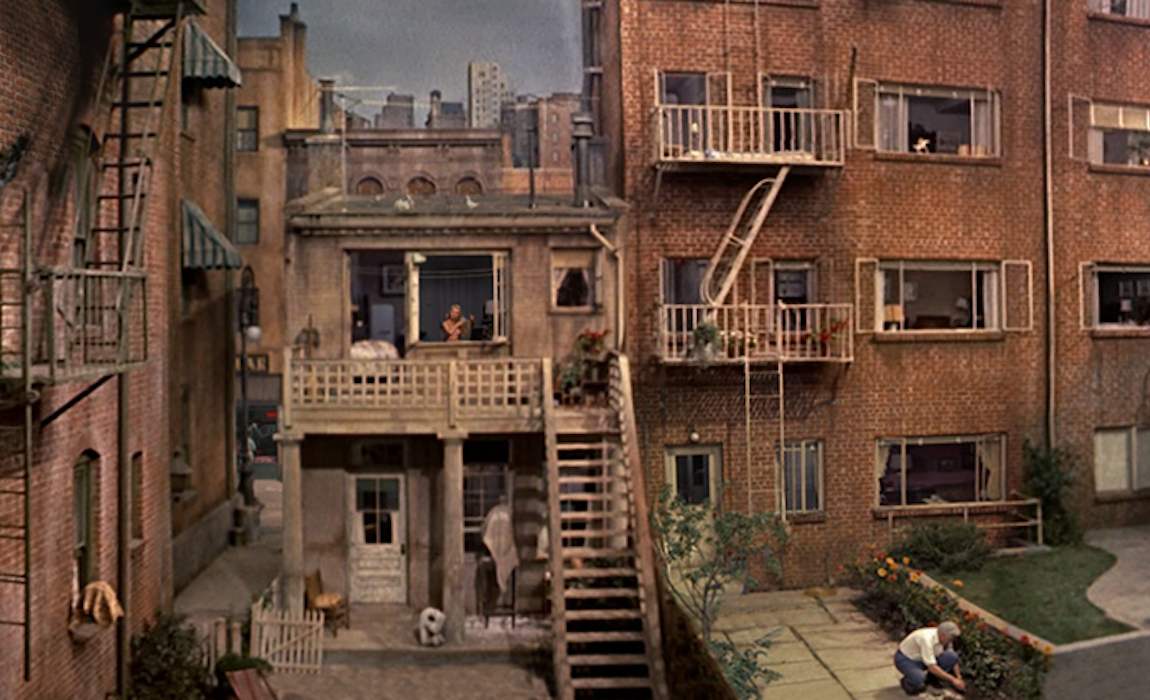 Through the back window, he can see several little adjoining patios and up to four stories of the apartment houses that abut his. It is a little world of its own. Across the way, Miss Lonelyheart (Judith Evelyn) fantasizes about having a romance, while directly above her traveling salesman Lars Thorwald (Raymond Burr) argues with his invalid, bedridden wife. On the top floor, a man and his sleep outside in the sweltering summer heat. They have a little dog that they let down into the patio in a basket on a pulley. To the left, a young dancer, Miss Torso (Georgine Darcy) exercises and fends off a spate of young admirers, while right below a middle-aged sculptress works on her latest project. At the upper right, a songwriter struggles to find a melody, while frequently entertaining his friends in show business. And on the far left, a newlywed couple honeymoons with the shade drawn most of the time.
 Jefferies hates his confined existence, but he has to live with the cast for one more week. After learning his trade in the Army taking photos from an airplane with his buddy Doyle (Wendell Corey), he is accustomed to traveling the world and putting himself in danger to get his award winning photographs. It is his life and he loves it. Unfortunately, he is in a serious relationship with Lisa Fremont (Grace Kelly), a fashionista who works in one of the big stores downtown. Convinced that their lifestyles are too different for anything to work between them, he puts her off. She’s simply too perfect for him. Beautiful, worldly, she seems unreal, but she loves him and is willing to sacrifice her safe, cozy world to be with him.
One night, as Jefferies dozes in his chair, he hears a glass shatter and a woman scream, but is too tired even to look out his window. Later, it begins to rain and he stirs himself, noticing Thorwald leave in the middle of the night with his sample suitcase, not once but twice. In the early morning hours, as he dozes we see Thorwald and a woman leaving their apartment. The next day, he sees a change in the accustomed pattern. The shades are drawn across the way and he can’t see Mrs. Thorwald, but later he sees the man cleaning a saw and a knife with a long, curved blade and his suspicion turns into a belief that Thorwald killed his wife. At first, no one believes him, but when Lisa sees the mattress rolled up and a trunk tied together, she also becomes convinced and finally Stella comes around. The only one who doesn’t believe that a murder has occurred is Detective Doyle.
The film contains everything Hitchcock does best and it is therefore the best example of all of his filmmaking techniques. In addition, it is a first rate suspense film with great comic relief that induces edge-of-your-seat tension. In other words, it’s a really good movie purely on its own merits.
Based on a short story, “It Had to Be Murder” by Cornell Woolrich, the story unfolds in a confined space. The script, written by John Michael Hayes in conjunction with Hitchcock, initially contained one scene outside this confined space, at the office of his editor (Gig Young), but faithful and creative Assistant Director Henry Bumstead pointed this out to Hitchcock and the scene was not used in the final cut, although Young’s voice is heard over the telephone. By restricting the scene to Jefferies’ apartment and only what he can see through his rear window, Hitchcock has confined the universe to just one small area and everything you need to see is present and accounted for.
The world is further narrowed to just two points of view. The first and most significant point of view is that of the audience. Like a voyeur, we are allowed to see into Jefferies’s private life, his affair with Lisa, the care given him by Stella, his arguments with Doyle, and his phone calls, but nothing else. We are in the position of looking through our own little window into his life. The second point of view is Jefferies’, as he peers into the courtyard and the windows of his constricted little universe. Only once in the film are we allowed to see something he doesn’t–and that is when Thorwald leaves his apartment in the early morning accompanied by a woman. Jefferies is asleep when that happens. It is a little thing, but it makes us realize that Thorwald may have actually taken his wife away, rather than killing her. It implants a little seed of doubt that Jefferies may be wrong.
Part of the point that Hitchcock makes with this restriction of point of view is that we are all constricted, each in our own way. Jefferies is literally constricted. He cannot move from his chair. Lisa is constricted in that she is tied to a man who is pushing her away and it seems like the main event of her life takes place in this little apartment. Doyle is constricted because he can’t investigate something on such restricted circumstantial evidence.
The only evidence of the outside world is in one narrow view of the street and in the people who come and leave from his own apartment and those of the other characters in his rear window. Those connections are tenuous. Miss Lonelyheart is looking for romance, but the only man who responds to her wants her only for sex. Miss Torso can’t accept a steady man into her life, but we don’t discover why until the end of the movie. The songwriter is restricted by the creative process. And Thorwald is restricted by his wife and he takes violent action to escape to freedom.
The movie also says a lot about human relationships, as described above, and the relationships between men and women. Jeffries and Lisa are the prime example of two people who are miles apart in view and who find a common ground through the action of a murderer. Only when Jefferies sees that Lisa can be adventurous and take chances does he truly reveal his love for her. Even though she appears ready to embrace his adventurous lifestyle, she makes a statement for her feminity in the end.
But the best of this movie lies in the camera work and the way Hitchcock moves point of view through the lens. He uses the camera relentlessly to build suspense, moving in a steady arc that starts slow, languid almost, and accelerates into rapid montage by the end of the movie. The comic parts are organic, derived from the situation and the characters’ natural involvement with the story. When I saw this movie on its first run in theaters, I was moved by the shared tension of the audience in the theater, each person so involved in the story that we all seemed to react as one person as it raced toward its conclusion.
At the end of the film, you want to go outside and breathe fresh air, to walk around see what exists beyond your four walls.
Every element of the movie works, including the sound. Although it begins with a jazz score, denoting Greenwich Village in the 1950’s, and there are snippets of score dropped in throughout, most of the movie sound appears natural: the songwriter’s piano, the babbling of neighbors, the laughter of children and the traffic in the street. It is all slightly muted, as if we are hearing what Jefferies hears.
If I had to recommend one Hitchcock movie–and only one–for everyone to see, this would be it. It is absolutely representative and might very well be his best film.


 Paul Wake Baker