The Birds

Hitchcock The Birds 01I was thirteen years old in 1963 when I went to a movie theater to Alfred Hitchcock’s latest move, The Birds, and I can still remember the effect it had, the tension it engendered, the thrill of fright, and my jangled nerves when I left the theater and stepped out into the sunlight. Based on the novella of the same name by Daphne du Maurier, it is one Hitchcock’s best films. When I watched it again over fifty years later, I was surprised that it created exactly the same effect as when I saw it in a movie theater for the first time.

Melanie Daniels (Tippi Hedren) stops into a pet store in downtown San Francisco on a Friday afternoon to pick up a minah bird as a gift, but it hasn’t arrived at the shop yet, so she writes down her name and address for delivery. As she stands at the counter, Mitch Brenner (Rod Taylor), asks her if she can help him. He’s looking for a pair of lovebirds as a birthday present for his little sister. Pretending to be a clerk, she shows him around the store, making up stories about lovebirds, even though she hasn’t the slightest idea what they look like. When a bird accidentally escapes, he traps it under his hat and addresses her by her name. A lawyer, he had actually recognized her from the first, but wanted to show her what it was like to be the butt of a practical joke. Angered, she follows him to the street, gets the number of his license plate, and calls her father’s newspaper to get his address. She then purchases a pair of lovebirds and tries to deliver them to his apartment, but a neighbor informs her that he will be in Bodega Bay all weekend visiting his family. Undeterred, she decides to deliver them there and drives the sixty miles north the next morning, Saturday.

Finding out that the Brenner family home is directly across the bay, she decides to take rent a motorboat and make a surprise delivery by sneaking up on the house from the water, but she doesn’t know his sister’s name. A local store owner directs to her to home of the school teacher, Annie Hayworth (Suzanne Pleshette). When the two women meet, it is obvious that Annie is sizing her up as a rival for Mitch’s affections. The sister’s name is Cathy, so Melanie makes out a card, gets in her boat and sets out across the bay. Seeing Mitch go out to the barn, she sneaks inside, leaves the birds with a note and returns to her boat. She watches as Mitch goes back inside then comes outside, surprised and looking around for her. He spots her in the boat and as she goes back across the bay, he gets in his truck and drives around to meet her. As she nears the dock, a gull shoots out of the sky and scratches her head badly enough that she is bleeding. Mitch takes her into the Tides restaurant to clean and bandage the wound. His mother, Lydia (Jessica Tandy) meets Melanie rather coldly, but everyone is curious about the bird attack.

When Mitch smugly remarks that she drove all that way to see him, Melanie lies and says that she was actually coming up to see her old friend Annie. Mitch invites her to come to dinner that evening and she meets Cathy (Veronica Cartwright), who begs her to attend her birthday party the next day. Melanie likes Cathy immediately, but Lydia seems to be almost jealous of her budding relationship with Mitch. As they sit down to eat, masses of sparrows fly down the chimney and fill the house. Mitch opens the windows and doors and tries to shoo them out. After they have fought them off, Melanie returns to Annie’s house to spend the night. As they discuss Annie’s former relationship with Mitch, a gull crashes against the door and dies.

On Sunday morning, she attends the birthday party, intending to drive back to San Francisco immediately afterward, but the party is attacked by a flock of gulls, diving and purposely trying to injure the children. As the family recovers from the attack, Melanie is persuaded to spend the night there. The next morning, Monday, Lydia goes to a nearby farm to investigate a problem she is having with her chickens, but discovers that the farmer is dead, his eyes picked out and his home destroyed by birds. In a panic, she returns home and the sheriff is called in. Mitch leaves with him to investigate further, but Lydia is so worried about Cathy at school that she sends Melanie to pick her up and bring her home.

At the school, Melanie waits for the children to finish their lesson. As they sing a children’s song, she waits outside, smoking a cigarette in front of the jungle gym, which slowly fills up with crows. Alarmed, she goes inside and she and Annie organize the children to leave in a mock fire drill. As the move down the road, the crows take flight and attack them as they run toward the village. Inside the Tides, she calls her father to alert him to the danger in Bodega Bay and everyone becomes concerned about the situation. A local fisherman reports that one of his boats was just recently attacked by gulls. An ornithologist, Mrs. Bundy (Ethel Griffies) tries to tell them that it is impossible for birds to work together in such a way, but if they did, there was no way humans could fight against the millions of birds in the world. A mother, with two young children, is panicked by their discussion and tries to flee, but the birds attack again, knocking over a man filling his car with gas. As the gas runs down the street, another man, lighting a cigar, ignites it and cars and the filling station all explode in fire as the birds corner Melanie in a telephone booth. Mitch gets her back into the restaurant and the mother accuses her of bringing on the bird attacks, crying out that none of it started until her arrival.
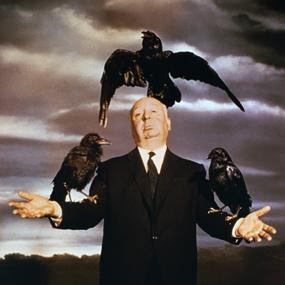
Hitchcock The Birds 03The attacks of the birds steadily escalate into an unforgettable conclusion to the movie.

When Hitchcock hired Evan Hunter to write the screenplay, he told him that the only thing there were keeping from du Maurier’s story was the title and the menace of the birds. With that freedom, Hunter moved the location from England to Northern California, an area that Hitchcock loved. The two of them then worked together to create an original story. The decision was made early on that they would make no attempt to explain the strange behavior of the birds, but Hitchcock suggested the scene where the townspeople discuss the situation.

The Birds follows Psycho in Hitchcock’s chronology of films and he had strongly considered not using a score for the previous film, but eventually worked with his musical collaborator, Bernard Herrmann in making his shocking fright film. For The Birds, he called in Hermann as a consultant, but actually used electronic sounds (by Sala and Remi Gassmann) and silence to create the terror in the film. All of the sounds of the birds are semi-artificial. They are natural bird sounds that have been input a mellotron-like keyboard system and played directly into a sound recorder. This was highly experimental for the time and a stark departure from the heavily scored films of the day.

The story is developed in pure Hitchcock style. It begins very lightly, with a comedic feel to it, an almost like the screwball comedies of the 1940’s, with a flighty society woman and a straight-laced lawyer, but it gradually becomes serious as small incidents with birds escalate into the terrorizing attacks that build steadily in intensity until the very end.

With the exception of a few uncertain moments from the young Veronica Cartwright early in the movie, all of the performances are very natural and believable, even Tippi Hedren who was acting in her first movie. Rod Taylor’s character wasn’t written with any depth, so he stands out as a man who reacts to the situation around him, which makes him a typical Hitchcock hero. Jessica Tandy and Suzanne Pleshette both bring incredible nuance and detail to their characters and so does Tippi Hedren. The women are created with the deepest detail, not only in this film, but in most of Hitchcock’s movies.

The technical detail and difficulty makes this a very unusual film for the master of suspense. Although he normally used the “blue screen” effect so that he could shoot most of his films in a studio, under controlled lighting, almost all of the effects using birds, both real and mechanical, were “sodium yellow screen” effects used in the film’s print, created by Ub Iwerks of Walt Disney Studios. In addition, he used many matte paintings that were printed into the final cut. For instance, in the scene where Hedren takes the boat across the bay, the entire village of Bodega Bay in the background is a painting. The same technique was used in the famous shot of the burning village from high above, with birds in the foreground. Part of the screen is live action on a limited stage, part is filled in with matte painting, and then the birds were actually painted onto the negative. All of these effects were quite radical for the day and today could all be done effortlessly using computer generated CGI effects.

The DVD contains a wonderful documentary called “All About the Birds” in which many of the principals, including Rod Taylor, Tippi Hedren, and Veronica Cartwright are interviewed. Evan Hunter provides great insight into how he developed the script with Hitchcock, technical wizards explain the special effects, and the original ending is discussed in some depth, using pages from Hunter’s original script. Hedren also discusses the psychological effect of how Hitchcock shot the scene in the upstairs bedroom using real birds that terrorized her and exhausted her to the point where she could no longer perform. That incident was featured in the derivative film, The Girl, which portrayed Hitchcock as a lustful man who inflicted that terror on Hedren for her refusal to have an affair with him.

The film will always have a place among the most frightening films ever made. Watching it at home on DVD, even on a big screen television, will never duplicate the effect it had in a theater full of people, all grasping their popcorn, gasping, sitting on the edge of their seats and even screaming, at times, together.

Nevertheless, it packs a huge punch and I highly recommend it!
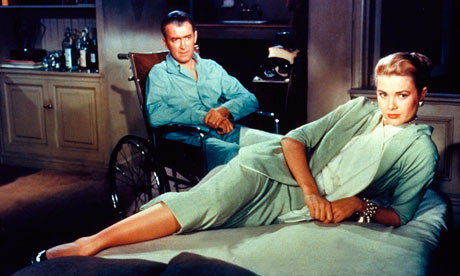
Rear Window

Rear Window - James Stewart and Grace KellyA nation of Peeping Toms.

That’s us, according to home care nurse Stella (Thelma Ritter) in Alfred Hitchcock’s 1954 masterpiece Rear Window.  She’s complaining to photographer L. B. Jefferies (James Stewart) as he sits in his wheelchair staring out the rear window of his apartment in Greenwich Village.  His left leg is encased in a great white cast bearing the inscription, “Here lie the broken bones of L. B. Jefferies.” He’s been housebound for six weeks recovering from an accident that occurred in the middle of a raceway as he attempted to photograph a racecar breaking apart.

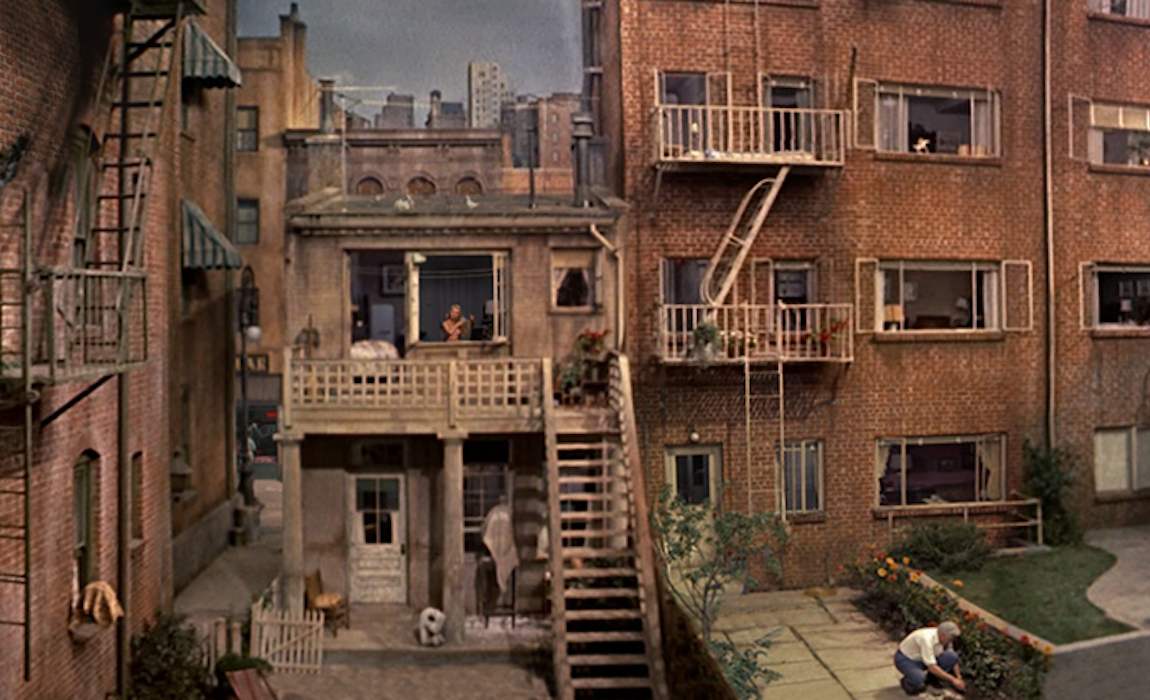
Not only is he broken apart, but a long, slow pan at the opening of the film shows a camera lying in pieces in front of the photograph he took. The small apartment is full of his equipment, past photos, and magazine spreads, and presents a kind of homey messiness in the middle of New York City.  His entertainment is watching his neighbors. rearwindowloop2Through the back window, he can see several little adjoining patios and up to four stories of the apartment houses that abut his. It is a little world of its own. Across the way, Miss Lonelyheart (Judith Evelyn) fantasizes about having a romance, while directly above her traveling salesman Lars Thorwald (Raymond Burr) argues with his invalid, bedridden wife. On the top floor, a man and his sleep outside in the sweltering summer heat.  They have a little dog that they let down into the patio in a basket on a pulley.  To the left, a young dancer, Miss Torso (Georgine Darcy) exercises and fends off a spate of young admirers, while right below a middle-aged sculptress works on her latest project. At the upper right, a songwriter struggles to find a melody, while frequently entertaining his friends in show business. And on the far left, a newlywed couple honeymoons with the shade drawn most of the time.

Rear-Window-pic-2Jefferies hates his confined existence, but he has to live with the cast for one more week. After learning his trade in the Army taking photos from an airplane with his buddy Doyle (Wendell Corey), he is accustomed to traveling the world and putting himself in danger to get his award winning photographs. It is his life and he loves it. Unfortunately, he is in a serious relationship with Lisa Fremont (Grace Kelly), a fashionista who works in one of the big stores downtown. Convinced that their lifestyles are too different for anything to work between them, he puts her off. She’s simply too perfect for him. Beautiful, worldly, she seems unreal, but she loves him and is willing to sacrifice her safe, cozy world to be with him.

One night, as Jefferies dozes in his chair, he hears a glass shatter and a woman scream, but is too tired even to look out his window. Later, it begins to rain and he stirs himself, noticing Thorwald leave in the middle of the night with his sample suitcase, not once but twice. In the early morning hours, as he dozes we see Thorwald and a woman leaving their apartment. The next day, he sees a change in the accustomed pattern.  The shades are drawn across the way and he can’t see Mrs. Thorwald, but later he sees the man cleaning a saw and a knife with a long, curved blade and his suspicion turns into a belief that Thorwald killed his wife. At first, no one believes him, but when Lisa sees the mattress rolled up and a trunk tied together, she also becomes convinced and finally Stella comes around. The only one who doesn’t believe that a murder has occurred is Detective Doyle.

The film contains everything Hitchcock does best and it is therefore the best example of all of his filmmaking techniques. In addition, it is a first rate suspense film with great comic relief that induces edge-of-your-seat tension. In other words, it’s a really good movie purely on its own merits.

Based on a short story, “It Had to Be Murder” by Cornell Woolrich, the story unfolds in a confined space. The script, written by John Michael Hayes in conjunction with Hitchcock, initially contained one scene outside this confined space, at the office of his editor (Gig Young), but faithful and creative Assistant Director Henry Bumstead pointed this out to Hitchcock and the scene was not used in the final cut, although Young’s voice is heard over the telephone. By restricting the scene to Jefferies’ apartment and only what he can see through his rear window, Hitchcock has confined the universe to just one small area and everything you need to see is present and accounted for.

The world is further narrowed to just two points of view. The first and most significant point of view is that of the audience. Like a voyeur, we are allowed to see into Jefferies’s private life, his affair with Lisa, the care given him by Stella, his arguments with Doyle, and his phone calls, but nothing else. We are in the position of looking through our own little window into his life. The second point of view is Jefferies’, as he peers into the courtyard and the windows of his constricted little universe. Only once in the film are we allowed to see something he doesn’t–and that is when Thorwald leaves his apartment in the early morning accompanied by a woman. Jefferies is asleep when that happens. It is a little thing, but it makes us realize that Thorwald may have actually taken his wife away, rather than killing her. It implants a little seed of doubt that Jefferies may be wrong.

Part of the point that Hitchcock makes with this restriction of point of view is that we are all constricted, each in our own way. Jefferies is literally constricted. He cannot move from his chair. Lisa is constricted in that she is tied to a man who is pushing her away and it seems like the main event of her life takes place in this little apartment. Doyle is constricted because he can’t investigate something on such restricted circumstantial evidence.

The only evidence of the outside world is in one narrow view of the street and in the people who come and leave from his own apartment and those of the other characters in his rear window. Those connections are tenuous. Miss Lonelyheart is looking for romance, but the only man who responds to her wants her only for sex. Miss Torso can’t accept a steady man into her life, but we don’t discover why until the end of the movie. The songwriter is restricted by the creative process. And Thorwald is restricted by his wife and he takes violent action to escape to freedom.

The movie also says a lot about human relationships, as described above, and the relationships between men and women. Jeffries and Lisa are the prime example of two people who are miles apart in view and who find a common ground through the action of a murderer. Only when Jefferies sees that Lisa can be adventurous and take chances does he truly reveal his love for her. Even though she appears ready to embrace his adventurous lifestyle, she makes a statement for her feminity in the end.

But the best of this movie lies in the camera work and the way Hitchcock moves point of view through the lens. He uses the camera relentlessly to build suspense, moving in a steady arc that starts slow, languid almost, and accelerates into rapid montage by the end of the movie. The comic parts are organic, derived from the situation and the characters’ natural involvement with the story. When I saw this movie on its first run in theaters, I was moved by the shared tension of the audience in the theater, each person so involved in the story that we all seemed to react as one person as it raced toward its conclusion.

At the end of the film, you want to go outside and breathe fresh air, to walk around see what exists beyond your four walls.

Every element of the movie works, including the sound. Although it begins with a jazz score, denoting Greenwich Village in the 1950’s, and there are snippets of score dropped in throughout, most of the movie sound appears natural: the songwriter’s piano, the babbling of neighbors, the laughter of children and the traffic in the street. It is all slightly muted, as if we are hearing what Jefferies hears.

If I had to recommend one Hitchcock movie–and only one–for everyone to see, this would be it. It is absolutely representative and might very well be his best film.

The Best Years of Our Lives

teresa wright & dana andrews - the best years of our lives 1946The stark reality of surviving life after war is best faced with the aid of friends and loved ones and that is story that is told in this 1946 film which remains one of the best films ever made.

At the end of World War II, three men meet hopping a military plane back to their home, a fictitious mid-western metropolis called Boone City. The officer in the group, Fred Derry (Dana Andrews) is returning to Marie (Virginia Mayo), a wife he barely knows, since they were married less than 20 days before he shipped out.  Although he was just a soda jerk before the war, his heroism as a bombardier in the Air Force brought him up to the rank of Captain.  Fellow passenger Al Stephenson (Frederick March), is a former banker who served as a Sergeant First Class in the Army.  The oldest and by far the wealthiest of the three, he is returning to his wife, Milly (Myrna Loy) and children, Peggy (Theresa Wright), who is in her early twenties, and Rob (Michael Hall) who is a freshman in college.  The third member of their party is Homer Parrish (Harold Russell), a Navy man who lost both of his hands when his aircraft carrier went down in the Pacific.  A former quarterback, he now uses two hook prosthetics that he is quite deft with, but when he left for the service, he was engaged to his childhood friend, Wilma (Cathy O’Donnell) and now he worries how she will accept his apparent disability.

Although all three men are looking forward to their return home, there is also a deep feeling apprehension. They’ve all seen intense action, watched friends die, and suffered the many tortures of war.  How will their civilian loved ones receive them?  Will they ever be able to relate to anyone who hasn’t experienced battle?

Taking a cab together, they look around their old home town and Homer tells them about his uncle Butch (Hoagy Carmichael) who runs the best bar and café in town. Attempting to avoid the reunion with his family, he suggests that they get a drink first, but the others agree to meet at Butch’s some time for a drink.  As Homer expected, his family is hyper-sensitive to the loss of his hands and he feels estranged from Wilma, although she shows him that she still loves him.  He is haunted by the feeling that everyone is ether staring at his hooks or purposely looking away–he is different and he feels that difference intensely.

After checking in with his parents (Gladys George and Roman Bohnen), Fred goes looking for his wife, but she is not at her apartment, having already gone to work at her nightclub job, so he ends up at Butch’s.

Al has a difficult time adjusting to the fact that his children have grown up while he was away and he is nervous and edgy. When Milly finds that they are out of liquor, Al decides to go out on the town with her and Peggy.  During the course of the evening, Al gets progressively drunker, but they finally end of Butch’s and find Fred, who is already pretty well tanked himself.  After Homer spills a glass of lemonade in front of Wilma and the two families, he leaves in frustration and also ends up at the bar.  The three of them are like people out of time and out of place and getting drunk seems the only way to deal with having to face this return to civilian life.  Peggy takes a shine to Fred, even though he is pretty well gone.  They take him back to his wife’s apartment building, but there is no answer when he rings the bell and he passes out in the doorway, so Milly and Peggy load him into the back seat of the car with Al, who is passed out.

Back at Al and Milly’s apartment, Peggy puts Fred in her room, loosening his tie, taking off his shoes and tucking him in while Milly does the same with Al in their bedroom. Peggy sleeps on the couch, but during the night she hears Fred calling out in his sleep.  He’s having a nightmare, reliving the loss of a friend’s life.  Peggy wakes him and calms him, wiping the sweat from his face and he falls back into his drunken sleep.  In the morning, he can’t remember where he is or that Peggy is Al’s daughter.  She enlightens him over breakfast.  When Milly joins them, Peggy gives Al a ride back to his wife’s apartment and Milly busies herself with trying to salve a very hungover Al.

Marie is a gorgeous blond and obviously lives in a completely different world of nightlife, money, and men, but when Fred tells her to quit her job, she agrees and tries to support him, even though he can’t find a job. When the money runs out, however, she can’t stand the idea of being poor and their relationship begins to suffer.  Finally, he takes a job working in his old drug store, spending part of his day at the perfume counter and part of it as a soda jerk.

Meanwhile, Al receives a call from his former boss at the bank, Mr. Milton (Ray Collins). They not only want to take him back, but to promote him to Vice President in charge of handling GI loans.  Al is uncertain about going back to work at the bank, but the offer is too good for him to pass up.  Early on, he receives an application from a former Navy officer who wants to buy some land to begin farming.  Although he has no collateral, Al approves the loan and is then counseled by Mr. Milton that they simply can’t do business that way.  Al tells him that the man’s collateral is in his heart, in his guts, and in his patriotism, but they part ways each seeing the situation differently.

When Peggy runs into Fred at the drugstore, he takes her out for lunch and then kisses her in the parking lot. They are in love, but the situation of his marriage is a firm impediment.  That afternoon, Peggy calls Marie and invites her and Fred to join she and her date for a night out, hoping that if she sees Fred and Marie together, she’ll get over her infatuation with him.  It coincides with a bank banquet at which Al is the guest of honor.  Before they all leave for the evening, Peggy confesses to her parents how she feels about Fred and that she is going to use the evening to get over her feelings.

At the banquet, Al again drinks too much. Milly watches him with apprehension and when he is invited to speak, he tells the assembled that the only way America won the war was by taking risks, by stepping in even when there was no collateral and getting the job done.  At the same time, Peggy is sizing up Marie and finding out that Fred is in a loveless marriage to a woman who is not worthy of him.  When she gets home, she tells her parents that she is intent on breaking up Fred’s marriage and having him for herself.  While all of this is going on, Homer has isolated himself, convinced that he is no longer worthy of Wilma.

This film comes with a stunning pedigree of collaborators. Producer Samuel Goldwyn got the original idea from a Time Magazine article about the difficulties of servicemen returning home.  He spoke with novelist McKinlay Kantor about writing a screenplay and Kantor produced a novella in blank verse called Glory for Me, which was adapted into the screenplay for The Best Years of Our Lives by the brilliant playwright Robert E. Sherwood.

Director William Wyler, who flew in combat missions over Europe during World War II as a cinematographer, was signed to direct. Although he assembled a top notch cast of well-known Hollywood actors to play most of the parts, he wanted to part of Homer Parrish to seem as real as possible, changing the character from a man with a psychological disorder to a tangibly physical manifestation.  It was this director’s decision that led to the casting of  Harold Russell, a non-actor in the critical role. Russell lost both of his hands while handling explosives making a training film.

The film taps deeply into human emotions. Almost from the very beginning, the viewer is led into the emotional landscape of each of the three men and feels a deeply human bond with them.  Wyler brings forth the best that each actor has to give in crafting a deeply felt, realistic portrayal of human being struggling with recovery after traumatic experiences. 

One might think that this film is all about the men, but it is definitely about the women, too. Frederick March and Dana Andrews give deep, emotionally valid performances as Al and Fred, but Myrna Loy and Theresa Wright are both amazing as Al’s wife and daughter.  Throughout the early scenes after the men return home, you can feel the women’s love and empathy as the stabilizing factors.  For an amateur, which Russell must be considered, his performance is beautiful and deep.  Never for a one moment does the viewer feel a false step in his acting, but the role of his fiancé Wilma has its own difficulties.  To be so good and true is almost impossible to achieve without seeming false, but Cathy O’Donnell’s eyes show the heart of the little girl who loved Homer and child and still holds him dear.

The movie is full of amazing little performances. Roman Bohnen as Fred’s father is mesmerizing in his brief few minutes.  Virginia Mayo gives unexpected depths to Maria, a part that might have been played as a simple tramp with no heart.  All of these performances add up to a movie that is completely compelling.

In glorious black and white.

I still consider this movie one of the ten best films ever made. It was certainly amply rewarded at the Academy Awards, taking Best Picture, Best Director, Best Actor (Frederick March), Best Screenplay, Best Supporting Actor (Harold Russell), Best Music (Hugo Friedhofer), and Best Film Editing (Daniel Mandell).  At two hours and forty-eight minutes, it’s a miracle that it even held anyone’s attention, but it is so well acted and directed, so well put together that time is no object here and time is something I take very seriously indeed.  For any movie to keep me engaged for much over an hour and a half, it must be a truly special film and there is no doubt that The Best Years of Our Lives is a very, very special film.

The emotional engagement is a such a level that once begun, it is difficult to disengage until it is over. Emotional involvement is so important, so much a part of what makes a good movie that it is truly elevating.

This is a very special film and as important and vibrant today as it was in 1946. It should be a part of every serious film buff’s film library and it should be watched every few years, just so we never forget what a truly great film can be.

Waitress

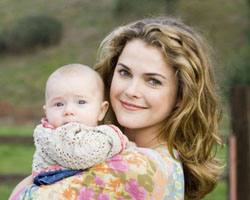
waitress keri russell with babyFunny, touching, tough: three words that truly describe this vastly underrated 2007 comedy-drama, written and directed by the late Adrienne Shelly.

Jenna (Keri Russell) is an amazing pie-maker in some unnamed southern town. She works at Joe’s Pie Diner with her friends, Becky (Cheryl Hines) and Dawn (Adrienne Shelly), under the management of Cal (Lew Temple) and the ownership of Joe (Andy Griffith).  She’s married to a domineering redneck man named Earl (Jeremy Sisto), who takes all of her tip money and bullies her relentlessly, but she’s been hiding away some of the money and she hopes to enter a pie contest where the prize is $25,000–with the intention of leaving him as soon as she can.  This plan gets derailed at the very beginning of the movie when she discovers she’s pregnant.

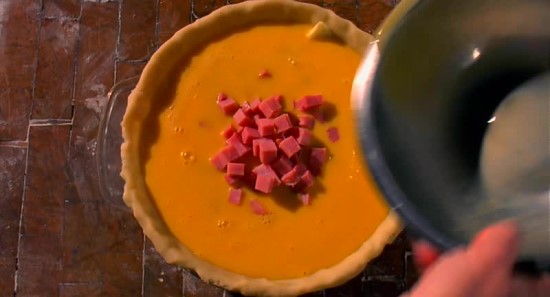
waitress I don't want earl's baby pieThis brings on the inspiration for her to make tomorrow’s featured pie, the “I Don’t Want Earl’s Baby Pie.” Dawn remarks that she shouldn’t probably write that on the menu board, so Jenna changes the name to the “Bad Baby Pie,” a quiche with Brie cheese and a smoked ham center.

waitress I hate my husband pieShe considers making an “I Hate My Husband Pie” made of bittersweet chocolate–unsweetened–made into a pudding and drowned in caramel. Deciding to keep the baby, she goes to see her doctor only to find that her gynecologist has gone into semi-retirement and most of her cases have been taken over by young, attractive Dr. Jim Pomatter (Nathan Fillion).  When he congratulates her, she tells him that she doesn’t really want the baby, but is having it anyway, so please don’t be all happy for her.  “It’s not a party.”

Her mother taught her to bake as a child, singing this little song (written by Adrienne Shelly):

Baby, don’t you cry, gonna make a pie
Gonna make a pie with a heart in the middle
Baby, don’t be blue, gonna make for you
Gonna make a pie with a heart in the middle
Gonna be a pie from heaven above
Gonna be filled with strawberry love
Baby, don’t you cry, gonna make a pie
Hold you forever in the middle of my heart.

waitress marshmallow-mermaid-pieEverything is about pie creation. She brings the doctor her “Marshmallow Mermaid Pie” that she created when she was nine years old.  She makes a “Falling In Love Pie” (chocolate mousse) for Dawn’s date, and she fantasizes about new pies night and day.  At one point, she considers making a “Baby Screaming Its Head Off in the Middle of the Night and Ruining My Life Pie” that would be a New York cheesecake brushed with brandy and topped with pecans and nutmeg.

waitress earl wants to kill me pie

“I Can’t Have An Affair Because It’s Wrong and I Don’t Want Earl to Kill Me Pie”

Finding Dr. Pomatter irresistible, she begins an affair with him and considers making an “Earl Murders Me ‘Cause I’m Having An Affair Pie” made with smashed blackberries and raspberries in a chocolate crust, but decides it would be better to make an “I Can’t Have An Affair Because It’s Wrong and I Don’t Want Earl to Kill Me Pie” with vanilla custard and banana–no–hold the banana. Among the other pies mentioned in the movie are the “Spanish Dancer Pie,” the “Naughty Pumpkin Pie,” the “Singing Tuna Casserole,” and “Jenna’s Special Strawberry Chocolate Oasis Pie.”

After she discovers that Becky is having an affair with Cal, she asks him, “Are you happy?” He answers, “I’m happy enough.  I don’t expect much, give much.  I don’t get much.  I generally enjoy whatever comes up.”  Dawn finds happiness with a little accountant named Ogie, but Earl continues to make Jenna’s life miserable, forcing her to have sex with him, slapping her around, and controlling her.  In fact, she conceives of the “Pregnant, Miserable Self-Pitying Loser Pie,” made of lumpy oatmeal with fruitcake mashed in and served flambé.

In spite of the comedy, the movie holds a very dark side. Earl, for example, though an ignorant bully, has unexpected depth.  He’s never really been loved and he depends on his control over Jenna to give meaning to his life.  Joe, the owner of the Pie Shop, is himself an old loser, but he advises Jenna to leave Earl and start all over.  “This life will kill you,” he says.  “Make the right choice.”

The script contains many unexpected depths and Shelly’s deft direction and control of the story arc keep the movie on point through its one hour and forty-eight minutes. Keri Russell is beautiful, with a big heart that makes you love and root for Jenna to find a way out of her mess.  Nathan Fillion is charming as the nervous, tender Dr. Pomatter.  Cheryl Hines and Adrienne Shelly are funny and poignant as her waitress friends and Andy Griffith is terrific as Joe–again providing unexpected depths.

But the pies are magnificent. Every pie in the movie looks absolutely beautiful and each one acts like a Greek chorus, providing commentary on the action.

waitress adrienne shellyUnfortunately, Adrienne Shelly did not live to see her movie appear at the Sundance Film Festival or to see its critical success. Three months before it was due to open, Shelly discovered a thief in her apartment.  The man panicked and killed her.  A foundation has since been established in her name to help young female filmmakers fulfill their dreams and you man contribute at The Adrienne Shelly Foundation.

Everyone should see this movie! It’s a film that can be seen over and over again with a kind of sensual culinary pleasure, with laughter and tears, and lots and lots of love.

Funny, touching, tough.

Jack Goes Boating

Jack Goes BoatingThis movie is about two relationships going in opposite directions. One of them, just beginning, is very sweet and the other is clearly at the end of its shelf life.

Jack (Phillip Seymour Hoffman) is a shy and sensitive New York limo driver who works for his uncle and lives in his uncle’s basement. He listens to raggae, tries to whirl his blond locks into dreads, and dreams about working for the MTA.  His best friend, Clyde (John Ortiz) also works for his uncle as a limo driver and is married to Lucy (Daphne Ruben-Vega) who works in the office of a mortician.

The couple sets Jack up with Lucy’s new co-worker, Connie (Amy Ryan), a shy, nervous girl who seems to be right for him. Their own shyness really works to their advantage as each one takes it nice and slow, careful to make sure of each other before taking any big steps at all.  As Jack walks Connie to a cab on their first date, she mentions that she’d like to go boating some time.  They are walking through the snow at the time and Jack remarks that it might be better to wait for summer.  But he takes it seriously and Clyde sets out to teach him how to swim at a Harlem pool.

Connie is approached by a strange man in the subway on her way to work and she violently resists, breaking her nose. Lucy calls 911 and she is taken to the hospital.  Jack buys a little stuffed koala bear for her and they talk about a second date, maybe for dinner.  She tells him that no one has ever cooked for her, so Jack decides to learn how to cook and make a splendid meal for her.  Clyde recommends a chef he knows from the Waldorf Astoria that he calls “the Cannoli.”  Without Jack prompting him, Clyde then volunteers that Lucy had an affair with the chef that lasted two years.  It’s obviously bothering him, but he tries to pretend that they’ve worked the problem out.

Applying himself to his swimming and cooking lessons, Jack gets good at both. After a few initial problems, he gets his application into the MTA and waits to hear whether he will be called for an interview.  As he and Connie become more intimate, he comes to understand that she has serious psychological issues about sex, but he is understanding and goes slow, much to her relief.

Without revealing how the movie ends, I will say that both situations come to a head when Jack finally cooks his big meal for Connie at Clyde and Lucy’s apartment.

Phillip Seymour Hoffman directed this moving film, based on the stage play he appeared in, adapted for the screen by the playwright, Robert Glaudini. The study in opposites is very funny at times, but a feeling of tension runs underneath the surface and it kept me on the edge of my seat wondering what would happen.  At an hour and twenty-four minutes in length, the pacing and timing are perfect.

Hoffman’s performance as Jack is just amazing. It is a pleasure to watch such a gifted actor creating such a layered character.  Amy Ryan gives a great performance as Connie and she works as a perfect foil for Jack.  You find yourself hoping that these two gentle, injured people will find a way to make their relationship work, even as it hurts to see what can happen to a relationship at the other end of the scale.  John Ortiz is excellent as Clyde and Daphne Ruben-Vega compliments him very well as the two cope with a relationship that doesn’t have the glue to hold it together.

I’m an innocent when it comes to betrayal. I’ll never understand how partners in a marriage can turn away and wound the other so deeply.  Jealousy remains one of the great emotional themes of art.

This is a very fine movie and it should be seen. When it was released, it kind of slid by me–and pretty much everyone else, I gather, but it is really good filmmaking.  It’s a story well-crafted and well-filmed and it deserves far more attention than it has gotten.  I highly recommend it for adult audiences.

Ordinary People

Ordinary Tim Hutton Elizabeteh McGovernFor those who remember what life was like in 1980, Ordinary People will be a real trip to the past.  For those who are too young to know, this movie will give you a brief tutorial in clothing, hair styles, cars, and so on.  For both types of people, this will be an extraordinary family drama, full of terrific performances, raw and deeply moving.  It won four Academy Awards including Best Picture and Best Director for Robert Redford.

Conrad Jarrett (Timothy Hutton) is a high school senior in Lake Forest, Illinois, a suburb of Chicago. Plagued with insomnia, he is a loner who shuns his friends and can barely communicate with his father Calvin (Donald Sutherland) and mother Beth (Mary Tyler Moore).  Recently released from a psychiatric hospital following a suicide attempt that was foiled by his father, Conrad has been home now for over a month, but still has not started therapy.  The false happiness and optimism of his parents grates against him as they all attempt to cope with the incident that started everything down this crazy road: the death of Buck, the older son in the family.  Calvin pretends that life can go on without regard to the death, while Beth seems to have retreated into a coldness that allows for no emotion whatsoever.

Finally, Conrad goes to see a therapist, Dr. Berger (Judd Hirsch), but all he can talk about is maintaining control over his life. Berger would like to see the boy experience some emotion, to face his own anger, terror, and remorse, but Conrad tries desperately to hold on.  Remembering how much he liked his time in the hospital, Conrad seeks out a girl that he had been friends with there, Karen (Dinah Manoff), but she seems reluctant to find a relationship with him.  She tells him that she is happy now and that he should be optimistic, too.  “Let’s have the best year of our lives,” she tells him.  At school, he continues on the swim team, which had been previously dominated by his brother, with all of the awards to prove it, but Calvin is, at best, a mediocre swimmer.  He finds it impossible to relate to his old friends, who were all friends of Buck’s, too.

The girl who stands in front of him in choir, Jeannine (Elizabeth McGovern) makes friends with him and a mutual attraction develops. For the first time since the accident that killed his brother, Conrad begins to have a sense of optimism.  But the tension within the family contains more than just Conrad’s angst.  Calvin has serious trouble dealing with Beth’s apparent lack of emotion and he goes to see Dr. Berger himself, discovering that he still has lingering grief over his son’s death and openly questions why his wife didn’t cry at the funeral.

As Christmas approaches, two dynamic incidents explode the plot wide open. Beth discovers that Conrad quit the swim team a month earlier and hadn’t told them, then Conrad finds out that his friend Karen has committed suicide.

Director Robert Redford handles this emotionally charged story very deftly. It could very easily have gone maudlin and mushy, but it always seems real and always completely honest.  There’s no fancy camera work or other tricks to divert us from the story, but Redford has a keen sense of pacing.  Two hours and four minutes of emotionally charged angst could have been way too much, but I never noticed the action dragging for one moment.  To be perfectly honest, I don’t really like dramas, but I couldn’t stop watching this one.  It is superbly crafted and Redford was deserving of the two Academy Awards.

The heartbeat of the story is provided by Timothy Hutton. His performance as Conrad is one of the best dramatic performances ever and he was given an Academy Award for it.  I’m not sure why they gave him Best Supporting Actor, when he is clearly the lead in this movie, but he would have deserved either one.  Donald Sutherland is terrific as Conrad’s father, giving a deep, heartfelt performance.  I felt a little bad for Mary Tyler Moore, because her character was so emotionally in control that she didn’t have the opportunity to really reveal her talents.  Nevertheless, she did an awful lot with very little to go on.  I kept wishing that they could have gotten Beth in to see the psychiatrist, because I felt that she was the one of all three that actually needed therapy more.  Hirsch is very good as the psychiatrist and both McGovern and Manoff are believable as the two girls.

The fourth Academy Award went to Alvin Sargent for his adaptation of the novel by Judith Guest. It is a really good screenplay, very tight, and beautifully crafted.

The title of the movie is enigmatic. On one hand, this really isn’t an ordinary family.  They are quite wealthy.  The parents golf, they are members of the country club, and their friends are all equally rich, if not more so.  But the title isn’t “ordinary family,” it’s Ordinary People and the title rings true on that level.  Stripped of their wealth, these people are just like everyone, struggling with their problems, trying to figure out how to live their lives in the face of adversity, trying to pretend that things are better than they really are so they won’t have to think about them.

One revealing scene occurs on Calvin’s first date with Jeannine. As they sit in McDonald’s eating burgers, she asks him what it was like to commit suicide.  He looks at her and remarks that she is the only person–outside of therapy–who has asked him about it.  That one stretch of dialogue speaks volumes about the level of disconnect that exists in this family, their utter refusal to face Conrad’s problems.

This is a great film and it is certainly one of the best domestic dramas of all time. Everyone should see it!

The First Annual Amy Adams Film Festival

When I finished the fifth draft of my novel Walk Against Time, I was suffering a bit of post-partum depression and decided to fill the void with Amy Adams movies, so I decided to create the First Annual Amy Adams Film Festival. Okay, it was a low-key affair, just me and a bowl of popcorn, but it was great fun.

I must confess right from the beginning that I love Amy Adams unconditionally.

There, it’s out in the open. A friend recently asked me what I love about Amy and I’ve got to confess that it’s pretty much the whole package.  Red hair, green eyes, a cute little pixie nose.  What’s not to love?  She’s not emaciated, but not overweight, either (okay, maybe just a tiny hint of baby fat).  Inside that perfect shell, there is a personality that just radiates optimism.  Don’t blame her, she can’t help it.  It’s how she is.  She’s like the Tom Hanks of female actors.  There’s just something that will never, ever give up on humanity and our potential.  Finally, you crinkle in a moderate dash of vulnerability that brings tears to my eyes.  Please, Amy, DON’T CRY!  I admit it freely.  I am besotted.

The film list below contains links to my reviews for each of the movies.  Just click on the name or photo to read the full review.

The First Annual Amy Adams Film Festival

Day 1

Leap Year

amy-adams-leap-yearAmy plays an Irish-American girl who travels to the auld country to propose to her sweetie on February 29th, when she believes he can’t refuse. Along the way, she meets an Irish pub owner that just might change her mind.  This is easily the worst of all the films in the festival.  It is a romantic comedy that is not entirely successful.  Read the review to find out why.  It’s a good film to begin the festival with because every movie will get better from now on.

Miss Pettigrew Lives for a Day

amy adams miss-pettigrewOne of Amy’s most adorable roles as nightclub singer Delysia Lafosse, a flibbertygibbet who is bouncing between three men. It takes a wonderful performance by Frances McDormand to help her realize her true love and find happiness.  A wonderful comedy!

American Hustle

amy_adams american hustleAmy does some real acting in this hilarious comedy about two con artists in the 1970’s who get into something over their heads. Christian Bale is unbelievably good in this movie and frankly he steals the show, but Amy is great, too.  In fact, everyone is good.
 

Enchanted

amy-adams encxhanted

This is an amazing Disney film containing both animation and live action with great music and some incredible songs. Yes, Amy sings again!  She is at her delightful best as Princess Giselle who is thrown out of her cartoon kingdom into downtown Manhattan by the evil queen Narissa, played by Susan Sarandon.  It’s joyful and funny and one of the best Amy Adams films ever.  A personal favorite.


Day 2

Sunshine Cleaning

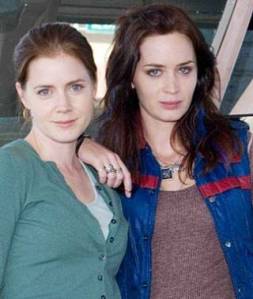
amy adams emily blunt sunshine cleaningThis is kind of a dark comedy about two down and out Albuquerque sisters, played by Amy and Emily Blunt, who start a business cleaning up crime scenes. It is both funny and touching and features a great performance by Blunt.  Alan Arkin appears as their father.
 The Fighter

amy_adams the fighter

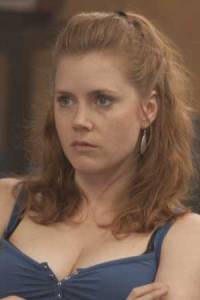
A great film on so many levels! Again, Christian Bale is over the top good and won a Best Supporting Actor Academy Award for his role as Dicky Eckland, the older brother of Amy’s love interest, Micky Ward, played by Mark Wahberg. Amy plays a smart bartender who helps Micky to escape his family’s bungling of his boxing career. She’s really good in this movie and creates a real regular girl-type character (except that she’s like totally gorgeous, as usual). This is a must-see movie!


Trouble with the Curve

Amy-Adams-in-Trouble-with-the-Curve-What more could one possibly ask than to have Clint Eastwood as Amy’s crusty old baseball scout father? She’s at her most vulnerable here in a movie that combines some subtle comedy with a deep hurt that she suffered in her childhood.  She and Clint are dynamite together and when you add in Justin Timberlake as her love interest, you have a wonderful, feel-good movie that just can’t be resisted.  Wonderful!


Julie and Julia


amy adams julie and juliaThe festival ends, appropriately enough, with Julie and Julia.  The first time I actually remember seeing Amy Adams in anything, it was this and I fell for her really hard as Julie Powell, a talented wannabe writer in a post 9/11 world who decides to cook her way through Julia Child’s legendary cookbook, Mastering the Art of French Cooking.  Although they have no scenes together, Meryl Streep’s endearing performance as Julia Child is a perfect counterpoint to Amy’s vulnerable, lovable Julie.  This is a film that I can literally watch over and over and love more each time.  As a writer, two scenes touch me the most.  First, when Julia receives the first printed copy of her book, and second, when Julie gets a call that a publisher is interested in publishing her blog.  I’m still waiting for the magical moment in my own life, but these two women are wonderful in their own joy of publication.  LOVE—LOVE—LOVE this movie!


And so the festival ends. An empty bowl of popcorn.  A little wetness about my eyes.  And a hope that the Second Annual Amy Adams Film Festival will be just as enjoyable as the first.

I hope you all like my reviews, please feel free to subscribe to my web site to enjoy all of the reviews I write in the future.

Until then, as Julia Child would say, Bon Appetit

Chocolat

Chocolat VienneMost things that give enjoyment are not bad. In fact, most things in life that we enjoy are entirely without sin, even if they do induce sensual pleasure, such as, let us say, chocolate, that most wonderful of confections.

My review contains information about the story, so if you haven’t seen the movie, beware. Reading this review may spoil the ending for you!

It is 1959, in a French village surrounded by a wall and a river, barricaded from the world as if it hadn’t changed since the Renaissance. On a Sunday morning when everyone is at church, a woman, Vianne (Juliette Binoche), and her young daughter Anouk (Victoire Thivisol), trudge through the wind and snow to open a chocolaterie. Vianne is destined to wander from town to town, as her mother did, dispensing the joy of chocolate.  She carries her mother’s ashes with her and she knows that Anouk will also be destined for the same fate.

 The mayor, Comte Paul de Reynaud (Alfred Molina) finds it sinful to open such a business during Lent and he encourages the villagers to boycott it and their young priest, Pere Henri (Hugh O’Conor) to preach sermons against it.  When he discovers that Anouk is an illegitimate child and that Vianne will not attend mass, he becomes even more consumed with driving her out of business.  He has his own problems: his wife has gone to Italy and it looks like she isn’t coming back and he is also struggling with his own desires for food as he starves himself in his sorrow.

chocolat anoukIn order to coax the villagers to buy her chocolate, Vianne gives away free samples, winning over Guillaume Blerot (John Wood), an older man whose little dog Charlie likes the treats. Blerot pines after a WWI widow, Madame Audel (Leslie Caron) and he wins her over with little chocolate treats.  Vianne’s first real friend comes in the form of her landlady, Armande (Judi Dench), who also doesn’t go to church.  She is estranged from her daughter, Caroline (Carrie-Anne Moss), who works for the Comte and keeps her son, Luc (Aurélien Parent-Koenig), away from his grandmother. Vianne arranged for Luc to spend some time with Armande at the chocolaterie under the pretense of his drawing a portrait of her.  Vianne wins another friend when the owner of the café, Serge (Peter Stormare) beats his wife Josephine (Lena Olin) who runs to the chocolaterie for sanctuary.  She stays and becomes Vianne’s assistant.  The Comte attempts to force Serge to get himself together, making him abstain from alchohol, teaching him manners, sending him to catechism classes.

The town is thrown into chaos when a band of gypsies arrives by boat, docking along the river front. Led by a charismatic young man, Roux (Johnny Depp), the gypsies want nothing more than to trade, but the Comte forbids it and mounts a campaign to have the villagers boycott the gypsies.  Of course, Vianne is intrigued and makes friends with Roux.  When Serge assaults the chocolaterie in a drunken rage, breaking open the door, the women fight him off and Josephine knocks him out with a skillet. Roux volunteers to repair Vianne’s door and she agrees to hire him, thus breaking the boycott.  The Comte takes his fight with her to a new level as he tells all of the villagers that to consort with her is to consort with the devil and he makes Pere Henri do the same thing from the pulpit.

Vianne feels that the whole world is against her and considers leaving, but Armande requests that she throw her a party for her 70th birthday.  Vianne also has planned a Festival for Easter Sunday. Most of Vianne’s friends attend, including Luc and Roux, but dessert is to be served on Roux’s boat and they all retire there to dance and enjoy the evening.  Caroline comes in search of Luc, but when she sees him dancing with his grandmother, she doesn’t interfere.  However, Serge brings the Comte to see the party and the mayor tells him, “Something must be done.”  When the party winds down, a fire erupts on the boats.  Seeing the damage, Vianne decides that it is time to leave, so she packs, over Josephine’s pleas that she stay, and forces to Anouk to join her, but they fight and her mother’s ashes are spilled.  There is laughter and she looks into her kitchen to find Josephine leading the villagers in the preparation for the Easter Festival.  She abandons her plans to leave.

On the night before Easter, Serge confesses to the Comte that he started the boat fire because the Comte had told him that “something must be done.” In a fit of rage, the Comte banishes Serge from the village, then goes to pray, confessing that he is so starved and so weak of spirit that he must do something.  Taking up a knife, he breaks into the chocolaterie to destroy the confections in the window display, but a bit of chocolate splashes onto his lip and he licks it up. In one moment, he loses his composure and begins to eat every bit of chocolate he can get his hands on.  The next morning, Pere Henri sees the mayor passed out in the window display, covered in chocolate.

It’s hard to imagine anyone crusty enough not to love Chocolat.  It is a wonderful movie, beautifully and movingly directed by Lasse Hallström, the Swedish director who also gave us The Cider House Rules (and, by the way, Lena Olin’s husband).  The music by Rachel Portman, part gypsy, part Hispanic, part French, is absolutely perfect for every scene in the film.  Adapted by screenwriter Robert Nelson Jacobs from the novel by Joanne Harris, the story is strong and true, moving, funny, and uplifting.

All of the actors are wonderful and it would be hard to single out one performance that stands out above the other, but I must mention that Judi Dench is amazing as Armande and that Johnny Depp’s guitar adds a great deal to the fun. Binoche is lovely as Vianne and it is good to see her teamed with Lena Olin, the first time the two women have worked together since The Unbearable Lightness of Being.

This is an incandescent story of freedom. No matter how firm oppression may seem, if you are good and true and give love back to the world, the world will eventually come to you.

Silver Linings Playbook

“The world will break your heart ten ways to Sunday. That’s guaranteed. I can’t begin to explain that. Or the craziness inside myself and everyone else. But guess what? Sunday’s my favorite day again. I think of what everyone did for me, and I feel like a very lucky guy.”

Cooper and Lawrence Silver Linings PlaybookThis delightful comedy/drama was written and directed by David O. Russell, adapted from the book The Silver Linings Playbook by Matthew Quick.  Centered around two quirky people, both at a crossroads in their lives, the film presents bi-polar disorder as a condition that can be overcome.

Pat Solatano, Jr. (Bradley Cooper), a former high school teacher, is held in a Baltimore psychiatric hospital for an episode in which he beat another teacher after finding him in the shower with his wife Nikki (Brea Bee). After serving his court-ordered eight months, his mother Dolores (Jacki Weaver) gets him out.  In the parking lot, a fellow inmate, Danny (Chris Tucker) jumps in the car, announcing that he has been released, too, but Dolores gets a call from the hospital asking that Danny be returned.  Arguing with his mother, Pat grabs the steering wheel and almost gets them in an accident.

Returning home, Pat stops by the library to pick up all of the books in Nikki’s literature syllabus, intending to read all of the books. He is determined that their marriage can be saved, even though Nikki has moved and taken out a restraining order against him.  Pat’s father, Pat, Sr. (Robert De Niro) has recently lost his job and is supporting the family working as a bookie, although he intends to open a restaurant so that he can look legitimate.  Family and neighbors are all passionate Philiadelphia Eagles fans and Pat, Sr. is hopelessly superstitious about wearing the right jersey, putting his remote controls in certain positions, and rubbing a green handkerchief so that the can bring good luck, “juju” to the Eagles.  He also has a temper and is barred from actually attending Eagles games because of his violent behavior.  His friend, Randy (Paul Herman), is a Cowboys fan and tries to make money in bets off of Pat, Sr. by gaoding him into making foolish bets.

Pat stays up all night reading Ernest Hemmingway’s novel A Farewell to Arms and then blows up at 4 AM because it doesn’t have a happy ending.  He throws the book out the window and harangues his parents.  Pat believes that the key to overcoming his illness is to find a silver linings in his every day life.  He tries to live by the motto Excelsior (ever upwards) and shares this vision with his therapist, Dr. Cliff Patel (Anupam Kher), who replies that he must get a strategy to live with his illness.

His friend, Ronnie (John Ortiz), invites him to a Sunday dinner. Married to a beautiful girl, Veronica (Julia Stiles), and with a baby, Ronnie is a broker who is suffering anxiety from fluctuations in the market.  Veronica’s sister, Tiffany (Jennifer Lawrence), whose cop husband was recently killed, shows up at the dinner and she and Pat find that they can talk about their various medications.

Tiffany agrees to deliver a letter to Nikki if Pat will dance with her in a competition and he reluctantly agrees. They begin to rehearse, but the dance competition takes on a new meaning when Pat, Sr. and Randy make a parlay bet that the Eagles will beat the Cowboys and that Tiffany and Pat can score at least a 5 in the dance competition.

The story is completely engaging. Even though the film runs nearly two hours, every single moment is compelling and one doesn’t notice the time.  Cooper and Lawrence are both really terrific, portraying characters that are complicated and yet disarmingly simple.  Lawrence won Best Actress for her role as Tiffany.  DeNiro is at his very best as Pat, Sr. and Jacki Weaver gives wonderfully believable and warming performance as Dolores.  All of the supporting cast are terrific.

Russell’s script and direction are spot on. The editing is amazing, as is the use of music and sound.

It is a movie that deserved all of its nominations and it should be seen by everyone. It is funny, full of pathos, and very moving.