Sinners and the Sea by Rebecca Kanner

the-sinners-and-the-sea-rebecca-kannerThe Sinners and the Sea, by Rebecca Kanner is a gritty novel that weaves realism, fantasy, and religious mythology into an exciting and thought-provoking story.

Based on the story of Noah, using the source material of the Torah and Old Testament of the Bible, Kanner tells her story in First Person Present, a style that has become increasingly popular over the last twenty years. It brings an immediacy to the tale that would be lacking in any other form.

Noah’s story is told here from the perspective of the nameless woman who becomes his wife. Born with a birthmark on her forehead, she is condemned as a Demon Child and only her father’s status as a prosperous farmer keeps her from being stoned to death. At nineteen, she is well-past marriage age and has given up hope.

The world depicted is primitive and barbarous, mankind in one of its earliest, most feral incarnations. The land is in the midst of a long drought and the people of her village have decided to kill her as a sacrifice to the gods. Just in time, her father procures a husband, Noah, a man hundreds of years old who is a disciple of the God of Adam.

Needing sons, he takes her as a wife and brings her to the most wicked city in the land, Sorum, where mercenaries kill each other every day and all of the women are whores. This is the evil world that God has decided to destroy. Their sons are Shem, Japheth, and Ham. When God commands Noah to build an ark to take only his wife, three sons and their wives, along with two of all of the animals on earth, Noah gets to work on the project.

It’s important to keep in mind that this is a work of fiction and not an attempt to recreate the Biblical story. Most of the characters belong to Kanner and not the Bible and she has even made changes in the Biblical characters to suit her purpose.

In this vicious world, there are only three people who seem to actually be pure and good. One of them is Noah’s wife, one is her third son, Ham, and the other is Herai, the simple-minded daughter of a whore.

Noah himself is a dried up old man who has a slavish devotion to his God and his calling to convert the sinners of the world to the God of Adam. There is no joy or love in this man. Shem, their oldest son, a man with no control over his sexual urges, constantly sneaks away to sleep with the whores and eventually gets one of them pregnant. Japheth is a cold-blooded killer who is angry all of the time.

Although God is not a character in the book, his personality is apparent through his actions: He is bitter, angry, and indiscriminate in his killing.

The paradox of the novel is that while God is determined to destroy most of humanity and the animals of the world for their wickedness, He apparently doesn’t care that the world is repopulated from sinners, such as Shem and Japheth, which will ultimately result in another world of sinners. There is no net gain from his killing.

The book itself is gritty and raw, very hard to put down once you get started, and the story is expertly told, full of action, and engaging right to the end, but it is not for readers who think that life is all sunshine and lollipops.

Ignoring for a moment the impossibility of the story itself and allowing the fantasy and mythology to be enough to carry it, this novel is about the brutality of life on Earth. The God who runs this world is brutal and uncaring, arbitrary and unreasonable. The fact that he exists and is capable of such madness is almost unthinkable, yet that is the reality of the world of Sinners and the Sea.

It reminds me of a verse from Bob Dylan’s “Highway 61 Revisited”:

God said to Abraham, “Kill me a son.”

Abe said, “Man, you must be putting me on.”

God said, “No.” Abe said, “What?”

God said, “You can do what you want, Abe, but

The next time you see me coming, you better run.”

Abe said, “Where you want this killing done?”

God said, “Out on Highway 61.”

On the Road by Jack Kerouac

On the RoadThis review contains spoilers.

“… the only people for me are the mad ones, the ones who are mad to live, mad to talk, mad to be saved, desirous of everything at the same time, the ones who never yawn or say a commonplace thing, but burn, burn, burn like fabulous Roman candles exploding like spiders across the stars and in the middle you see the blue centerlight pop and everybody goes ‘Awww!'”


On The Road, by Jack Kerouac is a picaresque novel set between 1946 and 1950. I understand that it is based on some of Kerouac’s real life experiences with Neal Cassady. Although I haven’t read any biographies, I know he was also friends with Allen Ginsberg and William S. Burroughs. Since I’m unfamiliar with his life, I’ll focus my comments strictly on the novel.

It is divided into five parts and written in first person past. The novel tells the story of the friendship between Sal Paradise, a New York (New Jersey) writer and his friend Dean Moriarty. Starting as it does just after World War II, Sal is a former G.I. who has also been married once.

He hangs out with his young, intellectual friends, but is determined at some point to get out on the road and see the country. Like a lot of youth in all different time periods, Sal is anxious to play around and become a part of the scene. The particular scene at this point in time consists of bars, jazz clubs, steamy Negro night clubs, and lots of booze and grass.

Dean is high-level bullshit artist who is half-crazy. From Denver, he spent a fair amount of his youth traveling with his father, who is a bum, and in reform school for stealing cars. Sal is attracted to him right away and they strike up a friendship as they travel back and forth across the country.

The brief plot involves Dean’s mad dash between women, most notably Marylou in Denver, whom he marries, Camille in San Francisco, whom he divorces Marylou to marry. They have two children. Eventually, he divorces Camille to marry Inez in New York, though he abandons her to live with Camille. Another plot element is the intensity of the parties that these guys and their friends have, growing crazier and crazier until Dean finally abandons a feverish Sal in Mexico City.

I can tell that I’ve grown old because there are many things in this novel that I loved when I was young and that I now find abhorrent. One, of course, is the treatment of women. Dean treats them like garbage and even Sal agrees that the perfect woman is one who simply lies there and tolerates the “gone” behavior of their men with a smile. All of Dean’s women seem to mature far beyond Dean, yet they tolerate his behavior.

Dean is one of the least admirable anti-heroes I’ve ever read. He is a self-centered thief and con man who doesn’t care even the tiniest bit for anyone that he hurts–and ultimately, he hurts everyone, including Sal. I’m down with a certain amount of drinking and drug use, but stealing one car after another, wrecking cars he’s been entrusted with, going through one woman after another with no concern for any of them, recklessly placing the lives of his friends in jeopardy, abandoning his friends, I can’t understand any of that. Nor can I understand why and how Sal still loves him at the end of the book. 

As far as telling a story, the books pretty much tells the same story over and over till the last page. There is no real character development and book doesn’t seem to have much to say, except this: take chances with your life and do not settle for a life unlived.

Although there are big sections of the book that are poorly written, there are also sections that absolutely sing with life. The long passages cobbled together with all kinds of metaphors sometimes achieve a roll and pitch that makes them almost musical and takes the book to a whole new level.

A brief note on the movie that was released a few years ago starring Kristen Stewart as Marylou. The film takes the story of the book and alters it in such a way that it clashes severely. One example of this is that homosexuality is severely looked down on the book, yet it is an important part of the movie. In the book, homosexuals are routinely referred to as “fags” and “queers,” yet the movie makes Carlo Marx homosexual and Dean a bi-sexual, yet he’s supposed to hate the “queers” more than anyone else. The great parts of the book are completely ignored in the film and it is really just a two hour orgy of sex and drugs. Not at all worth seeing. Read the book.

Chindi by Jack McDevitt

DeepsixSpoiler Alert! This review contains detailed information on the plot and resolution of the novel Chindi, by Jack McDevitt.  It is recommended that you read the novel before you read this review.  I also recommend reading The Engines of God and Deepsix, the first two novels in the series, before you read Chindi. It’s much more satisfying to read the entire series in sequence.

For those who haven’t read any of McDevitt’s Academy novels, a detailed introduction to the series is available at this site. Additionally, my reviews of The Engines of God and Deepsix are here as well. Chindi continues to develop the various themes that Jack McDevitt started seeding with the first book in the series.

The Earth continues to deteriorate under the burden of man’s existence. Overpopulation, drought, economic ennui, degrading weather patterns, religious strife and global warming all serve to hasten the downward spiral.  Yet humans continue to go on as if nothing was wrong.  The news headlines continue to be both bland recitations of meaningless power drivel, tawdry personal shortcomings and dire predictions.  Life goes on and everyone pretends that everything is okay.

People continue to be defined by their own shallow self-interest. Most everyone puts their own career and personal happiness above all: relationships, species growth, population control and the general health of the society.

The protagonist of these novels, our superluminal pilot, Hutch, is no exception, although she does possess other attributes that make us like and care for her. She herself cares for other people, she thinks positively about the universe and she has a fundamental understanding of how it works.  She’s not obsessed with power, wealth or the manipulation of others.

Author Jack McDevitt again uses many of the same devices that made the other Academy books successful. He starts us out with a Prologue set in the past – in this instance, it is June 2220 – only two years before the main action begins. This time frame for the Prologue is also during the period just prior to the main action which took place in Deepsix.

Unlike the other Academy novels, McDevitt does not break Chindi out into three or four sections, but rather simply goes chapter by chapter.

This book also contains the close escapes that mark most of McDevitt’s work and particularly the Academy novels. With such an intense degree of action, I’m quite surprised that the Academy novels have not been turned into movies or television.  In most of the books, these great escapes are not germane to thematic development, but are used to keep the reader glued to the page.  However, the themes explored in Chindi are based on the concept of risk.

The novel begins when a research vessel near a neutron star intercepts directed radio waves in the year 2220. Unable to trace them down to a source, the project leader, Pete Damon (a popular personality because of his program on the net explaining science to laymen), sends off all of the data to the Academy for review.

Two years later, on the verge of resigning from the Academy, Hutch is asked to perform one final mission. A group known as “the Contact Society” wants to mount a mission to investigate the radio waves.  Their leader, George Hockelmann (McDevitt has a lot of characters named George and they do seem to die), is an extremely wealthy businessman who has always dreamed of contacting an intelligent alien society.  He has built a starship, which he is willing to donate to the Academy, but first he wants to load up his friends and go investigate the radio waves, using Hutch as pilot.  She reluctantly agrees and boards the City of Memphis with George, Pete, Herman (George’s best friend) and Alyx Ballinger, an entertainer who does both live performances and sims, as actor, producer, and director.  She is, of course, fabulously beautiful.  They will pick up two other passengers along the way.

I find it a bit surprising, in the Academy universe, that scientists would be so skeptical of the Contact Society. In a world where intelligent aliens are known to exist (the Noks), where some intelligent species somewhere created the Omega clouds, where they know that several intelligent alien societies existed recently (the Hawks and the Monument Makers), and where there are a number of archeological sites on other planets, evidence of previous intelligent existence, why would scientists denigrate any group seeking to find intelligence?  This seems like a vestigial prejudice, something left over from our time that somehow carried forward into 2222.

For that matter, on first thought, it is at least mildly surprising that the Noks are so easily dismissed. Pretty much everyone refers to them as “the idiots” because they cannot seem to evolve past the point of constant warfare.  It has occurred to me that McDevitt might be trying to make a point about our own society – inferring that we are idiots for continuing to make war.  In some of the other Academy novels, Gregory MacAllister repeatedly refers to most of humanity as “morons”, people so caught up in their religions or politics or social beliefs that they cannot see the big picture – that all they are doing is reproducing, contributing waste, destroying the earth and adding nothing to human development and understanding.  Most readers, of course, would strongly disagree with the sentiment, especially if presented head-on.  But by presenting these thoughts in the example of the Noks and through the polarizing character of MacAllister, McDevitt is able to distance himself a bit from an unpopular opinion.

Part of the ridicule of the Contact Society from the world in general, and the scientific community in particular, is to set up a conflict between the “amateurs” seeking to make a breakthrough in contacting an intelligent species and the “professionals” who are certain they will not only fail, but make a blunder of it as well.

The two passengers they pick up are a funeral director, Nick, and an artist, Tor. It turns out that Tor had dated Hutch years before, but put up no resistance when she broke up with him, so she assumed he didn’t care.  In fact, Tor had fallen for her immediately, but didn’t want to seem pushy.  Years later, when he heard about the contact mission through his friends in the Society, he volunteered so that he could have a second opportunity with Hutch.

The relationship between Hutch and Tor is a good example of the shallow nature of the people that inhabit the Academy universe. When he knew Hutch previously, Tor was a failure as an artist, which was one of the reasons she dumped him.  He worked hard and became very good, partly so that he might have a second chance with her.  And she is actually very impressed that he is a good, successful artist.  The dynamic is typical male behavior played against typical female behavior.  Tor knows, for example, that Hutch will think less of him if doesn’t volunteer for dangerous assignments.  And, of course, Hutch knows that she will feel that way, too.  These appear to be simply archetypal reactions, behavior that could be demonstrated in a lab using any heterosexual male and female.  But it is another example of how, despite great scientific advances, people remain the same.

The book is also an example of Gregory MacAllister’s assertion in Deepsix that any time you put men and women together in a room the IQ drops dramatically.

As these members of the Contact Society follow the radio signal to its origination point, another ship follows it to its destination. There they discover the remains of what was once a living planet, destroyed in nuclear war, an old moon base and gigantic stealth satellites that receive the incoming signal.  While attempting to dismantle one of the satellites, something happens which destroys the ship.  Hutch and her group on the Memphis race to find out what happened.

After picking up the body parts, the group decides to investigate the moon base. It becomes apparent that the inhabitants were cut off from the planet after the nuclear annihilation and died from lack of food and oxygen.  Hutch has to babysit the amateurs who are mucking up scene.  Herman even attempts to steal an artifact.  While investigating, they discover that someone else had cut their way into the base long after the inhabitants had died, but they have no clue who or why.

The AI on the Memphis, Bill, discovers that there are a second set of stealth satellites in orbit, pushing the radio signals even further out into space.  They follow the signal and discover a habitable planet, one that looks much like earth and that does support advanced life.  There is a beautiful, intelligent flying species that they name the “Angels”.  George and the others immediately want to go down to meet them, but Hutch is reluctant.  Her past experience tells her that no matter what they look like, the situation could present great danger.  The others somehow talk her into going.

It is a mistake from the beginning. In the first place, you would think that a policy would be in place to prevent humans from barging into worlds where the technological level is low or non-existent.  In fact, humans have not interacted with the Noks because they are believed to be inferior.  Even Star Trek has a non-interference protocol that prevents them from blundering into societies that do not have warp capability.  For that matter, when McDevitt gets to the next book in this series, Omega, the World Council has a Protocol in place that prevents interference.

But George and the others go wading in and get attacked by the Angels. Both Herman and Pete are killed and the others are stunned and appalled that such beautiful creatures could behave so barbarically.  Hutch is vindicated.

Hutch’s courage is called into question quite a bit in this novel regarding the question of risk. She has already seen too many people die from taking stupid risks: Richard Wald, her archeologist friend delaying too long at Quraqua, George Hackett and Maggie Tufu taking foolish chances at Beta Pac III, another four dead at Deepsix and an entire ship just recently destroyed playing with a stealth satellite they didn’t understand.  She sees herself as fully justified in advising caution.  It certainly doesn’t mean that she is a coward, it just means that she is actually using her brains, something the others seem to have given up on.

Even after the death of his two close friends, George Hockelmann still feels like they did the right thing by attempting contact. Really?  With a species that was not technologically advanced?  What do you gain from that?  I thought the whole purpose of George’s mission was to contact a species that was at least as advanced as our own.  The mission becomes completely muddled after that fiasco – now all they want to do is to “see what’s out there” and that then allows them to do anything they want.

They do have a technological string dangling in front of their eyes: the radio signals. In each system, there are two sets of stealth satellites, one trio receiving signals, a second trio processing and resending them.

They move on to the next system receiving the signal, except that nothing is there and the signal appears to be going out toward a galaxy. Bill does some digging, however, and finds that the signal passes through twin gas giants on the outskirts of the system.  The team moves to investigate and they find two things: first that there is a moon in a vertical orbit that has a house on it and, second, that there is a spaceship orbiting one of the gas giants.

The house they find is quite large and had once been occupied by two very large creatures. It is filled with bookshelves, has a courtyard in the center, and has been frozen by exposure to space for a very long time now.  The view from the house – the gas giants with their ring systems and moons – is awe-inspiring.  McDevitt’s description of the scene is truly fine writing, worth the price of admission on its own.

But the spaceship orbiting one of the gas giants is huge. At first, they think it is an asteroid.  Indeed, it appears to have been built from an asteroid.  Alyx names the ship the Chindi, after the term Navajos use for a “spirit of the night”.  With Tor’s support – and against Hutch’s better instincts, George decides to investigate.  As the trip has gone on, Hutch has come to realize that she  returns Tor’s affection and it irritates her that he has pushed for boarding the Chindi.

They discover that the ship is actually automated – a roving museum, picking up artifacts and broadcasting events via the stealth satellites, a vast network of live entertainment, experienced sometimes thousands of years after it had occurred because it is broadcast at the speed of light. Fascinated, George breaks in and establishes a base to begin his investigation, along with Tor and Alyx.  There is intense pressure to get it done now.  Not only is an Academy team on the way (under the direction of a runaway egomaniac, Maurice Mogambo), but they have determined that the Chindi is simply using the gas giant’s upper atmosphere to refuel and it will be leaving soon.  To be caught on the Chindi during acceleration with limited air and power would be to invite death.  Dedicated McDevitt fans already know (more or less) what is about to happen.

As soon as the Chindi shows signs that it is about to leave, the team scrambles for the exit, but they are a little late.  Alyx manages to make it to the lander, but Tor gets stuck on the vehicle.  George, appropriately, gets swept away into space during the acceleration.

Throughout the novel, McDevitt balances the preciousness of life against the accomplishments of risk. After what Hutch has been through, she opts for life.  George, on the other hand, has made the decision that no matter what happens to his life, accomplishment is most important.  The problem with dying while accomplishing something is that you do not live to reap the rewards.  One has the sense, as George floats away into the soup of the upper atmosphere, that he has just realized this basic truth.  Throughout the novel, George’s major concern was not to make great discoveries, but rather to receive the accolades of accomplishment.  He is so concerned that Mogambo will ride in and take all of the credit that he ends up sacrificing the reward.  Mogambo, on the other hand, is distressed that George’s team has made all of the discoveries and he is scheming to spin the publicity to his own benefit.  With George gone – and given the gullibility of the press – this is actually quite easy.

The crux of the story comes down to the realization that the Chindi is not using FTL propulsion, but rather is running at sublight speed.  When it reaches cruise velocity, it is travelling at .25 of light speed – this is a velocity that no Academy ship can match.  Thus, Tor’s life is in serious jeopardy.

Hutch provides the solution: to use several ships tied together with a massive object, so that they can obtain a greater speed and enter hyperdimensional space loaded with mass. While in hyper, they dump the load and come roaring out into regular space slightly faster than the Chindi.  This proves to be another problem in that the engines are overheated and they cannot slow down enough.

At this point, Hutch throws all caution to wind and risks her own life for the reward of saving Tor. She jumps into a shuttle loaded down with go-packs and air tanks and brakes the shuttle till the fuel is gone, then she jumps out and uses the go-packs to continue decelerating.  Tor makes a net of cables and when she comes roaring in over the Chindi, he catches her and they both break free.

The scene contains all of the usual excitement that McDevitt generates in his bold rescues. The picture of Hutch soaring in over the Chindi at a velocity of 1/4 the speed of light and catching the net is brilliantly written and completely absorbs the reader, much like the conclusion of Deepsix.

It tells you a great deal about Hutch that she is willing to take a serious risk, but not for her ego; rather, she risks everything for her own personal happiness. As we see in the later novels, she marries Tor and they have several children.

But this is the end of Hutch as a pilot. For the remainder of the series, she will be tied to a desk at Academy Headquarters.  It is a terrific way to go out.  And for her, the reward was certainly worth the risk.

Sanditon and Other Stories by Jane Austen

Sanditon and Other StoriesThis is collection of Jane Austen’s “unpublished” work is required reading for diehard Jane Austen fans, Janeites, casual fans, English literature students, and anyone who is interested in the process by which one learns to write.

The title story, “Sanditon”, is actually Jane Austen’s final novel, which she was unable to finish. A funny, intriguing story of a little seaside resort, its greatest asset in its unfinished state is the comedy.  I’ve always had the sense that toward the end of her life she was returning to the twisted comedic roots of her juvenilia and this would serve to confirm that.  Unfortunately, it is probably only about one-third of a novel.

Another very sadly unfinished story is “The Watsons.”  I liked this best of everything included in this book.  It tells the story of a girl, Emma Watson, who was raised by her Aunt and Uncle.  When her Uncle dies, her Aunt remarries and moves off to Ireland, sending Emma back to her impoverished family without a cent.  Although Emma has been raised to be very genteel, she really adapts fairly well to returning to poverty, mostly because she has a very sunny disposition.  Her family, however, are a little weird.  Although her oldest sister is fairly well-grounded, the other two sisters (only one of which we meet) are full of foibles.  Pushed into acquaintance with their neighbors, she finds herself sought after by the local lothario and the local nobility, all the while finding herself more interested in the 30 year old parson.

The story is very funny and I laughed out loud a number of times while reading it. When it stopped, only about one-third of the way through, I was severely disappointed.  This is one that got away.  Jane should have finished it.

People hear a lot about Austen’s complete letter novel, Lady Susan, being as the main character is such a bitch. It’s all true.  Lady Susan is an unusual character for Austen to feature front and center, for she is conniving, heartless, and unfaithful.  The only charm she actually possesses is her extreme beauty.  And although in the end, her daughter is rescued from her and Susan received her due, she turns it all with a smile and looks for her next misadventure.

There’s not a lot of great writing in the “Juvenilia,” but the History of England is very funny and shows much of the wit she was to develop later in making Northanger Abbey such a hilarious novel and in endowing so many of her comic characters in the more popular novels.

To avoid disappointment, casual readers might want to read Lady Susan and skip” Sanditon”, “The Watsons”, and most of the “Juvenilia.” An excellent sourcebook and essential for Jane Austen fans.

Dragonsdawn by Anne McCaffrey

This review contains spoilers.

dragonsdawnDragonsdawn is a prequel to the entire Dragonriders of Pern saga. In fact, there is only one story which occurs in the timeline before Dragonsdawn and that is the short story, The Survey: P.E.R.N.c, which covers the brief period of time that the Exploration and Evaluation team discovered and conducted their examination of the planet that came to be called Pern.  The short story may be found in The Chronicles of Pern: First Fall, a collection which includes The Survey: P.E.R.N.c, plus four other terrific stories which occur chronologically after Dragonsdawn.

This novel tells the story of the group of colonists who actually settled Pern and it explains most of how the society devolved into what readers encountered when they opened their first Pern book, which is normally (and should be) Dragonflight during the Ninth Pass of the Red Star. If readers had any difficulty understanding that world, this will explain all, from the difference between a wherry and a watchwher to how the dragons were evolved from fire-lizards.

In addition, if anyone has ever wondered how the Holds of Pern got their names, you will get introduced to the people they were named after. For example, Benden was named after Admiral Paul Benden, one of the leaders of the colonial expedition.  The other leaders, Emily Boll, Jim Tilleck, and Ezra Keroon, likewise have holds named for them, as well as three villains among the colonists, Avril Bitra, Bart Lemos and Nabhi Nabol.

It is important to note that Dragonsdawn stands on its own as a novel. It may be read completely independently of any of the Dragonrider series and it will certainly entertain the reader.  It is the book that absolutely marks the Dragonrider series as science fiction and not fantasy.

The description of the three space ships which bring the colonists to Pern and the debarkation itself makes for marvelous science fiction. McCaffrey envisioned colonization from pretty much every perspective she could and she truly makes it work.  One senses the excitement of these war-torn people landing on a pastoral world that they can make all their own.  The work that they do to integrate native flora and fauna with Earth varieties, the pastoral society that they are setting up, and their interrelations are all written with superb understanding.

The characters are brought to life with immaculate detail – especially young Sorka Hanrahan and Sean Connell, the main characters of the tale. But most of the colonists are extremely well written, from the leaders to the botanists, veterinarians, farmers, gypsies, communication specialists, engineers and supply people.  Once again, Anne McCaffrey has performed a great job of drawing her positive characters.

But if McCaffrey has a weakness, I think it is in her creation of villains. I have noticed time and again the disconnect between the characters that we love and the characters we are supposed to hate.  The love works fine, but the villains are thinly drawn caricatures, their motivations paper thin and the evil putty thick.  Here again, Avril Bitra, the central villain, is almost comically unbelievable, having joined a colonial party and given up essentially fifteen years of her life so that she can take a few jewels from Pern, steal one of their small space ships, and spend another ten years of her life in hibernation so that she will be rich when she gets back to Earth.  Even if she could be certain that she could pull this off, why?  Luxury?  It makes no sense.  The other villains are even more unbelievable. 

I don’t mean to take anything away from the novel – I love it and highly recommend it – but beware that the parts dealing with the evil people are a little unbelievable.

I’ve felt for a long time that Anne McCaffrey should have primarily focussed on the people that we care about, because that is her strength. And in this novel, surviving on the planet itself and the deadly fall of Thread are enough of a challenge to the characters we care about without having to throw in some bad guys.

And I have to include a note here also about the edition that I read, which was the Book Club edition published in 1989 or 1990 (there is no notation in the book). I have never read a book so completely full of typos that it actually detracted from the enjoyment of reading.  Most editors can be allowed a few mistakes in any long book, but this Del Rey editor missed over thirty major typos, including repeatedly calling Jim Tilleck “Jim Keroon” (obviously confusing him with Ezra Keroon).  It is hard for a first time reader to keep things straight with this kind of editing, but it makes a frequent reader grind teeth.  Just beware of this particular edition – hopefully they fixed the problem in later editions.

On the other hand, the cover art by Michael Whelan (one of my favorite sf book cover illustrators) is really terrific, featuring Sorka Hanrahan standing outside a cave seaside surrounded by a fair of fire lizards.

I highly recommend this novel to all lovers of science fiction and fantasy, but particularly to readers who love the world of Pern. Enjoy!

Pride and Prejudice by Jane Austen

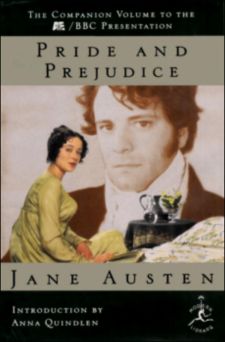
Pride_And_PrejudicePride and Prejudice was the first Jane Austen book I ever read. Picking it up was a part of my ongoing project of reading classics that I skipped in college. Knowing nothing about it, looking at the cover, I thought it might be a novel about upper class England and, although the book does deal with the upper class, it mostly deals with a middle class family.

The Bennet family, consisting of Mr. And Mrs. Bennet and their five girls, Jane, Elizabeth (Lizzy), Mary, Catharine (Kitty), and Lydia live in relative comfort, but without great wealth. However, with no male heirs, their estate has been entailed to a Mr. Collins, so that when Mr. Bennet passes, his wife and daughters will only have a very small amount of money–and no property–for their survival. It is incumbent on the daughters, then, to marry well.

When a Mr. Bingley moves in to the one great estate in the area, Mrs. Bennet is determined that he should marry one of his daughters. The book contains one of the most memorable opening lines of any novel ever written. 

It is a truth universally acknowledged, that a single man in possession of a good fortune, must be in want of a wife.

Mr. Bingley has brought his good friend, Mr. Darcy, along with him. Possessed of a great fortune and a beautiful estate, Darcy appears cold, distant, and–to Lizzy’s eyes–arrogant. While Mr. Bingley begins an attachment to Jane, Darcy brought to an even lower esteem when a young militia man, Mr. Wickham, tells Lizzy that Darcy did him a great evil in denying him the living that Darcy’s father had promised. Lizzy forms an attachment with Wickham, but Mr. Collins then comes to town with the notion of marrying one of the Bennet girls and keeping the property in the family.  When he proposes to Lizzy, however, she bluntly turns him down, so he instead marries her friend Charlotte Lucas.

Mr. Darcy, seeing what is going on between Bingley and Jane, urges his friend to retire to London, so the whole party packs up and leaves. Jane is sent to London to stay with her uncle and aunt, Mr. and Mrs. Phillips, in the hope of reuniting with Bingley.  In the meantime, Lizzy goes to visit Charlotte and meets Lady Catherine de Bourgh, Darcy’s aunt. When he shows up for a visit, he seeks out Lizzy and blunders out a proposal that takes her completely by surprise.  Angry at his actions–destroying her sister’s chance of happiness and Mr. Wickham’s hopes of fortune–she refuses him in a very emotional scene.

Of course, Mr. Wickham had lied about their past association.

The twin subjects of pride and prejudice are fully examined, not only in the characters of Lizzy and Darcy, but in the supporting characters as well. All of Lizzy’s actions throughout the first part of the book are based on a quickly formed prejudice. Mr. Darcy’s apparent pride is actually a difficulty in dealing with new acquaintances.  The same prejudice that put Mr. Darcy into a dim light also promoted the character of Wickham, who was actually a pretty bad person.  Mrs. Bennet certainly feels a great deal of false pride, having no idea how ridiculous she actually is.  Pride also appears in the form of Mr. Collins, whose obsequious fawning on Lady Catherine de Bourgh is both funny and insightful.

Almost lost in this circus of pride and prejudice is the amazing change that comes over Mr. Darcy after Lizzy rejects him. When she points out to him his own pride, it shakes him up so much that it causes a complete alteration of his character, partly because he didn’t see himself clearly before and partly because Elizabeth thinks these terrible things about him. After Elizabeth receives his letter, she is forced to reevaluate her own thinking and ultimately realizes her own prejudice.

The book is essentially a romantic comedy, but it touches on so many different aspects of English society at the beginning of the 19th Century that it ends up having a lot to say, without ever coming across as preachy. In dealing with such issues as women’s place in society, the economic structure of England, class relations, and child rearing, it reaches a very high level of storytelling, layering in themes far deeper than one would imagine in a romantic comedy.  It remains one of the most influential novels ever written and has spawned numerous films, clubs, and so on.

A wonderful novel! I highly recommend Pride and Prejudice to all readers!

Where the Heart Is by Billie Letts

This novel of modern Oklahoma is something of an enigma.

It tells the story of a girl named Novalee Nation, from the time when she is 17 years old until she is in her mid-twenties. Eight months pregnant, naïve, and actually somewhat ignorant, she has left her home in Tellico Plains, Tennessee with her boyfriend Willie Jack Pickens and is headed for Bakersfield, California.where the heart is

Novalee is quite charming in her ignorance. She believes that the number seven always brings her bad luck.  After all, on her seventh birthday, her mother ran away with a baseball player, leaving her to the kindness of friends and orphanages, in the seventh grade, her only friend got sent to the Tennessee State School for Girls, and when she got stabbed in the arm at the bar she worked at, the wound required seventy-seven stitches.

When her shoes fall through the floor of the car and she has relieve her bladder, Willie Jack pulls into a Wal-Mart in Sequoyah, Oklahoma. He gives her ten dollars, then drives off and leaves her there.  She figures it out when her change from the ten dollars comes to $7.77.

On her first day there, she meets three people who will be instrumental in her survival and good fortune: Sister Husband, a blue-haired lady who runs the town Welcome Wagon, Moses Whitecotton, a baby photographer, and Benny Goodluck, a Native American boy who gives her a buckeye tree. At a loss for what to do, she simply lives in the Wal-Mart, keeping tabs of how much she owes them for the products she uses.  When the buckeye tree starts to get sickly, she goes to the town library and meets Forney Hull.  A strange young man addicted to knowledge, Forney runs the library while his sister, the alcoholic librarian, lives upstairs.  He becomes extremely protective of Novalee and he busts a plate glass window in the Wal-Mart to help her when she gives birth to a daughter.  Cautioned by Moses that she must give her baby a very strong name, she names the girl Americus.

A reader might derive from this that the novel is all about a naïve person overcoming their background to make a success of their life—and it’s true that part of the novel is definitely about that. All of the strange and interesting names would also suggest an air of goofy whimsy—and it’s true that part of the novel fits that description.  In fact, there is such a relaxed, fun, and goofy feeling about the book that the hard parts seem to come out of the blue.  However, they do not.  The gritty, sexually perverse parts of the novel only accent how important it is to appreciate the good things in your life, the people who are important to you, and the value of overcoming even the deepest, darkest adversity.

If the book has any theme, though, it is a message to young women: do not base your sexual or long-term relationships on how a boy looks or how much money a man makes.  While Novalee and Lexi make a long string of mistakes, their lives are contrasted sharply with Sister Husband, whose one illicit relationship carries far more love than that of Willie Jack or any of the men who have left Lexi with children—or the one man who left her beaten and sodomized her children. It is a very good feeling when both of these incredible women finally figure out what is important.

This novel is quite an achievement. You can hear Oklahoma on every page with the voice of the author, in the sound of the characters’ voices, in the wind blowing across the prairie.  It is inspiring, uplifting, and yet gritty and realistic.

I highly recommend this book!

Book Reviews by Author: A – M

Alcott, Luisa MayLuisa May Alcott

(November 29, 1832 – March 6, 1888)

Friends with Ralph Waldo Emerson, Nathaniel Hawthorne, and Henry David Thoreau, Ms. Alcott had to work to help support her family, and like Jane Austen before her, she spun stories for her supper. Well known for her one transcendent novel, she also contributed sequels to the well-loved classic.

Little WomenLittle Women Norton Critical Edition

This is the story of four American sisters, Meg, Jo, Beth, and Amy, during and just following the Civil War.  Shepherded by their mother (Marmee), they become friends with their neighbors, Mr. Laurence and his grandson, Teddy (Laurie).  The book follows their lives, as well as various men they become involved with, but the book is concentrated in the person of Jo, the bookish second daughter, who is fifteen at the beginning of the story.


Isaac Asimov

Foundation


Jane Austen

Pride and Prejudice

Mansfield Park

Sanditon and Other Stories


Charlotte Brontë

Jane Eyre


Truman Capote

In Cold Blood


Orson Scott Card

Ender’s Game


Arthur C. Clarke

The Songs of Distant Earth


Rachel Cohn and David Levithan

Nick & Norah’s Infinite Playlist


Suzanne Collins

The Hunger Games


Deborah Kay Davies

Grace, Tamar and Laszlo the Beautiful


Timothy Egan

The Worst Hard Time


Nicholas Evans

The Horse Whisperer


John Fowles

The Collector


Karen Hesse

Out of the Dust


Barbara Holland

Katharine Hepburn


Katelan Janke

Survival in the Storm:

The Dust Bowl Diary of Grace Edwards


Stephanie Kallos

Broken for You


Rebecca Kanner

The Sinners and the Sea


Jack Kerouac

On The Road


Barbara Kingsolver

Animal Dreams


Ron Koertge

Stoner & Spaz


Harper Lee

To Kill a Mockingbird


Billie Letts

Where The Heart Is


Anne McCaffrey

An Introduction to the World of Pern

Dragonsdawn

The Dragonriders of Pern Trilogy

Dragonflight

Dragonquest

The White Dragon


The Harper Hall Trilogy

Dragonsong

Dragonsinger

Dragondrums


The Renegades of Pern


All the Weyrs of Pern


Jack McDevitt

The Academy Novels

An Introduction to the Series

The Engines of God

Deepsix

Chindi