Julie and Julia

Julie-e-Julia-sonypictures_-com_-brReleased in 2009, three years before the death of its writer and director, Nora Ephron, Julie and Julia is probably the best film that the bright and nimble director ever made. Best known for her iconic romantic comedies, most notably Sleepless in Seattle and When Harry Met Sally, Ephron was gifted at both major behind-the-scenes creative skills.  The film world will not be the same without her.

Ephron adapted Julie and Julia from two books, both non-fiction, in creating a film that looks at the most important years two very interesting women: the famous Julia Child and virtually unknown Julie Powell.

Julia Child is best known for her impressive cookbook, Mastering the Art of French Cooking, a book designed to open up the mysterious world of French culinary arts to the American housewife. The Child part of the screenplay is based on the book My Life in France, by Julia Child and Alex Prud’homme, in which Child documented her time learning French cooking while living there with her husband, Paul, a diplomat.

Julie Powell was an aspiring writer in New York when she gave up on her novel and decided to cook her way through Mastering the Art of French Cooking and blog about it on a daily basis. Unknown at first, the blogs published on Salon.com eventually earned a very respectable readership and ultimately launched Powell’s career as a writer, in the form of her memoir, Julie and Julia: 365 Days, 524 Recipes, 1 Tiny Apartment Kitchen.

That Ephron was able to translate these two memoirs, each taking place in a distinctly separate time and place, is something of a minor miracle, but she did it with her usual dexterity, good humor, and great understanding of romance.

Heading the cast are two outstanding actresses, the distinguished and honored Meryl Streep as Julia Child and a breakaway younger star, Amy Adams, as Julie Powell. Cutting back and forth between post-war France and post 9/11 New York City, the script deftly intertwines the two stories, juxtaposing Child’s struggle to get into a French cooking school with Powell’s struggle to find herself while working a civil service job helping the families of 9/11 victims.

Ultimately, of course, Child hooks up with her two co-authors and begins an association that lasts many years before the cookbook is finally published. At the same time, Powell begins her arduous task of preparing 524 recipes in 365 days.  Both of the women go through tremendous trials in accomplishing their objectives, but the support of loved ones Paul Child (Stanley Tucci) and Eric Powell (Chris Messina) ultimately pull them through.  There is much love in the food in the film and much love between the two couples.

Streep and Tucci are simply adorable as Paul and Julia Child. It would have been very easy to botch such a well-known personality as Julia, but Streep is way more than up to the task, giving us the essence of the woman in lovingly crafted performance.  Tucci, always splendid, does not disappoint as her supporting husband.  Adams is absolutely delightful as Powell, giving just the right amount of vulnerability and fortitude to make us cheer when she wins out.

In addition, both periods are scrupulously recreated on the screen, both in production design and costuming. Both Paris and New York have never looked better and it produces a visual feast that compares with the extraordinary cuisine.

The real star of the film is–of course–the food. Beautifully crafted by master chefs, each and every plate looks so scrumptious that it is hard not salivate while watching.  Although the actors all gained weight, I admire their ability to look hungry after maybe 30 takes while eating Lobster Thermidor.

Finally, the film succeeds at the ultimate level–it deeply touches the viewer. Ephron was a master at making an audience both laugh and cry and she was clearly at the top of her game when she made this movie.  It is guaranteed to delight and it is a film that can be watched over and over again with no loss of love.

Please, see it!!!

Pride and Prejudice by Jane Austen

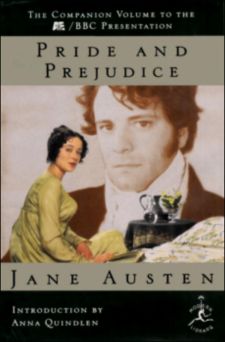
Pride_And_PrejudicePride and Prejudice was the first Jane Austen book I ever read. Picking it up was a part of my ongoing project of reading classics that I skipped in college. Knowing nothing about it, looking at the cover, I thought it might be a novel about upper class England and, although the book does deal with the upper class, it mostly deals with a middle class family.

The Bennet family, consisting of Mr. And Mrs. Bennet and their five girls, Jane, Elizabeth (Lizzy), Mary, Catharine (Kitty), and Lydia live in relative comfort, but without great wealth. However, with no male heirs, their estate has been entailed to a Mr. Collins, so that when Mr. Bennet passes, his wife and daughters will only have a very small amount of money–and no property–for their survival. It is incumbent on the daughters, then, to marry well.

When a Mr. Bingley moves in to the one great estate in the area, Mrs. Bennet is determined that he should marry one of his daughters. The book contains one of the most memorable opening lines of any novel ever written. 

It is a truth universally acknowledged, that a single man in possession of a good fortune, must be in want of a wife.

Mr. Bingley has brought his good friend, Mr. Darcy, along with him. Possessed of a great fortune and a beautiful estate, Darcy appears cold, distant, and–to Lizzy’s eyes–arrogant. While Mr. Bingley begins an attachment to Jane, Darcy brought to an even lower esteem when a young militia man, Mr. Wickham, tells Lizzy that Darcy did him a great evil in denying him the living that Darcy’s father had promised. Lizzy forms an attachment with Wickham, but Mr. Collins then comes to town with the notion of marrying one of the Bennet girls and keeping the property in the family.  When he proposes to Lizzy, however, she bluntly turns him down, so he instead marries her friend Charlotte Lucas.

Mr. Darcy, seeing what is going on between Bingley and Jane, urges his friend to retire to London, so the whole party packs up and leaves. Jane is sent to London to stay with her uncle and aunt, Mr. and Mrs. Phillips, in the hope of reuniting with Bingley.  In the meantime, Lizzy goes to visit Charlotte and meets Lady Catherine de Bourgh, Darcy’s aunt. When he shows up for a visit, he seeks out Lizzy and blunders out a proposal that takes her completely by surprise.  Angry at his actions–destroying her sister’s chance of happiness and Mr. Wickham’s hopes of fortune–she refuses him in a very emotional scene.

Of course, Mr. Wickham had lied about their past association.

The twin subjects of pride and prejudice are fully examined, not only in the characters of Lizzy and Darcy, but in the supporting characters as well. All of Lizzy’s actions throughout the first part of the book are based on a quickly formed prejudice. Mr. Darcy’s apparent pride is actually a difficulty in dealing with new acquaintances.  The same prejudice that put Mr. Darcy into a dim light also promoted the character of Wickham, who was actually a pretty bad person.  Mrs. Bennet certainly feels a great deal of false pride, having no idea how ridiculous she actually is.  Pride also appears in the form of Mr. Collins, whose obsequious fawning on Lady Catherine de Bourgh is both funny and insightful.

Almost lost in this circus of pride and prejudice is the amazing change that comes over Mr. Darcy after Lizzy rejects him. When she points out to him his own pride, it shakes him up so much that it causes a complete alteration of his character, partly because he didn’t see himself clearly before and partly because Elizabeth thinks these terrible things about him. After Elizabeth receives his letter, she is forced to reevaluate her own thinking and ultimately realizes her own prejudice.

The book is essentially a romantic comedy, but it touches on so many different aspects of English society at the beginning of the 19th Century that it ends up having a lot to say, without ever coming across as preachy. In dealing with such issues as women’s place in society, the economic structure of England, class relations, and child rearing, it reaches a very high level of storytelling, layering in themes far deeper than one would imagine in a romantic comedy.  It remains one of the most influential novels ever written and has spawned numerous films, clubs, and so on.

A wonderful novel! I highly recommend Pride and Prejudice to all readers!

Where the Heart Is by Billie Letts

This novel of modern Oklahoma is something of an enigma.

It tells the story of a girl named Novalee Nation, from the time when she is 17 years old until she is in her mid-twenties. Eight months pregnant, naïve, and actually somewhat ignorant, she has left her home in Tellico Plains, Tennessee with her boyfriend Willie Jack Pickens and is headed for Bakersfield, California.where the heart is

Novalee is quite charming in her ignorance. She believes that the number seven always brings her bad luck.  After all, on her seventh birthday, her mother ran away with a baseball player, leaving her to the kindness of friends and orphanages, in the seventh grade, her only friend got sent to the Tennessee State School for Girls, and when she got stabbed in the arm at the bar she worked at, the wound required seventy-seven stitches.

When her shoes fall through the floor of the car and she has relieve her bladder, Willie Jack pulls into a Wal-Mart in Sequoyah, Oklahoma. He gives her ten dollars, then drives off and leaves her there.  She figures it out when her change from the ten dollars comes to $7.77.

On her first day there, she meets three people who will be instrumental in her survival and good fortune: Sister Husband, a blue-haired lady who runs the town Welcome Wagon, Moses Whitecotton, a baby photographer, and Benny Goodluck, a Native American boy who gives her a buckeye tree. At a loss for what to do, she simply lives in the Wal-Mart, keeping tabs of how much she owes them for the products she uses.  When the buckeye tree starts to get sickly, she goes to the town library and meets Forney Hull.  A strange young man addicted to knowledge, Forney runs the library while his sister, the alcoholic librarian, lives upstairs.  He becomes extremely protective of Novalee and he busts a plate glass window in the Wal-Mart to help her when she gives birth to a daughter.  Cautioned by Moses that she must give her baby a very strong name, she names the girl Americus.

A reader might derive from this that the novel is all about a naïve person overcoming their background to make a success of their life—and it’s true that part of the novel is definitely about that. All of the strange and interesting names would also suggest an air of goofy whimsy—and it’s true that part of the novel fits that description.  In fact, there is such a relaxed, fun, and goofy feeling about the book that the hard parts seem to come out of the blue.  However, they do not.  The gritty, sexually perverse parts of the novel only accent how important it is to appreciate the good things in your life, the people who are important to you, and the value of overcoming even the deepest, darkest adversity.

If the book has any theme, though, it is a message to young women: do not base your sexual or long-term relationships on how a boy looks or how much money a man makes.  While Novalee and Lexi make a long string of mistakes, their lives are contrasted sharply with Sister Husband, whose one illicit relationship carries far more love than that of Willie Jack or any of the men who have left Lexi with children—or the one man who left her beaten and sodomized her children. It is a very good feeling when both of these incredible women finally figure out what is important.

This novel is quite an achievement. You can hear Oklahoma on every page with the voice of the author, in the sound of the characters’ voices, in the wind blowing across the prairie.  It is inspiring, uplifting, and yet gritty and realistic.

I highly recommend this book!

M

 Man Who Knew Too Much Stewart and DayThe Man Who Knew Too Much

Never endanger an American’s children.  That is the advice given by a foreign minister to his English lackey when it is already too late for the villains in this remake of a film that Alfred Hitchcock originally directed in England before he crossed the pond.  Wishing to enlarge and improve on his earlier film, he teamed up with his signature actor and composer to produce this widescreen thriller in 1956.


Marnie 03Marnie

Marnie is undoubtedly Alfred Hitchcock’s most unusual film.  There’s no murder, no spies, no sabotage, and practically no suspense.  It is a straight up psychological drama.  This might have been a great film, with sufficient editing, perhaps with a different leading actress as Marnie and maybe an American actor as Mark, with some of the action sequences done more realistically.  As it is, the movie looks like an overblown Hollywood version of what should be a compelling drama.


Midnight Cowboy 03Midnight Cowboy

This classic 1969 John Schlesinger film, adapted by Waldo Salt, from the novel by James Leo Herlihy, won three Academy Awards, for Best Picture, Best Director and Best Adapted Screenplay.  It is the only X-Rated film to ever win Best Picture.  Starring Jon Voight and Dustin Hoffman, in what many consider his signature role, the film is about what happens to our dreams when they are tested against harsh reality.


 Miss PettigrewMiss Pettigrew Lives for a Day

London in 1939 was a hodgepodge of pre-war jitters.  Depression era soup kitchens operated down the block from posh nightclubs for the rich and the middle class worked to scratch out a decent living.  This is a rip-roaring comedy filled with delightful performances by Frances McDormand and Amy Adams.


mr and mrs smithMr. and Mrs. Smith

This 1941 “screwball comedy” was the first of two comedies that Alfred Hitchcock directed during his long and distinguished career, the other being the black comedy, “The Trouble with Harry.”  The script, by Academy Award winning screenwriter Norman Krasna, found its way to Carole Lombard, the actress who actually gave the name “screwball” to this kind of comedy, and she backed the project.


Much Ado About NothingMuch Ado About Nothing

If you buy the cliché that young people who argue and harp at each other are actually flirting, then William Shakespeare’s Much Ado About Nothing might have been the first great play to use it.  In Joss Whedon’s modern dress adaptation, he has whittled the play to under two hours and presented it in a witty original format.


936full-mystic-river-photoMystic River

Mystic River is a hard-hitting blue collar crime movie by the amazing Clint Eastwood.  Released in 2003, it tells the story of three boyhood friends forever changed by an incident in 1975.  Eastwood makes a point of the fact that things do not add up–it is part of the appeal of the movie.  And it is usually a fact of life that most filmmakers do not worry themselves over.  For Clint Eastwood, however, the fact that life doesn’t add up is the very point of the movie.

Book Reviews by Author: A – M

Alcott, Luisa MayLuisa May Alcott

(November 29, 1832 – March 6, 1888)

Friends with Ralph Waldo Emerson, Nathaniel Hawthorne, and Henry David Thoreau, Ms. Alcott had to work to help support her family, and like Jane Austen before her, she spun stories for her supper. Well known for her one transcendent novel, she also contributed sequels to the well-loved classic.

Little WomenLittle Women Norton Critical Edition

This is the story of four American sisters, Meg, Jo, Beth, and Amy, during and just following the Civil War.  Shepherded by their mother (Marmee), they become friends with their neighbors, Mr. Laurence and his grandson, Teddy (Laurie).  The book follows their lives, as well as various men they become involved with, but the book is concentrated in the person of Jo, the bookish second daughter, who is fifteen at the beginning of the story.


Isaac Asimov

Foundation


Jane Austen

Pride and Prejudice

Mansfield Park

Sanditon and Other Stories


Charlotte Brontë

Jane Eyre


Truman Capote

In Cold Blood


Orson Scott Card

Ender’s Game


Arthur C. Clarke

The Songs of Distant Earth


Rachel Cohn and David Levithan

Nick & Norah’s Infinite Playlist


Suzanne Collins

The Hunger Games


Deborah Kay Davies

Grace, Tamar and Laszlo the Beautiful


Timothy Egan

The Worst Hard Time


Nicholas Evans

The Horse Whisperer


John Fowles

The Collector


Karen Hesse

Out of the Dust


Barbara Holland

Katharine Hepburn


Katelan Janke

Survival in the Storm:

The Dust Bowl Diary of Grace Edwards


Stephanie Kallos

Broken for You


Rebecca Kanner

The Sinners and the Sea


Jack Kerouac

On The Road


Barbara Kingsolver

Animal Dreams


Ron Koertge

Stoner & Spaz


Harper Lee

To Kill a Mockingbird


Billie Letts

Where The Heart Is


Anne McCaffrey

An Introduction to the World of Pern

Dragonsdawn

The Dragonriders of Pern Trilogy

Dragonflight

Dragonquest

The White Dragon


The Harper Hall Trilogy

Dragonsong

Dragonsinger

Dragondrums


The Renegades of Pern


All the Weyrs of Pern


Jack McDevitt

The Academy Novels

An Introduction to the Series

The Engines of God

Deepsix

Chindi


An Introduction to the Universe of the Academy Novels by Jack McDevitt

Academy IntroIn the realm between hard science fiction and space opera there is a zone where some of the rules of science may be broken very carefully, but the author may still make his or her universe look and feel realistic.

The works of Jack McDevitt certainly belong in that zone and none more squarely than the Academy Novels, which I am about to begin reviewing. The purpose of this introduction is to present a basic understanding of the world that McDevitt has created. For those who have not yet read the novels, it will serve to set up the reading. For those who have already read the series, it will be a refresher to make the reviews easier to follow. As for the reviews themselves, I will be assuming that the reader has already finished reading the novels, so there will be spoilers. Not so for this introduction.

The Academy Novels officially begin on the date of February 12, 2197, which is where the Prologue to The Engines of God (1994) kicks the series off. The other novels in this series include Deepsix (2001), Chindi (2002), Omega (2003), Odyssey, (2006) and Cauldron (2007).  The conclusion takes place in the year 2255.

At this time in future history, governments have consolidated in order to control the gradual, but sure, devastation of Earth.  Although there is a governing World Council, it is made up of political entities that were previously two or more countries.  The North American Union (NAU), for example is made up of the United States and Canada.  However, between overpopulation, drought, economic ennui, degrading weather patterns, religious strife and global warming, death has become so commonplace that no one thinks twice about a few million dying in India due to a grain shortage.  Melting of the polar ice caps has raised shorelines around the world, so the people have had to re-engineer their cities to go on.  The wealthy and those who cultivate professions that are in demand still do quite well.  There are expensive restaurants, dinner parties and diverse live entertainment.  The poor are generally never seen.

What McDevitt has done in his future history is to show that no matter how bad things get, most of the population will continue to go on as if nothing was wrong.  He has taken this attitude directly from the present situation on Earth and extrapolated on it.  We are at this moment presiding over the initial stages of Earth’s deterioration: the world economy fluctuates dramatically with widespread unemployment and collapsing markets, the earth is suffering from multiple natural disasters, we continue to depend on fossil fuels and, yes, we are pretty much ignoring global warming. Yet, if you turn on a television today, you would think that we were at the height of prosperity with no problems in the world. 

Media plays a large part in these novels.  McDevitt drops in news headlines throughout the Academy Novels and the news is both devastating and understated.  No matter what happens, life goes on and we all pretend that everything is okay.  In fact, as long is everything is okay for me, then it is okay for everyone.

One criticism that McDevitt receives quite often is that his characters are shallow and two-dimensional.  Although I would not argue that point in general, I believe the characters in the Academy Novels are that way on purpose.  They fit in with his extrapolation of the present into the future.  Although everyone today tries to look on the bright, happy side of existence, the truth is that most people are terribly mundane.  We are gradually becoming a society of specialists, of people who concentrate on their own little niche.  Very few people are well rounded intellectually and most of them are not intellectual at all.  Most people today – and in McDevitt’s future – are shallow and self-involved.  We tend to feed off of tawdry news events, social gossip, games, images and social interaction aimed at our own personal well-being.

In the Academy, most of the scientists, academics, engineers and technicians are specialists who burrow into their own little worlds, so caught up in their own careers and specialties that most of them have no life outside of their areas of expertise.  And within those areas, most are concerned with their own ego more than they are with actual technological development.

The politicians are pragmatists who flow with the general tide.  They don’t think for themselves.  Instead, they take polls and roll with whatever will keep them in power.  When the Greens finally become a political powerhouse, they are just like the Democrats and Republicans of today.  They do not listen to others, they do not think things through and make rational decisions.  Instead, they push their agenda unconscionably regardless of any evidence to the contrary.

I think that this approach to future history by McDevitt is very smart indeed and it is something that we all can see and understand just by looking around us. He isn’t really introducing any new conflicts here, but he has extrapolated fiercely on what is and that realism sticks in your brain. Issues that we debate at this moment are still being debated nearly 200 years in the future and people and attitudes haven’t changed. It is both deeply chilling and bizarrely reassuring at once.

Throughout the novels, news organizations play a big role and McDevitt again has extrapolated from our present to our future.  Most of the reporters are plainly superficial; they are suave, beautiful manikins, who play up whatever appears to be an emotional event and they mostly ignore more difficult, in-depth stories.  Man jumps off building.  Congressman caught in love tryst: details at eleven.  Like scientists and entertainers, reporters are more concerned with their own future than they are with the news.

The exception to this is the magazine, The National, whose editor, Gregory MacAllister, delights in attacking pompous airheads.  He is definitely similar to the curmudgeonly journalist H. L. Mencken of the Twentieth Century.  Although, in many ways, he is dislikeable (for example, he is an outspoken chauvinist and he distrusts religious leaders on the grounds that they have become more important than God), he also provides one of the deeper characters in the series.  He is capable of listening, analyzing problems and changing his mind.  At his best, he truly does reach for the underlying truth of existence.  This level of complexity sets him well apart from others.

Technologically, some big changes take place during the next 200 years.

Of course, the big thing – and the first thing that really takes the Academy Novels outside the realm of hard science fiction – is the development of faster than light space travel (FTL).  At a time when space exploration was believed to be dead, scientist Ginjer Hazeltine developed a theory of transdimensional transit.  Once a drive unit was perfected, it was named the Hazeltine Drive.  This is a rather murky theory, but most science fiction that crosses the threshold into space opera depends on some mechanism or other to allow transit across many light years in a short period of time.  If you don’t worry about the details, you will be fine. 

The Academy, by the way, is the space exploration arm of the NAU, controlling all official flights throughout the galaxy.  Eventually, of course, private companies contract to have their own vessels built.  Kosmik, Inc., for example, is involved in the business of terraforming.  Orion Tours allows the extremely wealthy to go site seeing.  And the media have their own vessels so that they can rush to the scene of any intergalactic hanky panky.

Since development of the Hazeltine Drive, the Academy has been looking through the Orion Arm of our galaxy (our immediate neighborhood) for two things: planets with an Earth-like biosphere that would be good for colonization and alien life. 

Several planets have been found that meet the first criteria, some with only single-celled life, some with much higher, non-intelligent life, but most simply sterile.  One planet has been found that possesses intelligent life: Inokademeri.  But the inhabitants, referred to as Noks, have not developed technologically past where humans were at in World War I.  Due to their innate intolerance, they are constantly at war; they have used up most of their natural resources and are considered (in MacAllister’s words) “idiots”.  It is so bad on Nok that scientists are not permitted interaction with the locals.  A few of the planets capable of supporting human life have actually been colonized, one by religious zealots and the other by political malcontents.  Both colonies are failing.

And although humans most deeply desire to find another intelligent species, one that is technologically mature, they haven’t had much luck.  In fact, mostly what they have found is archeological treasures: races that evolved a complex society and then (for one reason or another) died off.  These discoveries – and others that will be discussed later – become a major plot element in several of the novels.

The other breakthroughs that keep the Academy Novels firmly outside the realm of hard science fiction are anti-gravity devices, artificial gravity and Flickinger fields.

Anti-gravity is used for a number of functions.  There are vehicles that skim through the sky, depositing their passengers on special landing pads.  (Apparently ground transportation has all but disappeared.)  There is also the “spike” which is used to lift vehicles beyond a planet’s gravity well.  And anti-gravity comes in really handy if you have to move anything that is large, massive or unwieldy.

Artificial gravity is, of course, used to keep people upright and functioning in a zero gravity environment, such as a space ship.

And the Flickinger Field is a kind of personal force field made of energy that molds itself to the human body.  When connected with air tanks, these fields act like a space suit, protecting the wearer from harsh environments.  They do have two problems: they are not impermeable (leaving them open to breaching) and they have a hard shell that forms over the face so that the wearer can breathe.  Rest assured that these problems will be exploited by McDevitt.

Two of the best technological advances are easily within our grasp.

Artificial Intelligence has become a booming business in the Academy Novels.  An AI runs every household; it serves as friend, cook, butler, maid, alarm and communications system.  It’s like having a Google you can chat with.  In addition, all complex operations are now exclusively handled by AIs and they even serve as back-up systems for pilots of space ships.

What’s really neat is that AIs can also appear as holograms.  The common AI system on every Academy vessel is named Bill and he interacts with every captain in a unique individual way, projecting different images of “himself” throughout the ship.  Contrary to the official line, AIs do have a sense of humor.

The disappearance of television isn’t spectacular because it is replaced (as is actually happening now) by the net and by 3D interactive entertainment known as Sims.  The Net is huge, but as we see now in television, there are a few “channels” that rise to the top.  In this way, there is a common experience, much the way we have now with the major broadcast networks.  Some programs and personalities always rise to the top.  And the desire for common entertainment experience will always funnel viewers in specific directions.

The Sims are like watching a movie that takes place around you, but you can also program your image and voice to appear as one of the characters.  If you have a number of people doing this, it is apparently quite a bit of fun.

The protagonist of the Academy Novels is a pilot named Priscilla Hutchins (everyone calls her Hutch), a diminutive, black-haired beauty imbued with her own particular hang-ups and fears. She is tied to the Academy pretty much throughout the series, but in the beginning she mostly works with the archeologists.  In fact, it is her association with one of the most prestigious of these, Dr. Richard Wald, which leads to the beginning of The Engines of God.

Hutch lives in Arlington, VA, just outside of what remains of Washington, DC. With all of the coastal flooding that continues as a result of polar ice melting, the former capital of the United States is now partly underwater, with the rest bolstered by levees so that the buildings may remain as tourist attractions.

She is one of those people matched perfectly with her job.  In the first few novels, one can feel the excitement of space exploration through her eyes: the awe of discovery, the wonderful little social groups that form during a long flight, and the vastness of the universe.  Hutch is smart and sexy, she has a grip on reality that others could benefit from touching.  She is heroic, but not for the reasons that others behave heroically.  She is immensely likeable, a terrific character to carry a series through six novels.

But the time she spends on Earth is pained.  Her mother wants grandchildren and a stable relationship for her daughter. Hutch herself would like some stability, but her long absence hampers this ambition. The men who are interested in her simply cannot tolerate the absences, so Hutch remains frustrated on that level. However, her relationship with academics and archeologists is most stimulating – the time that they spend traveling between systems (normally a few months) is really the basis of her social life. She is both intelligent enough to hold her own with them, so whether they are just playing games, running sims or engaged in arcane discussions, she gains a great deal emotionally from the trips.

The most fascinating and puzzling discovery by the archeologists is the existence of gigantic sculptures scattered here and there along the rim. Perhaps the most fascinating is an alien’s self-portrait left on the snow-covered surface of Iapetus, the third largest of Saturn’s moons. That these aliens, referred to as “the Monument Makers” (for lack of a better term), actually visited the solar system some 24,000 years ago is a source of amazement to archeologists.  Most of the sculptures are cubes or rectangles – shapes with straight lines and right angles – but the one on Iapetus is clearly a self-portrait.

It is at this point, on February 12, 2197, that The Engines of God begins. Hutch has piloted Dr. Wald to view the Iapetus sculpture and the opening words of the novel paint a chilling picture:

“The thing was carved of ice and rock. It stood serenely on that bleak, snow covered plain, a nightmare figure of gently curving claws, surreal eyes and lean fluidity. The lips were parted, rounded, almost sexual… stamped on its icy features was a look she could only have described as philosophical ferocity.”


The Horse Whisperer by Nicholas Evans

TheHorseWhispererBookSPOILER ALERT: Details of the novel are revealed in this review.

First, I saw the film before I read the book, so that has prejudiced my reaction somewhat.

This is the story of a family that has been fractured by a monumental accident. Grace Maclean is a twelve year old girl, the daughter of very wealthy New Yorkers.  Her father, Robert is a lawyer and her mother Annie is a magazine editor, an English woman.

Grace’s embrace of life is fullsome and the reader is drawn to her immediately.  Robert Maclean is also an extremely sympathetic character.  Annie, however is a driven woman. After taking over at the magazine, she has instituted a “bloodletting” by firing old staffers and has alienated not only those she works with, but her husband and daughter as well.

The first unfortunate decision Nicholas Evans made was to feature the most despicable character in the book and set her up as the centerpiece of the action.

But the book still begins with tremendous promise.  The writing is excellent, the descriptions so precise as to engender the feeling that one is living in the moments and places he creates.  Grace is riding her horse, Pilgrim, with her friend Judith at the country estate that the Macleans own.  Her father has come down from New York with her, while Annie works away in the Big Apple.  On an icy road, the horses panic as a tractor trailer advances on them, skidding on the ice itself.  Grace is thrown off as her horse Pilgrim turns to face the oncoming semi and literally leaps at it trying to protect her rider.

Judith and her horse are both killed, Pilgrim is severely wounded and Grace’s leg is mangled so severely that it must be amputated.  There is severe psychological trauma for both Grace and Pilgrim.  The horse is crazed and completely uncontrollable.  While Robert reacts in much the way one would expect a parent to, Annie controls her emotions completely, but becomes obsessed with finding a cure for Pilgrim.

That cure comes in the form of Tom Booker, a cowboy and rancher in Montana who is a “horse whisperer”.  He has the ability to calm and cure horses with psychological problems.  At first, he refuses to work with Pilgrim.  Annie’s persistence, which includes driving her daughter and the horse to Montana, finally pays off once Tom meets Grace and sees that the problem runs deeper than just an injured horse.  He takes on Pilgrim as a project and Annie and Grace move to the spare house at the ranch so that Grace can work with Tom as he slowly brings Pilgrim back to life.

At this point, the story has been told so expertly that a reader cannot disengage no matter what.  The story has been wonderfully drawn as the tale of a family that has fallen apart, a girl and horse painfully and perhaps permanently wounded and the calm man who can supply the solutions to cure them all.

Unfortunately, it is also at the point that Evans strays from his story and inserts a romance that has no business being in this book.  By having Annie fall for Tom, the reader comes to vilify her and see her as the selfish, arrogant bitch that she apparently is.  Further, the character of Tom, initially so strong and admirable, becomes a parody — the cowboy who can’t help falling in love with city women.  Why on earth this calm and centered human being could fall in love with one of the most unlikable characters ever written is a complete mystery that has no answer, except that it adds a level of melodrama that brings the book to a complete halt.  Maybe it wouldn’t have been so bad if it had merely been a flirtation that Tom turned his back on (in order to work on the horse, which is what the story is really about), but Evans does not stop when given the chance.  He creates a little vacation for Tom’s ranch family — to Disneyland of all places — so that Tom can spend a week having sex with Annie.

At this point, the story has become thoroughly disgusting and all of the promise has permanently departed.  After the week of sex, Grace finds out, of course, and takes Pilgrim out on some kind of crazy ride.  It says a great deal that the reader finds their own disgust reflected in Grace.  In rescuing Grace, Tom allows himself to get killed.  Now, what’s going on with that is also a complete mystery.

Lost in this tawdry little subplot is the final cure of Pilgrim, which should have been built correctly so that it provided the denouement of the story that Evans so carefully set up during most of the book.  It becomes almost a little side show as Tom and Annie wallow in lust and self-pity.

I guess the bottom line is that every author should have an editor with a steady hand who can say, “Stop — you’re going in the wrong direction.”  But with the state of publishing any more, it may even have been an editor who said, “You need some romance in this book.”

It’s a great pity to see a story with so much promise flushed down the drain.